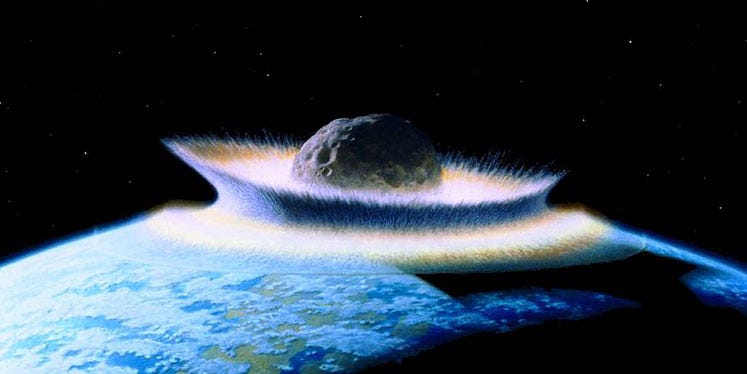
The asteroid that ended the age of non-avian dinosaurs was already famous for being the ultimate cosmic party crasher. Around 66 million years ago, a massive space rock slammed into what is now Mexico’s Yucatán Peninsula, blasted a crater into the planet, darkened the sky, disturbed the climate, and helped rewrite the story of life on Earth. But scientists have been asking an even bigger question: did that single impact also shake loose volcanic activity far away from the crater, including along undersea ridges deep beneath the oceans?
Recent research suggests the answer may be yes. The Chicxulub impact, best known as the dinosaur-killing asteroid strike, may have sent seismic waves through Earth powerful enough to disturb magma systems at mid-ocean ridges. These ridges are not decorative seams on the ocean floor. They are the long, volcanic boundaries where tectonic plates pull apart and new ocean crust forms. If the study is correct, the asteroid did not merely make a crater and ruin a perfectly good Cretaceous afternoon. It may have triggered a worldwide pulse of undersea volcanic eruptions.
That idea does not replace the asteroid extinction theory. Instead, it adds another layer to it. The end-Cretaceous extinction was not a simple “rock falls, dinosaurs vanish” cartoon. It was a planetary disaster involving impact shock, darkness, climate cooling, acid rain, wildfires, tsunamis, disrupted food webs, and possibly increased volcanic activity both on land and beneath the sea.
What Happened When the Chicxulub Asteroid Hit Earth?
The Chicxulub impactor was roughly six to nine miles wide, depending on the estimate. It hit Earth at tremendous speed and created a crater roughly 110 to 125 miles across. The impact site was especially unlucky because the target rocks contained carbonate and sulfate minerals. When vaporized, these rocks helped inject climate-altering gases and dust into the atmosphere.
In plain English: Earth got punched in the face, then the atmosphere got filled with the geological equivalent of smoke, glitter, and bad news.
The immediate effects were horrifying. The impact generated extreme heat, shock waves, ejecta, mega-tsunamis, and earthquakes. Material blasted into the sky eventually rained back down, heating the atmosphere and igniting fires in many regions. Fine dust and sulfate aerosols could have blocked sunlight, interrupting photosynthesis on land and in the oceans. Once plants and plankton suffered, food chains began collapsing from the bottom up.
That collapse helps explain why about three-quarters of species disappeared during the Cretaceous-Paleogene extinction event. Non-avian dinosaurs died out, while some smaller feathered dinosaurs survived and continued evolving as birds. So technically, dinosaurs are not completely gone; they are just outside your window, yelling at sunrise and stealing fries at the beach.
The New Twist: Undersea Volcanoes May Have Joined the Disaster
The most intriguing part of the undersea volcano theory comes from research analyzing the structure of ancient seafloor. Scientists examined global data related to seafloor age, ocean floor topography, spreading rates, and gravity anomalies. Gravity anomalies are tiny variations in Earth’s gravitational field that can reveal extra mass beneath or on the seafloor. In this case, the anomalies may indicate unusual amounts of magma added to oceanic crust around the time of the Chicxulub impact.
The researchers found an unusual signal in seafloor created around 66 million years ago. The pattern suggested a short-lived increase in magma output at mid-ocean ridges, especially in parts of the Pacific and Indian Oceans. These were not volcanoes with dramatic cone-shaped peaks like Mount St. Helens. They were submarine volcanic systems, mostly hidden beneath miles of seawater, quietly building crust while the surface world was having a very bad millennium.
The proposed mechanism is seismic triggering. When the asteroid struck, it sent enormous seismic waves through Earth. Those waves may have shaken existing magma systems, changed pressure conditions, and helped magma move upward. Think of a soda bottle that has been sitting quietly. Shake it hard enough, and suddenly it becomes a sticky science experiment. Earth’s magma systems are obviously more complicated than soda, but the basic idea is similar: disturbance can help stored pressure escape.
What Are Mid-Ocean Ridges?
Mid-ocean ridges are underwater mountain chains that wrap around the planet like seams on a baseball. They form where tectonic plates move apart. As the plates separate, hot mantle material rises, melts through decompression, and creates basaltic magma. That magma cools into new ocean crust.
This process is one of the most important engines in Earth geology. Most volcanic activity on Earth happens not on land, but underwater along these ridges. Humans rarely notice because the eruptions occur deep below the ocean surface. No dramatic news helicopter footage. No ash cloud grounding flights. Just Earth quietly running its crust-making factory in the basement.
Because ocean crust forms continuously and moves away from ridges over time, the seafloor preserves a kind of geological tape recording. By studying the age and structure of ocean crust, researchers can look backward through millions of years of volcanic history. Around the K-Pg boundary, that tape may show an unusual burst of magmatic activity.
How Strong Is the Evidence?
The undersea volcano hypothesis is fascinating, but it should be handled carefully. Science is not a movie trailer where every discovery must be “shocking,” “mind-blowing,” and “everything we knew was wrong.” The evidence points to a possible global pulse of mid-ocean ridge magmatism near the time of the Chicxulub impact. That is important. But it does not prove that submarine volcanism was the main killer.
The strongest evidence remains that the asteroid impact caused a rapid global environmental crisis. The impact closely aligns with the extinction boundary, and the global layer enriched in extraterrestrial material supports the timing. Models of impact winter, darkness, cooling, and food-web collapse explain why ecosystems failed so quickly.
The volcanic signal may instead show that Chicxulub had aftershocks in the broadest possible sense. The asteroid may have triggered or intensified volcanic systems that were already active. If so, undersea eruptions were likely part of a larger chain reaction rather than the single villain. The asteroid was still the lead actor; undersea volcanism may have been a dangerous supporting character with excellent timing.
The Deccan Traps Connection
No discussion of dinosaur extinction and volcanism is complete without the Deccan Traps. These massive lava flows in India were active around the same time as the Chicxulub impact. They represent one of the largest volcanic provinces on land, with layers of basalt in some places more than a mile thick.
For decades, scientists have debated whether the Deccan Traps helped cause the extinction, simply worsened environmental stress, or mostly affected recovery after the asteroid. Some studies suggest Deccan volcanism began before the impact and may have released large amounts of carbon dioxide, sulfur compounds, and other gases. Those emissions could have affected global climate. Other studies argue that the most damaging volcanic effects occurred too early or were too limited to explain the sudden extinction of non-avian dinosaurs.
The undersea volcano study matters because it supports a broader possibility: Chicxulub may have influenced volcanic activity far from the impact site. If seismic waves could affect mid-ocean ridges, they might also have influenced the Deccan system. That does not settle the debate, but it makes the end-Cretaceous disaster look more interconnected.
Why Underwater Eruptions Matter
At first glance, underwater volcanoes may seem less dangerous than land volcanoes. After all, if lava erupts under the ocean, surely the water handles it, right? Nice try, but Earth is not that tidy.
Submarine volcanism can alter ocean chemistry, release gases, create new crust, and affect hydrothermal systems. The environmental impact depends on eruption volume, depth, gas content, and how quickly materials enter the ocean-atmosphere system. Deep underwater eruptions may not blast ash into the sky like explosive land eruptions, but large-scale changes in seafloor magmatism can still matter in Earth’s long-term carbon, heat, and chemical cycles.
The study estimated that the amount of magma involved could have been enormous, potentially comparable in scale to some of the largest eruptive episodes in Earth history. However, not all magma would have erupted directly onto the seafloor. Some may have been injected into the lower crust, where its surface effects would be muted. That uncertainty is one reason scientists remain cautious.
A One-Two Punch for Planet Earth
The phrase “one-two punch” is useful here. The first punch was the asteroid impact: immediate, violent, and globally disruptive. The second punch may have included intensified volcanic activity, both at the Deccan Traps and along mid-ocean ridges. Together, these processes could have made Earth’s recovery more complicated.
Imagine an ecosystem already coping with darkness, cooling, acid rain, collapsing photosynthesis, and widespread fires. Add extra volcanic gases or changes in ocean chemistry, and the recovery picture becomes messier. Life did recover, of course. Mammals diversified. Birds survived. Flowering plants continued their rise. Eventually, primates showed up, followed much later by humans, who now spend part of their time arguing online about whether a tomato is a fruit. Evolution is majestic and occasionally ridiculous.
The key lesson is that mass extinctions are rarely simple. They often involve overlapping stressors. The Chicxulub impact may have been the decisive trigger, while volcanism shaped the environmental background and aftermath.
What This Means for Dinosaur Extinction Science
The undersea volcano idea makes the K-Pg extinction story richer. It pushes scientists to think of Earth as a connected system. A giant impact in one location can send energy through the entire planet. That energy can disturb oceans, sediments, faults, magma chambers, and climate systems.
This matters because Earth history is not just a list of isolated events. It is a network of causes and consequences. The asteroid did not merely arrive, explode, and leave. It interacted with the planet it struck. The target rocks mattered. The ocean mattered. The atmosphere mattered. Existing volcanic systems mattered. Timing mattered.
That is why the question “Did the asteroid kill the dinosaurs?” is both useful and incomplete. A better question is: how did the asteroid transform Earth’s systems so quickly and so severely that many species could not survive?
Common Misunderstandings About the Asteroid and Volcano Theory
Misunderstanding 1: Volcanoes Replace the Asteroid Explanation
They do not. The strongest evidence still points to the Chicxulub impact as the main driver of the sudden extinction event. Volcanism may have contributed, amplified, or complicated the disaster, but it does not erase the asteroid’s central role.
Misunderstanding 2: Undersea Volcanoes Were Like Exploding Islands Everywhere
Most mid-ocean ridge volcanism is not like a Hollywood volcano. It is usually basaltic, deep, and spread along ridge systems. The drama is real, but it is geological drama, which means it often takes place in darkness, under pressure, and without a soundtrack.
Misunderstanding 3: Scientists Have Solved Every Detail
Not yet. Researchers still debate timing, eruption rates, gas emissions, climate effects, and recovery patterns. That uncertainty is not a weakness. It is how science works. The story improves as new methods, better dating, and better models become available.
Experiences and Reflections: Why This Topic Feels So Powerful
Thinking about the dinosaur-killing asteroid and possible undersea volcano eruptions is a humbling experience. It reminds us that Earth is not a static stage where life simply performs. The planet is active, restless, and deeply interconnected. A rock from space hit one location, yet the consequences may have traveled through the atmosphere, oceans, crust, and mantle. That is both terrifying and amazing.
One of the most interesting experiences when learning about this topic is realizing how much of the story is hidden. The crater is buried. Much of the key evidence lies in rocks, microscopic fossils, gravity data, ocean crust, and chemical signals. There is no security camera footage of the impact. There is no dinosaur diary reading, “Bad weather today. Sky on fire. Would not recommend.” Instead, scientists reconstruct the event from clues scattered across the planet.
This makes the topic feel like a detective story. The iridium-rich layer acts like a calling card from space. The Chicxulub crater provides the crime scene. Fossils show the victims and survivors. Climate models explain the method. Deccan lava flows add a possible accomplice. Now, seafloor gravity anomalies suggest that even underwater volcanoes may have reacted to the impact. It is less like a simple murder mystery and more like a full planetary investigation.
For readers, the most memorable part may be the scale. Humans are used to local disasters: storms, fires, floods, earthquakes. The K-Pg extinction was different. It was global. It affected forests, oceans, coastlines, plankton, reptiles, birds, mammals, and the chemistry of the sky. Learning about it can make modern life feel strangely fragile. Our world depends on sunlight, stable food webs, ocean health, and atmospheric balance. The dinosaurs learned that lesson the hard way, although “learned” may be too generous since most of them were busy not surviving.
Another powerful experience is seeing how science changes without becoming chaotic. Earlier debates often framed the extinction as asteroid versus volcanoes. Today, the picture is more nuanced. The asteroid was probably the decisive blow, but volcanism may have influenced environmental stress and recovery. This is a useful reminder that good science often moves from simple arguments to layered explanations.
The undersea volcano hypothesis also makes the oceans feel more mysterious. Many people imagine the seafloor as flat, quiet, and boring. In reality, it is full of ridges, vents, faults, lava flows, and chemical exchanges. The bottom of the ocean is not Earth’s storage closet. It is an active part of the planet’s engine room.
Finally, this topic is exciting because it connects ancient catastrophe with modern curiosity. No one can stop a 66-million-year-old asteroid, but we can study it. We can drill into craters, map the seafloor, analyze isotopes, model climate, and ask better questions. That curiosity is one of humanity’s best traits. We may be tiny compared with planets and asteroids, but we are very good at picking up clues and refusing to stop wondering.
Conclusion
The idea that the dinosaur-killing asteroid may have also triggered undersea volcano eruptions does not overturn the classic Chicxulub story. It expands it. The asteroid impact remains the leading explanation for the rapid collapse of ecosystems at the end of the Cretaceous, but new evidence suggests the disaster may have shaken Earth’s volcanic systems as well.
Mid-ocean ridges, Deccan lava flows, seismic waves, climate disruption, and extinction all belong to the same grand puzzle. The result is a more complex and more fascinating picture of one of the most important turning points in Earth history. The dinosaurs did not simply lose to a space rock. They lived through a planetary chain reaction.
Note: This article is written for web publication and synthesizes current scientific understanding without inserting source links into the body content.