Note: This article is written for web publication and synthesized from reputable design, museum, auction, authorized manufacturer, and modern furniture market references.
Charlotte Perriand dining chairs are not the kind of furniture that quietly sits in the corner and asks for nothing. They have opinions. They understand architecture. They know the difference between “rustic” and “accidentally left in the garage.” Whether made of tubular steel, saddle leather, oak, rush, straw, or beautifully honest wood, Perriand’s chairs carry the rare ability to look both intellectual and completely usable at the dinner table.
For collectors, interior designers, and homeowners with a soft spot for modernist design, Charlotte Perriand dining chairs represent more than seating. They represent a philosophy: furniture should serve real life, not pose for it. Perriand believed in comfort, practicality, craftsmanship, and the art of living well. Her dining chairs are proof that a chair can be simple without being boring, strong without being bulky, and elegant without needing to wave a tiny designer flag.
Who Was Charlotte Perriand?
Charlotte Perriand was a French architect and designer born in 1903, and she became one of the most important figures in 20th-century modern design. Early in her career, she worked with Le Corbusier and Pierre Jeanneret, contributing to some of the most recognizable modernist furniture of the era. But reducing her legacy to “the woman who worked with Le Corbusier” would be like calling the Eiffel Tower “a tall metal thing in Paris.” Technically true, wildly insufficient.
Perriand developed a design language that moved from polished machine-age materials to warm natural textures. Her work included tubular steel chairs, modular storage, alpine interiors, Japanese-influenced furniture, and practical pieces designed for everyday living. She was not interested in decoration for decoration’s sake. Her work asked a sharper question: How can design improve the way people live?
That question sits at the heart of Charlotte Perriand dining chairs. They are not merely collector’s objects, although many are now highly collectible. They were designed, selected, or associated with real interiors: apartments, mountain resorts, student housing, family homes, and public spaces. They were made to be touched, pulled out from a table, used during long meals, and occasionally dragged across the floor by someone who really should lift the chair instead.
Why Charlotte Perriand Dining Chairs Matter
The importance of Charlotte Perriand dining chairs lies in their balance of modernity and humanity. Many modernist chairs from the early and mid-20th century look brilliant but feel as welcoming as a tax audit. Perriand understood proportion, posture, and material warmth. Her chairs often have a directness that makes them easy to place in contemporary homes, even decades after their original design period.
Her dining chairs also reveal her ability to work across different materials and moods. The LC7 swivel chair shows her early fascination with tubular steel and mechanical precision. The Méribel and Dordogne-style chairs show her embrace of wood, rush, straw, and regional craft traditions. Les Arcs dining chairs show her talent for designing practical furniture for mountain architecture, where durability and compactness mattered as much as visual rhythm.
Key Charlotte Perriand Dining Chair Styles
LC7 Swivel Chair
The LC7, also known as the “7 Fauteuil Tournant,” is one of Charlotte Perriand’s most famous chair designs. Originally created in 1927 for her own Paris apartment, it later became part of the celebrated Le Corbusier, Pierre Jeanneret, and Charlotte Perriand collection. With its tubular steel frame, padded seat, rounded backrest, and swivel function, the LC7 feels both architectural and surprisingly friendly.
Although often used as an office or occasional chair, the LC7 can also function beautifully as a dining chair in the right setting. Around a sleek glass, stone, or lacquered table, it brings a crisp modernist presence. It is not the chair for someone who wants a farmhouse breakfast nook with gingham curtains. It is the chair for someone who says, “I enjoy dinner, conversation, and structural integrity.”
Modern authorized versions by Cassina keep the LC7 alive for contemporary interiors. These versions usually feature a steel frame and leather or fabric upholstery. The chair’s round, compact silhouette makes it especially useful in dining rooms where comfort and movement are priorities.
Méribel Chairs
The Méribel chair is one of the most beloved Charlotte Perriand dining chair designs because it captures the warmth of alpine modernism. Typically associated with wood frames and rush seats, Méribel chairs have a grounded, honest character. They feel rustic, but not clumsy. They are refined, but not fussy. In other words, they are exactly what many modern interiors are trying to be after three Pinterest boards and one mild identity crisis.
The Méribel chair is often recognized by its sturdy wooden construction, curved back, rush or woven seat, and modest proportions. It works beautifully with wood dining tables, stone floors, plaster walls, and minimalist rooms that need warmth. Unlike some collectible design pieces that appear allergic to daily use, Méribel chairs look better when they seem lived with.
Collectors value original and vintage Méribel chairs for their authenticity, patina, and connection to Perriand’s mountain interiors. Their popularity has also made them a frequent reference point for designers seeking a softer, more natural version of modernism.
Dordogne Dining Chairs
Dordogne chairs associated with Charlotte Perriand and Robert Sentou are another important category for collectors. These chairs often feature wooden frames with straw or rush seats and backs, creating a look that is humble, textural, and deeply French. They are the kind of chairs that make a dining room feel like someone might serve soup from a ceramic pot and then casually discuss architectural theory.
The Dordogne style reflects Perriand’s interest in regional craft and natural materials. These chairs are admired for their simplicity, but simplicity here does not mean basic. The proportions, joinery, and material choices give them lasting visual power. They pair well with both rustic tables and modern interiors, especially when the room benefits from texture and warmth.
Vintage Dordogne dining chairs can vary in attribution, condition, and market value, so buyers should study provenance carefully. A good chair should have more going for it than a seller’s enthusiastic use of the word “iconic.”
Les Arcs Dining Chairs
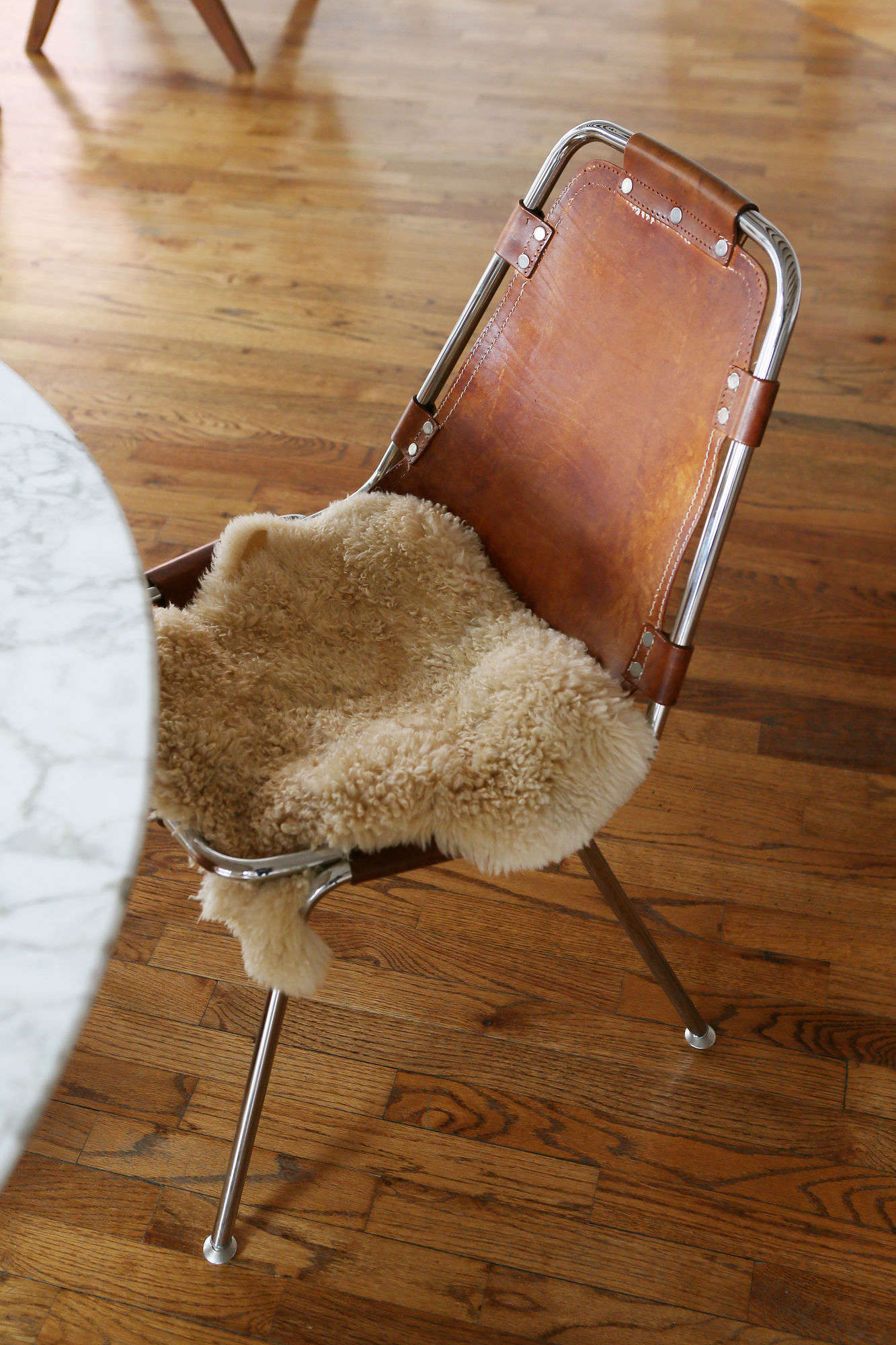
Charlotte Perriand’s work for the Les Arcs ski resort in France produced some of her most practical and recognizable furniture. Les Arcs dining chairs often combine leather seats with metal frames, creating a rugged yet elegant look. These chairs were made for real use in mountain apartments, where furniture needed to be compact, durable, and visually aligned with the architecture.
The Les Arcs chair is especially appealing today because it suits modern apartments, cabins, lofts, and dining spaces that need a little design authority without becoming too precious. The leather brings warmth, while the steel frame keeps the profile light. This combination makes the chair feel both utilitarian and collectible.
In many contemporary interiors, Les Arcs dining chairs are used around wood tables, marble tables, or even minimalist metal tables. Their visual flexibility is part of their charm. They can look rustic, industrial, modern, or alpine depending on the room around them.
Design Features That Define Charlotte Perriand Dining Chairs
Human-Centered Proportions
Perriand cared deeply about the body. Her chairs were not designed as static sculptures. They were meant to support sitting, eating, working, gathering, and living. That may sound obvious, but furniture history contains many chairs that appear to have been designed for people who do not possess knees.
Charlotte Perriand dining chairs usually have clear, rational proportions. The back height, seat angle, frame thickness, and material choices all contribute to comfort and usability. Even when a chair looks minimal, it tends to feel intentional rather than stripped down for drama.
Honest Materials
One of the great pleasures of Perriand’s dining chairs is their material honesty. Wood looks like wood. Leather gains character. Rush and straw bring texture. Steel provides structure. Nothing tries too hard to imitate something else. In an age of faux finishes and mystery composites, that honesty feels refreshing.
Her material palette also evolved over time. Early works leaned toward tubular steel and industrial modernism, while later pieces embraced natural materials and craft traditions. This evolution gives collectors many options, from polished modernist chairs to earthy alpine seating.
Practical Beauty
Perriand’s chairs are beautiful because they solve problems gracefully. A dining chair needs to be light enough to move, strong enough to use daily, comfortable enough for long meals, and visually balanced around a table. Her best chairs meet those demands without unnecessary ornament.
This is why Charlotte Perriand dining chairs remain relevant in modern interiors. They do not depend on trend colors, exaggerated shapes, or novelty. Their beauty comes from proportion, use, and material intelligence.
How to Style Charlotte Perriand Dining Chairs
Pair Them with a Simple Wood Table
A simple wood table is often the safest and most satisfying partner for Perriand dining chairs. Méribel and Dordogne-style chairs look especially strong with oak, pine, ash, or walnut tables. The goal is not to make everything match perfectly. In fact, a little variation in wood tone can make the room feel collected rather than showroom-staged.
Use Contrast in Modern Interiors
In a clean contemporary home, Charlotte Perriand dining chairs can prevent a room from feeling cold. Leather Les Arcs chairs can soften concrete floors and white walls. Rush-seat chairs can add warmth to minimalist spaces. LC7 chairs can bring a crisp architectural note to a polished dining room.
The key is restraint. Let the chairs speak. They have excellent manners, but they do not enjoy being surrounded by too many loud accessories.
Mix With Other Modernist Pieces
Perriand chairs can work beautifully with furniture by Jean Prouvé, Pierre Jeanneret, Le Corbusier, Isamu Noguchi, Alvar Aalto, or the Eameses. The trick is to avoid turning the room into a museum gift shop with better lighting. Choose pieces that share a spirit of function, material clarity, and strong proportion.
Let Patina Be Part of the Story
Vintage Charlotte Perriand dining chairs often show signs of use, and that can be part of their appeal. A softened leather seat, gently worn rush, or mellowed wood surface can add depth. Of course, there is a difference between “beautiful patina” and “this chair survived a bar fight.” Condition still matters.
Buying Charlotte Perriand Dining Chairs
Original Vintage vs. Authorized Reissue
Buyers generally face two paths: vintage originals or authorized contemporary editions. Vintage chairs offer history, rarity, and patina. They may also come with restoration issues, uncertain attribution, or higher maintenance needs. Authorized editions, such as Cassina-produced pieces for the LC collection, offer reliability, documented production, and modern comfort standards.
For the LC7, authorized production is especially important because the design is widely copied. A genuine Cassina example will have clearer documentation than a vague “in the style of” listing. For vintage wood, rush, straw, or Les Arcs chairs, provenance becomes even more important.
Check Provenance and Documentation
When buying collectible Charlotte Perriand dining chairs, ask for documentation. Provenance may include invoices, gallery records, auction history, labels, expert opinions, or publication references. Documentation does not just protect value; it protects you from paying masterpiece money for a chair with a very active imagination.
Because Perriand’s work is highly desirable, the market includes reproductions, inspired pieces, and uncertain attributions. Some may be beautiful in their own right, but they should be priced honestly. A chair “in the manner of Charlotte Perriand” is not the same as a verified Charlotte Perriand chair.
Inspect Construction and Materials
Look closely at the frame, joints, seat weaving, leather, metal finish, and overall proportions. For wood chairs, check for cracks, loose joints, replaced parts, or aggressive refinishing. For rush or straw seats, inspect sagging, breaks, and repairs. For leather-and-metal Les Arcs chairs, examine the leather thickness, stitching, patina, and frame condition.
Restoration is not automatically bad. Sensitive restoration can extend the life of a chair. But heavy refinishing, replaced materials, or poorly executed repairs can reduce both beauty and value.
Are Charlotte Perriand Dining Chairs Comfortable?
Yes, but comfort depends on the model and your expectations. The LC7 offers padded comfort and a swivel function, making it one of the more physically forgiving options. Méribel and Dordogne-style chairs provide firmer support, with woven seats that can be comfortable for dining but may not feel plush. Les Arcs chairs often offer a flexible, practical sitting experience, especially when the leather has aged well.
These are dining chairs, not recliners. They are made for meals, conversation, and lingering over coffee, not for falling asleep during a documentary about concrete. Still, their proportions are generally thoughtful, and many people find them more comfortable than they look.
Why Designers Still Love Them
Interior designers continue to use Charlotte Perriand dining chairs because they add instant depth without shouting. They bring history, but not dustiness. They bring modernism, but not coldness. They bring craft, but not nostalgia overload.
In a dining room, chairs do more visual work than many people realize. They repeat around the table, set the rhythm of the room, and influence how formal or relaxed the space feels. Perriand chairs are especially powerful because they can make a room look curated without making it look untouchable.
Common Mistakes to Avoid
Buying Only for the Name
A famous designer name does not automatically make a chair right for your home. Consider scale, comfort, condition, and how the chair works with your table. A rare chair that makes every dinner guest feel like they are being punished is not a design victory.
Ignoring Seat Height
Always check seat height against your dining table. Vintage dining chairs can vary, and some may sit lower or higher than expected. A beautiful mismatch can quickly become awkward when everyone at dinner looks like they are seated at different altitudes.
Over-Restoring Vintage Pieces
One of the joys of vintage Perriand chairs is their material character. Over-restoration can remove the very qualities that make them desirable. A careful cleaning and structural repair may be wise; sanding away decades of patina until the chair looks like it just joined a luxury gym may not be.
Experiences with Charlotte Perriand Dining Chairs
Living with Charlotte Perriand dining chairs is a little different from simply admiring them in photographs. In images, they look composed, balanced, and collectible. In a real dining room, they become warmer and more personal. You notice the curve of a backrest when you pull the chair out. You notice the texture of rush or leather when sunlight moves across the room. You notice how the chair changes the mood of dinner before the food even arrives.
A set of Méribel-style chairs, for example, can make a dining area feel grounded and calm. They do not demand polished silverware or formal table settings. They look just as good beside a bowl of pasta as they do beside a carefully plated roast chicken. Their woven seats and wooden frames bring a kind of quiet confidence. They suggest that the owner appreciates design but still understands that chairs are for sitting, not for intimidating guests.
Les Arcs chairs create a different experience. Their leather and metal combination feels more compact, more architectural, and slightly more urban. Around a wooden table, they can make a room feel like a modern mountain apartment, even if the nearest mountain is a pile of laundry in the hallway. They are practical, visually light, and easy to mix with contemporary elements. The leather softens over time, which gives each chair a slightly individual personality.
The LC7 offers yet another kind of pleasure. Because it swivels, it feels more dynamic than a traditional dining chair. It works especially well in open-plan spaces where the dining table may double as a work surface, meeting spot, or evening wine station. The chair has a crisp, modern presence, but the rounded back and padded seat keep it from feeling severe. It is a chair that can move from dinner to desk duty without complaining.
One of the best experiences with Charlotte Perriand dining chairs is how easily they age into a home. Many designer pieces look thrilling at first and then become difficult to live with because they dominate the room. Perriand’s chairs tend to do the opposite. They settle in. They become part of daily rituals: breakfast, emails, family dinners, late-night snacks, long conversations, and the occasional “I’m just sitting here for five minutes” that becomes forty.
They also invite better design decisions around them. Once you place a thoughtful chair at the table, flimsy lighting, awkward rugs, and oversized centerpieces suddenly become more obvious. Perriand’s work has a way of encouraging clarity. You may find yourself editing the room, removing clutter, choosing better materials, and letting space breathe. That is not because the chairs are bossy. They are simply well designed, and good design has a persuasive effect.
For collectors, the experience includes the thrill of research. Tracking down a set of authentic vintage chairs can involve auction records, gallery conversations, condition reports, and a few moments of deep breathing when prices appear. But for many enthusiasts, that research is part of the joy. Each chair carries a story: where it was made, where it lived, how it was used, and how it survived.
For everyday homeowners, the lesson is simpler. You do not need a museum-quality interior to appreciate Charlotte Perriand dining chairs. You need a respect for proportion, materials, and livable beauty. These chairs remind us that dining spaces are not just places to eat quickly before checking email again. They are places to gather, pause, talk, laugh, argue mildly about paint colors, and enjoy the small architecture of daily life.
Conclusion
Charlotte Perriand dining chairs remain iconic because they combine intelligence, comfort, craft, and timeless style. From the tubular-steel confidence of the LC7 to the alpine warmth of Méribel chairs, the rustic elegance of Dordogne seating, and the practical beauty of Les Arcs designs, Perriand’s chairs continue to feel remarkably fresh.
Their appeal is not only visual. These chairs carry a philosophy of living well through useful, honest, human-centered design. They prove that furniture can be refined without being precious and practical without being dull. For anyone building a dining room with character, Charlotte Perriand dining chairs offer something rare: history you can actually sit on.