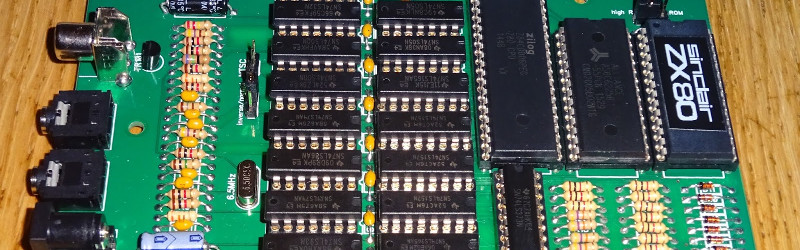
The Sinclair ZX80 is the kind of computer that makes modern devices look slightly overdramatic. Today, our laptops arrive with multi-core processors, glossy displays, facial recognition, and enough memory to misplace an entire decade of vacation photos. The ZX80 arrived in 1980 with 1K of RAM, a membrane keyboard, monochrome TV output, and the confidence of a tiny white spaceship that had absolutely no intention of apologizing.
Yet this little machine mattered. A lot. The Sinclair ZX80 helped turn personal computing from an expensive hobby into something a curious teenager, a practical parent, or a soldering-iron enthusiast could actually imagine owning. It was small, affordable, strange, clever, and occasionally frustrating in ways that now feel almost charming. A thoroughly modern Sinclair ZX80, then, is not just a replica of old hardware. It is a celebration of a design philosophy: make computing accessible, make it understandable, and make every byte count like it is paying rent.
What Was the Sinclair ZX80?
The Sinclair ZX80 was a home computer introduced in 1980 by Science of Cambridge, the company that soon became better known as Sinclair Research. In the United Kingdom, it was promoted as one of the first personal computers available for under £100. In the United States, it was sold through Sinclair’s American operation and was notable for its remarkably low price compared with many competing systems of the era.
The original ZX80 used a Z80-compatible processor running at around 3.25 MHz, included 1K of RAM, and stored its operating system and Sinclair BASIC interpreter in a compact 4K ROM. Programs were saved and loaded with an ordinary cassette recorder. A household television became the display. There was no sound chip, no disk drive, no color graphics, and certainly no app store waiting politely for your password.
But that is exactly why the ZX80 is fascinating. It was a complete computer reduced to its essentials. It asked a simple question: how little hardware do you actually need before a person can write code, save programs, learn logic, and feel the electric thrill of commanding a machine?
Why the ZX80 Felt So Modern in 1980
To understand the ZX80, it helps to remember what personal computing looked like at the time. Many popular computers were expensive, bulky, and aimed at committed hobbyists or schools with serious budgets. Machines such as the Apple II, Commodore PET, and TRS-80 were influential and capable, but they were not pocket-money purchases. The ZX80 entered the room with a different attitude: computing should be cheap enough to be tempting.
That low price was not magic. It came from ruthless engineering choices. The machine relied heavily on standard TTL logic chips instead of a custom graphics chip. The case was lightweight plastic. The keyboard was a flat membrane rather than a full-travel typing experience. The display system borrowed time from the CPU, which meant the screen famously blanked when the computer was busy doing work. In other words, the ZX80 did not hide its compromises. It put them on the family TV.
Still, the value was undeniable. For people who wanted to learn programming, the ZX80 was a door opening. It came with Sinclair BASIC, and although the 4K ROM version was limited, it gave beginners a direct way to experiment. Type a line, run it, change it, break it, fix it, and repeat. That loop is still the foundation of learning to code today.
The Design Genius Behind the Limitations
A Computer Built From Constraint
The ZX80 was not powerful by modern standards, but its constraints were part of its identity. The 1K RAM limit sounds almost comical now. A modern web page can use more memory just to display a cookie banner that nobody wanted. But with 1K, programmers learned discipline. Variable names, line numbers, screen output, and program structure all had to be handled carefully.
Sinclair BASIC used a clever keyword-entry system. Instead of typing every BASIC command letter by letter, users pressed keys that produced entire keywords depending on the input mode. This saved memory and reduced typing errors. It also made the keyboard look like a miniature control panel for a submarine designed by a mathematician.
The Famous Screen Blanking
One of the ZX80’s best-known quirks was the way its display disappeared during processing. Because the CPU helped generate the video signal, it could not always calculate and keep the screen alive at the same time. When a program ran, the display could blank out until the machine paused for input or finished the task.
Was this ideal? Not exactly. Was it unforgettable? Absolutely. The blanking screen became part of the ZX80 personality. It reminded users that they were not dealing with an invisible black box. They were watching a machine juggle duties in real time, and sometimes the juggler dropped the TV picture to catch the math.
Expansion Without Luxury
The original ZX80 allowed expansion through a rear edge connector. RAM packs and other accessories could extend what the little computer could do. Later, users could upgrade the ROM to a ZX81-style 8K BASIC, giving the ZX80 a more capable software environment. Enthusiasts also modified machines with better keyboards, improved video output, and additional memory.
This upgrade culture is one reason the ZX80 still attracts retro-computing fans. It was never just a sealed appliance. It invited tinkering, even when that invitation sometimes arrived in the form of a wobbly RAM pack and a quiet prayer.
A Thoroughly Modern Sinclair ZX80: What Does That Mean?
A modern Sinclair ZX80 can mean several things. It may be a faithful replica built from newly manufactured circuit boards. It may be a redesigned clone with practical improvements such as composite video output, modern power connectors, and built-in memory expansion. It may be an emulator running on modern hardware. Or it may be a maker project that captures the spirit of the original while removing a few of the historical headaches.
The appeal is not simply nostalgia. Modern retro-computing projects let people study real hardware at a human scale. Unlike today’s tiny system-on-chip devices, the ZX80’s architecture can be understood piece by piece. The CPU, ROM, RAM, keyboard scanning, display generation, and cassette interface are all visible concepts. For learners, that transparency is gold. For collectors, it is history with solder pads.
Modern Improvements That Make Sense
Composite Video Instead of RF
The original ZX80 connected to a television using RF output, which made sense in 1980. Today, RF inputs are less common, and modern displays are not always friendly to old analog signals. A modern ZX80-style build often replaces the original RF modulator with composite video. This makes the machine easier to connect to monitors and capture devices while preserving the monochrome charm.
More RAM Without the Wobble
The original 1K RAM made sense for cost control, but most users quickly wanted more. External RAM packs expanded capacity, yet they could also be physically unreliable if bumped. Modern builds often include 16K RAM on the main board, avoiding the classic “do not touch the table or the program vanishes” problem. Retro authenticity is wonderful; losing your work because someone sneezed near the expansion pack is less wonderful.
ZX80 and ZX81 ROM Options
Some modern recreations include support for both ZX80 and ZX81 ROMs. This lets users compare the early 4K BASIC experience with the improved 8K BASIC environment. The ZX81 ROM brought a more polished programming experience, although hardware differences meant that not every ZX81 behavior could be perfectly reproduced on a ZX80-style system without extra circuitry.
Modern PCBs and Better Documentation
One of the biggest advantages of a modern Sinclair ZX80 project is documentation. Today, designers can redraw schematics in tools such as KiCad, manufacture clean circuit boards, publish files, and discuss revisions with a global community. What once required magazine ads, mail order, and a sturdy envelope can now become an open hardware project shared across continents.
Why Makers Still Love the ZX80
The ZX80 is a maker’s machine before “maker” became a fashionable word. It rewards curiosity. It is simple enough to understand, awkward enough to teach patience, and historic enough to feel meaningful. Building or using one today is not about outperforming a modern laptop. That contest ended before it began, and the laptop brought a thermonuclear spreadsheet.
Instead, the ZX80 teaches the shape of computing. It shows how memory, input, display, and storage work together. It demonstrates how cost shapes design. It proves that limitations can inspire creativity. Many early programmers learned by typing in code from magazines, experimenting with BASIC, and discovering that a tiny machine could become a calculator, game platform, learning tool, or personal laboratory.
In an age of cloud platforms and sealed devices, that direct relationship feels refreshing. You are not just using software; you are meeting the machine halfway.
The ZX80 and the Birth of Accessible Home Computing
The Sinclair ZX80 helped establish a pattern that shaped the 1980s home computer boom. Affordable machines created new programmers. New programmers created games, utilities, newsletters, user groups, and small businesses. The ZX80 led directly into the ZX81 and later the ZX Spectrum, one of the most beloved computers in British computing history.
In the United States, the Sinclair story continued through Timex-related models, including the Timex Sinclair 1000, which was based on the ZX81. These machines were inexpensive, compact, and widely discussed in computer magazines. Even when they were criticized for their keyboards, limited memory, or fragile expansions, they gave many users their first hands-on experience with programming.
That is the ZX80’s greatest legacy. It was not the most comfortable computer. It was not the most powerful. It was not even the most graceful. But it was reachable. And in technology, reachable often matters more than perfect.
Using a Modern ZX80 Today
A modern ZX80 experience can be surprisingly enjoyable if expectations are properly calibrated. This is not a machine for multitasking, streaming, or pretending to be productive while opening seventeen browser tabs. It is a machine for focus. You sit down, type a BASIC command, see a result, and understand exactly what happened.
Beginners can use it to learn programming fundamentals: variables, loops, conditions, input, and output. Electronics hobbyists can study its circuit design and learn why certain timing choices mattered. Collectors can appreciate the industrial design, especially the distinctive white case and blue membrane keyboard. Writers and historians can use it as a lens into the moment when computing stopped being a distant institutional tool and became a domestic object.
The modern version also removes some barriers. Composite video makes display setup easier. Stable onboard RAM reduces frustration. Fresh PCBs avoid the risks of aging hardware. Emulators allow users to explore the system without owning original equipment. These improvements make the ZX80 more accessible while keeping its educational character alive.
What the ZX80 Teaches Modern Technology
The ZX80 teaches that great technology does not always begin with maximum power. Sometimes it begins with a sharp goal. Sinclair wanted to reduce the cost of entry, and nearly every design decision served that mission. The result was imperfect, but it was influential because it changed who could participate.
Modern product designers can still learn from that. Affordable tools create communities. Transparent systems create learners. Simple platforms invite experimentation. The ZX80 did not need to hide its machinery because the machinery was the point.
There is also a cultural lesson here. The ZX80 reminds us that early computing was playful. People typed programs from magazines, traded tips, modified hardware, and pushed machines beyond their intended limits. Today’s retro-computing movement keeps that playful engineering alive. It says, in effect, “Yes, your phone is faster, but can you understand it with a continuity tester and a cup of coffee?”
Buying, Building, or Emulating a ZX80
Original Sinclair ZX80 computers are collectible and can be expensive, especially in good condition with documentation and accessories. For many enthusiasts, building a modern replica or using an emulator is more practical. A replica offers the tactile satisfaction of real hardware without relying on a fragile vintage unit. An emulator offers instant access and is ideal for learning BASIC, studying software, or testing programs.
Builders should pay attention to video compatibility, keyboard quality, ROM selection, memory configuration, and expansion support. A faithful replica may preserve original quirks, while a modernized design may prioritize usability. Neither approach is wrong. One is like restoring a classic car with period-correct tires; the other is like adding seat belts because you enjoy arriving in one piece.
Experience Section: Living With the ZX80 Spirit in a Modern World
The most rewarding experience related to a thoroughly modern Sinclair ZX80 is the sudden change in pace. Modern computers encourage speed. Open the lid, unlock the screen, receive notifications, update three apps, ignore four alerts, and somehow forget why you opened the device in the first place. A ZX80-style machine does the opposite. It slows the room down.
Sitting with a ZX80, whether original, recreated, or emulated, feels more like working with a musical instrument than using a consumer gadget. The keyboard demands intention. The memory limit demands planning. The display reminds you that the machine is doing its best with very little. You do not casually throw code at it; you negotiate with it.
That negotiation is surprisingly fun. Writing a short BASIC program becomes a puzzle. You think about how many lines you need, how to reuse variables, and how to make output readable on a 32-character-wide screen. A simple number guessing game feels satisfying because every part is visible. There is no framework hiding the logic, no library silently doing the heavy lifting, and no error message that appears to have been written by a committee trapped in a basement.
For someone used to modern programming, the ZX80 mindset can be refreshing. It strips away the layers and asks: what is the smallest working idea? That question is powerful. It applies to software design, electronics, writing, education, and even daily problem-solving. The ZX80 rewards people who start small, test quickly, and improve patiently.
There is also a tactile pleasure in modern retro hardware. A newly made PCB, clean solder joints, a practical video output, and stable memory can make the old design feel approachable. You get the historical flavor without needing to treat the machine like an archaeological artifact that might crumble if someone opens a drawer too aggressively. The result is a bridge between eras: vintage logic with modern reliability.
The best moment comes when a short program finally runs. Maybe it prints a pattern. Maybe it asks for a number. Maybe it draws chunky block graphics that look like a city skyline designed by a calculator. It does not matter. The joy is in understanding the whole chain from keypress to screen. That feeling is rare now, and the Sinclair ZX80 still delivers it beautifully.
Conclusion: A Tiny Computer With a Giant Echo
A thoroughly modern Sinclair ZX80 is more than a retro novelty. It is a tribute to affordable computing, clever engineering, and the joy of learning by doing. The original ZX80 turned severe limitations into an invitation. Modern recreations, upgrades, and emulators keep that invitation open for new generations of hobbyists, programmers, collectors, and curious learners.
The ZX80 was not perfect. Its keyboard was flat, its memory was tiny, and its display had the dramatic habit of vanishing whenever the CPU got busy. But it was accessible, understandable, and inspiring. That is why it still matters. In a world where technology often feels sealed, polished, and mysterious, the Sinclair ZX80 remains wonderfully human: small, clever, flawed, affordable, and full of possibility.