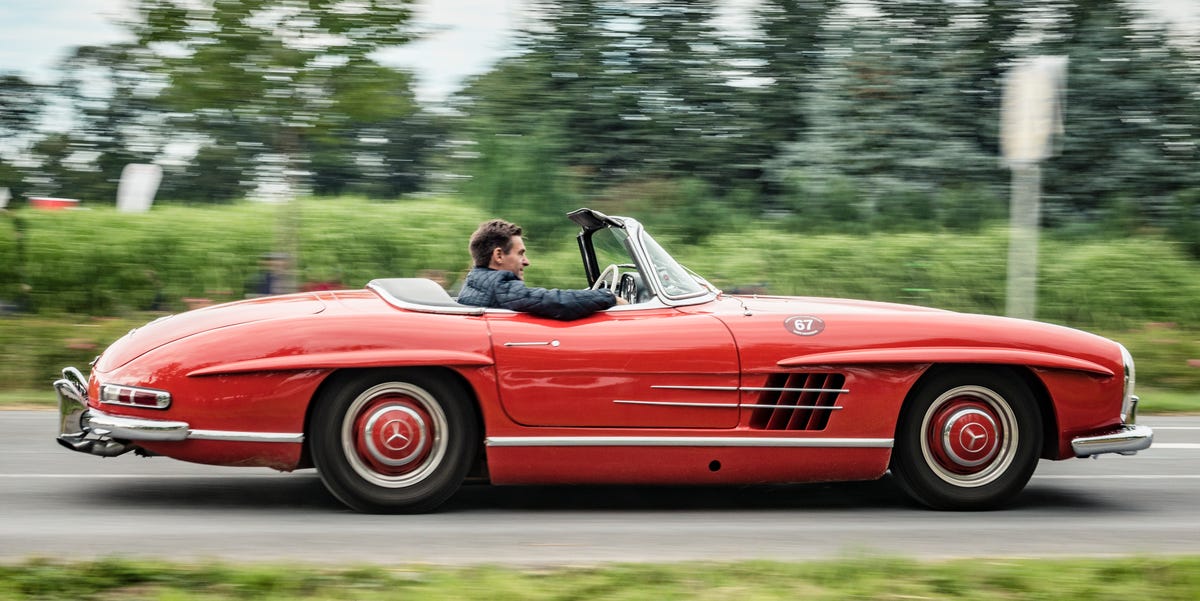
There are many cruel little reminders that adulthood is not the glamorous movie trailer we were promised. Your back now makes noises. Your calendar has passwords in it. And your sensible daily driver, with its practical cupholders and emotionally neutral paint color, may have just been outclassed by a machine built for someone who still thinks dinosaurs might be hiding behind the couch.
Yes, the joke is real: for about $50,000, a child can technically end up with a more stylish car than the one parked in your driveway. Not a plastic ride-on with cartoon eyes and a steering wheel that barely turns, either. We are talking about a miniature electric car styled after the Mercedes-Benz 300 SL Roadster, one of the most beautiful automobiles ever created. Which means the preschool parking lot may now have its own concours d’elegance.
That headline sounds like clickbait with a silver grille. But beneath the absurdity is a genuinely interesting story about luxury, nostalgia, automotive design, and the strange modern market for tiny cars that are somehow not toys, not fully practical vehicles, and yet very much objects of desire. In other words, they are exactly the kind of thing car culture loves: irrational, gorgeous, and impossible to stop talking about.
What Exactly Is the $50K Kid Car?
The machine inspiring all this envy is a miniature electric tribute to the Mercedes-Benz 300 SL Roadster. It is not a cheap big-box store battery buggy with a fake badge slapped on the nose. It is the kind of scaled-down car that treats details seriously, from its polished presentation to its upscale cabin touches. The reported specs are what make people do a double take: an electric motor rated at 1.5 kW, a top speed just shy of 28 mph, and a price hovering around $49,000.
That is the moment this story stops being cute and starts becoming hilarious. Twenty-eight mph is not toy-store territory. It is “please keep Grandpa from trying it in the cul-de-sac” territory. Add in leather seating, an aluminum-style instrument panel, a proper-looking selector, and enough visual drama to make most commuter crossovers look like office furniture, and suddenly the headline makes brutal sense. The four-year-old may not understand provenance, but everyone else at the Cars and Coffee will.
And that is the real hook here. This is not just about a wealthy family buying something extravagant for a child. It is about the fact that a miniature car can now be built with such care, such fidelity, and such shameless charm that adults immediately begin mentally trading in their own vehicles. Nobody looks at a little classic-inspired EV like this and thinks, “Very sensible purchase.” They think, “I hate how much I love this.”
Why the Mercedes 300 SL Is the Perfect Car to Miniaturize
Some cars shrink badly. This one doesn’t.
The original Mercedes-Benz 300 SL has always had an unfair advantage in beauty contests. Its proportions are clean, athletic, and just dramatic enough to feel special without trying too hard. The coupe is famous for its gullwing doors, while the roadster brought the same elegance into open-air form. Either way, it is one of those rare designs that still looks expensive even when seen as a poster, a die-cast model, or a laptop wallpaper.
That matters because not every car works as a scaled-down fantasy. Many modern vehicles rely on size for their visual impact. Shrink them and they become lumpy, awkward, or accidentally adorable. The 300 SL is different. It carries itself with such clarity that even at a reduced scale it still looks like a proper machine. The long hood, the low stance, the delicate brightwork, the sense that this thing belongs outside a grand hotel in the south of Franceit all survives the diet.
There is also history doing a lot of heavy lifting here. The 300 SL is not just “some old Mercedes.” It is one of the foundational myths of postwar performance motoring. It came from racing bloodlines, helped define the brand’s sporting image, and became a symbol of glamorous speed. That legacy gives any miniature version instant credibility. Build a tiny replica of a forgettable sedan and you have a novelty. Build a tiny 300 SL and you have a conversation piece with a pulse.
The original was already a flex before “flex” existed
Part of the 300 SL’s lasting power comes from the fact that it was never merely pretty. It was fast, advanced, and culturally loaded. It carried racing DNA into road-car form and became one of the era’s defining status objects. Long before supercars became social-media content, the 300 SL was quietly telling the world that engineering and style could share the same garage.
That makes the child-sized version more than a silly rich-person accessory. It is a miniature version of an icon that once represented speed, exclusivity, and taste. So yes, the tiny car is funny. But it is funny in the same way a miniature tuxedo on a bulldog is funny: because it is unexpectedly committed to the bit.
$50K Is Real-Car Money, and That Is the Whole Point
At this price, the joke writes itself. Around the same money can buy an actual, full-size new luxury EV. It can buy a practical family car, a decent sports sedan, or something used and properly thrilling. In other words, $50,000 is not fantasy money in the car market. It is a real budget for a real vehicle with doors, airbags, and the ability to travel farther than a wealthy child’s driveway.
That is why this miniature 300 SL lands so well online. If it cost $5,000, people would shrug and call it a premium toy. At $50,000, it enters the sacred territory of adult compromise. Suddenly the comparison becomes deliciously rude. You spent your money on a responsible machine with warranty coverage, a back seat, and phone integration. Meanwhile, somebody else spent roughly the same amount on a tiny electric style bomb with vintage looks and zero interest in practicality.
The truth is that most adult cars are bought under pressure from life. Commute. Kids. Weather. Financing. Insurance. Parking. Fuel or charging. Boring but necessary questions that slowly sand down whatever wild imagination you had at age nine. The mini 300 SL, by contrast, answers to none of that. It exists almost entirely to delight, show off, and start conversations. Which, if we are honest, is what many car enthusiasts wish more new cars still did.
The Tiny Luxury Car Trend Is Bigger Than This One Mercedes
If this sounds like a one-off oddity, it isn’t. The market for upscale miniature or junior classics has been quietly building momentum. The Bugatti Baby II proved there was serious interest in small electric machines that blend heritage design with real craftsmanship and a price tag that makes accountants sigh. The Bentley Blower Junior pushed the idea further into the realm of sanctioned, collectible eccentricity. Ferrari and Aston Martin-inspired junior cars have done the same.
That matters because it shows this is not random nonsense from the fringes of the internet. It is a niche, yes, but it is a real niche with buyers, branding, engineering, and status attached. These cars live at the intersection of luxury goods, collectible design, automotive nostalgia, and family theater. They are for people who already have the garage and are now decorating the lifestyle around it.
Seen that way, the mini 300 SL is less a child’s first car and more a rolling expression of taste. It belongs in the same mental category as bespoke watches, rare pedal cars, branded speedboats, or beautifully unnecessary furniture. Its job is not transportation. Its job is to make people grin and mutter, “That is ridiculous,” followed immediately by, “Where can I see one?”
So Who Is Actually Buying Something Like This?
Not every buyer is purchasing it for a kid who will use it as intended. Some are collectors who want a miniature companion piece to a full-size classic. Some are luxury families who enjoy the theater of matching machines. Some are hotels, museums, showrooms, and event spaces that understand the commercial power of a crowd-stopping display. And some buyers, let’s be honest, are adults who know perfectly well the child is just the official excuse.
There is also the emotional angle. Enthusiasts often talk about wanting to pass car culture down to the next generation. Usually that means posters, toy cars, shop time, or eventually a first project car. In ultra-premium circles, it can apparently mean giving your kid a scaled electric homage to one of the most revered sports cars in history. Excessive? Absolutely. But it is also strangely consistent with the way enthusiasts think. People who love cars do not just want mobility. They want mythology.
Is It Absurd? Completely. Is It Also Cool? Very.
This is where the article should probably pretend to be stern and practical. No child needs a $50,000 mini Mercedes. It is extravagant. It is unnecessary. It is the kind of thing that makes your practical aunt whisper, “Society has gone too far.” All true.
But coolness has never depended on necessity. If anything, coolness often begins where necessity ends. Nobody needs a mechanical watch in the smartphone era, yet people adore them. Nobody needs a hand-built weekend roadster when a crossover can haul mulch and groceries, yet sports cars still make hearts beat faster. This mini 300 SL belongs to that same glorious family of objects that dare to ask not, “Is this sensible?” but, “Will people remember this?”
And they will. Because while your average modern car wins points for efficiency and packaging, this little machine wins on vibe. Its appeal is not spreadsheet logic. It is emotional logic. It is the fantasy of childhood and the mythology of classic motoring colliding in one shiny, improbable package. That is hard to resist, even if your rational brain is staging a protest.
What the Headline Really Says About Modern Car Culture
The reason this story travels so well is that it sneaks up on a deeper truth: a lot of adults feel emotionally underfed by today’s mainstream cars. Modern vehicles are better than ever in safety, efficiency, refinement, and technology. Yet many are visually cautious, digitally overloaded, or designed by committees determined never to frighten a lease customer.
Then along comes a tiny 300 SL-style electric runabout, and people lose their minds. Why? Because it reminds them that style still matters. Delight still matters. Character still matters. Even in miniature, a machine with presence can embarrass a full-size car whose main personality trait is “available in silver.”
That is why the joke feels sharp. It is not really about a child having a better car than an adult. It is about the fact that a tiny machine built around romance and design can feel more emotionally rich than a much larger, more expensive, more practical vehicle built around caution. The little car wins because it remembers that automobiles were once allowed to be aspirational first and rational second.
The Experience: What It Feels Like When a Preschooler Pulls Up in Something Cooler Than Your Car
Picture the scene. You arrive somewhere in your perfectly decent adult vehicle. It starts every morning. It has a backup camera, climate control, and enough cargo room for a warehouse club run. You feel solid. Competent. Financially literate. Then a tiny electric 300 SL-style roadster hums into view like a joke told by a couture house. Suddenly your own car, moments ago a respectable purchase, feels like a rolling appliance with cupholders.
The first reaction is laughter. It has to be. The proportions are so charming and the concept so outrageous that your brain needs a second to catch up. Then the second reaction hits: admiration. The tiny hood line is right. The stance works. The bright trim glints. The whole thing carries itself with more charisma than vehicles ten times its size. It is like watching a miniature tuxedoed jazz band enter a room. You know it is silly, but you also know everyone is going to talk about it.
And that is the strange magic of these junior classics. They create an experience far out of proportion to their size. A regular luxury SUV might impress people for three seconds before blending into the landscape of modern wealth. A miniature classic does the opposite. It becomes a story. Neighbors point. Parents laugh. Grandparents start telling tales about “real cars from back in the day.” Even people who are not car people immediately understand that this is something unusual.
For a child, the experience would be pure wonder. The seating position feels special. The steering wheel is not a cartoon prop but an invitation. The dashboard suggests rules, rituals, and a little world of your own. Even at low speed, the sensation is not just movement; it is ceremony. You are not merely driving around the patio or private lane. You are making an entrance. That matters more than range figures ever will.
For adults, the experience is slightly more complicated because it comes with a side helping of envy. There is nostalgia in it, certainly. Most of us grew up with plastic ride-ons, pedal cars, RC fantasies, and the belief that grown-up motoring would be all glamour and no traffic. Seeing a child-sized luxury classic brings all of that roaring back. It reminds you of the distance between what cars meant to you as a kid and what they became once payments, potholes, and parking garages entered the chat.
That is why these machines punch above their weight culturally. They do not just trigger desire; they trigger memory. They reconnect cars to play, beauty, and spectacle. They suggest that driving can still be theatrical, even if the vehicle in question technically belongs to someone who cannot tie their shoes without supervision. A tiny 300 SL-style EV may not be practical, but practical is not why anyone remembers their favorite car story.
And maybe that is the final twist. The coolest part is not that a four-year-old could drive a cooler car than you. It is that the little car exposes how hungry people still are for delight. Give them elegance, scale-model perfection, a whisper of classic racing romance, and just enough absurdity to make the whole thing irresistible, and they light up. Adults do not only want transportation. They want to feel something. This tiny Mercedes-shaped marvel just happens to deliver that feeling with a child-size steering wheel and a price tag outrageous enough to become legend.
Final Verdict
So, could your four-year-old drive a cooler car than you for just $50K? In pure style terms, alarmingly, yes. That is the insult. It is also the appeal.
The miniature 300 SL-style EV is not a rational purchase, and nobody should pretend otherwise. But it is a brilliant symbol of what still makes car culture fun: fantasy, craftsmanship, history, and a complete refusal to let practicality have the final word. It turns a child’s runabout into an objet d’art, a conversation starter, and a rolling reminder that beauty does not stop mattering just because adulthood got serious.
And if that stings a little when you glance back at your competent crossover, well, welcome to the club. The preschool concours waits for no one.