Technology did not merely join the stock market. It rewired the machinery, attracted an enormous share of investor capital, and then quietly climbed into nearly every portfolio through index funds. Today, software chooses trades, smartphones turn spare moments into trading sessions, and a handful of technology-driven corporations can determine whether a broad market index smiles or sulks.
The market has not disappeared inside a computer, but it sometimes feels that way. To understand what happened, we need to examine three overlapping revolutions: the rise of Big Tech companies, the automation of trading, and the transformation of investing into an inexpensive digital service.
Technology Ate the Market in Three Different Ways
The title sounds dramatic, but “ate” is surprisingly accurate. Technology consumed the stock market from three directions.
First, technology companies became some of the largest and most profitable businesses in history. Second, electronic networks, algorithms, and data centers took over the process of buying and selling securities. Third, investment apps, exchange-traded funds, social media, and artificial intelligence changed how ordinary people make financial decisions.
The result is a market in which technology is simultaneously the product, the plumbing, and the salesperson. That is a neat tricklike owning the restaurant, manufacturing the ovens, and designing the menu customers cannot stop ordering from.
From Trading Floors to Machines
Wall Street’s slow-motion digital makeover
For much of the twentieth century, the stock market was a loud physical place. Brokers gathered on exchange floors, shouted orders, waved paper, and somehow avoided spilling coffee on transactions worth millions of dollars.
Computers began entering the picture decades ago. The New York Stock Exchange says computer data-processing technology was first applied to its operations during the 1960s. Electronic order-routing systems followed, allowing orders to travel from brokerage offices to trading posts within seconds.
Nasdaq accelerated the transition when it launched in 1971. According to Nasdaq’s historical account, wider distribution of computerized quotes helped automate trading, reduce costs, and expand market access.
Modern U.S. equity trading is now overwhelmingly electronic. Orders move among exchanges, alternative trading systems, market makers, and other venues. A person tapping “buy” sees a clean confirmation screen; behind it, a complicated network begins making decisions in fractions of a second.
Algorithms became the market’s invisible workforce
Institutional investors rarely send enormous orders into the market all at once. Doing so could push the price against them. Instead, algorithms divide large orders into smaller pieces, select trading venues, monitor available liquidity, and adjust execution based on price, time, volume, and market conditions.
High-frequency trading firms go further. They use extremely fast systems to quote prices, detect short-lived differences, and manage thousands of positions. These firms can improve liquidity and narrow bid-ask spreads during normal conditions. However, speed can also amplify instability when many automated strategies respond to the same signal.
This does not mean a sinister robot controls the Dow from a basement. It means the market has become a collection of interacting programs, each following rules created by humans. Unfortunately, humans are perfectly capable of programming both brilliance and chaos.
Even settlement became faster
Technology also transformed what happens after a trade. On May 28, 2024, most covered U.S. securities moved from a two-business-day settlement cycle to T+1. The Securities and Exchange Commission explained that stocks, bonds, ETFs, certain mutual funds, and other securities would generally settle one business day after the trade.
Faster settlement reduces the time during which a failed transaction or financial problem can create trouble. It is not glamorous technology, but market plumbing becomes very exciting when it breaks.
Then Technology Companies Took Over the Indexes
Big Tech grew into Really, Really Big Tech
The second takeover happened inside market indexes. Apple, Microsoft, Nvidia, Amazon, Alphabet, Meta Platforms, and other technology-driven businesses built global platforms with extraordinary scale.
Software can often be copied and distributed at a low additional cost. Digital platforms can serve another million users without constructing a million new storefronts. Cloud computing, online advertising, semiconductor design, operating systems, e-commerce, and subscription software therefore produced attractive margins and powerful network effects.
Many leading companies also accumulated large cash reserves, repurchased shares, and invested heavily in data centers, chips, artificial intelligence, and research. Investors rewarded their growth, causing their market capitalizationsand their index weightsto expand.
The S&P 500 is diversified, but not equally
The S&P 500 contains hundreds of companies, but it is weighted by float-adjusted market capitalization. A corporation worth several trillion dollars therefore has far more influence than a smaller constituent.
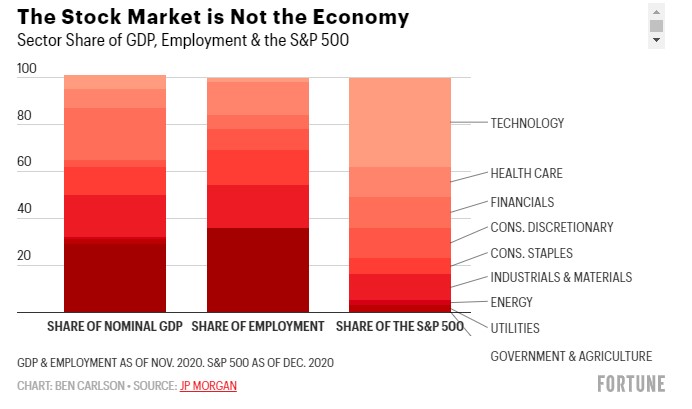
Recent data from S&P Dow Jones Indices placed the index’s 10 largest constituents at roughly 36% of its total weight, while the information technology sector represented about 38%. These percentages change with market prices, but the central point does not: a relatively small group of giants can steer the headline index.
Official sector labels also understate technology’s reach. Alphabet and Meta are classified under communication services. Amazon and Tesla sit in consumer discretionary. A bank may be categorized as financials even though its competitive advantage increasingly depends on software, data, and cybersecurity.
Technology has become less like one slice of the economic pie and more like the electricity powering the bakery.
Market concentration is not automatically a bubble
High concentration deserves attention, but it is not proof that a crash is waiting behind the curtains. Markets have always created dominant businesses, and long-term shareholder wealth has historically come from a surprisingly small number of exceptional companies.
Research summarized by Arizona State University’s W. P. Carey School of Business found that a tiny minority of stocks generated most long-term stock-market wealth. This helps explain why diversified portfolios can work: investors do not need to identify every future champion in advance.
Concentration nevertheless raises risk. When the biggest companies trade at demanding valuations, disappointments in earnings, regulation, AI adoption, or capital spending can affect the entire index. An investor who thinks a broad large-cap fund is completely neutral may unknowingly own a substantial technology and artificial-intelligence bet.
Index Funds Helped Technology Swallow More Capital
Passive investing created an efficient feedback mechanism
Index funds made diversified investing cheaper and easier. Instead of choosing individual companies, investors could buy a fund tracking the S&P 500 or the total U.S. stock market. Regular retirement-plan contributions then directed money into these funds automatically.
The growth has been remarkable. The Investment Company Institute’s 2026 Fact Book reported that index funds held 52% of long-term mutual fund and ETF assets at year-end 2025, up from 19% in 2010. The organization also reported that U.S.-domiciled ETFs held $13.4 trillion at the end of 2025.
Market-cap-weighted funds do not intentionally favor technology. They simply allocate more money to companies as their market values rise. However, that mechanism means successful giants receive larger portfolio weights. New contributions then buy those companies in proportion to their expanded size.
This is not a perpetual-motion machine. Prices can fall, index weights can shrink, and fundamentals eventually matter. Still, the system can make a market leader’s influence feel self-reinforcing during a sustained bull run.
Low costs changed investor expectations
Technology also squeezed investment fees. Automated portfolio management, electronic records, and scale allowed index providers and fund companies to offer remarkably inexpensive products. Vanguard reported that approximately 40% of ETF flows went into S&P 500 strategies during 2025, while warning that portfolios could become heavily exposed to large-cap technology-related stocks.
Cheap diversification is a genuine achievement. The catch is that “inexpensive” and “low risk” are not synonyms. A seat belt is inexpensive too, but it does not make driving through a hurricane a sensible weekend activity.
Trading Apps Turned Investing Into a Consumer Product
The broker moved into everyone’s pocket
Opening a brokerage account once involved forms, phone calls, minimum deposits, and commission charges. Mobile platforms removed much of that friction. Investors can now open accounts, transfer funds, research securities, buy fractional shares, and monitor portfolios from a phone.
This democratization expanded access. A person no longer needs substantial capital to build a diversified portfolio. Educational materials, financial statements, earnings calls, and market data are more accessible than ever.
But reduced friction also makes impulsive behavior easier. When trading resembles scrolling through an entertainment app, patience starts looking suspiciously old-fashioned.
Zero commissions did not make trading costless
Commission-free trades reduced an obvious barrier, but brokers still operate businesses rather than charitable lemonade stands. Revenue may come from interest, subscriptions, securities lending, or payment for order flow.
FINRA materials on digital engagement have discussed concerns that payment for order flow, zero commissions, and app-design practices could create incentives encouraging frequent trading. Investors may also face bid-ask spreads, taxes, poor execution, and the behavioral cost of making too many decisions.
Social media created a new kind of market signal
The 2021 meme-stock episode showed how rapidly online communities could concentrate attention on a handful of securities. The SEC’s GameStop report documented extraordinary volatility and trading volume as bullish sentiment spread through social media.
Online discussion can surface valuable research, but it can also reward confidence over competence. A viral post is not automatically wrong; it is simply not a substitute for understanding a company’s cash flow, valuation, competitive position, and risks.
Options and Instant Trading Compressed Time
Technology did not merely make trading faster. It encouraged markets to focus on shorter time horizons. Weekly and same-day options allow traders to speculate on movements measured in hours or minutes.
Cboe data show that zero-days-to-expiration contracts account for a large share of S&P 500 index-option activity. These instruments can help sophisticated participants hedge precise risks, but their prices may move violently as expiration approaches.
For long-term investors, the lesson is not that options are evil. It is that the modern market contains participants playing completely different games. One computer may be managing risk for the next 20 seconds while a retirement saver is investing for the next 20 years. They share a price, not a time horizon.
Artificial Intelligence Is the Latest Main Course
Artificial intelligence intensified the market’s technology obsession. Investors began evaluating semiconductor designers, cloud platforms, networking companies, data-center operators, software developers, utilities, and even cooling-equipment manufacturers through an AI lens.
The economic opportunity is real. AI may improve programming, logistics, scientific research, customer service, advertising, manufacturing, and countless administrative tasks. FINRA also notes that broker-dealers are exploring AI applications across their own operations.
Yet an important business can still be a poor investment if its stock price assumes perfection. Investors must distinguish among technological adoption, company revenue, sustainable profit, and the valuation paid for those profits. Those four items are related, but they are not identical twins.
Capital spending presents another challenge. Data centers and advanced chips require enormous investment. The companies supplying the infrastructure may profit early, while buyers must later prove that AI-generated revenue justifies the expense. During a gold rush, shovel sellers often celebrate first; the miners receive the invoice.
Did Technology Make the Stock Market Better?
In many ways, yes. Trading costs fell. Quotes became more transparent. Small investors gained access to diversified funds, fractional shares, professional research, and fast execution. Settlement became more efficient, while global investors received broader access to U.S. securities.
The market also became more complex. Liquidity is distributed across many venues, automated systems can react together, and incentives hidden behind a friendly app may be difficult to recognize. The SIFMA equities primer describes a landscape shaped by multiple trading venues, passive investing, retail activity, regulation, and changing order-routing practices.
Meanwhile, technology’s dominance in major indexes can widen the gap between the stock market and the everyday economy. A neighborhood restaurant may struggle with wages and rent while a global cloud company reports booming demand. Both are part of the economy, but only one has enough index weight to move millions of retirement accounts.
The Federal Reserve’s May 2026 Financial Stability Report described equity valuation pressures as elevated. That observation does not forecast an immediate decline, but it reminds investors that excellent technology cannot repeal the relationship between price and future returns.
What Investors Should Do About a Technology-Heavy Market
Know what is inside the portfolio
Owning several funds does not guarantee diversification if all of them hold the same mega-cap companies. Investors should examine sector exposure, top holdings, geographic allocation, company size, and overlap among funds.
Separate a great company from a reasonable price
Strong revenue growth, excellent management, and an impressive product do not make valuation irrelevant. Expected future cash flows still determine long-term investment value.
Avoid competing with machines at their favorite game
Individual investors rarely possess the speed, data, or infrastructure of professional trading firms. Their advantage is the ability to wait. A patient investor does not need to win the next millisecond.
Use technology without becoming used by it
Automation can support regular contributions, rebalancing, tax management, and disciplined saving. Notifications, leaderboards, social-media excitement, and constant price checking can do the opposite. The same phone can build a retirement portfolio or turn investing into a casino with excellent typography.
Remember that the real economy is becoming digital too
Technology’s influence is not entirely a market illusion. U.S. Census Bureau data showed that e-commerce represented 16.9% of retail sales in the first quarter of 2026, and online sales were growing faster than total retail sales. Digital tools are spreading through nearly every industry, blurring the boundary between technology companies and ordinary businesses.
Experiences From Living Through the Technology Takeover
The dot-com lesson: a correct idea can become an expensive trade
Investors who experienced the late-1990s internet boom saw a genuine technological revolution wrapped in unrealistic expectations. The internet did transform commerce, media, advertising, and communication. However, many companies with “dot-com” in their names lacked durable revenue, defensible business models, or any visible path to profit.
The practical lesson was painful but valuable: accurately predicting the future does not guarantee that every company associated with that future will succeed. Some internet pioneers disappeared, while later winners became corporate giants. Technology changed the world, but it did not save investors who paid any price for any stock wearing a digital hat.
The index-fund experience: convenience can hide concentration
During the 2010s, many investors embraced automatic contributions to broad-market funds. The experience was refreshingly boring. Money entered the account each month, shares accumulated, fees remained low, and there was no need to inspect dozens of earnings reports over breakfast.
As mega-cap technology stocks outperformed, however, these portfolios quietly changed. Investors who had never selected Apple, Microsoft, Nvidia, Amazon, or Alphabet individually still developed substantial exposure to them. The experience demonstrated that passive investing eliminates the need to choose stocks, but it does not eliminate market structure. An index always follows rules, and those rules shape the risks investors own.
The 2020–2021 experience: investing became entertainment
When people spent more time at home, mobile trading, online communities, stimulus money, and dramatic market swings produced a new investor culture. Screenshots of gains circulated online. Meme stocks became social identities. Options strategies once discussed mainly by professionals entered everyday conversation.
Some participants learned valuable financial concepts and began long-term investing. Others discovered that a rapidly rising position can feel like proof of genius right until it becomes an advanced course in humility. The episode showed how technology can expand participation while also compressing the time available for reflection.
The AI experience: fear of missing out gained a business plan
The AI boom felt different because many leading beneficiaries were already profitable, cash-rich companies. Investors could point to real semiconductor demand, cloud revenue, data-center construction, and enterprise spending. This was not merely a collection of websites hoping someone would eventually invent customers.
Still, the emotional pattern was familiar. Rising prices attracted attention; attention generated confident forecasts; confident forecasts justified higher prices. Investors learned once again that a compelling innovation story becomes most dangerous when nobody is willing to discuss what could go wrong.
The enduring experience: behavior matters more than the interface
Across every phase of the technology takeover, one principle survived: new tools do not remove old emotions. Greed still encourages people to chase. Fear still makes them sell at uncomfortable moments. Overconfidence still arrives after a few successful trades wearing a tiny crown.
The healthiest experience comes from using technology to reduce errors rather than multiply decisions. Automatic investing, diversified funds, written allocation rules, scheduled portfolio reviews, and limited notifications can turn powerful digital tools into useful servants.
Technology ate the stock market because it produced valuable companies, efficient infrastructure, and irresistible financial products. Investors do not need to escape that system. They simply need to understand what is on the menuand avoid becoming dessert.