Nothing ruins a pleasant evening outdoors quite like becoming the featured entrée at an all-you-can-eat mosquito buffet. Repellent helps, long sleeves help, and dramatically waving a paper plate around may provide emotional relief. But a well-chosen mosquito trap can quietly capture adult mosquitoes while you concentrate on more important matters, such as preventing the burgers from becoming charcoal briquettes.
To identify the best mosquito traps, we compared current product specifications, public-health guidance, entomology research, and hands-on findings from major American home and garden testing teams. We focused on mosquito-catching ability, ease of setup, maintenance, operating costs, coverage, noise, and whether each trap targets mosquitoes or simply commits random acts of violence against every moth in the neighborhood.
Our Top Mosquito Trap Picks
| Category | Recommended Trap | Best For | Main Attraction Method |
|---|---|---|---|
| Best Overall | DynaTrap 1/2 Acre LED Outdoor Insect Trap | Typical suburban yards | UV-LED light and fan |
| Best Premium | Biogents BG-Mosquitaire CO2 | Serious mosquito pressure | CO2, human-scent lure, and suction |
| Best for Large Properties | Mosquito Magnet Patriot Plus | Yards up to one acre | Propane-generated CO2 and octenol |
| Best Indoor | Katchy Original Indoor Insect Trap | Bedrooms, kitchens, and entryways | UV light, fan, and glue board |
| Best Traditional Zapper | Flowtron BK-40D | Mixed flying-insect problems | UV light, octenol, and electric grid |
Do Mosquito Traps Actually Work?
Yes, a mosquito trap can catch mosquitoes. That does not automatically mean every trap will noticeably reduce the number of bites in every yard. Mosquito species behave differently, weather changes their activity, neighboring properties may contain breeding sites, and a warm human producing carbon dioxide is difficult for a plastic gadget to out-advertise.
Female mosquitoes locate potential hosts with several cues, including carbon dioxide, body odors, heat, movement, and visual contrast. This is why the strongest outdoor mosquito traps generally imitate more than one part of a human presence. A trap using CO2, scent, contrasting colors, and suction has a more convincing sales pitch than a blue light alone. The CDC notes that mosquitoes use specialized sensory organs to detect carbon dioxide and odors, while professional surveillance programs select different traps for different mosquito species and life stages.
Traditional bug zappers deserve additional skepticism. University extension guidance reports that UV-only zappers do not consistently reduce outdoor mosquito biting rates and may kill large numbers of harmless insects. CO2 and octenol can make an attract-and-kill device more appealing to female mosquitoes, but even an advanced trap should be treated as one component of mosquito control rather than a force field around your patio.
The Best Mosquito Traps Reviewed
Best Overall: DynaTrap 1/2 Acre LED Outdoor Insect Trap
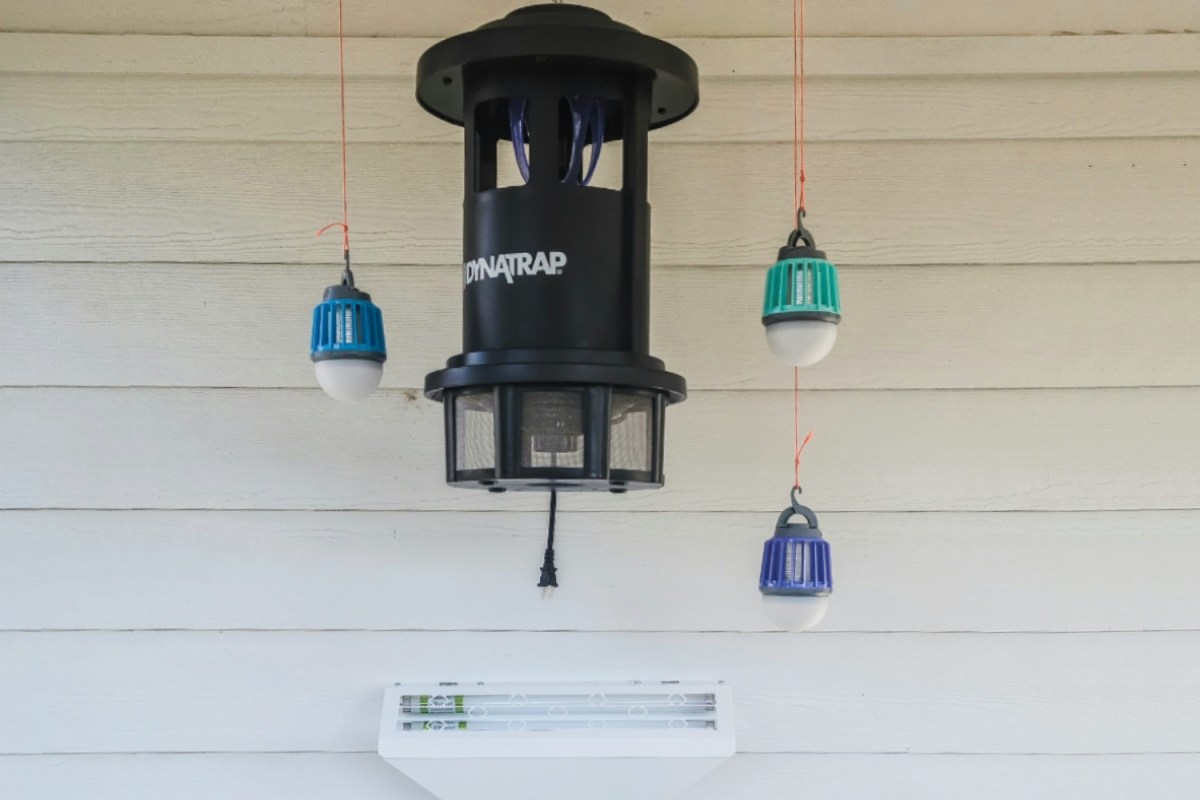
The DynaTrap is our best overall recommendation because it balances performance, simplicity, appearance, and reasonable maintenance. It resembles a sturdy outdoor lantern instead of a piece of laboratory equipment that escaped during a thunderstorm.
The trap combines UV-LED light with a fan that draws approaching insects into a retaining basket. There is no loud electrical crack, no propane tank, and no glue board to peel away while attempting not to examine its contents too closely. The current half-acre model is intended for continuous outdoor operation and has a power cord of approximately six feet, so many users will need a properly rated outdoor extension cord.
In independent residential testing, a half-acre DynaTrap captured mosquitoes along with other flying insects and received high marks for straightforward setup, weather resistance, appearance, and easy basket cleaning. Its biggest limitation is selectivity. Light-based attraction may bring in moths, beetles, and other nighttime visitors, so not everything in the basket will be a mosquito.
Choose it when: You want a dependable mosquito trap for a normal backyard without managing fuel tanks or recurring adhesive cartridges.
Skip it when: Your property has extreme mosquito pressure, large wetlands nearby, or aggressive daytime Aedes mosquitoes that respond more strongly to human scent and CO2.
Best Premium Trap: Biogents BG-Mosquitaire CO2
The BG-Mosquitaire CO2 is the most mosquito-focused machine in this guide. It is designed to imitate a human host with carbon dioxide, a proprietary artificial skin-scent lure, visual contrast, and airflow. Once mosquitoes approach, a fan pulls them into a catch bag where they dehydrate.
This is a particularly compelling choice in areas with tiger mosquitoes, which may bite during the day and are not always impressed by a glowing nighttime bulb. The trap can operate with its scent lure alone, but adding the CO2 system broadens its appeal to more mosquito species. A CO2 cylinder is generally not included, so buyers must obtain and refill a compatible tank locally.
The machine uses little electricity and avoids insecticide, electrical zapping, and propane combustion. It is also designed to be more selective than a general-purpose bug zapper. The trade-off is a higher initial cost, ongoing purchases of scent lures and CO2, and more attention to placement and airflow.
Choose it when: Mosquitoes are a major recurring problem and you are willing to pay for a targeted, season-long outdoor system.
Skip it when: You want something portable, completely maintenance-free, or usable without an electrical outlet and CO2 supplier.
Best for Large Properties: Mosquito Magnet Patriot Plus
The Mosquito Magnet Patriot Plus is less like a patio accessory and more like a tiny mosquito-processing plant. It uses propane to generate a continuous stream of CO2, combines that plume with an octenol attractant, and pulls biting insects into a net.
The manufacturer rates it for properties up to one acre. It also requires a low-energy 12-volt electrical connection, so buyers need both a propane cylinder and access to power. The trap is intended to run continuously during mosquito season rather than being switched on ten minutes before guests arrive.
Results are not instant. Mosquito Magnet guidance suggests that noticeable improvement may take roughly seven to ten days and that reducing the local population can require several weeks of continuous operation. Propane and attractant replacement add significant operating costs, while clogged nets, dirty airflow passages, or startup problems can reduce performance.
Choose it when: You have a large yard, heavy biting pressure, and enough motivation to maintain a propane-powered appliance all summer.
Skip it when: You prefer plug-and-play simplicity or only need protection around a small apartment balcony.
Best Indoor Mosquito Trap: Katchy Original
The Katchy Original is a compact indoor trap that combines UV light, a fan, and a replaceable glue board. Small flying insects approach the illuminated opening, get pulled downward by the fan, and become stuck to the adhesive surface.
Its quiet operation and enclosed glue board make it suitable for bedrooms, kitchens, home offices, and entryways. It is also much less alarming at 2 a.m. than an indoor zapper loudly announcing each successful catch.
However, expectations matter. Katchy is excellent for occasional indoor mosquitoes, gnats, fruit flies, and similar small pests. It is not a substitute for repairing window screens, closing doors, removing indoor standing water, or addressing an outdoor breeding problem. Its UV-based attraction also works best in a dark room, away from competing lamps and windows.
Choose it when: A few mosquitoes or other small flying insects repeatedly enter your living space.
Skip it when: You need broad outdoor coverage or want to reduce an established yard population.
Best Traditional Zapper: Flowtron BK-40D
The Flowtron BK-40D is a powerful outdoor bug zapper with a UV black light, a 5,600-volt grid, an octenol cartridge, and a claimed coverage area of up to one acre. It is durable, widely available, and satisfying in the same primitive way as bubble wrap: light, sound, and immediate evidence that something happened.
We recommend it only with an important qualification. It is better viewed as a mixed flying-insect killer than as the most scientifically targeted mosquito trap. Octenol may improve mosquito attraction, but UV zappers can catch many non-target insects and should not be expected to create a bite-free yard.
Hang it well away from seating areas so attracted insects move away from people rather than through the middle of dinner. You will also need to replace the UV bulb and mosquito attractant periodically.
Choose it when: You have a broad nighttime flying-insect problem and prefer a rugged, familiar zapper.
Skip it when: Mosquito-specific capture and protection of harmless insects are your highest priorities.
How to Choose the Right Mosquito Trap
Match the Trap to the Mosquito Problem
A single indoor mosquito near your bed calls for a very different product than hundreds of mosquitoes emerging from a shaded drainage area. Compact UV-and-glue traps are practical indoors. Fan traps work well for ordinary yards. CO2 mosquito traps make more sense when the biting pressure is severe or when light-based traps are producing baskets full of moths but few mosquitoes.
Ignore Coverage Claims Without Studying Your Yard
A “one-acre” rating does not guarantee equal performance across a one-acre property. Fences, buildings, dense vegetation, wind, competing lights, nearby animals, and breeding sites all affect the movement of an attractant plume. A strategically placed half-acre trap may outperform a larger unit installed in the brightest, windiest corner of the lawn.
Calculate the Ongoing Cost
The least expensive trap on the shelf may require costly glue boards, attractant packs, UV bulbs, propane, or CO2 refills. Before buying, estimate a full mosquito season of operation. The premium device with efficient replacement parts may be less expensive than the bargain model that develops a weekly appetite for proprietary cartridges.
Consider Noise and Cleanup
Fan traps produce a steady hum. Zappers produce intermittent cracks. Glue boards are quiet but require replacement. Catch baskets and nets must be emptied before accumulated insects block airflow. Choose the form of maintenance you are realistically willing to perform, not the version completed by your imaginary, more responsible future self.
Where Should You Place a Mosquito Trap?
Placement can matter as much as the machine. Most outdoor mosquito traps should not be installed directly beside the patio table. A trap is designed to attract mosquitoes, so putting one next to your ankles is similar to opening a seafood restaurant beside a seagull convention.
Position the trap between likely mosquito resting or breeding areas and the space you want to protect. Look for shaded, humid locations near dense shrubs, drainage channels, wood lines, rain barrels, or other unavoidable water sources. Avoid strong wind, direct competition from bright lights, and places where sprinklers will soak electrical components.
Indoor traps should be placed near the route insects use to enter, such as a door, window, sink area, or mudroom. UV traps generally perform better after dark when competing lights are turned off.
Our Real-World Experience With Mosquito Traps
The most important lesson from repeated mosquito-trap testing is that the first night tells you almost nothing. A trap may capture a handful of insects immediately, but reducing the number of mosquitoes around a property requires consistent operation. Mosquitoes already living in shrubs continue to bite, new adults continue to emerge, and additional mosquitoes may fly in from neighboring yards. A trap is playing defense for an entire season, not competing in a five-minute game show.
Basket inspection is also more educational than glamorous. At first glance, a full chamber looks like proof of a historic victory. Look more closely, however, and you may find moths, beetles, midges, and insects that have never bitten anyone and were probably just trying to get home. This is where CO2 and scent-based traps usually feel more convincing. Their catches tend to align more closely with the blood-feeding insects users actually want to remove.
Placement experiments often produce larger improvements than upgrading to a more expensive model. A fan trap positioned beside the patio may collect surprisingly little because people are warmer, larger, and releasing more carbon dioxide than the trap. Move the same machine toward a shaded hedge or damp corner, and its catch can improve. The trap intercepts mosquitoes before they reach the seating area instead of trying to win their attention after dinner has arrived.
Maintenance is another unglamorous difference between a useful trap and expensive yard decoration. Fan intakes accumulate pollen and insect debris. Glue boards fill with gnats. Nets restrict airflow. UV bulbs gradually weaken. CO2 tanks become empty at exactly the moment you have invited twelve people over for a cookout. A quick weekly inspection prevents most of these problems and takes less time than searching the house for anti-itch cream later.
We also learned that trap noise is subjective. A small indoor fan quickly becomes background sound for many people, but light sleepers may notice it beside the bed. Outdoor fan traps are usually unobtrusive from a few yards away. Zappers are different. Some users find the electrical crack reassuring; others find it impossible to enjoy a quiet conversation while the device celebrates every moth.
Finally, the strongest results come from combining a trap with boring prevention. Emptying plant saucers, cleaning gutters, covering rain barrels, refreshing pet water, fixing screens, and treating unavoidable standing water accomplish more than buying a second gadget while ignoring a bucket filled with rain behind the shed. The EPA notes that mosquitoes can develop in containers as small as bottle caps, while CDC guidance emphasizes eliminating water-holding sites and using larvicides where water cannot be removed.
The best practical routine is simple: remove breeding sites, operate the trap continuously, inspect it weekly, and use an EPA-registered skin repellent when mosquito-borne illness or intense biting is a concern. The trap lowers pressure. Repellent protects the person. Source reduction stops tomorrow’s mosquitoes from graduating into today’s problem.
Final Verdict
For most homeowners, the DynaTrap 1/2 Acre LED Outdoor Insect Trap offers the best balance of convenience, coverage, appearance, and maintenance. The Biogents BG-Mosquitaire CO2 is the stronger premium option for buyers who want mosquito-specific attraction, while the Mosquito Magnet Patriot Plus is built for large properties and serious seasonal infestations.
Indoors, the Katchy Original is compact, quiet, and practical for catching occasional intruders. The Flowtron BK-40D remains a capable general bug zapper, but buyers primarily interested in mosquitoes should understand the limitations of UV-based electrocution.
No mosquito trap can overcome an untreated breeding site, poor placement, or unrealistic expectations. Choose the right attraction method, let the trap operate consistently, and give it a little help by removing standing water. Mosquitoes are persistent, but fortunately, they are not known for strategic planning meetings.