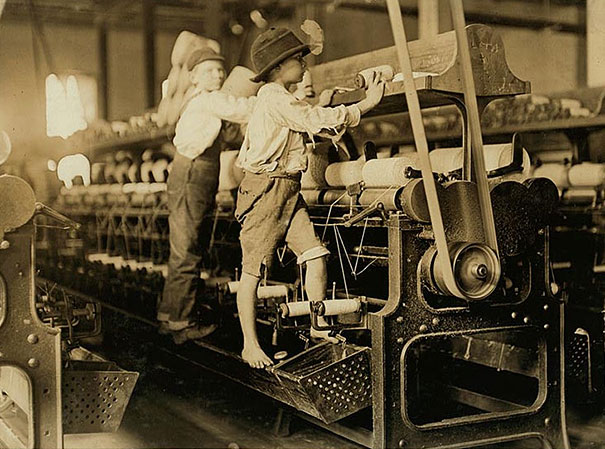
Some photographs ask to be admired. Lewis Hine’s child labor photographs ask something far less comfortable: that we stop, stare, and admit what America once allowed children to endure. These are not quaint “old-timey” snapshots of kids helping out at the family store. They are visual evidence of long shifts, dangerous machinery, filthy air, tired faces, and childhoods traded for wages that could barely buy a decent dinner.
Hine understood something powerful long before social media, viral outrage, or documentary streaming specials existed: people can ignore statistics, but it is much harder to ignore a child looking directly into the camera. That is why his pictures still feel like a punch to the chest. They make child labor impossible to file away as an abstract historical issue. Instead, they put names, faces, and tiny shoulders under the weight of very adult burdens.
In the early twentieth century, Hine traveled through mills, mines, canneries, farms, and city streets documenting children at work across the United States. The result was not just a body of photography. It was a public argument, a moral indictment, and, eventually, part of the force that helped change labor law. More than a century later, these photographs remain among the most powerful images in American reform history.
Who Was Lewis Hine, and Why Did His Camera Matter?
Lewis Hine was not originally famous as an artist with a velvet scarf and a dramatic studio pose. He began as a teacher and trained in sociology, which explains a lot about the way he worked. He was interested in people, systems, injustice, and the plain facts of everyday life. When he started photographing workers and immigrants, he did not aim to create dreamy, decorative pictures. He wanted images that could persuade.
That made him a perfect fit for the National Child Labor Committee, the reform organization that sent him out to document child workers. Hine went where many employers did not want outsiders to look too closely: cotton mills, coal breakers, glass factories, canneries, and city streets crowded with newsboys and little messengers. He often had to move like a detective. Factory owners were suspicious. Supervisors were hostile. Some children had been coached to lie about their ages. Hine interviewed them anyway, took careful notes, and gathered details about age, height, hours, pay, and family circumstances.
That combination of empathy and evidence is what makes his work so durable. He did not simply say, “This is sad.” He showed exactly why it was wrong. A child was not just “young.” Hine might note that she had worked there for a year, ran multiple sides of a spinning machine, worked nights, or earned only a few cents a day. His captions were often as devastating as the images themselves.
Why These Pictures Still Hurt to Look At
The emotional force of Hine’s photographs comes from their honesty. He was not staging melodrama. He did not need to. The truth was already dramatic enough. A thin child standing barefoot beside industrial machinery is not subtle. A row of breaker boys covered in coal dust does not require a dramatic soundtrack. A four-year-old oyster shucker does not need a filter.
What makes the images especially heartbreaking is that the children rarely look theatrical. Many of them look calm, wary, curious, or simply tired. That restraint makes the pictures more powerful, not less. The children do not appear to be performing misery for the viewer. They are simply there, caught in the middle of work that should never have belonged to them in the first place.
Hine also had a gift for making scale visible. In mill photographs, a child may look tiny against the length of spinning frames. In mine photographs, the boys appear swallowed by darkness, dust, and heavy labor. In street-trade images, the children look small against the rough business of city life. The message lands without needing a sermon: the world of labor was oversized, and the children inside it were expected to adapt.
The Most Haunting Kinds of Child Labor Hine Captured
Textile Mill Workers
Some of Hine’s best-known photographs come from textile mills in the South and New England. These images are especially striking because of the contrast between child-sized bodies and machine-sized expectations. Young spinners and doffers stood among whirring frames, lint-filled air, and long rows of equipment that seemed to stretch forever. The jobs required speed, repetition, and constant attention. It was dangerous work, and the environment was exhausting.
One famous subject was Addie Card, photographed in a Vermont cotton mill. Her image has become one of the defining faces of child labor in the United States. She appears frail, serious, and far too young for the industrial world surrounding her. Hine’s photographs of mill children did not just show them working. They showed how labor made children look older and smaller at the same time.
Breaker Boys in Coal Country
If you want a visual definition of “stolen childhood,” the breaker boys come painfully close. These boys worked in coal breakers, sorting slate and impurities from coal. It was dirty, dangerous labor in harsh conditions. Hine photographed groups of boys in Pennsylvania with faces darkened by dust, clothing worn thin, and expressions that feel older than their years. They look like kids who had skipped straight from childhood into fatigue.
The coal images matter because they shatter any romantic idea that early industrial work “built character.” Coal dust did not build character. It built coughs, injuries, and exhaustion. Hine’s lens made that plain.
Oyster Shuckers and Cannery Children
Then there are the oyster shuckers, some of the most shocking children in Hine’s archive. These were not teenagers putting in a few after-school hours. Some were extremely young. Hine photographed very small children working around shell piles, knives, wet floors, and repetitive hand labor in canning communities. The images are unsettling because they reveal how thoroughly labor invaded family and community life. Work was not somewhere children visited occasionally. It shaped the entire environment around them.
These photographs are especially effective because they feel domestic and industrial at once. You see children, but you also see production. You see poverty, but also a system that treated children as useful pieces of it.
Newsboys, Messengers, and Street Trades
Not all child labor took place behind factory walls. Hine also photographed children working in the streets as newsboys, shoe shiners, and messengers. These images carry a different kind of sadness. The children are out in public, surrounded by adult commerce, traffic, vice, and risk. They may not be standing beside a machine, but they are still exposed to adult worlds far too early.
A little newsboy standing alone late at night can be as heartbreaking as any factory portrait. The street-trade photographs remind us that child labor was not only about industrial production. It was also about survival in a system where children were expected to hustle, bargain, roam, and endure.
What Made Hine’s Photography So Effective?
Plenty of reformers wrote reports. Hine did something slightly more dangerous to the defenders of child labor: he made exploitation visible. Once the public saw a tiny spinner in a mill or a six-year-old newsboy on the street, it became harder to pretend that child labor was harmless, wholesome, or economically necessary.
His pictures worked because they balanced compassion with clarity. He did not reduce children to symbols. Each child appears as a person first. That is the quiet genius of the work. Hine did not just photograph “the issue.” He photographed individual human beings, each with posture, expression, clothing, and presence. Even when children are grouped together, they never fully disappear into the crowd.
He also used captions with unusual precision. This was not vague activism. Hine often recorded ages, workplaces, hours, and wages. Sometimes he documented the lies adults told about children being “old enough.” Sometimes he noted that a child worked nights or had already spent years on the job. That factual texture gave the images legal, political, and moral weight.
Visually, Hine was remarkably disciplined. His images are direct. He avoids sentimentality. He does not clutter the frame with needless drama. Instead, he lets the child, the workplace, and the plain fact of the situation speak. The effect is almost surgical. You cannot really wiggle out of what you are seeing.
From Pictures to Policy: How Hine Helped Change America
At the turn of the twentieth century, child labor was deeply woven into the American economy. Millions of children worked in factories, mines, fields, stores, and on city streets. Reformers had been pushing back for years, but public awareness needed fuel. Hine’s photographs became part of that fuel.
The images were used in reports, exhibits, pamphlets, and lectures. They traveled into public conversations where statistics alone might have failed. Seeing one exhausted child in a photograph could do what a page of numbers could not: create moral urgency. Hine’s work helped make child labor look not normal, but intolerable.
That momentum contributed to major reform efforts. The Keating-Owen Act of 1916 tried to limit child labor by restricting interstate commerce in goods produced under certain exploitative conditions. The law was later struck down by the Supreme Court, which is the sort of legal twist that makes historians sigh loudly into their coffee. Still, the broader reform movement did not disappear. The issue remained alive, and federal protections became stronger with the Fair Labor Standards Act of 1938, which banned oppressive child labor and established lasting labor standards.
It would be too simple to say that one photographer “ended” child labor. History is never that tidy. Activists, journalists, lawmakers, workers, reform organizations, and changing public attitudes all played roles. But it would also be wrong to downplay Hine’s influence. His photographs gave reform a face, and once those faces entered public life, they were hard to forget.
Iconic Images That Still Define the Story
Addie Card in the Cotton Mill
Addie Card remains one of Hine’s most recognizable subjects because the photograph does so much with so little. She stands in a mill, looking outward, neither dramatized nor hidden. Her expression is plain, but the situation is not. The industrial backdrop makes her youth feel even more vulnerable. The image has endured because it captures the central contradiction of child labor: a child placed inside an adult system of profit.
The Little Spinner in Georgia
Another unforgettable image shows a young spinner in a Georgia cotton mill. Hine’s mill portraits often reveal children who were physically small but burdened with precise, relentless tasks. These photographs make one point with brutal efficiency: when people say “children worked in mills,” they are not talking about light chores. They are talking about industrial labor.
Group Portraits of Breaker Boys
The group photographs of breaker boys are among Hine’s most emotionally complex works. The boys stand shoulder to shoulder, caked in grime, staring toward the camera. Some look defiant, some blank, some curious. Together they become a portrait of labor as environment. The dirt is not decorative. It is evidence. The group setting also suggests scale. This was not an isolated case. It was a workforce.
Oyster Shuckers on the Gulf Coast
Hine’s cannery and oyster-shucking photographs are devastating because the children are often so young. Their size makes the work look even more absurd and cruel. The shell piles, buckets, and repetitive labor turn childhood into production. These images are among the clearest examples of how poverty and labor exploitation often traveled together.
Newsboys on City Streets
The newsboy portraits may seem less industrial, but they are no less revealing. Children selling papers at odd hours, wandering city blocks, and surviving on hustle were part of the same labor story. Hine photographed them not as charming little entrepreneurs, but as kids navigating hard adult realities.
Why These Photographs Still Matter Now
It is tempting to look at Hine’s images and congratulate ourselves for being more enlightened than the past. That is always the favorite hobby of the present. Unfortunately, history is rarely that polite. Modern child labor laws in the United States are stronger than they were in Hine’s era, but debates over enforcement, workplace safety, and illegal child labor have not vanished.
That makes Hine’s work feel current in an uncomfortable way. His photographs remind us what happens when profit outruns conscience and when children are treated as economic tools instead of developing human beings. The legal framework may have changed, but the ethical question has not: how much vulnerability is a society willing to tolerate when money is involved?
His images also still matter because they model a kind of responsible witness. Hine did not look away. He did not prettify suffering. He did not turn hardship into aesthetic wallpaper. He looked carefully, recorded honestly, and pushed the public to do the same.
Conclusion
The heart-breaking pictures of child labour in USA by Lewis Hine remain essential because they do more than document a dark chapter in American history. They reveal how reform begins: first by seeing clearly, then by refusing to accept what is seen as normal. Hine’s child labor photographs endure because they combine humanity, evidence, and quiet outrage in a way few images ever manage.
They show children who should have been in school, at play, or asleep in bed, yet were instead standing in mills, sorting coal, shucking oysters, and roaming city streets for work. That is why the photographs still ache. They are not just historical records. They are moral records. And they continue to ask a very sharp question: when a society says it values children, what does that look like in practice?
Experience and Reflection: What It Feels Like to Sit With These Images Today
Looking at Lewis Hine’s child labor photographs today is a strangely layered experience. At first, there is the distance of history. The clothing is old. The machinery looks antique. The settings belong to another era. You may think you are about to study the past in a safe, museum-like way, with the emotional temperature set somewhere between “interesting” and “educational.” Then the faces start working on you.
That is when the experience changes. A child in a mill does not feel old-fashioned for very long. A dusty breaker boy does not remain a “historical subject.” An exhausted newsboy does not stay inside the category of “archival image.” They become children again, and that is the unsettling part. The century separating viewer and subject suddenly feels very thin.
One of the strongest emotional reactions these photographs create is disbelief. Not disbelief that child labor happened, because most people know that on paper. It is a more physical disbelief: they were really that young. You see their small hands, their narrow shoulders, their uncertain stances, and your brain keeps trying to place them in modern childhood. You imagine them holding a backpack, sitting in a classroom, tying a shoe, arguing over snacks, or pretending they are not sleepy on a school morning. Then the image pulls you back. No backpack. No classroom. Just the machine, the coal, the shells, the street.
Another part of the experience is anger, though it arrives quietly. Hine’s images do not scream. They accumulate. One photograph might move you; ten can corner you. The repetition becomes its own argument. This was not bad luck. It was not a handful of isolated tragedies. It was structure. It was policy failure. It was public tolerance. It was an economy that had room for children, as long as they were useful.
And yet the photographs are not hopeless. That may sound odd, given the subject, but it is true. There is dignity in the way Hine sees his subjects. He never treats them as trash, props, or pity machines. Even in terrible conditions, the children retain presence. They are visible. They matter. That is part of what makes the experience of viewing these photographs so powerful. The images do not only tell us what was done to children. They also insist that those children were fully human, fully real, and fully worthy of memory.
Spending time with Hine’s work also changes how you think about reform. Laws can sound dry. Advocacy can sound abstract. But photographs like these reveal what reform is actually for. It is for protecting specific bodies, specific lungs, specific hands, specific childhoods. It is for the child standing in the frame who should never have had to be there. That is why these pictures still matter. They do not merely ask us to remember history. They ask whether we have learned enough from it.