Note: This first-person photo essay is written in the voice of a traveling photographer and is grounded in documented Romanian history, architecture, and rural traditions.
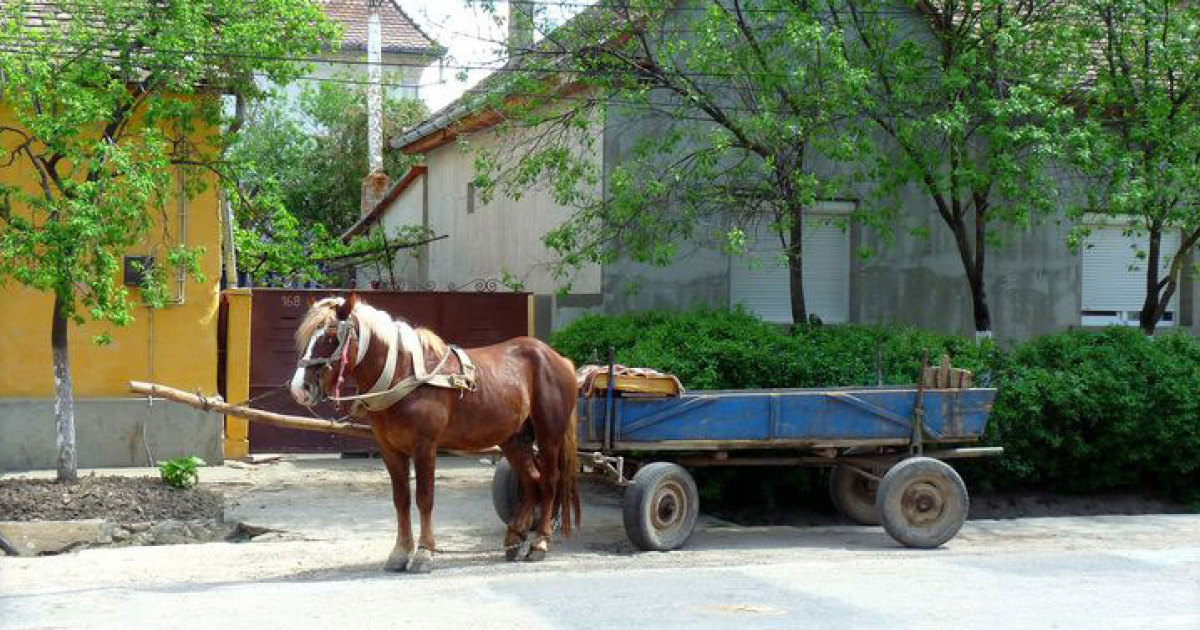
At sunrise, the village road was almost empty. Mist rested over the fields, smoke curled from brick chimneys, and a horse-drawn cart moved slowly past a row of pastel houses. The driver lifted two fingers from the reins in greeting. Behind him, a dog trotted with the confidence of someone who clearly believed he owned the road.
I raised my camera, then lowered it again.
The scene looked too perfectly arranged to be real. There were wooden gates darkened by decades of rain, haystacks shaped like giant loaves of bread, and tiled roofs glowing orange beneath the first light. Somewhere beyond a garden wall, a rooster was screaming as if dawn had arrived without completing the proper paperwork.
This was rural Romania: not a movie set, not an open-air museum, and not a country trapped in the past. These were living communities where centuries-old buildings stood beside satellite dishes, where farmers checked smartphones between chores, and where a quiet lane could hold more architectural history than some entire cities.
Over several days, I photographed villages in Transylvania and Maramureș that appeared frozen in time. Yet the deeper I looked, the more I understood that their beauty did not come from being unchanged. It came from the way history remained visible while life continued around it.
What “Frozen in Time” Really Means
The phrase “frozen in time” sounds romantic, but it can also be misleading. Romanian villages are not decorative relics waiting for visitors to arrive with expensive cameras and linen shirts. People live, work, raise families, repair roofs, argue over fences, and complain about the weather in them.
What makes certain Romanian villages feel timeless is the survival of their traditional layout and everyday rhythms. Long, narrow homes line the main streets. Courtyards hide barns, workshops, vegetable gardens, and fruit trees. Cows still return from communal pastures in some communities, recognizing their own gates without needing directions from Google Maps.
Old construction materials remain visible everywhere: timber, clay, lime plaster, handmade roof tiles, stone foundations, and wooden shingles. Many houses were designed not as isolated objects but as working farmsteads, with living spaces facing the street and agricultural buildings stretching behind them.
Time has not stopped here. It has simply left more fingerprints.
Viscri: Pastel Houses and a Fortified Church
Viscri is one of the best-known traditional villages in Transylvania, although “best-known” is relative. There are no skyscrapers, shopping malls, or giant signs announcing that you have reached somewhere important. Its visual identity comes from a long village street bordered by compact Saxon houses painted in shades of blue, green, yellow, and dusty pink.
I arrived early, before most visitors. Morning light skimmed the uneven walls and brought out every crack in the plaster. Wooden doors opened into deep courtyards, and geraniums spilled from windowsills. The colors were cheerful without looking polished. This was not the coordinated palette of a trendy resort; it was a collection of individual homes that had slowly grown harmonious.
Above the village stands its fortified church, part of the UNESCO-listed group of Transylvanian villages with fortified churches. These settlements were shaped by Transylvanian Saxon communities whose farmsteads, land-use patterns, and defensive religious buildings developed over centuries.
From the church hill, the village unfolded below me in red tile, pale walls, orchards, and surrounding fields. The landscape explained the settlement better than a guidebook could. Houses clustered together for community and protection, while farmland spread outward toward the hills.
I photographed the view, but the image I remember most clearly was much smaller: an elderly woman sweeping the pavement in front of her gate. She worked slowly, carefully, and with such concentration that I began to suspect every leaf had personally offended her.
Biertan and the Architecture of Protection
Biertan feels more monumental. Its fortified church rises above the village on a hill, surrounded by defensive walls, towers, and covered stairways. The church is not merely an attractive landmark; it reflects a period when religious buildings also served as places of refuge.
While photographing the walls, I tried to imagine an entire community sheltering inside during danger. Fortified churches could contain storage areas and protected spaces that helped villagers endure attacks. Their scale makes sense only when you understand that they defended more than a congregation. They defended a social world.
Below the church, tiled roofs pressed together along narrow streets. Weathered facades carried the soft irregularity that photographers love and contractors usually attempt to eliminate. Nothing was perfectly straight. Every surface seemed to have negotiated its own private agreement with gravity.
The best photographs came when I stopped treating the church as the only subject. A cat slept beneath a carved doorway. Laundry moved in the breeze beside an ancient wall. A tractor rolled past a building old enough to make the tractor look like an impatient teenager.
Mălâncrav and the Evening Cow Parade
Mălâncrav offered a different kind of drama. Its main street was quiet during the afternoon, but near sunset the village changed. Cattle returned from communal grazing areas, moving through the center in a loose procession.
The animals separated from the herd as they recognized their homes, turning through individual gates while villagers waited outside. It was orderly, ordinary, and wonderful. No one announced the event. There were no tickets, barriers, or souvenir stands. It happened because it was time for the cows to come home.
Photographically, the scene was chaotic. Dust floated through the golden light. People crossed the road. Animals blocked one another. My carefully chosen composition lasted about half a second before a cow placed its entire body in front of the lens.
That imperfect frame became one of my favorites. It captured the truth of the village better than a postcard could. Rural life is not arranged for visual convenience. It moves according to weather, animals, work, and habit.
Maramureș: A Landscape Built From Wood
In northern Romania, Maramureș has a visual language of its own. Wood dominates the landscape: wooden houses, carved porches, shingled roofs, fences, barns, monumental gates, and slender church towers rising over orchards.
The region’s wooden churches are among Romania’s most distinctive architectural treasures. Several are recognized by UNESCO for the way they combine local timber-building traditions with Orthodox religious forms and Gothic influences. Their tall towers appear almost impossibly delicate, as though someone sharpened a church into a pencil and pointed it toward the sky.
I photographed one church shortly after rain. The shingles had turned nearly black, and clouds moved behind the steeple. The entire structure seemed to grow from the wet earth. Inside, the atmosphere shifted. Painted religious scenes, worn surfaces, and filtered light created a space that felt intimate despite the tower above it.
Nearby, carved wooden gates marked the entrances to homes. Some were decorated with ropes, rosettes, trees, suns, or geometric patterns. These gates were not simply barriers. They expressed craftsmanship, family identity, status, and symbolic protection.
I spent an embarrassing amount of time photographing one gate from different angles. Eventually, the homeowner appeared and watched me in silence. I pointed at the carving and said it was beautiful. He nodded, looked at my camera, and replied with an expression that seemed to mean, “Yes, obviously. Are you planning to photograph the hinge too?”
Haystacks, Meadows, and Handmade Landscapes
The Romanian countryside is not simply natural scenery. Much of its beauty has been shaped by generations of agricultural work. Meadows are cut, hay is gathered, orchards are maintained, and fields are divided into long strips that follow inherited boundaries.
Traditional haystacks became recurring subjects in my photographs. Their forms looked simple from a distance, but they represented practical knowledge: how to arrange hay around a central pole, protect it from rain, and store winter feed without modern machinery.
In some places, I saw people working with hand tools in fields filled with wildflowers. Elsewhere, modern equipment had taken over. The contrast mattered. These landscapes are not preserved automatically. Traditional practices survive only when people can still make a living from them.
The temptation is to romanticize everything old. A wooden rake looks charming in a photograph, especially when the photographer is not the person expected to use it all afternoon. Rural labor is physically demanding, and modern machinery can make life safer and more productive.
The challenge is not to prevent change. It is to avoid replacing every locally adapted tradition with something standardized, disposable, and visually identical to everywhere else.
Săpânța and the Cemetery That Smiles at Death
In the Maramureș village of Săpânța, the Merry Cemetery transforms remembrance into colorful folk art. Hundreds of painted wooden crosses feature portraits and short verses describing the people buried beneath them.
The images show villagers at work, at home, driving vehicles, caring for animals, or experiencing the circumstances that ended their lives. The poems can be affectionate, blunt, humorous, or unexpectedly candid. Death is not hidden behind formal language. Instead, individual personalities remain visible.
The dominant blue of the crosses makes the cemetery surprisingly bright. At first, the colors seem playful. Then the details slow you down. A painted scene may contain grief, irony, pride, or an entire biography reduced to a few lines and a simple image.
I kept my camera lowered for several minutes before photographing anything. Cemeteries require restraint, even when they have become cultural landmarks. The goal was not to collect amusing gravestones. It was to document a local tradition that treats memory as honest storytelling.
The Merry Cemetery feels timeless for a different reason than the fortified churches. It shows that remembrance does not have to erase humor. A person can be mourned and still remembered as stubborn, funny, unlucky, hardworking, or excessively enthusiastic about brandy.
Village Kitchens and the Taste of Place
Romanian village life is also preserved through food. In parts of Transylvania, community-based dining initiatives allow travelers to eat meals prepared by local cooks using ingredients from gardens and farms.
My most memorable table was crowded with bread, soup, cheese, pickled vegetables, potatoes, and a dessert I had promised myself I would only taste. I conducted seven additional quality-control tests.
The meal revealed the same qualities I saw in the architecture: practicality, seasonality, and knowledge passed through families. Food was not presented as an abstract national cuisine. It belonged to a household, a garden, a village, and a particular time of year.
Photographing meals also changed the way I approached portraits. Sitting at a table created conversation before the camera appeared. Once people understood why I was interested in their village, the photographs became more collaborative and less like visual theft.
The Difficult Balance Between Preservation and Change
The beauty of Romania’s historic villages is fragile. Emigration, aging populations, unsuitable renovations, abandoned houses, and economic pressure can alter them rapidly. A traditional roof may be expensive to repair. A handcrafted wooden gate requires skills that fewer people practice. Young residents may leave because picturesque scenery does not guarantee stable employment.
Restoration projects in villages such as Viscri and Criș demonstrate one possible path forward. Traditional houses can become guest accommodations, community spaces, or small businesses while retaining local materials and construction methods. Tourism can support craftspeople, cooks, guides, farmers, and property owners.
However, preservation can create new problems when villages become products rather than communities. Too many vacation homes may empty a place outside tourist season. Aggressive renovation can turn imperfect houses into polished imitations of themselves. Visitors may arrive searching for “authenticity” while demanding parking lots, flawless Wi-Fi, and cappuccino foam engineered to military standards.
The most successful preservation respects local needs first. A village should not have to remain inconvenient so outsiders can enjoy the illusion of traveling backward in time.
How I Photographed the Villages Respectfully
I Arrived Early and Stayed Late
Dawn and evening offered softer light, but timing was not only about photography. These hours revealed village routines: animals being fed, gates opening, workers leaving for fields, and families returning home.
I Asked Before Making Close Portraits
A public street is not permission to treat people as scenery. When language made conversation difficult, a smile, gesture toward the camera, and patient pause usually communicated the question.
I Avoided Rearranging Everyday Life
The temptation to move tools, open gates, or ask someone to repeat an action can be strong. I resisted whenever possible. Documentary photography becomes weaker when the photographer begins directing reality like a low-budget historical drama.
I Photographed Modern Details Too
Cars, solar panels, utility wires, plastic buckets, and mobile phones belong to the story. Excluding every modern object creates a false version of village life. Romania’s rural communities are compelling because different periods coexist, not because the present has been digitally evicted.
What These Romanian Villages Taught Me
Before arriving, I expected to photograph old houses and scenic roads. Instead, I found myself documenting relationships: between homes and fields, churches and communities, craft and survival, memory and change.
The villages looked frozen in time only from a distance. Up close, they were constantly adapting. Roofs were repaired. Buildings found new uses. Traditions were maintained, modified, or sometimes lost. Preservation was not a passive condition. It was work.
My photographs captured wooden churches, fortified walls, haystacks, carved gates, and colorful houses. Yet the strongest images also contained evidence of movement: smoke leaving a chimney, cattle returning home, a curtain shifting behind glass, or a person stepping through a doorway.
Those details prevented the villages from becoming nostalgic fantasies. They reminded me that heritage survives not because time stops, but because people keep deciding that certain things are worth carrying forward.
Field Notes: The Experience Behind the Photographs
The most important part of photographing Romanian villages was learning to slow down. At first, I approached each location with the anxious energy familiar to traveling photographers. I wanted the perfect street, the perfect cloud, the perfect villager walking into the perfect patch of light at exactly the perfect moment. Reality responded by sending me parked vans, unpredictable livestock, and several extremely curious dogs.
Eventually, I stopped hunting photographs and began waiting for them.
In one village, I sat on a bench near a blue house while the afternoon light remained stubbornly flat. Nothing happened for nearly an hour. Then a woman opened the gate, carried a basket into the road, and began speaking to a neighbor across the street. A child appeared behind her. A dog stretched in the doorway. The village did not suddenly become theatrical; it simply became itself.
That moment changed my method. Instead of photographing only architecture, I began watching how people moved through it. A gate mattered because someone opened it each morning. A well mattered because families still gathered around it. A church stairway mattered because generations had climbed the same steps for baptisms, weddings, funerals, and ordinary Sunday services.
I also learned that hospitality often begins before language. In Maramureș, I met people with whom I shared only a handful of words. We communicated through gestures, food, laughter, and repeated demonstrations of camera equipment. One man studied my camera settings with great seriousness, although I suspected he understood them better than I did. Another family offered homemade drinks at an hour when my stomach was still expecting coffee. Refusing seemed impolite; accepting made the next section of road unusually philosophical.
The weather became part of the experience. Rain deepened the color of wood and stone. Fog erased distant hills, making church towers appear suspended in blank space. Strong midday sunlight, usually a photographer’s enemy, revealed the bright paint of houses and cemetery crosses. I stopped wishing for different conditions and started asking what each condition could show.
There were uncomfortable moments too. I worried about turning hardship into visual charm. A damaged roof might create beautiful texture, but it could also represent a repair the owner could not afford. An elderly farmer using traditional tools might embody valuable knowledge, but the work could be exhausting and poorly paid.
That tension stayed with me. Photography simplifies. It removes sounds, smells, labor, economics, and everything outside the frame. A graceful image of a hayfield does not show the hours required to cut and stack it. A peaceful village street does not reveal how many young residents have moved away.
For that reason, my favorite photographs are not the cleanest ones. They contain contradictions: an ancient church beside a utility pole, a horse cart passing a modern car, or a restored guesthouse facing an abandoned barn. These combinations show that Romanian villages are not surviving in a sealed historical bubble. They are negotiating with the present every day.
When I finally left, I carried thousands of photographs but no single image that explained everything. That felt appropriate. The villages were visually timeless, yet socially complex; peaceful, yet changing; carefully preserved in some places and vulnerable in others.
They did not teach me how to travel backward in time. They taught me how to notice the past continuing inside the present.
Conclusion
Romania’s traditional villages offer far more than attractive backgrounds for travel photography. Viscri’s pastel Saxon houses, Biertan’s fortified church, Mălâncrav’s returning cattle, Maramureș’s wooden architecture, and Săpânța’s painted crosses reveal different ways communities preserve memory.
To photograph these places responsibly is to recognize that they are living landscapes. Their future depends on residents, craftspeople, farmers, preservation groups, thoughtful visitors, and economic opportunities that allow traditions to remain useful rather than merely decorative.
The villages may look frozen in time, but their true beauty lies in movement: doors opening, animals returning, roofs being repaired, meals being shared, and old knowledge finding a place in modern life.
I arrived searching for the past. What I found was something more interestinga present that had not erased it.