Stock market history is usually told through explosions. There is 1929, when panic helped turn a market collapse into a national trauma. There is Black Monday in 1987, the dot-com bust, the global financial crisis, and the lightning-fast COVID-19 selloff. These episodes have everything a financial documentary could want: fear, villains, flashing red numbers, and at least one television commentator looking as though someone has unplugged the economy.
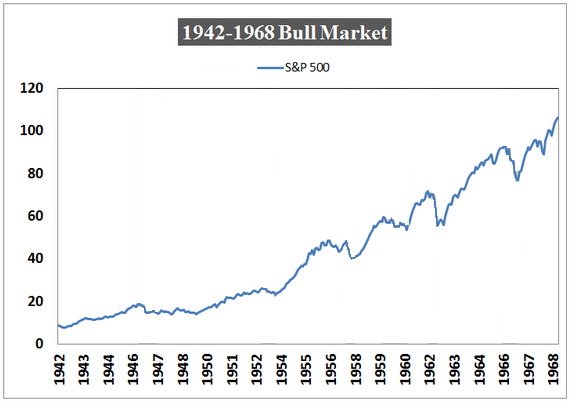
Yet one of America’s most powerful bull markets ended without a famous crash. From 1942 through 1968, U.S. stocks delivered extraordinary long-term gains while surviving wars, recessions, inflation scares, political turmoil, and several painful bear markets. The run did eventually lose momentum, but it did not conclude with a single spectacular implosion. It faded, stumbled, and finally gave way to a harsher market environment.
That quieter ending matters. It challenges the popular belief that every long bull market must finish with a cinematic collapse. Sometimes the market does not drive off a cliff. Sometimes it simply runs out of road.
What Does “Didn’t End in a Crash” Actually Mean?
Bull markets, bear markets, and suspiciously round numbers
A bull market is generally described as a sustained period of rising stock prices. A bear market is commonly defined as a decline of at least 20% from a recent peak. Why 20% rather than 19% or 21%? Wall Street apparently likes round numbers almost as much as it likes expensive lunches.
A market crash is harder to define. The term normally suggests a sudden, unusually severe decline accompanied by panic, forced selling, or a broader financial breakdown. A bear market can unfold gradually and remain limited to roughly 20% to 35%. A crash usually feels more violent and may produce losses of 40%, 50%, or more.
The distinction is important because ordinary bear markets are not rare accidents. They are recurring features of investing. A crash, by contrast, is an extreme event. Treating every correction as the opening scene of another Great Depression can lead investors to make expensive decisions based on fear rather than evidence. Morningstar similarly distinguishes corrections from deeper bear markets by the severity of the decline and the degree to which investor confidence deteriorates.
Market cycles can overlap
Definitions become even messier when short-term and long-term cycles overlap. A cyclical bear market can occur inside a secular bull market. Stocks may fall more than 20%, recover, and continue climbing for years. Likewise, a powerful rally can occur during a long period of disappointing inflation-adjusted returns.
This is why selecting the exact beginning or ending of a bull market is partly an analytical choice. One observer may begin the postwar bull market near the 1942 wartime low. Another may choose a later date based on economic recovery, inflation-adjusted prices, or the point at which an earlier market high was surpassed. Markets do not distribute certificates announcing that a new era has begun.
The Overlooked Bull Market of 1942–1968
Extraordinary returns without a legendary finale
The broad U.S. stock market produced a remarkable total return from 1942 through 1968. A calculation using annual S&P 500 total-return data maintained by New York University professor Aswath Damodaran produces an annualized return of approximately 14.6% over those 27 calendar years. One dollar compounded at that rate would have grown to roughly $39 before taxes, fees, and inflation.
Those numbers would be impressive during any period. They are especially striking because investors did not begin in an atmosphere of comfort. In 1942, the United States was fighting a global war, consumer goods were restricted, and the ultimate economic cost of the conflict was unknowable. The Federal Reserve was helping finance the war by supporting low Treasury rates, including a formal commitment to maintain a low rate on short-term government bills.
The bull market therefore began when the headlines were terrifying, not when the future looked pleasantly predictable. That pattern appears repeatedly in market history: prices often turn before the news becomes reassuring. Investors who wait for complete certainty may discover that certainty arrives only after a large portion of the recovery has already occurred.
Why this bull market receives less attention
The 1942–1968 advance is not remembered as vividly as the booms of the 1920s, 1990s, or 2000s. One reason is that it lacked a dramatic bubble-bursting finale. The period included serious declines, but it did not end with the type of immediate 50% collapse that creates a permanent landmark in financial memory.
Ben Carlson’s original discussion of this market noted that the worst decline near the end of the cycle was roughly 36% from 1968 to 1970. He also observed that several bear markets occurred during the broader advance, yet the United States went from the late 1930s until the 1973–1974 downturn without a market loss exceeding his informal 40% crash threshold.
In other words, investors endured plenty of turbulence. They simply did not receive the giant fireball that later generations could use as a convenient ending.
Why the Postwar Bull Market Was So Powerful
America entered a new economic era
World War II left the United States with enormous industrial capacity, technological expertise, high household savings, and relatively little damage to its domestic infrastructure. Factories that had produced military equipment shifted toward automobiles, appliances, construction materials, and consumer products. After years of rationing and restricted consumption, households were eager to spend.
The Library of Congress describes the postwar United States as becoming more affluent than many Americans could have imagined before the war. Public programs also supported education and homeownership. The Servicemen’s Readjustment Act, better known as the GI Bill, provided eligible veterans with education assistance, unemployment benefits, and support for purchasing homes and farms.
These programs helped expand the educated workforce, suburban development, construction, and consumer demand. However, access to those benefits was not equal. Discriminatory housing practices and local administration prevented many Black veterans from receiving the same opportunities, an essential limitation when discussing the era’s prosperity.
Employment and production supported corporate growth
The end of wartime production created fears that millions of returning service members would face unemployment. The adjustment was not painless, but the economy ultimately entered a long period of expansion. Bureau of Labor Statistics research notes that unemployment hovered around 4% during the early 1950s, although several recessions interrupted the broader growth trend.
Rising employment, population growth, infrastructure development, household formation, and technological innovation created fertile conditions for corporate revenue and profit growth. Stock prices did not rise merely because investors became more cheerful. The economic base underneath publicly traded businesses was expanding.
Monetary policy evolved
Interest rates were held unusually low during World War II to make federal borrowing less expensive and stabilize the Treasury market. As inflationary pressure increased, the arrangement became difficult to maintain. The Treasury–Federal Reserve Accord of March 1951 ended the wartime rate peg and restored greater monetary-policy independence to the Federal Reserve.
This change did not eliminate recessions or inflation, but it marked an important transition toward the modern relationship between monetary policy, economic stability, and financial markets. The bull market survived that transition, demonstrating that a long expansion does not require one permanent interest-rate setting.
The Market Rose Despite Recessions and Inflation
Economic contractions did not automatically kill the bull
The postwar economy was not one uninterrupted victory parade. According to the National Bureau of Economic Research, contractions occurred in 1945, 1948–1949, 1953–1954, 1957–1958, 1960–1961, and 1969–1970. Some were related to postwar adjustment, changes in government spending, tighter credit, inventory corrections, or weakening industrial activity.
Yet the existence of multiple recessions did not prevent stocks from generating strong long-term returns. Markets evaluate the expected future stream of corporate profits, not just the current quarter’s economic statistics. A recession can damage earnings and sentiment without permanently ending a multidecade expansion in productivity, population, and business activity.
This is a valuable reminder for modern investors: “The economy is slowing” and “stocks must decline for years” are not identical statements. Sometimes markets fall before a recession begins and recover before it ends. Sometimes they move sideways. Occasionally they ignore the economic script entirely, presumably because nobody gave the market a copy.
Inflation arrived in waves
Inflation also challenged households and policymakers. After many wartime price controls were removed, consumer prices surged. Bureau of Labor Statistics data show that prices increased at an annualized rate of 12.8% between February 1946 and August 1948. The pressure later eased, and inflation was generally more moderate during much of the 1950s and early 1960s before accelerating again late in the decade. By the final months of 1968, the 12-month CPI increase had reached 4.7%.
The market’s resilience during these shifts does not mean inflation was harmless. Inflation changes consumer purchasing power, interest rates, valuations, and business costs. The lesson is narrower: one inflation surge does not reveal the entire future path of stock prices.
No Crash Does Not Mean No Pain
Looking at a long-term chart can make the postwar bull market appear smooth. Real investors did not experience it that way. They lived through abrupt selloffs, recessions, geopolitical confrontations, inflation shocks, and long stretches in which the market seemed to go nowhere.
A 25% decline is not transformed into a relaxing spa treatment simply because a later historian labels it a “normal bear market.” For an investor with $100,000, it represents a temporary loss of $25,000. For a retiree withdrawing money, the consequences may be more serious. For a nervous investor who sells near the bottom, the temporary loss can become permanent.
This is why the difference between volatility and financial ruin depends partly on portfolio design. Investor.gov recommends aligning asset allocation with an investor’s time horizon and risk tolerance. FINRA similarly emphasizes diversification across and within asset classes, along with periodic rebalancing, as tools for managing investment risk.
A diversified investor with adequate cash reserves may be able to tolerate a bear market. Someone who has concentrated every dollar in speculative stocks and needs the money next year may discover that the same bear market feels suspiciously like a personal crash.
Why Investors Expect Every Bull Market to End Badly
Recent disasters dominate the imagination
Investors tend to build expectations from the events they remember most clearly. Someone whose formative experience was the Great Depression may remain skeptical of stocks for decades. Someone who began investing during the technology boom may assume innovation always produces effortless wealth. Someone who endured both the dot-com collapse and the financial crisis may see a bubble hiding behind every new high.
This tendency is reinforced by loss aversion. Investors commonly feel the pain of losing money more intensely than the pleasure of gaining an equivalent amount. CFA Institute research and commentary describe myopic loss aversion as a bias that causes people to focus excessively on short-term losses while underweighting potential long-term gains.
That is why crashes dominate financial folklore. A 40% decline occurring over several months becomes a defining life event. A 15% annualized return compounded over decades becomes a spreadsheet.
Drama receives more attention than gradual change
Financial media naturally focus on sudden events. “Market Falls 8% in Historic Session” is an obvious headline. “Businesses Quietly Became More Productive for the 14th Consecutive Year” lacks a certain caffeine content.
The result is a distorted picture of market history. Investors may conclude that every prosperous period must end with a spectacular collapse because spectacular collapses are the endings everyone discusses. The postwar bull market reminds us that cycles can also end through inflation, slowing earnings growth, valuation compression, repeated bear markets, or years of disappointing real returns.
Lessons From a Bull Market Without a Crash
Do not confuse possibility with certainty
A crash is always possible. That does not make it predictable. Investors who constantly sell because a crash might happen can spend years missing dividends, earnings growth, and compounding. The appropriate response to uncertainty is not pretending risk has disappeared, but building a portfolio that does not require accurate crash forecasts.
A bear market is not evidence that the system has failed
Meaningful declines are part of stock ownership. If an investor’s plan works only when prices rise, it is not an investment plan; it is a weather-dependent picnic. Expectations should include corrections, bear markets, recessions, and periods when safer assets outperform stocks.
Time horizon changes the meaning of volatility
A decline can be an inconvenience for a 30-year investor, a major threat for someone making a home down payment next month, and a sequence-of-returns problem for a new retiree. Risk should therefore be defined by financial goals and spending needs, not merely by how frightening a chart looks.
Preparation is more useful than prediction
Investors cannot control the market’s next move, but they can control diversification, costs, savings rates, position sizes, emergency reserves, and rebalancing rules. Vanguard’s research on staying the course emphasizes that U.S. equities have historically remained resilient despite bear markets and periodic volatility. Staying invested does not mean ignoring risk; it means creating an allocation that can be maintained when risk becomes uncomfortable.
Do not assume the next ending will resemble the last one
The crashes of 2000–2002 and 2007–2009 encouraged a generation of investors to expect every bull market to end with stocks being cut in half. Earlier investors might have expected inflation or geopolitical conflict to be the main danger. The next cycle may end through a shock everyone recognizes, or through a slow adjustment that receives no memorable nickname.
Extended Investor Experience: What a Quiet Market Ending Feels Like
Imagine a household beginning to invest in 1942. The decision does not feel bold or brilliant. The country is at war, newspapers carry casualty reports, and nobody knows how long the conflict will last. The household buys shares gradually through a diversified portfolio and continues saving from each paycheck. The first lesson arrives quickly: markets can rise while the world still feels dangerous.
After the war, the family’s financial life changes. Consumer products return to store shelves, employment expands, and housing construction accelerates. The portfolio grows, but so do living costs. The inflation of the late 1940s makes higher account balances less impressive at the grocery store. The investor learns that nominal wealth and purchasing power are not the same thing.
Then comes a recession. Stocks weaken. Commentators warn that wartime demand had created an artificial economy and that peace will expose its weaknesses. Selling sounds prudent. The family does not sell everything, partly because the portfolio is intended for long-term goals and partly because nobody can agree on what to buy back or when. The economy recovers, and the market resumes its climb.
This pattern repeats. Prosperity is interrupted by recessions, political crises, military conflict, tighter credit, and sudden market declines. Each setback seems unique while it is happening. In hindsight, historians place the episodes neatly inside a long bull market. In real time, there is no neat labelonly uncertainty, newspaper headlines, and a brokerage statement that has become considerably less charming.
As the years pass, the greatest threat changes. Early in the period, investors fear depression and postwar unemployment. Later, they worry about inflation, higher interest rates, international tension, and excessive stock valuations. The portfolio’s risks evolve even though the investor’s basic behavior does not: save regularly, diversify, rebalance, and avoid turning every forecast into a trade.
By 1968, the account is dramatically larger than it was in 1942. That success creates a new problemconfidence. After decades of strong returns, investors may assume that established companies can be purchased at almost any price. Some fashionable growth stocks become market favorites. The future looks prosperous, but expectations embedded in prices have become demanding.
The market then declines. It does not collapse by 80% or disappear into a financial black hole. Instead, the investor experiences a grinding bear market that removes roughly a third of the portfolio’s value. Inflation reduces the real value of money at the same time. The decline feels severe, yet it lacks a single unforgettable day that future documentaries can replay in slow motion.
There is no announcement that the great postwar bull market has ended. No bell rings. No broker calls to say, “Congratulations, you have officially crossed into a new secular regime.” The realization arrives gradually. Returns become less dependable, inflation becomes more persistent, and the investment environment that rewarded earlier strategies begins to change.
This hypothetical experience explains why quiet endings can be harder to recognize than crashes. A crash provides emotional clarity: prices plunge, panic spreads, and everyone knows something extraordinary has happened. A slow transition creates ambiguity. Investors repeatedly wonder whether each decline is another temporary interruption or evidence that the long-term environment has changed.
The practical lesson is not that investors should ignore warning signs. It is that they should avoid making their financial security dependent on identifying the final day of a bull market. A resilient plan assumes that markets can decline sharply, recover unexpectedly, move sideways for years, and change character without asking permission.
The bull market that did not end in a crash ultimately teaches a more useful lesson than a dramatic disaster story. Wealth is often built during periods that feel uncertain, tested during declines that feel unprecedented, and preserved by decisions that look boring in the moment. Crashes make history books. Discipline pays the bills.