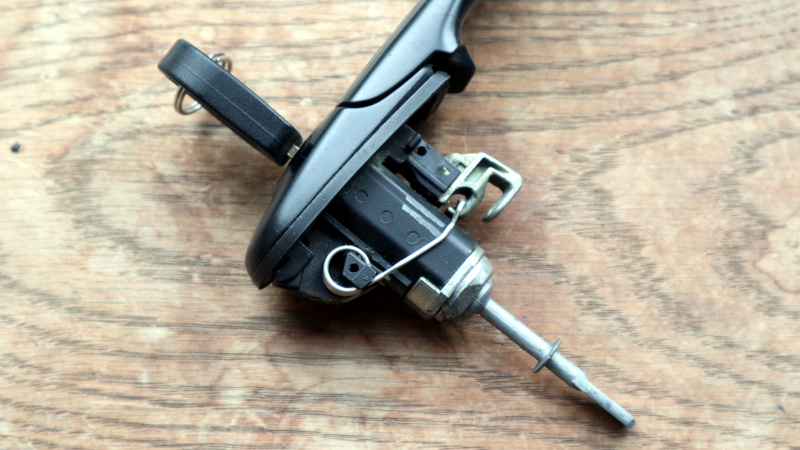
Every old-car owner eventually learns the same spiritual lesson: reliability is not a permanent condition; it is a temporary truce. One day your beloved Volkswagen is a faithful little machine with charming European manners. The next day, your key is trapped in the driver’s door, the lock mechanism has turned into metallic granola, and you are standing in public reconsidering every life choice that led you to German engineering.
This is the tale of a crumbling Volkswagen lock, but it is also a bigger story about automotive design, cheap-but-clever die-cast parts, DIY repair temptation, and the eternal garage question: should you fix the tiny broken part, replace the whole assembly, or glare meaningfully toward Wolfsburg?
The short answer: yes. All three.
When a Volkswagen Door Lock Fails, It Fails With Personality
The classic scenario is painfully simple. You insert the key into an older Volkswagen door lock, turn it as usual, and something inside the handle assembly gives up like a tired office printer on tax day. The key may spin without unlocking the door. It may jam. The handle may lift but do absolutely nothing. In the worst version, the key stays stuck in the door and you are suddenly the star of a one-person roadside drama titled Why Didn’t I Bring Torx Bits?
Older Volkswagens, including late-1990s Polo, Golf, Jetta, and related models, often use a lock barrel connected to a small mechanical tailpiece, paddle, or cam. When the key turns, that little part transfers motion into the latch mechanism. It is not glamorous. It will never be featured in a Super Bowl ad. But if it breaks, the whole car becomes a very expensive box with opinions.
The villain is often a small die-cast zinc alloy part. Zinc die casting is widely used because it allows manufacturers to produce detailed, accurate, low-cost components at scale. For small mechanical pieces, that sounds ideal. The problem is that “small,” “thin,” “loaded repeatedly,” and “living inside a wet car door for decades” is not exactly a wellness retreat for metal.
The Tiny Part That Can Ruin Your Morning
Inside many Volkswagen lock assemblies, the key cylinder turns a metal insert or paddle that fits into a slot in the latch. Over years of use, the tabs on that insert can fatigue, crack, or shear off. Once that happens, the lock cylinder may still accept the key, but the actual latch never gets the memo.
That is what makes this failure so annoying. The key is fine. The door is fine. The car may run beautifully. Yet a small part, roughly the emotional size of a cracker crumb, can strand you outside your vehicle while pedestrians walk by pretending not to enjoy the show.
Volkswagen did not invent this kind of pain. Door locks, handles, cables, latch modules, and actuators fail across brands. But Volkswagens of certain generations are famous among DIY owners for making simple jobs feel like puzzles designed by someone who owned three extra hands. A retaining spring may need to be compressed, twisted, aligned, and convinced through negotiation. A circlip may launch itself into low Earth orbit. A Torx screw may be placed exactly where your wrist cannot bend.
Why Zinc Die Casting Makes SenseUntil It Doesn’t
To be fair to the mysterious engineer in Germany, zinc alloy is not automatically a bad material. Zinc castings can be strong, dimensionally accurate, corrosion-resistant, and economical. They are excellent for detailed shapes and high-volume production. That is why they appear in hardware, brackets, housings, handles, and countless automotive components.
The issue is not simply “zinc bad.” The issue is whether the part’s shape, thickness, stress points, exposure, and service expectations match the material. A thick zinc casting in a protected environment can last for ages. A thin little lock insert with sharp corners, tabs, spring pressure, road vibration, moisture, and thousands of key turns has a harder life.
This is where design matters. Rounded transitions reduce stress concentration. Better sealing slows corrosion. Stronger replacement materials can help. And making the part serviceable without requiring a medieval apprenticeship would be, frankly, polite.
Mechanical Locks vs. Modern Door Actuators
Older Volkswagen lock failures are often mechanical: broken paddles, worn cylinders, cracked linkages, weak springs, and tired handles. Newer vehicles add another layer of mischief: electronic door lock actuators.
A door lock actuator is usually a small electric motor and gear mechanism connected to the latch. Press the key fob or interior button, and the actuator moves the lock. When it fails, symptoms may include one door refusing to lock, a sluggish lock, clicking or grinding noises, random alarm behavior, or a door-ajar light that lies to your face.
Moisture is a common enemy. Water can enter a door through worn seals, failed weatherstripping, or imperfect handle assemblies. Once moisture reaches electrical contacts, switches, or circuit boards, corrosion and intermittent operation can begin. That is why some door-lock issues seem worse after rain. The car is not haunted. It is damp.
When Door Locks Become a Safety Issue
A broken driver’s door lock feels like an inconvenience, but door latch and lock systems are also safety components. A door must stay closed in a crash, open when occupants need to exit, and lock or unlock predictably. In the United States, door retention components are covered by federal safety standards, and manufacturers may issue recalls when a defect creates an unreasonable safety risk.
Modern examples show how serious this can become. Volkswagen has dealt with door-handle and lock-related recalls on certain newer vehicles where water ingress could affect electronic components and cause malfunctioning behavior. That does not mean every Volkswagen lock problem is a recall issue, but it does prove a larger point: doors are not decoration. They are safety systems with handles.
If your Volkswagen door lock behaves strangely, check for open recalls by VIN, especially if the problem involves doors opening unexpectedly, warning lights, repeated clicking, electronic failures, or water intrusion. For an old mechanical lock barrel on a vintage daily driver, the repair may be your responsibility. For a safety recall, the manufacturer may have a required remedy.
The Temptation of the 3D Printer
Here is where every modern tinkerer leans forward. If the broken Volkswagen part is small, why not model it and 3D print a replacement?
It is a delicious idea. Measure the original, draw it in CAD, print a prototype, install it, and become the hero your driveway deserves. For test fitting or emergency use, this can be brilliant. A printed part can help you understand the geometry and prove that the mechanism works before buying or fabricating a stronger replacement.
But for a load-bearing lock component, regular PLA is usually not the ideal final answer. Standard PLA is easy to print, but it has poor heat resistance compared with engineering plastics. Cars get hot. Door interiors experience vibration, moisture, and repeated force. A PLA lock paddle may work long enough to make you proud, then deform or snap at the exact moment you are late for something important.
PETG, nylon, polycarbonate, or metal fabrication may be better options depending on the part. Lost-PLA casting is another fascinating path: print the part, use it as a pattern, burn it out, and cast a metal replacement. That is wonderfully nerdy and possibly excessive when a replacement repair kit costs less than lunch. Still, excessive garage solutions are how civilization advances, or at least how we avoid paying dealership prices.
Repair Kit, Used Handle, or Whole Assembly?
For many older Volkswagen models, lock cylinder repair kits are available online. These kits often include the paddle, spring, clips, seals, and related small pieces. Some are marketed for specific models and part numbers, such as Polo 6N-era lock repair components. They are usually inexpensive, which is both good news and a warning label.
A cheap repair kit can restore function quickly, but quality varies. Some aftermarket castings are rough. Some springs are hateful. Some pieces need careful filing or fitting. Before installing, compare every part with the original. Check the length of the paddle, the orientation of tabs, and the way the spring seats. Grease lightly where appropriate, but do not pack the cylinder with random lubricant that attracts dirt like a magnet for future regret.
A used handle assembly may be easier, especially if the original is damaged beyond the small internal part. A complete new assembly can be more secure and less fiddly, but it may cost more and could require rekeying or carrying separate keys. Nobody wants a key ring that looks like a janitor’s retirement party.
How to Diagnose a Crumbling Volkswagen Lock
Start with the symptom. If the key turns but nothing happens, suspect the mechanical link between the cylinder and latch. If the key will not turn, the cylinder wafers may be worn, dirty, frozen, or damaged. If the power lock works from one switch but not another, look toward wiring, switches, or the actuator. If one door alone is acting up, that door’s actuator or latch module becomes suspicious. If all locks fail at once, the issue may be a fuse, control module, battery, or central locking system.
For a mechanical door-handle lock problem, remove the handle carefully. Many Volkswagens hide a retaining screw at the door edge, often requiring a Torx driver. Keep the key inserted when removing the cylinder if the service procedure calls for it. Work over a tray or towel because springs and clips enjoy freedom.
Once removed, inspect the paddle or tailpiece. Broken tabs, cracks, crumbled casting, or missing bits are strong evidence. Also inspect the latch slot. Sometimes the lock barrel is blamed when the latch mechanism itself is stiff, worn, or jammed.
Tools and Patience: The Real Repair Ingredients
The usual toolkit may include Torx bits, trim tools, needle-nose pliers, a pick set, small screwdrivers, white lithium grease or lock-safe lubricant, a flashlight, and a magnetic parts tray. The secret tool is patience, ideally supported by coffee.
Do not force the key. Do not yank the handle like you are starting a lawn mower. Do not spray mystery chemicals into everything and call it “diagnostics.” Work slowly, take photos before disassembly, and lay parts out in order. If the spring orientation looks confusing, congratulations: you have met the designer’s final boss.
After reassembly, test the lock before closing the door fully. Use a screwdriver to simulate the latch position where appropriate, verify that the key locks and unlocks smoothly, then test the handle from inside and outside. Only close the door once you are confident the latch will release again. Locking yourself out after a repair is not a rite of passage; it is a comedy sketch with invoices.
What This Teaches About German Engineering
German engineering has a reputation for precision, and much of that reputation is deserved. Volkswagen has built millions of cars that feel solid, efficient, and cleverly packaged. But precision does not always mean friendly repairability. Sometimes a design optimized for factory assembly becomes a small nightmare twenty years later in someone’s driveway.
That does not make the car bad. It makes it honest. Every machine is a collection of compromises: cost, weight, assembly speed, durability, security, parts availability, and service access. The broken lock simply reveals those compromises in a way that makes you mutter at a door handle.
The best repair mindset is not blind brand loyalty or dramatic rage. It is curiosity with a socket set. Ask why the part failed. Ask whether the replacement improves the weak point. Ask whether you are repairing the cause or just the symptom. Then, by all means, make one sarcastic comment about the engineer. You have earned it.
Experience Notes From the Garage: Living With a Fussy Volkswagen Lock
Anyone who has owned an older Volkswagen knows the relationship becomes personal. You do not simply “operate” the car. You learn its moods. The driver’s door needs a confident pull, not an aggressive one. The passenger lock prefers warmer weather. The hatch opens only when Mercury is emotionally supportive. Every sound becomes data.
A crumbling Volkswagen lock is one of those repairs that begins with denial. At first, the key feels slightly gritty. You tell yourself it is dirt. Then the lock occasionally refuses to turn unless you wiggle the key with the tenderness of a safecracker in a movie. You add a little lubricant. It improves for three days. You feel brilliant. Then, in a parking lot, the key rotates with no resistance at all, and your stomach drops because you recognize the sensation of money leaving your life.
The most memorable part of this repair is not the broken casting. It is the absurd scale of the failure. A car is a heavy, complex machine containing an engine, transmission, suspension, electronics, brakes, airbags, and miles of wiring. Yet the day can be defeated by a small tab hiding inside a door handle. It is humbling in the way only old cars can be humbling. They remind you that engineering is not abstract. It is physical. Tiny parts matter.
There is also a strange satisfaction in fixing it. Once the handle is off and the lock barrel is on the bench, the mystery becomes visible. You can see the failed part. You can understand how the key’s rotation was supposed to travel through the mechanism. You can hold the broken piece and say, “Really? You?” That moment is worth something.
The first reassembly attempt may be ugly. The spring fights back. The clip refuses to seat. The paddle faces the wrong direction. You check the photos you wisely took, or regret not taking them. Eventually, the parts align, the cylinder clicks into place, and the key turns with crisp mechanical purpose. Suddenly the car feels less like an enemy and more like a stubborn friend who needed dental work.
That is the beauty of these repairs. They are irritating, but they reconnect you with the machine. A shop can replace a lock assembly, and sometimes that is the smartest choice. But a careful DIY repair teaches you how the system works. It teaches you why cheap metal can be both clever and cursed. It teaches you to keep Torx bits in the trunk. Most importantly, it teaches you that when an old Volkswagen fails, it rarely does so quietly. It gives you a story.
So yes, there may be an engineer in Germany we would like a word with. Not a hostile word. More of a firm, coffee-fueled conversation. We would ask why the spring needed to be so dramatic, why the tabs were so thin, and whether anyone considered the poor soul repairing this thing in a driveway decades later. Then we would probably thank them anyway, because the car is still here, still fixable, and still interesting enough to make us care.
Conclusion
A crumbling Volkswagen lock is a small failure with a big personality. It combines material science, clever design, cost-cutting, aging, moisture, DIY problem-solving, and just enough frustration to make a grown adult negotiate with a door handle. Whether you repair it with an aftermarket kit, replace the full assembly, fabricate a stronger piece, or print a temporary emergency part, the lesson is the same: small components deserve respect.
Old Volkswagens reward owners who pay attention. When the key feels rough, the lock clicks strangely, the handle gets lazy, or one door starts behaving differently from the others, investigate early. A little maintenance today can prevent a public wrestling match with your own car tomorrow.
And if you do end up with a key stuck in the door, remember: breathe, get the Torx driver, save the tiny parts, and prepare your best speech for that engineer in Germany.