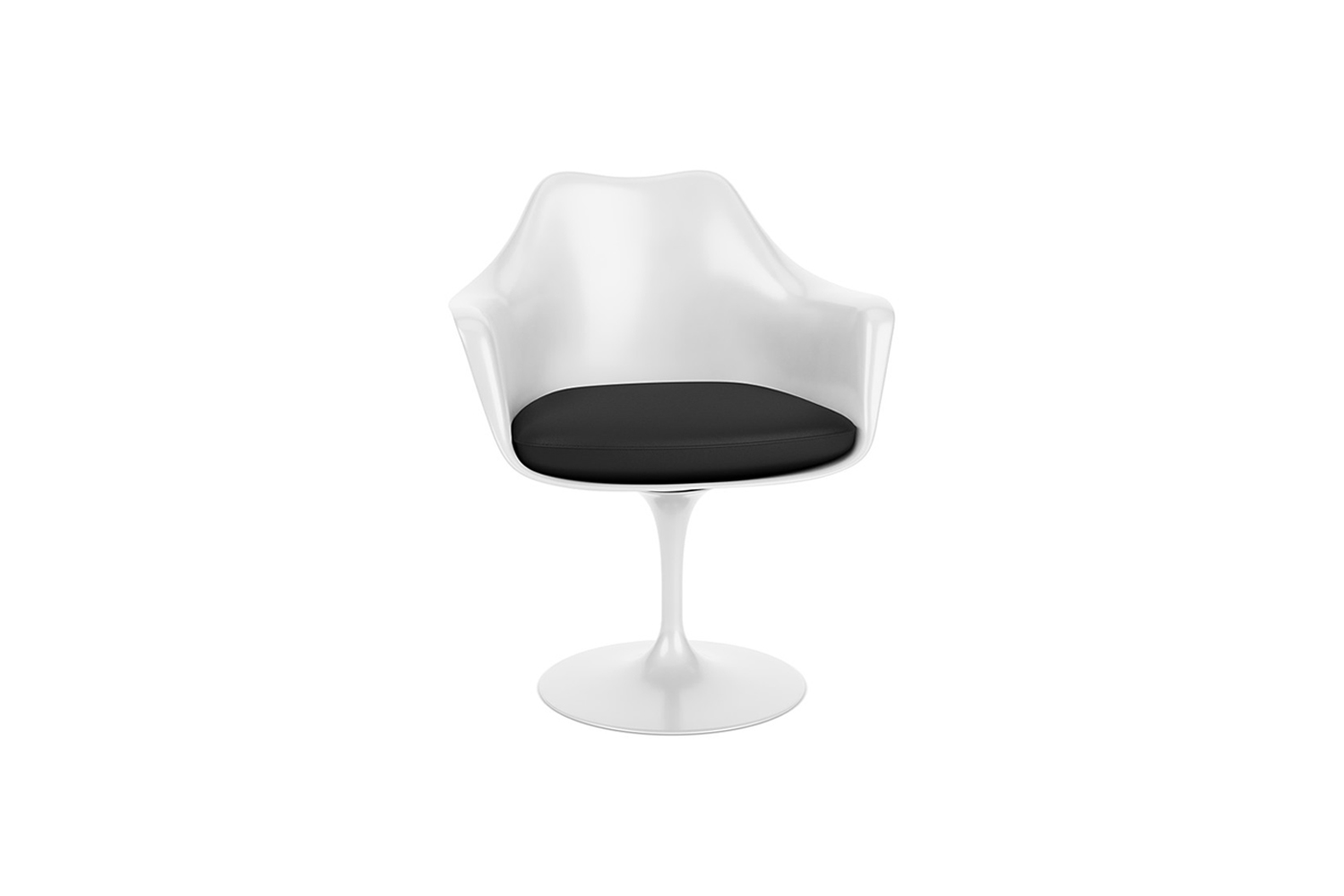
The Tulip Chair Armchair looks as though a flower, a wineglass, and a small spaceship held a design meetingand somehow agreed on everything. With its sculptural shell, curved arms, removable cushion, and single pedestal base, this mid-century modern chair has remained instantly recognizable for decades. It is elegant without being fussy, futuristic without looking like movie-set leftovers, and practical enough to serve at a dining table, desk, vanity, or reading corner.
Designed by Finnish-born American architect Eero Saarinen for Knoll in the mid-1950s, the chair was part of a larger attempt to simplify the visual chaos beneath tables. Saarinen disliked the tangle of conventional furniture legs and famously described it as a “slum of legs.” His answer was the Pedestal Collection: tables, stools, side chairs, and armchairs supported by one graceful central stem.
Note: Specifications, labels, upholstery options, and production details may vary by year. Buyers evaluating a vintage chair should compare markings, dimensions, construction, and provenance with reliable manufacturer or specialist records.
What Is a Tulip Chair Armchair?
The Tulip Chair Armchair is the wider, armed version of Saarinen’s pedestal dining chair. It has a bowl-like seat shell that rises into a rounded back and sweeps forward to create integrated armrests. Beneath it sits a tapered pedestal that flares into a circular foot. The silhouette feels continuous, even though the chair is not literally made from one uninterrupted material.
Museum examples reveal the clever engineering behind the visual trick. The upper shell uses molded, fiberglass-reinforced plastic, while the stronger pedestal is cast aluminum. A smooth finish helps the two components appear unified. The result is a chair that seems to grow from the floor like a tulip stem rather than stand on four separate legs.
Tulip Armchair Versus Tulip Side Chair
The armchair is broader and more enveloping than the armless side chair. A current authentic armchair is approximately 32 inches high, 26 inches wide, and 23.25 inches deep, with a seat height near 18 inches. By comparison, the side chair is narrower and can be easier to fit around a compact table.
Choose the armchair when comfort, visual presence, and elbow support matter most. Choose the side chair when you need to seat more people, preserve extra clearance, or keep a smaller room feeling open. Mixing the two can work beautifully: armchairs at the ends of a rectangular table and side chairs along the sides create hierarchy without making the dining room feel like a board meeting.
The Design Story: Decluttering the Floor
Saarinen approached furniture with the instincts of both an architect and a sculptor. He had studied sculpture in Paris, architecture at Yale, and design in the experimental environment surrounding Cranbrook Academy of Art in Michigan. There he formed lasting relationships with figures including Charles Eames and Florence Knoll. Those connections helped turn ambitious prototypes into furniture that could actually be manufactured, sold, and lived with.
The Pedestal Collection emerged from years of sketches, scale models, mock-ups, and material experiments. Saarinen’s goal was not merely to create a strange-looking chair with one leg. He wanted the chair, table, and surrounding room to read as a calm, unified environment. That larger-context thinking explains why the Tulip Chair Armchair often looks especially convincing beside a Saarinen pedestal table: the forms speak the same visual language.
Why the Tulip Chair Armchair Became an Icon
A Silhouette You Can Recognize Across a Room
Many chairs are perfectly useful but visually anonymous. The Tulip Armchair is not one of them. Its broad shell and narrow stem create a memorable outline from almost any angle. Even in a neutral finish, it acts as a sculptural object. In a bold fabric, it becomes the room’s extrovert.
It Solves a Real Spatial Problem
The central pedestal reduces the forest of legs beneath a dining table. That does not magically make a room larger, but it can make the floor plane appear calmer and easier to read. The swivel seat also helps people enter and exit without dragging the entire chair backward, a small convenience that becomes surprisingly valuable in tight breakfast areas.
Comfort and Everyday Ergonomics
The Tulip Chair Armchair is generally better suited to dining, conversation, desk work, and short reading sessions than to hours of deep lounging. Its curved shell offers lateral support, the arms provide a natural place to rest the forearms, and the loose seat cushion adds softness. The upright posture is useful at a table because it does not encourage diners to slowly disappear into upholstery before dessert arrives.
The swivel mechanism improves usability, especially when chairs sit close together. However, this is not a height-adjustable office chair with lumbar controls, tilt tension, and enough levers to launch a satellite. For full-time computer work, a task chair is usually the healthier choice. The Tulip Armchair is best when visual impact and moderate-duration comfort share equal billing.
How to Style a Tulip Chair Armchair
At a Round Dining Table
A round pedestal table and Tulip Armchairs create one of modern design’s most cohesive dining arrangements. The repeated central bases leave more visual breathing room below the tabletop. White chairs with a white table produce a clean architectural effect, while colored cushions prevent the setting from feeling like an especially tasteful laboratory.
As an Accent, Desk, or Vanity Chair
One Tulip Armchair can work beside a bookcase, bedroom window, writing desk, or dressing table. Its silhouette is strong enough to stand alone, while the swivel makes nearby storage easier to reach. Confirm that the arms fit beneath the work surface, and choose durable upholstery when coffee, cosmetics, pets, or enthusiastic children are part of the forecast.
In Traditional or Eclectic Interiors
The chair also pairs well with vintage rugs, paneled walls, brass lighting, and dark wood. Its clean curves give ornate elements breathing room, while older textures keep the glossy shell from feeling overly pristine. Mixing eras confidently is usually more interesting than making a room look like a furniture catalog trapped in one decade.
Choosing Color, Upholstery, and Finish
White is the best-known base color because it emphasizes the chair’s flower-like form and reflects light. Black feels more graphic and grounded, while gray offers a quieter transition in contemporary spaces. The cushion is where personality enters: red creates a classic mid-century accent, deep blue adds polish, olive works with natural wood, and bouclé supplies tactile warmth.
For a dining area, prioritize stain resistance and cleanability. Leather can be practical and sophisticated, although it may show scratches and patina. Textured wool blends look rich but can collect crumbs with the dedication of a tiny upholstered archivist. In homes with pets or young children, a durable performance fabric is often the sensible hero.
Authentic Knoll Chair or Replica?
The Tulip Chair’s fame has produced countless copies, from careful licensed examples to inexpensive approximations with suspiciously skinny bases and proportions that look as though they were remembered from a dream. A current authentic Knoll chair is typically identified by manufacturer markings, including the KnollStudio logo and Saarinen’s signature, but vintage labeling practices changed over time.
Construction provides additional clues. Authentic examples use a molded fiberglass shell and a substantial cast-aluminum pedestal, not a lightweight plastic base pretending to be metal. The transitions should look smooth, the proportions balanced, and the swivel stable. Upholstery quality, cushion shape, fasteners, finish, and overall weight can also help.
For vintage purchases, do not rely on one sticker or seller claim. Ask for clear photographs of the underside, labels, hardware, shell, base, and cushion. Request provenance and restoration details. Early chairs may have different markings from later production, and replacement upholstery does not automatically erase authenticity. When the price is serious, consult a reputable modern-design dealer, auction specialist, or appraiser before handing over serious money.
Tulip Chair Armchair Buying Checklist
- Measure the room: Allow space for the chair’s 26-inch width, swivel movement, and circulation around the table.
- Check table clearance: Compare the chair’s arm height with the underside of the tabletop or desk.
- Test the swivel: Rotation should feel controlled, stable, and free from grinding or excessive wobble.
- Inspect the shell: Look for cracks, stress marks, discoloration, poorly repaired damage, or separation near mounting points.
- Inspect the base: Check for chips, corrosion, uneven contact with the floor, and evidence of amateur refinishing.
- Evaluate the cushion: Confirm that the foam remains supportive and that the fabric suits your household.
- Verify authenticity: Review markings, dimensions, construction, seller reputation, and documented history.
- Plan delivery: Although the chair is compact, its rigid shell and broad arms can make narrow stairways surprisingly dramatic.
Care and Maintenance
Dust the shell and base with a soft cloth. For routine cleaning, use a lightly dampened cloth and a mild soap solution, then dry the surface. Avoid abrasive pads, aggressive solvents, and improvised chemical experiments. A glossy white finish may look tough, but it does not enjoy being scrubbed with something designed for barbecue grates.
Treat upholstery according to the specific textile or leather instructions. Blot spills promptly rather than rubbing them deeper into the fibers. Vacuum crumbs with a suitable upholstery attachment, and rotate or reposition a removable cushion when practical to encourage even wear. Protect the chair from prolonged direct sunlight, which can fade fabric and contribute to discoloration over time.
Periodically check that the chair remains stable and the swivel operates smoothly. Vintage fiberglass should be handled with care, especially if cracks or repairs are present. Professional restoration is preferable when structural damage, significant finish loss, or collectible value is involved.
Living With a Tulip Chair Armchair: The Real Experience
The first experience of bringing a Tulip Chair Armchair into a room is usually visual. Even before anyone sits down, the furniture arrangement looks cleaner. A conventional chair creates four vertical interruptions at floor level; the Tulip replaces them with one centered stem and a rounded foot. In a small dining area, that simplification can make the setting feel less crowded, particularly when the table also has a pedestal base.
During daily use, the swivel becomes the feature people notice most. At breakfast, a sitter can turn toward the kitchen counter, reach for a forgotten napkin, and rotate back without scraping the chair across the floor. At a desk, the same movement makes it easy to shift between a laptop and nearby shelving. Guests often discover the swivel within seconds, followed by one or two unnecessary rotations because apparently adulthood has limits.
The arms change the sitting experience compared with the side chair. They create a mild sense of enclosure and make conversation feel relaxed, especially when the chair is used away from the dining table. The shell supports the body from the sides, while the cushion softens what would otherwise be a firm seat. For a meal, an hour of conversation, or a morning of occasional desk work, the posture feels composed and comfortable. After several continuous hours, however, many users will prefer a chair with more adjustable back support.
Living with a white Tulip Armchair also teaches a small lesson in maintenance. Dust, denim transfer, shoe marks, and crumbs are easier to notice against a pale finish. Fortunately, that visibility encourages quick cleaning before grime becomes a long-term tenant. A darker cushion can disguise minor spills, while a textured fabric adds warmth but requires more attentive vacuuming.
Placement matters more than expected. Against a wall, the chair’s profile can flatten visually. Pulled slightly forward, with open space around the pedestal, it becomes sculptural. In a mixed interior, it often works best beside materials that contrast with its smooth shell: a woven rug, oak cabinet, stone tabletop, linen curtain, or aged brass lamp. These textures make the chair feel intentional rather than dropped in from a science-fiction cafeteria.
The armchair can also influence how a room is used. A lone example near a bedroom window becomes the preferred spot for putting on shoes, reading messages, or stacking clothes that are “not dirty enough to wash,” a major category in modern domestic life. At a vanity, the swivel improves access. In an entryway, the arms make standing easier for some users, though the broad footprint must not obstruct circulation.
Over time, the most satisfying aspect is that the chair does not fade into the background. It remains noticeable without becoming exhausting. Visitors recognize it, children enjoy the swivel, design enthusiasts inspect the base, and everyone else simply finds a comfortable place to sit. That combinationconversation piece, practical seat, and compact sculptureis why the Tulip Chair Armchair continues to earn space in real homes rather than surviving only behind museum ropes.