Winning a chess game in three moves sounds like something whispered in a school cafeteria by a kid who just learned where the queen goes. “I can beat anyone in three moves,” they say, dramatically adjusting invisible sunglasses. The truth is more interesting: yes, a three-move checkmate is possible, but it is not something you can force against a careful opponent from the starting position.
The classic three-move checkmate works only when your opponent weakens the king’s diagonal, moves key pawns carelessly, and leaves the royal front door wide open with a welcome mat that says, “Queen, please enter.” That is why this guide teaches the pattern honestly. You will learn the moves, the idea behind the attack, how to recognize the opportunity, and why stronger players usually do not fall for it twice.
In this guide, “how to checkmate in 3 moves in chess” means learning a beginner trap based on fast queen activity, open diagonals, weak king safety, and the famous Fool’s Mate family of patterns. Use it as a lesson in tactics, not as your entire chess personality. Nobody wants to be the player who brings the queen out early every game like she forgot her coffee.
What Is a 3-Move Checkmate?
A three-move checkmate is a game-ending attack delivered on White’s third move, usually after Black makes two serious pawn mistakes. The common line looks like this:
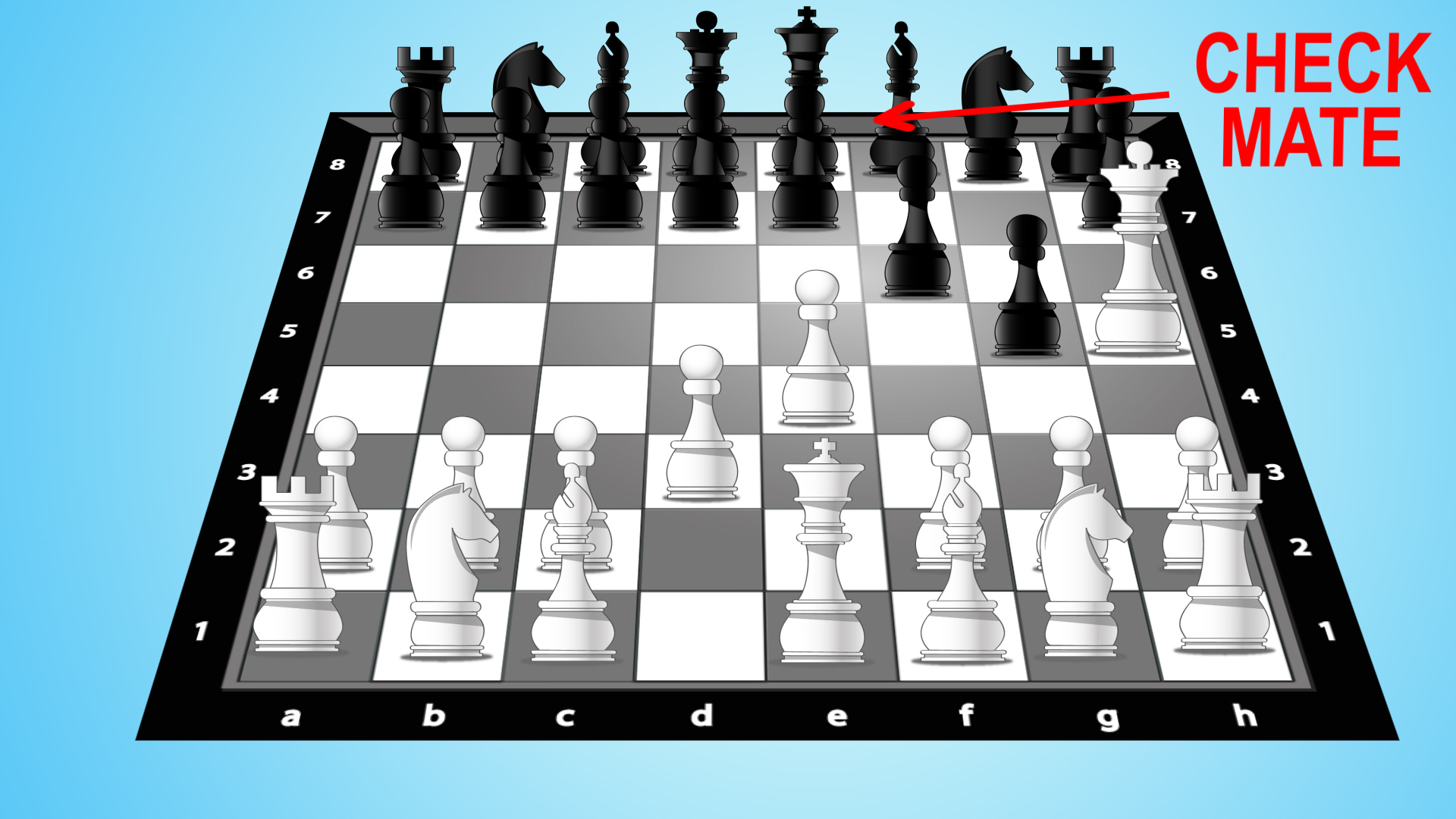
1. e4 f6 2. d4 g5 3. Qh5#
The “#” symbol means checkmate. White’s queen moves to h5 and attacks the black king along the diagonal h5-g6-f7-e8. Because Black has already moved the f-pawn from f7 to f6, the f7 square is empty. Because Black has also pushed the g-pawn to g5, the king’s shelter is badly weakened. The queen now gives check, and Black has no legal way to escape, block, or capture the queen.
This is closely related to Fool’s Mate, the fastest checkmate in chess, which usually happens when Black checkmates White after White exposes the king with careless f-pawn and g-pawn moves. The three-move version flips the idea so White delivers the final blow on move three.
Why This Checkmate Works
Fast checkmates almost always share the same secret ingredient: weak squares near the king. At the start of a chess game, the king is protected by a small pawn fortress. When a player pushes the f-pawn and g-pawn too early, the diagonal toward the king can open dangerously.
In the three-move checkmate line, Black’s move …f6 removes the f7 pawn from the diagonal between h5 and e8. Then …g5 weakens more dark squares and fails to stop White’s queen. When White plays Qh5#, the queen attacks the king directly. Black’s pieces are still asleep on the back rank, probably wearing tiny chess pajamas, and none of them can rescue the king.
The lesson is bigger than memorizing moves. You are learning that king safety matters from move one. Pawns are small, but when they leave home too early, they can create giant holes.
How to Checkmate in 3 Moves in Chess: 7 Steps
Step 1: Start With 1. e4
White begins by moving the king’s pawn two squares forward:
1. e4
This is one of the most popular first moves in chess because it controls the center and opens lines for the queen and bishop. For this specific checkmate, it also clears the diagonal from d1 to h5, allowing the queen to move later.
Do not think of this as a random pawn push. It is the key that unlocks your queen’s path. Without moving the e-pawn, the queen cannot travel to h5.
Step 2: Watch for Black’s Mistake: 1…f6
The trap begins only if Black responds poorly:
1…f6
This move weakens Black’s king position. It moves the f7 pawn, which normally helps shield the king and blocks the queen’s diagonal attack from h5 to e8. In most beginner openings, moving the f-pawn early is risky because it exposes the king and does not develop a piece.
If Black plays a normal move like 1…e5, 1…c5, or 1…e6, the three-move checkmate is usually no longer available. That is your first important reality check: this is a trap, not a magic spell.
Step 3: Play 2. d4 to Control the Center
White continues:
2. d4
This move strengthens White’s central control and keeps the queen’s diagonal open. White now has pawns on e4 and d4, which is a healthy-looking center. Even if the checkmate does not happen, White has not completely wrecked the position.
This matters because beginner traps should still teach good chess. If you only memorize tricks, you may win one funny game and then lose ten games where your queen gets chased around like a celebrity at an airport.
Step 4: Wait for the Second Mistake: 2…g5
The checkmate appears only if Black continues with another weakening move:
2…g5
This is the move that completes the disaster. Black has now weakened both the f-file area and the kingside dark squares. The diagonal from h5 to e8 is open because the f7 pawn has moved, and the g-pawn has failed to provide useful defense.
When a player moves pawns in front of the king without a clear reason, they often create targets. In fast checkmates, the king is not defeated because the attacker is a genius wizard. The king is defeated because its own pawns wandered off like tourists without a map.
Step 5: Deliver 3. Qh5#
Now White plays the winning move:
3. Qh5#
The queen moves from d1 to h5 along the diagonal d1-e2-f3-g4-h5. The path is clear because White moved the e-pawn on move one. From h5, the queen attacks the black king on e8 along the diagonal h5-g6-f7-e8.
Because Black’s f7 pawn has already moved to f6, the queen’s line is open. The black king is in check. Black cannot capture the queen, cannot block the diagonal, and cannot move the king to safety. That is checkmate.
Step 6: Confirm It Is Actually Checkmate
Before celebrating, always check the three conditions of checkmate:
- The king is in check. White’s queen attacks the king on e8.
- The king cannot move to a safe square. Black’s own pieces and White’s control limit escape.
- The check cannot be blocked or the checking piece captured. Black has no legal defense against the queen’s attack.
This habit is important. Many beginners shout “checkmate!” when they really mean “check,” “I hope this is scary,” or “I moved my queen and would like applause.” Real checkmate means there is no legal answer.
Step 7: Learn the Lesson, Not Just the Trick
The three-move checkmate teaches several valuable chess principles:
- Do not weaken the pawns in front of your king without a reason.
- Fast queen attacks can punish careless play.
- Open diagonals are powerful attacking highways.
- Checkmate patterns are easier to spot when you understand weak squares.
- A trap is useful, but good development wins more games over time.
Use this pattern to recognize danger and opportunity. If your opponent plays suspicious kingside pawn moves, look for queen checks and open diagonals. If you are the one defending, keep your king safe and develop pieces instead of launching random pawns into space.
Another Version: 3-Move Checkmate With a Capture
There is another common three-move pattern:
1. e4 f5 2. exf5 g5 3. Qh5#
Here, Black plays …f5, White captures with exf5, Black weakens further with …g5, and White again plays Qh5#. The key idea is the same: the f7 pawn has left its original square, the diagonal to the king is open, and Black has no practical defense after the queen arrives.
This version is slightly more dramatic because White captures a pawn first. It also shows why opening the f-file and diagonal near the king can be dangerous. In chess, greed is not always bad, but loose king safety is usually expensive.
Why You Should Not Rely on 3-Move Checkmates
Trying to win every game with a three-move checkmate is like trying to pass every test by guessing “C.” It may work once in a while, but the strategy has a short shelf life.
Stronger players will not play …f6 and …g5 so casually. They will develop knights, control the center, protect their king, and possibly punish your early queen move. If your queen comes out too soon without a real target, your opponent can gain time by attacking it. Every queen retreat gives them another move to build a better position.
That does not mean the pattern is useless. It is excellent for learning tactical vision. Once you understand why Qh5# works, you can recognize similar diagonal attacks, weak f-pawns, exposed kings, and mating nets in more advanced games.
How to Defend Against 3-Move Checkmate
If you are playing Black, the easiest defense is simple: do not make the weakening moves. Avoid pushing the f-pawn and g-pawn early unless you understand the consequences.
Develop Pieces Instead
Good beginner moves include developing knights and bishops, fighting for the center, and preparing to castle. Moves like …e5, …Nf6, …Nc6, or …d5 are usually more useful than random kingside pawn pushes.
Respect Early Queen Checks
If your opponent brings the queen out early, do not panic. Ask three questions:
- What is the queen attacking?
- Is my king actually in danger?
- Can I develop a piece while attacking or blocking the queen?
Many beginner queen attacks can be answered by calm development. The goal is not to chase the queen emotionally. Chess pieces do not respond well to drama. Develop, defend, and make the queen waste time.
3-Move Checkmate vs. Scholar’s Mate
Many beginners confuse the three-move checkmate with Scholar’s Mate. Scholar’s Mate usually happens in four moves and uses the queen and bishop to attack the weak f7 square:
1. e4 e5 2. Qh5 Nc6 3. Bc4 Nf6?? 4. Qxf7#
The idea is similar because the f7 pawn is a common target. At the start of the game, f7 is protected only by the king, making it tactically sensitive. In Scholar’s Mate, White uses the bishop on c4 and queen on h5 or f3 to attack f7 twice.
The three-move checkmate, by contrast, does not require the bishop. It works because Black moves the f-pawn and opens the queen’s diagonal to the king. Both patterns teach the same lesson: the squares around the king are not decorative. They are security equipment.
Common Mistakes Beginners Make
Mistake 1: Moving the Queen Too Early Without a Purpose
The queen is powerful, but that also makes her a target. If she comes out early and does not create a real threat, your opponent can attack her with developing moves. Suddenly your queen is running around the board while your knights and bishops are still at home wondering why they were not invited.
Mistake 2: Ignoring the Center
Fast checkmates are exciting, but the center remains important. Moves like e4 and d4 are useful because they support both attack and development. If the checkmate fails, central control gives you a playable game.
Mistake 3: Calling Checkmate Too Soon
A check is not automatically checkmate. Always look for legal king moves, blocks, and captures. Learning to verify checkmate helps you avoid awkward moments, like announcing victory while your opponent calmly takes your queen.
Mistake 4: Forgetting That Opponents Can Improve
The first time you win with a three-move checkmate, it feels amazing. The second time against the same opponent, they may defend. The third time, they may set a trap for your queen. Chess players learn quickly, especially after being checkmated before the snacks arrive.
Practice Position: Spot the Pattern
Imagine this position after two moves:
1. e4 f6 2. d4 g5
Ask yourself:
- Is the diagonal from d1 to h5 open for White’s queen?
- Has Black moved the f7 pawn away?
- Can the queen on h5 attack the king on e8?
- Can Black block, move, or capture?
If the answers line up, 3. Qh5# ends the game. Practicing this thought process matters more than memorizing notation. The goal is to train your eyes to see open lines and weak kings.
How This Trap Improves Your Chess
Even if you never win a serious game with a three-move checkmate, studying it improves your chess in several ways. You learn how diagonals work. You learn why the f-pawn is sensitive. You learn how queen checks can become mating threats. Most importantly, you learn that bad pawn moves around the king can lose instantly.
Chess is full of patterns. Back-rank mate, ladder mate, smothered mate, Arabian mate, Scholar’s Mate, and Fool’s Mate all teach you how pieces cooperate to trap the king. The three-move checkmate is one of the simplest patterns, which makes it perfect for beginners.
Experience Notes: What Players Learn From Trying 3-Move Checkmate
The first experience many players have with the three-move checkmate is pure comedy. Someone learns the line, rushes to a board, and waits for the opponent to play the exact wrong moves. If the opponent cooperates, the game ends quickly and the winner feels like a tactical genius. If the opponent does not cooperate, the queen may wander out to h5 anyway, where it gets attacked, chased, and treated like an unwanted guest at a very organized dinner party.
That experience is valuable. It teaches a beginner that chess is not just about what you want to do. It is also about what the opponent allows. A three-move checkmate is possible only because Black weakens the king. If Black plays normal developing moves, White must switch plans. This is one of the biggest early lessons in chess: do not play hope chess. Hope chess means making a move and hoping your opponent misses the threat. Real chess means making moves that improve your position even when your opponent defends correctly.
Another useful experience comes from being on the losing side. Getting checkmated in three moves is embarrassing for about thirty seconds, then educational forever. The player learns not to push the f-pawn and g-pawn carelessly. They learn that the king needs shelter. They learn to ask, “What changed when I moved that pawn?” That question alone can save dozens of future games.
Many coaches use quick mates as teaching tools because they are memorable. A long strategic explanation about weak diagonals may float away like a balloon. But losing to Qh5# sticks in the brain. It is simple, visual, and slightly painful in a productive way. The next time the same player reaches for the f-pawn, a tiny alarm bell rings.
Players also learn emotional control. Fast wins can create overconfidence. Fast losses can create frustration. Both feelings are normal, but neither should drive your moves. If you win with the trap, smile and keep studying. If you lose to it, reset the pieces and learn the defense. Chess improvement is not about never making mistakes. It is about making a mistake once, understanding it, and not inviting the same disaster back for tea.
In real games, the best use of the three-move checkmate is as a pattern-recognition exercise. You may not see the exact move order often, but you will see kings with weakened diagonals. You will see f-pawns move too early. You will see queen checks become dangerous when defenders are missing. The trap becomes a small window into a much larger chess idea: checkmate happens when the king has no safe square, no useful block, and no defender left in time.
So practice the line, enjoy the occasional quick win, and laugh when it works. But also build a complete chess foundation: develop pieces, control the center, castle early, calculate threats, and study common mating patterns. The three-move checkmate is a fun spark. Good chess is the fire you build after that spark appears.
Conclusion
Learning how to checkmate in 3 moves in chess is a fun way to understand fast tactics, weak king safety, and the power of open diagonals. The key line, 1. e4 f6 2. d4 g5 3. Qh5#, works only when Black makes serious mistakes, but the lesson is useful for every beginner. Protect your king, respect queen checks, avoid careless pawn moves, and study patterns instead of relying only on tricks.
A three-move checkmate may win a quick game, but the real victory is learning how checkmate works. Once you understand why the trap succeeds, you can recognize similar threats, defend against them, and build stronger attacks of your own. That is how a beginner trick becomes real chess knowledge.