Walking with a blind person is not about becoming a superhero guide, a human GPS, or the dramatic narrator of every sidewalk crack in North America. It is about respect, clear communication, and using a few simple techniques that help both people move comfortably. The good news? You do not need a cape. You only need manners, patience, and the ability to avoid saying “over there” while pointing dramatically at something the other person cannot see.
Whether you are helping a friend, a family member, a coworker, a customer, or someone you have just met, the most important rule is simple: ask first. Blind people and people with low vision are not all the same. Some use a white cane, some use a guide dog, some prefer a human guide in certain places, and some may not need help at all. The goal is not to take control. The goal is to offer support in a way that protects independence.
This guide explains three practical ways to walk with a blind person using respectful etiquette, human guide technique, and real-world navigation tips. You will learn what to say, how to position your body, how to handle doors and stairs, and how to avoid common mistakes that can make assistance awkward or unsafe.
Why Learning How to Walk With a Blind Person Matters
Many people want to help but are unsure how. That uncertainty can lead to two opposite problems: doing nothing when help would be welcome, or doing too much by grabbing, pulling, pushing, or loudly announcing, “I will save you!” The second option may be well-intended, but it can feel startling, disrespectful, and physically unsafe.
Walking assistance works best when it feels like teamwork. A blind person may use sound, touch, memory, cane technique, a guide dog, smartphone navigation, or orientation and mobility skills to travel. A human guide is just one tool, not a replacement for the person’s own ability. Think of yourself as a helpful travel partner, not the captain of a tiny sidewalk ship.
Good guidance is especially useful in crowded events, unfamiliar buildings, airports, restaurants, hospitals, construction zones, narrow hallways, staircases, and places where signs or layouts are confusing. In those moments, a calm guide can make the difference between a smooth walk and a comedy of elbows.
Way 1: Ask First and Communicate Clearly
Start With a Respectful Offer
The best way to help a blind person walk is to begin with a simple question: “Would you like assistance?” That question does two important things. First, it respects the person’s independence. Second, it gives them the chance to tell you what kind of help, if any, would actually be useful.
Do not grab someone’s arm, backpack, cane, sleeve, or guide dog harness. Sudden touch can throw off balance and cause stress. It can also interrupt the person’s travel skills. If you would not randomly grab a sighted stranger and steer them like a grocery cart, do not do it to a blind person either. Society already has enough grocery cart energy.
If the person accepts your offer, ask how they prefer to be guided. Some people may say, “May I take your elbow?” Others may prefer your shoulder, forearm, or verbal directions only. People have different heights, walking speeds, balance needs, and comfort levels. Asking is not awkward; assuming is.
Use Specific Language, Not Vague Directions
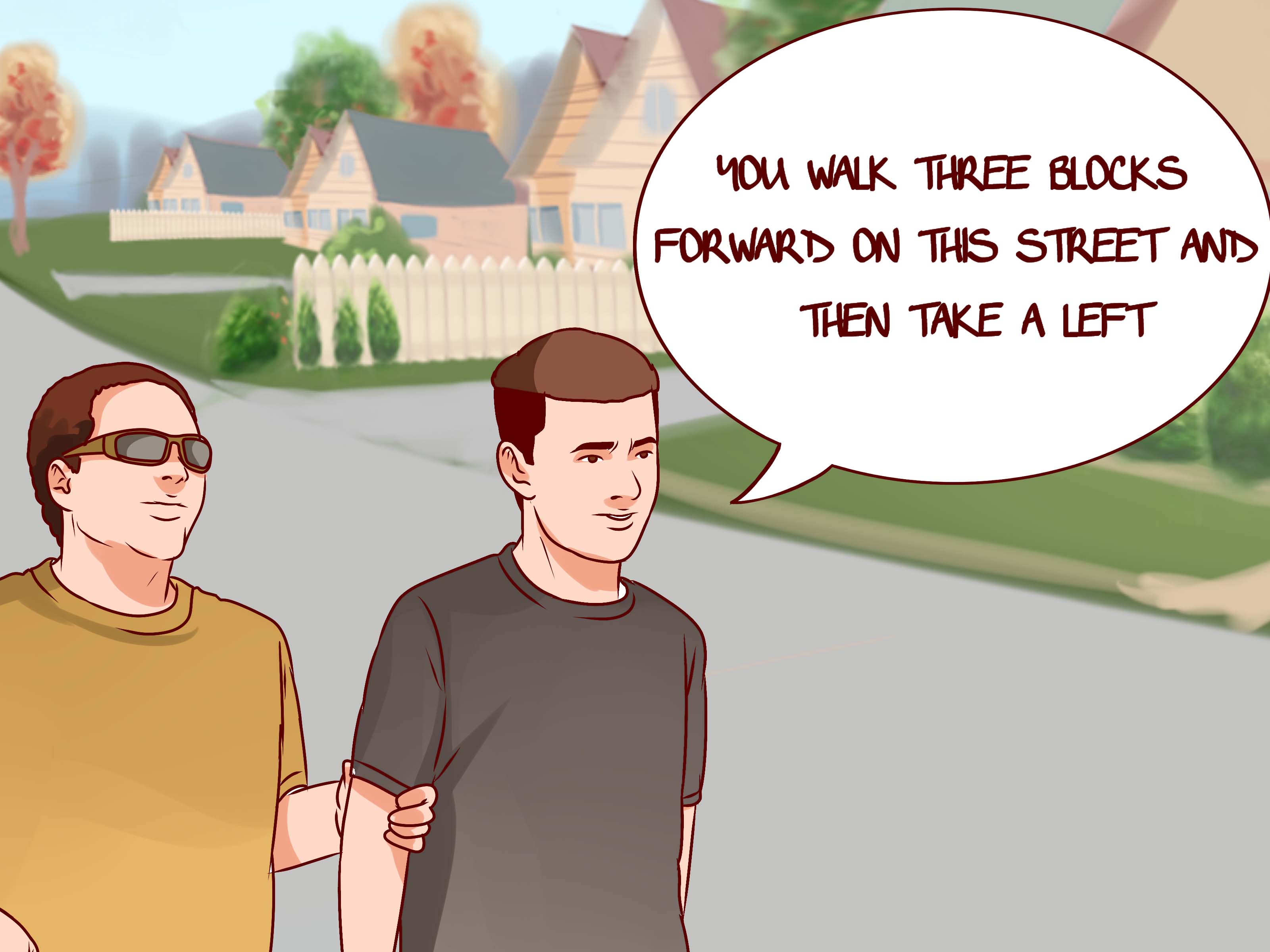
Clear language is a major part of safe walking assistance. Instead of saying “It is over there,” say “The door is about ten feet ahead on your left.” Instead of “Watch out,” say “There is a low sign at head height on the right.” Specific details help the person decide how to move.
Useful phrases include:
- “There is a curb coming up in about three steps.”
- “We are approaching a narrow doorway.”
- “The stairs go down, and the handrail is on your right.”
- “The hallway turns left after this desk.”
- “There is a chair directly in front of you, about two feet away.”
Try to avoid panic language unless there is immediate danger. “Stop” is fine when needed, but “Oh no, oh no, oh no!” is less helpful unless you are auditioning for a disaster movie. Calm, direct words are easier to process while walking.
Speak to the Person, Not Around Them
When walking with someone who is blind, talk directly to them. Do not ask their companion, “Does he want help?” or “Can she walk over here?” Blindness does not cancel personhood, opinions, hearing, humor, or the ability to answer a question.
It is also perfectly acceptable to use everyday words like “see,” “look,” or “watch.” Many blind people use those words too. You do not need to turn a normal sentence into a linguistic obstacle course. “See you later” is fine. “Perceive you through available sensory channels later” is not necessary, though it would make a memorable business card.
Way 2: Use Proper Human Guide Technique
Let the Blind Person Hold Your Arm
The standard human guide or sighted guide technique usually works like this: the guide stands slightly ahead, and the blind person holds the guide’s arm just above the elbow. This position allows the blind person to feel changes in direction, pace, and elevation through the guide’s body movement.
The guide should not hold, pull, or push the blind person. Instead, offer your arm and allow the person to take it. This gives them control over their own balance and spacing. You lead by walking naturally; they follow by reading the movement of your arm and body.
In most situations, the blind person walks about a half-step behind the guide. This gives time to respond when the guide slows down, turns, steps up, or steps down. Walk at a comfortable pace and ask, “Is this speed okay?” Do not crawl forward like you are sneaking past a sleeping dragon unless the person asks you to slow down.
Adjust for Narrow Spaces
When approaching a narrow area, such as a crowded aisle, doorway, or tight hallway, tell the person what is happening. You can move your guiding arm slightly behind your back. This signal lets the person know to move behind you in single file. Once the path widens, bring your arm back to the usual position.
A simple phrase works well: “This is a narrow spot; I am moving my arm back.” After passing through, say, “The path is open again.” Clear cues prevent awkward shoulder bumps, backpack collisions, and the classic “two people trying to become one person in a doorway” problem.
Handle Stairs, Curbs, and Ramps With Care
Before stairs, pause briefly and say whether the stairs go up or down. If there is a handrail, mention which side it is on. Let the blind person choose whether to use your arm, the handrail, or both. Step onto the first stair ahead of them, then continue at a steady pace.
For curbs, slow down and say “curb up” or “curb down.” Do not yank someone upward or pull them off a curb. Your body movement, combined with a clear verbal cue, gives the person the information needed to step safely.
For ramps, mention the slope: “The floor slopes down gently,” or “We are going up a ramp.” This is especially helpful because ramps can be subtle. A sudden incline without warning can feel like the floor is playing a prank.
Approach Doors Smoothly
Doors can be easy or surprisingly dramatic. When you reach a door, say whether it opens toward you or away from you, and mention which side the handle is on. Position the blind person on the hinge or handle side if possible, depending on the door and available space.
If you open the door, allow the person to follow through while maintaining contact with your guiding arm. Do not push them through the doorway. Once through, pause if needed so they can reorient. Revolving doors, heavy doors, and automatic doors may require extra communication.
For car doors, place the person’s hand on the door handle or roof edge and let them enter independently. You can describe the direction the car is facing and where the seat is. Avoid placing your hand on their head to “protect” them. A verbal cue is usually better and far less weird.
Way 3: Describe the Environment and Respect Independence
Give Useful Information, Not a Podcast About Every Object
Describing surroundings can be helpful, but balance matters. A blind person may want to know about obstacles, landmarks, route changes, seating, food placement, or people nearby. They probably do not need a full documentary about every ceiling tile unless the ceiling tile is falling, famous, or somehow holding snacks.
Focus on information that affects movement or decision-making. Mention obstacles such as wet floors, low branches, temporary signs, loose rugs, uneven pavement, open drawers, construction barriers, and crowded areas. In social spaces, mention where the entrance, counter, restroom, table, or empty chair is located.
Use Clock Directions and Spatial Details
Clock directions are often useful when describing objects nearby. For example, “Your water glass is at two o’clock,” or “The chair is at your eleven o’clock.” This works best when the person is seated or standing still and facing a known direction.
For walking, left, right, ahead, behind, near, far, and distance estimates are usually clearer. Try saying, “The elevator is straight ahead about fifteen feet, then slightly to the right.” That is much better than “It is by the plant,” especially if there are twelve plants and all of them are silently judging you.
Respect Guide Dogs and White Canes
If the person uses a guide dog, do not pet, feed, call, distract, or give commands to the dog. A working guide dog is focused on navigation. Distracting the dog can create safety risks. Complimenting the dog from a respectful distance is one thing; turning into the dog’s new best friend during a street crossing is another.
If the person uses a white cane, do not move it, hold it, kick it aside, or treat it like an accessory. A cane is a mobility tool and a symbol of independence. Give the person space to use it. When guiding, they may still use the cane in their other hand to gather information about the environment.
Do Not Disappear Without Saying So
If you are walking with a blind person and need to leave, say so clearly. Do not silently wander away. It is uncomfortable to keep talking to someone who has vanished, although it does give the air a chance to practice listening.
Say, “I am going to step away now,” or “I am leaving you near the front desk; the counter is directly in front of you.” If you guide someone to a chair, place their hand on the back or arm of the chair and let them sit themselves. If you guide them to a line, explain who or what is ahead: “You are behind one person, and the counter is about six feet ahead.”
Common Mistakes to Avoid When Walking With a Blind Person
Mistake 1: Grabbing or Pushing
The biggest mistake is grabbing someone without permission. Even if your intention is kind, grabbing can be frightening and unsafe. Offer your arm instead. Let the person decide whether to accept.
Mistake 2: Over-Helping
Helping does not mean taking over. Do not order food for the person, answer questions for them, or move their belongings without asking. Independence matters. Your job is to provide useful information, not become the manager of their entire afternoon.
Mistake 3: Giving Unclear Warnings
“Be careful!” is not enough by itself. Careful of what? A curb? A bike? A low branch? A suspiciously ambitious puddle? Be specific: “There is a puddle on your left,” or “A bike is parked across the sidewalk ahead.”
Mistake 4: Walking Too Fast or Too Slowly
Do not assume the person needs a painfully slow pace. Many blind people move confidently and quickly. Ask about speed, then adjust. Good guiding feels natural, not like a parade float inching through downtown.
Mistake 5: Ignoring the Person’s Preferences
Some people prefer detailed descriptions. Others want only essential cues. Some like holding the elbow; others prefer the shoulder or verbal directions. The best method is the one that works for the person you are with.
Practical Examples of Walking With a Blind Person
Example: At a Restaurant
You might say, “Would you like my arm to get to the table?” If they say yes, offer your elbow and walk slightly ahead. As you approach the table, say, “The chair is on your right. I am placing your hand on the chair back.” Let them sit independently. Once seated, you can describe the table: “Your glass is at one o’clock, silverware is on the right, and the menu is in front of you.”
Example: At a Crosswalk
Ask if they want assistance crossing. If yes, offer your arm. Stop at the curb, say “curb down,” and wait for the appropriate crossing signal or safe traffic gap. Walk straight across at a steady pace. On the far side, say “curb up” before stepping onto the sidewalk.
Example: In a Crowded Event
Say, “There is a crowd ahead. The path is narrow for about twenty feet.” Move your guiding arm slightly behind your back if single-file walking is needed. Mention obstacles such as strollers, cables, display stands, or chairs. Once through, return to normal guiding position and say, “The space opens up now.”
Extra Experience Section: What Real Walking Support Feels Like in Everyday Life
One of the most useful lessons about walking with a blind person is that confidence grows from rhythm. At first, a new guide may overthink every step. They may describe too much, slow down too dramatically, or keep asking, “Are you okay?” every twelve seconds. The intention is sweet, but the result can feel like walking with a nervous weather reporter. After a few minutes, things usually become easier. The guide learns to keep a steady pace, give short cues, and trust the person they are walking with.
Imagine walking with a blind friend through a busy farmers market. There are people stopping suddenly, children moving at unpredictable speeds, dogs sniffing everything, and tables full of produce. A helpful guide does not need to describe every tomato. Instead, they might say, “Crowd ahead, moving slowly. Table on your right. We are turning left around a stroller.” Those details are practical. They help the blind person understand the space without drowning them in unnecessary narration.
Another common experience happens in office buildings. Elevators, glass doors, security desks, and identical hallways can make navigation confusing for anyone. A good guide might say, “We are entering through a glass door that opens toward us. The security desk is straight ahead. The elevator is about twenty feet to the left.” This kind of description gives structure. It helps the person build a mental map, which can be useful later if they return to the same building.
Walking outdoors brings different challenges. Sidewalks may have uneven pavement, tree roots, construction signs, café tables, scooters, and curbs that appear with the comic timing of a jump scare. A guide should mention changes before they happen: “Uneven pavement for the next few steps,” or “We are moving slightly right to avoid a sign.” The goal is not to create fear. The goal is to share information early enough for the person to respond comfortably.
Social comfort matters too. When walking with a blind person, keep the conversation normal. Talk about the event, the weather, the restaurant, the meeting, the movie, or the fact that the elevator music sounds like a keyboard falling asleep. Do not make the entire walk about blindness. Assistance is part of the moment, not the person’s entire identity.
One especially important experience is learning when to be quiet. Sometimes the person may be listening carefully to traffic, echoes, announcements, footsteps, or environmental sounds. If they pause, do not rush them. A few seconds of silence may help them gather information. Good guiding is not only about speaking clearly; it is also about noticing when not to interrupt.
Finally, remember that mistakes can happen. You may give a late cue, bump a chair, or choose the wrong door. Apologize briefly, correct the situation, and continue. There is no need for a dramatic speech of regret. Respectful assistance is not about perfection. It is about communication, consent, and teamwork. When done well, walking with a blind person feels less like “helping someone who cannot” and more like two people moving through the world with shared awareness. That is the real skill: not control, not rescue, but partnership.
Conclusion
Learning how to walk with a blind person is really learning how to be a thoughtful human being in motion. Ask before helping. Offer your arm instead of grabbing. Use clear, specific language. Describe useful details. Respect guide dogs, white canes, and personal preferences. Most of all, remember that the person you are guiding is still leading their own life.
The best walking assistance feels calm and natural. It protects safety without smothering independence. It turns an unfamiliar hallway, crowded sidewalk, or tricky doorway into a shared route instead of a stressful guessing game. And yes, it may also save both of you from bumping into a decorative plant that had absolutely no business being in the middle of the walkway.