Every so often, a chip appears that makes hardware people stop mid-scroll, squint at the spec sheet, and say the sacred maker phrase: “Wait… it does what for how little?” The Kendryte K210, a RISC-V system-on-chip built with neural-network acceleration on board, is one of those parts. It is not just another microcontroller wearing an “AI” sticker like a cheap superhero cape. It combines dual-core 64-bit RISC-V processing, on-chip memory, camera-friendly interfaces, audio-processing features, and a dedicated neural-network accelerator designed for convolutional neural networks.
In plain English, this means a tiny embedded board can recognize faces, detect objects, process camera input, listen through microphone arrays, and make decisions locally without begging a cloud server for permission. That is a big deal. Edge AI, TinyML, embedded machine learning, and RISC-V development all meet in this one delightfully nerdy corner of silicon.
The phrase “RISC-V chip with built-in neural networks” sounds like marketing poetry written by a robot after three espressos, but the idea is practical: put the intelligence close to the sensor, reduce latency, save bandwidth, improve privacy, and let small devices do useful work without hauling a data center around like a backpack full of bricks.
What Is the RISC-V Chip With Built-In Neural Networks?
The star of this discussion is the Kendryte K210, a system-on-chip originally designed for AIoT applications. AIoT simply means artificial intelligence plus Internet of Things, which is a fancy way of saying “small connected devices that can think a little before phoning home.” The K210 is built around two 64-bit RISC-V CPU cores running at a nominal 400 MHz, each with a floating-point unit. That already makes it interesting for embedded developers who want more flexibility than a traditional low-end microcontroller.
But the truly spicy part is the KPU, short for Knowledge Processing Unit. The KPU is a hardware accelerator for convolutional neural networks, the kind of neural networks commonly used in image classification, face detection, object detection, and visual pattern recognition. Instead of forcing the main CPU cores to chew through every multiply, activation, and pooling operation, the chip can offload CNN inference to specialized hardware.
That division of labor matters. A regular microcontroller can blink LEDs, read sensors, and run control loops all day. Ask it to perform real-time image recognition, though, and it may begin to sweat through its GPIO pins. With a neural network accelerator, the K210 can handle computer vision tasks while keeping the rest of the system responsive.
Why RISC-V Makes This Chip More Interesting
RISC-V is an open instruction set architecture, not a single processor brand. That distinction matters. Unlike proprietary architectures, RISC-V gives chip designers a modular foundation they can adapt for different performance, power, and cost targets. For AI hardware, that flexibility is delicious. Designers can combine standard CPU cores with custom accelerators, vector extensions, DSP-like blocks, and memory systems built around specific workloads.
The K210 shows why that matters. It does not try to be a general-purpose laptop processor. It does not want to run your spreadsheet, your browser, and seventeen background update services. Its job is tighter: embedded intelligence for machine vision and machine hearing. RISC-V provides the programmable control side, while the KPU and audio-processing blocks handle the heavy lifting for neural-network and signal-processing tasks.
That is the larger trend in modern AI hardware. The future is not one giant processor doing everything. It is heterogeneous computing: CPUs, NPUs, GPUs, DSPs, memory blocks, and accelerators working together like a tiny silicon kitchen crew. The CPU is the chef calling orders. The accelerator is the line cook flipping 10,000 matrix multiplications before the toast burns.
Key Features That Make the Kendryte K210 Stand Out
Dual-Core 64-Bit RISC-V Processing
The K210 includes two 64-bit RISC-V cores with floating-point support. For embedded projects, dual-core processing gives developers room to separate workloads. One core can manage application logic, communications, user interface tasks, or sensor input, while the other handles supporting computation. In practice, this makes the chip feel more like a compact AI computer than a bare-bones microcontroller.
Dedicated KPU Neural-Network Accelerator
The KPU is the headline act. It accelerates convolutional neural network inference and supports common CNN operations such as convolution, activation, pooling, and related layer configurations. This is the part that allows the K210 to run face detection or object recognition on-device. For makers, researchers, and embedded engineers, that means projects can react to visual input quickly without streaming every frame to a remote server.
On-Chip SRAM
Memory is the unsung hero of embedded AI. Neural networks do not merely need compute; they need somewhere to store weights, feature maps, buffers, and intermediate results. The K210 includes several megabytes of on-chip SRAM, commonly described as 8 MB total, with memory available for general processing and AI workloads. That is generous compared with many small microcontrollers and helps reduce dependence on slower external memory.
Machine Vision and Camera Support
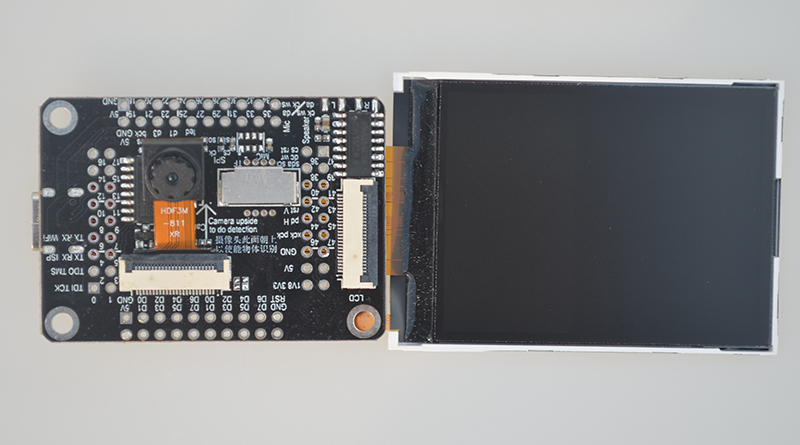
The chip was clearly designed with cameras in mind. Development boards based on the K210 often include camera modules, TFT displays, and storage options. This makes the platform attractive for projects such as face recognition access systems, smart cameras, object counters, line-following robots, QR recognition, and small inspection tools. Basically, if your project needs to look at the world and make a tiny decision, the K210 wants to be invited.
Audio and Signal Processing
The K210 also includes features aimed at machine hearing, including audio-processing support and an FFT accelerator. That opens the door to wake-word detection, sound classification, directional audio experiments, and sensor-fusion projects that combine vision and sound. Imagine a smart door device that sees motion, listens for a command, and reacts locally. That is much more elegant than shipping raw video and audio to the cloud like a gossip with unlimited bandwidth.
What Can You Actually Build With It?
The most obvious examples are computer-vision projects. A K210 board can run small neural-network models for face detection, object detection, image classification, and simple scene recognition. With the right camera and trained model, it can identify whether a person is present, classify basic objects, or detect a target in a live video stream.
In a workshop, that might become a tiny safety monitor that detects whether a hand is too close to a machine. In a classroom, it might become a low-cost AI learning kit that lets students see neural networks working in real time. In a smart-home project, it might become a local face-recognition lock, though anyone building access control should treat security with the seriousness it deserves. A neural network that recognizes your face is cool; a lock that opens because it saw a printed selfie is less cool.
Industrial examples are also easy to imagine. A small K210-based camera could check whether a product is present on a conveyor, whether an indicator light is on, or whether an object is roughly aligned. It will not replace high-end machine-vision systems with complex optics and industrial-grade reliability, but it can make simple inspection tasks cheaper and more accessible.
Why Edge AI Matters
Edge AI means running machine-learning inference close to where data is created. Instead of recording data, uploading it, processing it somewhere far away, and waiting for a response, the device performs the analysis locally. This has four major advantages: lower latency, better privacy, reduced bandwidth, and lower operating cost.
Latency matters when decisions need to happen immediately. A robot avoiding an obstacle cannot pause dramatically while Wi-Fi has an existential crisis. A smart camera detecting a person should not need a round trip to a cloud server before turning on a light. Local inference lets devices respond in milliseconds rather than depending on network conditions.
Privacy matters because sensors collect sensitive data. Cameras and microphones in homes, factories, schools, and hospitals can reveal more than users intend. When inference happens locally, raw data can remain on the device. The system can send only a result, such as “person detected” or “machine anomaly found,” instead of streaming video or audio.
Bandwidth matters because video is heavy. Sending continuous camera feeds to the cloud is expensive and power-hungry. If a small chip can filter events locally, the system can transmit less data. That is good for battery life, network congestion, and monthly bills, which are the three horsemen of IoT annoyance.
The TinyML Connection
TinyML is the practice of running machine-learning models on very small, resource-constrained devices. These devices may have limited memory, limited power, and no operating system. The goal is not to run giant language models or generate cinematic cat portraits. The goal is efficient inference for specific tasks: detect a keyword, classify a gesture, recognize a vibration pattern, identify a visual feature, or trigger an action based on sensor input.
The K210 fits nicely into this world because it gives developers a bridge between microcontroller simplicity and neural-network acceleration. It is more capable than many traditional MCUs, but still small enough for embedded projects. It also arrived at a time when makers were beginning to ask a very important question: “Can we do AI without buying a GPU the size of a sandwich press?”
The answer is yes, as long as the model is small, optimized, and matched to the hardware. That last phrase is important. Edge AI is not magic dust. A model trained for a desktop GPU may not fit or run efficiently on a tiny accelerator. Developers often need quantization, model conversion, supported layers, memory planning, and careful testing.
The Software Side: Where the Fun Gets Slightly Less Fun
Hardware can be exciting, but software support decides whether a chip becomes a beloved platform or a drawer artifact. The K210 ecosystem has included SDKs, examples, model conversion tools, MicroPython-style workflows through MaixPy, Arduino-compatible boards, and development kits from Sipeed and others. That lowered the barrier for hobbyists and educators who wanted to experiment with embedded AI.
Still, neural-network deployment on embedded hardware is not as simple as dragging a model into a folder and shouting “be intelligent!” The KPU supports particular model structures and operations, so developers must convert models into compatible formats. This can involve training in frameworks such as TensorFlow, converting to an intermediate format, quantizing weights, and generating a model file suitable for the K210 toolchain.
That workflow is manageable, but it rewards patience. Version mismatches, unsupported layers, memory limits, and documentation gaps can make the process feel like negotiating with a very small wizard. The good news is that the broader embedded-AI ecosystem has matured. Tools for TinyML, model optimization, and edge deployment are far more approachable today than they were when early K210 boards first started appearing in maker shops.
How It Compares With Other Edge-AI Options
The K210 is not the only way to do edge AI. Developers can choose microcontrollers with DSP instructions, Arm Cortex-M boards running LiteRT for Microcontrollers, Raspberry Pi boards, Google Coral accelerators, Intel Movidius-based devices, ESP32-class boards, or newer AI microcontrollers with integrated NPUs. Each option has trade-offs.
A Raspberry Pi gives you Linux, Python, USB, networking, and a familiar development environment. It also uses more power and may be overkill for simple always-on sensing. A USB AI accelerator can deliver much higher performance but needs a host processor and more system complexity. A classic microcontroller is cheap and efficient but may struggle with vision workloads unless the model is extremely small.
The K210 sits in a charming middle ground. It is small, efficient, affordable, and designed for local neural-network inference. It is not a universal AI monster. It will not train large models, run huge networks, or replace a modern NPU. But for compact CNN inference, especially camera-based projects, it remains an important example of where embedded AI hardware was headed.
Why Makers Loved the “New Part Day” Moment
Part of the excitement came from price and accessibility. When a chip with RISC-V cores and neural-network acceleration shows up at hobbyist-friendly prices, people notice. The maker community has a long tradition of turning odd, inexpensive parts into wildly creative projects. Give them a cheap AI-capable chip and a camera, and suddenly someone is building a bird classifier, a robot eye, or a gadget that recognizes whether the coffee mug is present. This is how civilization advances, one over-engineered desk toy at a time.
The other reason was symbolic. The K210 suggested that AI acceleration did not have to belong only to expensive development kits or cloud platforms. It could become a normal feature in small embedded devices. Today, that idea feels obvious because edge AI is everywhere in product roadmaps. At the time, it felt like peeking around a corner into the future.
Practical Strengths of the K210
The first strength is integration. CPU cores, SRAM, camera interfaces, audio features, security accelerators, and the KPU live together on the same chip. That simplifies board design and reduces the number of external components needed for basic AI projects.
The second strength is low-power inference. Specialized hardware can perform certain neural-network operations more efficiently than a general-purpose CPU. That makes the chip better suited for battery-powered or thermally constrained devices.
The third strength is educational value. For learning embedded AI, a K210 board provides visible results. Students can connect a camera, load a model, and see detections on a small screen. That feedback loop is motivating. Nothing says “I understand neural networks now” like watching a tiny board draw boxes around objects, even if it occasionally mistakes a stapler for a dog.
Real Limitations Developers Should Know
No chip is perfect, and the K210 is not an exception. The KPU is designed around specific CNN operations, so model compatibility matters. Developers cannot assume every modern neural-network architecture will run smoothly. Some networks must be simplified, retrained, quantized, or redesigned for the accelerator.
Memory is another limit. Several megabytes of SRAM is generous for an embedded chip, but tiny compared with desktop systems. Large models will not fit. High-resolution image processing can also be challenging. Developers need to think carefully about input size, model depth, frame rate, and buffer usage.
The software ecosystem can also require tinkering. Documentation, examples, community libraries, and toolchains have improved over time, but embedded AI remains more hands-on than web development. You may not get a friendly error message. Sometimes the device simply refuses to cooperate, like a cat with a USB-C port.
Why This Chip Still Matters Today
Even as newer AI microcontrollers and NPUs arrive, the K210 remains historically important because it helped popularize a practical idea: neural-network acceleration can live inside inexpensive embedded hardware. It also showed how RISC-V could be part of AI-focused silicon rather than just a teaching architecture or niche microcontroller option.
The broader industry has moved strongly in this direction. Edge-AI microcontrollers now target image processing, audio classification, predictive maintenance, wearables, smart-home devices, and industrial sensing. RISC-V continues to gain attention because open, modular processor design is attractive for specialized workloads. AI is not one workload; it is a zoo. A flexible architecture helps designers build the right cage for each animal.
Specific Project Ideas for the RISC-V Neural-Network Chip
Smart Camera for Local Detection
A K210-based smart camera can detect whether a person, object, or simple visual pattern is present. Instead of streaming footage continuously, it can trigger an alert only when something relevant happens. This is useful for low-bandwidth monitoring, wildlife cameras, classroom demos, and home automation.
Face Detection Door Interface
A development board with a camera and display can run a face-detection model and provide a simple access-control prototype. For real security, developers should add liveness detection, encryption, logging, and fallback methods. As a learning project, though, it is excellent.
Audio Keyword or Direction Detection
With audio-processing support, the chip can be used in experiments involving microphone arrays, wake words, or sound classification. A device might listen for a specific tone, machine noise, or command and respond locally.
Factory Indicator Reader
Many machines still communicate through lights, labels, meters, and gauges. A small AI camera can watch for a status light or detect whether a gauge needle falls into a danger zone. This is not glamorous, but factories love useful things more than glamorous things.
Experience Notes: Building With a RISC-V Chip That Has Neural Networks Built In
Working with a chip like the K210 feels different from working with a normal microcontroller. With a typical MCU, your mental model is simple: read inputs, process logic, drive outputs. With the K210, you start thinking in pipelines. A camera captures an image. The image is resized or formatted. A neural network model runs through the KPU. The CPU reads the result. The display draws a box. A GPIO pin triggers a relay. Suddenly, your little board is not just reacting to voltage levels; it is interpreting the scene.
The first practical lesson is that model size matters more than enthusiasm. It is easy to train a model on a laptop and feel like a genius. Then you try to deploy it to embedded hardware and discover that your model is too large, too slow, or full of layers the accelerator does not support. This is the moment when embedded AI teaches humility, usually with a compiler error and a suspiciously empty serial monitor.
The second lesson is that lighting and sensors are part of the model, whether you admit it or not. A face-detection demo that works beautifully on your desk may struggle near a window, under a flickering LED lamp, or inside a shadowy hallway. Camera angle, exposure, lens quality, and input resolution can change results dramatically. The neural network may be digital, but the world is stubbornly analog.
The third lesson is that local inference feels magical when it works. There is something deeply satisfying about disconnecting from the internet and watching a small board still recognize objects in real time. No cloud account. No subscription. No dramatic loading spinner. Just a tiny chip making decisions. It is the embedded developer equivalent of growing tomatoes in your backyard: maybe not necessary, but very satisfying.
The fourth lesson is that debugging AI hardware requires both software thinking and hardware thinking. If detection fails, the problem might be the model, the conversion tool, the camera driver, memory allocation, image format, power stability, or your assumption that the object would look the same from every angle. Embedded AI debugging is less like solving a crossword puzzle and more like interviewing suspects in a mystery novel.
The fifth lesson is that these chips are perfect for learning because they force trade-offs. You cannot hide behind unlimited RAM or massive compute. You must choose smaller models, cleaner data, tighter input sizes, and practical goals. That discipline is valuable. It teaches developers that AI is not just about accuracy on a benchmark; it is about making a system that works in the real world, inside a power budget, with actual sensors, imperfect data, and users who will absolutely point the camera at the wrong thing.
In that sense, the RISC-V chip with built-in neural networks is more than a part. It is a small classroom in silicon. It teaches architecture, machine learning, signal processing, embedded software, power management, and patience. Especially patience.
Conclusion: Small Chip, Big Signal
The Kendryte K210 and similar RISC-V edge-AI chips represent a major shift in embedded computing. Intelligence is moving closer to sensors. Cameras, microphones, and industrial devices no longer need to send every raw signal to the cloud before making a basic decision. With a RISC-V CPU and a built-in neural-network accelerator, a tiny board can recognize patterns, classify inputs, and respond locally.
That does not mean every toaster needs a neural network. Some toasters should remain humble. But for robotics, smart cameras, education, industrial sensing, and low-power AI experiments, chips like the K210 opened a door. They made neural-network inference feel approachable, affordable, and hackable.
The real lesson of “New Part Day: The RISC-V Chip With Built-In Neural Networks” is not just that one chip had exciting specs. It is that embedded AI had crossed an important threshold. Neural networks were no longer confined to servers, GPUs, or expensive development kits. They had entered the maker drawer, right next to jumper wires, mystery resistors, and that one USB cable nobody can identify but everyone is afraid to throw away.