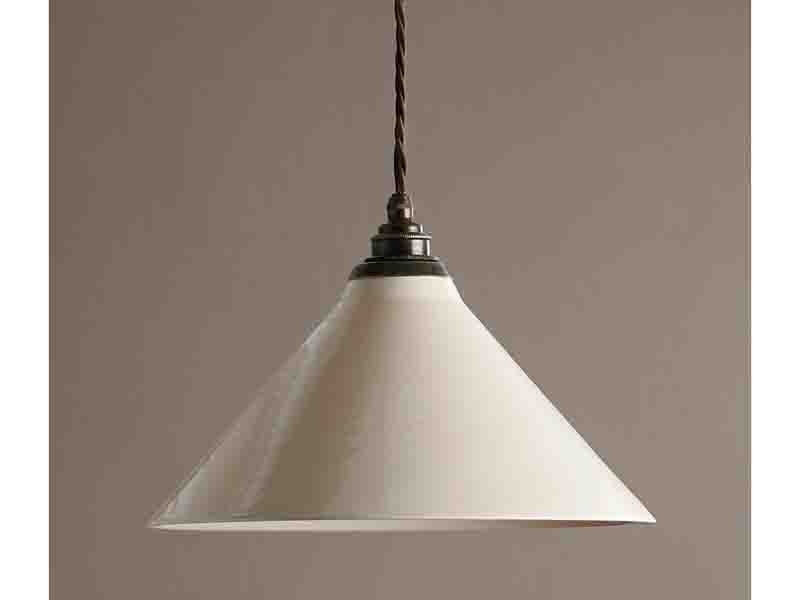
The Creamware Pendant Light is proof that a ceiling fixture does not need to sparkle like a disco ball or resemble a piece of abandoned spacecraft to command attention. With its glossy ceramic shade, warm cream color, aged brass hardware, and quietly vintage personality, this handcrafted pendant makes a room feel collected rather than decorated in one frantic weekend.
Created by deVOL Kitchens, the light draws inspiration from traditional cream-colored pottery and old European utility fixtures. It is simple enough for a restrained kitchen, characterful enough for an eclectic dining room, and polished enough to prevent “farmhouse” from wandering into chicken-themed wallpaper territory.
This guide examines its materials, construction, appearance, lighting performance, placement, maintenance, and everyday experience. It also explains how to decide whether this ceramic pendant light is a lasting investment or merely a very attractive object trying to distract you from an unfinished backsplash.
What Is the Creamware Pendant Light?
The Creamware Pendant Light is a handcrafted hanging fixture built around a glazed earthenware shade. The current U.S. version is produced in a ceramics studio in Leicestershire, England, then assembled with an antiqued brass lampholder, matching ceiling hardware, and dark brown twisted fabric cord.
Its shade begins as smooth white earthenware clay. After casting and firing, the surface receives a glossy cream glaze that gives the fixture an almost glasslike shine. The finish is warm without appearing yellow, allowing it to work with natural wood, painted cabinetry, stone countertops, plaster walls, brick, and a surprisingly long list of metals.
“`
Available Sizes and U.S. Specifications
The pendant is offered in two sizes. The small shade measures approximately 9 inches in diameter and 4.5 inches high. The large version measures about 12.625 inches in diameter and 6.5 inches high. Both include roughly 10 feet of fabric-covered cord, making them adaptable to standard ceilings, taller rooms, and installations where a generous drop is required.
The U.S. model uses a standard E26 Edison-screw lampholder and is rated for a bulb up to 60 watts. It is designed for a 120-volt household electrical system and includes mounting hardware for a standard ceiling junction box. The fixture is UL Listed, an important detail when purchasing decorative lighting that must be more than a pretty bowl hanging over people’s heads.
“`
Why the Design Feels Both Old and New
The Creamware Pendant Light does not copy one historical fixture exactly. Instead, it combines references that feel familiar: French farmhouse crockery, early utility lighting, traditional ceramics, aged metal fittings, and fabric-covered electrical cord. The result has the charm of an antique without requiring you to investigate century-old wiring with the nervous expression of a bomb technician.
“`
A Connection to Historic Creamware
Historic creamware became popular in the 18th century as a refined, pale earthenware used for plates, bowls, serving pieces, and tea sets. Its creamy tone offered a lighter, more elegant alternative to many earlier household ceramics. Josiah Wedgwood and other British potters helped transform the material into fashionable tableware sold across Europe and North America.
The modern pendant is not simply an antique creamware vessel with a hole drilled through it. Its name and color instead evoke the understated domestic character of traditional cream-colored pottery. That association matters because the shade feels less like manufactured lighting equipment and more like a functional ceramic object.
The Beauty of Crazing
One of the fixture’s most distinctive features is its subtle crazing. These fine lines form in the glossy glaze when the glaze and clay body contract at slightly different rates during cooling. In many ceramic applications, crazing is treated as a technical defect. Here, it is part of the visual story.
The hairline pattern becomes more noticeable when light grazes the surface at certain angles. Because the lines develop differently on every shade, no two fixtures appear completely identical. That variation gives the Creamware Pendant Light the kind of personality mass-produced fixtures often attempt to imitate with suspiciously repetitive “hand-applied” marks.
“`
How the Creamware Pendant Is Made
The production process helps explain the fixture’s premium appearance. Liquid clay, commonly called slip, is prepared until smooth and poured into a mold. After the mold draws moisture from the clay and forms the shade walls, the excess slip is removed. The piece is allowed to firm before being taken from the mold and prepared for firing.
The shade undergoes an initial bisque firing before the cream glaze is brushed onto the surface. Multiple glaze layers create the rich, glossy finish. A second kiln firing melts and bonds the glaze to the earthenware body, producing the finished shade and encouraging its characteristic crazing pattern.
This process includes variables that are difficult to standardize perfectly. Clay consistency, glaze thickness, kiln position, cooling speed, and human application can influence the final appearance. Small differences are therefore evidence of the making process rather than reasons to demand that every pendant look as identical as a row of plastic food containers.
What Makes This Ceramic Pendant Light Special?
“`
It Adds Texture Without Visual Clutter
Some pendant lights make their presence known through color, enormous scale, exposed wiring, or enough glass globes to populate a small solar system. The Creamware Pendant takes a quieter route. Its rounded shade and reflective glaze introduce depth, while the restrained palette prevents the ceiling from becoming visually crowded.
This balance is particularly useful in kitchens, where cabinetry, appliances, hardware, tile, seating, and countertops already compete for attention. The pendant contributes texture without starting an argument with everything else in the room.
It Softens Hard Kitchen Materials
Kitchens contain many hard surfaces: stone, steel, tile, glass, sealed wood, and painted cabinetry. A glazed ceramic pendant belongs to that material family but feels more artisanal and tactile. Its slightly imperfect surface can soften a highly structured room, especially when paired with aged brass and fabric cord.
It Works Across Several Interior Styles
Although often associated with English country and vintage farmhouse interiors, the fixture is more versatile than its nostalgic appearance suggests. In a minimalist kitchen, one large pendant can add warmth without interrupting clean lines. In a traditional room, a pair can reinforce classic cabinetry and brass hardware. In an industrial loft, the cream glaze creates a gentle contrast with concrete, black steel, and exposed brick.
It also fits comfortably into transitional, cottage, Mediterranean, organic modern, and eclectic interiors. The secret is its simplicity. Decorative objects with fewer exaggerated details tend to travel between styles more successfully.
“`
Where to Use the Creamware Pendant Light
“`
Over a Kitchen Island
A kitchen island is the most obvious setting. The opaque ceramic shade directs much of the light downward, helping illuminate a preparation or serving surface. Two large pendants can suit a substantial island, while three small fixtures may produce a lighter rhythm over a longer counter.
As a general starting point, hang the bottom of each pendant approximately 30 to 36 inches above the countertop. The correct height depends on ceiling height, user height, shade size, and sightlines. People standing across the island should be able to see each other without ducking around the fixture like participants in an unusually polite boxing match.
Above a Dining Table
A single large Creamware Pendant works especially well over a round breakfast table or compact dining table. Its bowl-like shape echoes the table below and creates a focused visual center. Over a long rectangular table, two or three fixtures can provide better proportion and more even illumination.
Center the light over the table rather than automatically centering it in the room. Furniture determines the composition in dining spaces, and a pendant hanging several inches away from the table center will look wrong even when the ceiling blueprint insists everything is technically correct.
In a Bedroom
The pendant can bring warmth and character to a bedroom, particularly one with painted woodwork, vintage furniture, linen textiles, or restrained colors. A single fixture in the center of the room provides a decorative focal point, while small pendants can replace bedside lamps when installed with thoughtful switching and height.
In an Entryway or Hall
Its compact profile makes the small version suitable for a foyer, hallway, pantry, mudroom, or reading nook. Because the shade is relatively shallow, it offers more clearance than a deep lantern or chandelier. Always confirm that the bottom of the fixture remains comfortably above head height in circulation areas.
“`
Choosing the Right Size and Quantity
Scale is the difference between a pendant that looks intentional and one that appears to have arrived from a dollhouse. Begin by measuring the room, ceiling height, island or table dimensions, and distance from nearby cabinets.
The small shade is useful over compact counters, bedside tables, sinks, or narrow islands where multiple pendants are planned. The large shade has greater visual weight and generally works better as a single feature or as a pair over a broad island.
For multiple fixtures, measure spacing from the center of one shade to the center of the next. Many installations begin with approximately 24 to 36 inches between centers, but the ideal arrangement depends on shade diameter and island length. Leave breathing room near the ends of the counter so the pendants do not feel squeezed against the edges.
Before the electrician arrives, make temporary paper circles matching the shade diameter and tape them above the proposed locations. Crude? Yes. Effective? Also yes. A cardboard mock-up has saved more lighting plans than many expensive visualization apps.
Selecting the Best Bulb
The bulb affects both the room and the appearance of the cream glaze. A warm-white LED around 2700K produces a cozy, traditional atmosphere and emphasizes the fixture’s creamy tone. A 3000K bulb offers a slightly cleaner light that can be useful in kitchens while remaining comfortable in the evening.
Very cool bulbs may make the shade appear flatter or more yellow by comparison. They can also feel clinical in rooms filled with aged brass and natural materials. Unless the kitchen doubles as a surgical suite, intensely blue-white light is rarely the most flattering partner for creamware.
Choose brightness in lumens rather than relying only on wattage. A moderate-output LED may be enough for dining or mood lighting, but food preparation usually requires additional illumination. The Creamware Pendant should therefore form part of a layered plan that also includes ambient ceiling light, under-cabinet task lighting, or wall lights.
A dimmable LED bulb paired with a compatible dimmer gives the fixture far greater range. Bright light can support breakfast preparation or homework, while a lower setting creates a soft pool of light for dinner. LEDs also consume considerably less electricity and generally last much longer than traditional incandescent bulbs.
Installation and Safety Considerations
Ceramic shades have more weight and fragility than many thin metal alternatives. The ceiling junction box and mounting system must be secure and appropriate for the fixture. Follow the manufacturer’s instructions, observe the maximum bulb rating, and use the supplied hardware rather than improvising with whatever screw happens to be rolling around in the kitchen drawer.
Hardwired installation involves household electrical connections and should be completed by a qualified electrician when local rules, the existing wiring, or the installer’s experience require it. The power must be switched off at the breaker before electrical work begins.
The fixture is intended for suitable indoor locations. Do not assume that a beautiful ceramic surface automatically makes the entire assembly appropriate for a shower, exposed porch, or other wet area. Location ratings apply to the complete electrical fixture, not merely to the shade material.
Cleaning and Long-Term Care
Turn off the light and allow the bulb and fitting to cool before cleaning. Support the ceramic shade with one hand while gently wiping it with a soft, dry microfiber cloth. For greasy kitchen residue, use a lightly dampened cloth and a small amount of mild soap, then dry the surface carefully.
Avoid abrasive pads, harsh chemical sprays, and aggressive scrubbing. These can dull the glaze, mark the brass, or catch on the natural crazing pattern. Do not soak the shade or allow moisture to reach the lampholder, cord, ceiling rose, or electrical connections.
Inspect the cord, mounting hardware, and lampholder periodically. If the fixture shifts, the cable becomes damaged, or the ceramic develops a structural crack rather than fine surface crazing, stop using it until the problem has been professionally assessed.
Advantages and Possible Drawbacks
“`
Reasons to Choose It
- Handcrafted glazed earthenware gives every shade individual character.
- The neutral cream finish complements a wide range of colors and materials.
- Antiqued brass and twisted fabric cord create an authentic vintage influence.
- Two sizes support single-fixture and multiple-pendant arrangements.
- The standard U.S. bulb base makes replacement bulbs easy to find.
- Its simple form is less likely to date quickly than a highly fashionable novelty fixture.
Points to Consider
- Handmade ceramic lighting costs more than many mass-produced alternatives.
- The opaque shade concentrates light downward rather than illuminating every corner.
- Ceramic requires careful handling during installation, cleaning, and moving.
- Natural glaze variation may not suit buyers who expect factory-perfect uniformity.
- Internationally made fixtures may involve shipping, return, and replacement considerations.
“`
Real-World Experience: Living With a Creamware Pendant Light
The most noticeable change after installing a Creamware Pendant is not simply that the room becomes brighter. The ceiling suddenly participates in the design. Before installation, a kitchen may have attractive cabinets, handsome countertops, and carefully chosen hardware, yet still feel unfinished. The pendant acts like punctuation at the end of the sentence. Without it, the room speaks. With it, the room knows when to stop.
During the first few days, attention tends to focus on the glossy shade. Morning sunlight reveals the glaze’s warm undertone, while evening illumination makes the cream surface appear deeper and softer. The fine crazing may be almost invisible from across the room, then suddenly become clear when viewed from the side. That small discovery is part of the appeal. The fixture rewards observation rather than announcing every detail immediately.
Height adjustment often proves to be the most important practical decision. A pendant installed too high can feel disconnected from the table or island, as though it is nervously retreating toward the ceiling. Too low, and it interferes with conversation, sightlines, and enthusiastic hand gestures. Temporarily holding the shade at several heights before shortening the cord helps identify the position that feels natural.
In a working kitchen, the downward light is useful but should not be expected to perform every lighting job. A pair of Creamware Pendants can beautifully illuminate the island while leaving wall counters comparatively dim. Once under-cabinet lights or gentle recessed lighting are added, the entire room becomes more balanced. The pendants then provide character and focused illumination without being forced to work overtime.
Bulb selection produces another surprisingly large difference. A harsh, cool bulb can make the shade look more yellow and expose the bulb with distracting intensity. Replacing it with a warm or neutral dimmable LED typically makes the ceramic finish appear richer. At full brightness, the fixture supports cooking and cleaning. Dimmed in the evening, it creates a pool of light that makes takeout pizza feel suspiciously close to a planned dinner party.
The surface also changes with the room around it. Against dark green cabinetry, creamware appears crisp and traditional. Near warm oak, it feels relaxed and rustic. Against white walls, the aged brass and brown cord become more prominent. This responsiveness explains why the pendant can move between English country, modern organic, transitional, and industrial interiors without appearing confused about its identity.
Cleaning is straightforward, although kitchen installations collect more residue than bedroom fixtures. A gentle monthly dusting keeps the glaze reflective. Occasional wiping removes cooking film before it becomes stubborn. The shade should always be supported during cleaning; ceramic lighting is durable in normal use but remains poorly equipped for an argument with a stone countertop.
Over time, the fixture becomes less of a decorative purchase and more of an architectural feature. Visitors may notice it, but the household begins to experience it through routines: switching it on before sunrise, dimming it during dinner, seeing the brass age gradually, and catching the crazing pattern in afternoon light. Those repeated moments are where handcrafted objects earn their value.
The Creamware Pendant Light is therefore most satisfying for someone who appreciates subtle variation, traditional materials, and objects that become more familiar rather than more boring. It does not rely on spectacle. Its appeal comes from proportion, finish, material honesty, and the way it quietly improves the atmosphere around ordinary activities.
Final Verdict
The Creamware Pendant Light combines the warmth of traditional pottery with the usefulness of modern pendant lighting. Its glossy earthenware shade, natural crazing, antiqued brass hardware, and fabric cord create a fixture that feels established from the day it is installed.
It is especially well suited to kitchens, dining areas, bedrooms, and entryways that need texture without excessive decoration. Proper sizing, careful hanging height, layered lighting, and a warm dimmable LED bulb will help it perform as well as it looks.
This is not the cheapest route to illuminating a countertop. It is, however, a thoughtful choice for homeowners who prefer craftsmanship over disposable trends. The Creamware Pendant does not shout for attention. It simply hangs there looking calm, useful, and annoyingly photogenic.