When the sun clocks out, the fun does not have to go with it. DIY glow-in-the-dark games turn an ordinary backyard, basement, garage, school gym, or birthday party space into a neon playground where kids, teens, and adults suddenly become professional athletes, treasure hunters, and very dramatic laser ninjas. The best part? You do not need a Hollywood lighting crew, a giant budget, or a PhD in “things that sparkle.” Most glow games can be made with glow sticks, LED lights, fluorescent tape, washable neon paint, plastic bottles, cones, balloons, paper, and a little imagination.
Glow-in-the-dark games work because they combine simple materials with a powerful party trick: visibility in low light. Glow sticks create light through a chemical reaction called chemiluminescence, while fluorescent materials shine brightly under black light because they absorb ultraviolet light and release visible light. Translation: science is doing the decorating while you take the credit.
This guide covers the best DIY glow-in-the-dark games, how to set them up safely, what materials to use, and how to make the whole night feel organized instead of “someone tripped over a lawn chair and now the dog is wearing three glow necklaces.” Whether you are planning a glow party, summer camp activity, family night, youth group event, classroom celebration, or backyard sleepover, these ideas are easy, affordable, and seriously memorable.
Why DIY Glow-in-the-Dark Games Are So Popular
There is something magical about playing after dark. Familiar games feel brand-new when the balls, targets, lines, and players glow. A basic ring toss becomes a carnival challenge. Bowling with plastic bottles suddenly feels like cosmic bowling without the rented shoes. Even a simple scavenger hunt becomes more exciting when clues are hidden under a black light or marked with glowing tape.
DIY glow games are also popular because they encourage movement. Kids and teens get to run, toss, jump, crawl, balance, and work as teams without feeling like they are doing “exercise.” That is a win, because active play supports coordination, strength, confidence, and social skills. Add glowing materials, and suddenly everyone wants to participateeven the person who normally claims they are “just here for snacks.”
Glow-in-the-Dark Game Safety First
Before we start turning your home into a neon obstacle course, let’s talk safety. Glow games are fun, but they should still be planned carefully, especially when children are involved.
Use Glow Sticks the Right Way
Glow sticks are generally considered low-risk when used as intended, but they should never be cut open, chewed, or used as drink decorations inside cups. The liquid inside can irritate the mouth, skin, or eyes, and the small plastic parts may become a choking hazard for younger children. Keep glow sticks sealed, inspect them for cracks, and throw away damaged ones immediately. Also, remind players that glow bracelets are for wrists, not for dramatic sword fights with siblings. Every family has one glow-stick gladiator; do not feed the legend.
Be Smart With Black Lights
Black lights can make white and neon materials glow beautifully. Choose consumer-grade LED black lights designed for parties or decorations, and avoid UV-C sanitizing lamps, which are not party lights. Do not let players stare directly into black lights at close range, and place cords where no one can trip. If you are playing outdoors, use extension cords rated for outdoor use and keep electrical equipment away from water.
Clear the Playing Area
Low light makes everything more exciting, including the possibility of stepping on a garden hose with the confidence of a cartoon character. Before the games begin, remove obstacles, wet leaves, tools, sharp objects, fragile decorations, and anything that could cause a fall. Mark boundaries with glow tape, cones, or LED string lights. If younger kids are playing, keep the lights dim rather than completely dark.
Essential Supplies for DIY Glow-in-the-Dark Games
You do not need everything on this list. Start with a few basics, then build your glow-game empire one neon roll of tape at a time.
- Glow sticks, glow bracelets, and glow necklaces
- Battery-powered LED tea lights or mini puck lights
- Fluorescent tape or neon duct tape
- Washable neon paint or glow paint
- White paper, poster board, or cardboard
- Plastic bottles, cups, buckets, hula hoops, and cones
- Ping-pong balls, foam balls, beach balls, or beanbags
- Black lights for indoor neon games
- Painter’s tape for temporary floor lines
- Flashlights for supervision and cleanup
For budget-friendly planning, buy multipurpose materials. A pack of glow bracelets can become ring toss rings, team markers, scavenger hunt clues, bracelet prizes, and boundary lines. A roll of neon tape can mark hopscotch squares, bowling lanes, obstacle courses, and score zones. The more reusable your setup is, the less your wallet will glare at you from across the room.
Best DIY Glow-in-the-Dark Games
1. Glow-in-the-Dark Ring Toss
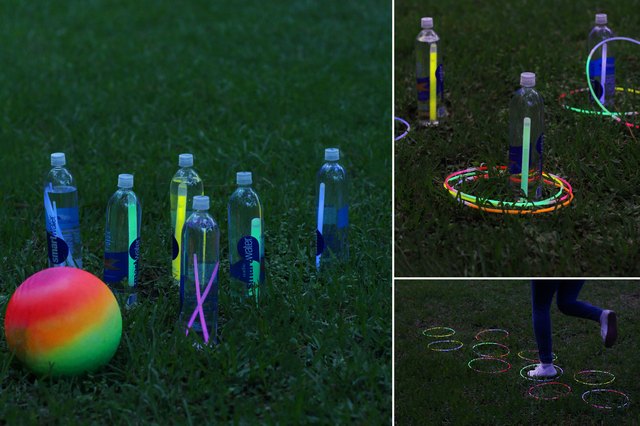
Ring toss is one of the easiest glow games to make. Place plastic bottles, cones, or paper towel rolls upright on the ground. Add glow sticks inside clear bottles or wrap targets with fluorescent tape. Use glow bracelets as rings. Players stand behind a glowing line and try to toss rings over the targets.
To make the game more challenging, assign point values based on distance. A target close to the throwing line can be worth one point, while the tiny cone in the backalso known as “the cone of heartbreak”can be worth five points. For team play, use different bracelet colors for each team.
2. Glow Bowling
Glow bowling is perfect for driveways, patios, hallways, gyms, and basements. Fill clear plastic bottles with a little water to weigh them down, then place a sealed glow stick inside each bottle. Arrange them like bowling pins. Use a lightweight ball, such as a foam ball or small playground ball, and mark the lane with neon tape.
For younger players, use fewer pins and place them closer together. For older kids and adults, create bonus rounds: bowl backward, bowl with the non-dominant hand, or bowl while wearing a glow necklace crown. The crown adds no athletic value, but it does increase confidence by approximately 400 percent.
3. Neon Hopscotch
Classic hopscotch becomes instantly cooler with glow tape. Use fluorescent painter’s tape or neon duct tape to create numbered squares on a driveway, sidewalk, garage floor, or indoor play mat. If you have a black light, white and neon tape will pop beautifully. Use a glowing beanbag, LED puck, or small glow bracelet as the marker.
You can also turn hopscotch into a fitness challenge. Write actions inside the squares: spin, clap, jump twice, freeze, dance, or balance on one foot. The result is part game, part exercise, part low-budget talent show.
4. Glow Scavenger Hunt
A glow scavenger hunt works indoors or outdoors and can be adapted for almost any age. Hide glow sticks, neon paper clues, small LED lights, or fluorescent objects around the space. Give players a list of items to find, or write clues that lead them from one glowing location to the next.
For a mystery version, create a storyline: “The moon crystals have gone missing,” “The backyard aliens need help,” or “Someone stole the birthday cake recipe.” Hide clues in envelopes marked with fluorescent stickers. Under black light, the clues feel secret and official, even if they are taped to a laundry basket.
5. Glow Capture the Flag
Capture the flag is a high-energy outdoor game that becomes even better with glowing team colors. Give one team blue glow bracelets and the other team green or orange. Use two glowing objects as flags, such as LED balls, glow-wrapped cones, or small buckets with battery lights inside.
Set clear boundaries before play begins. Mark safe zones with glow tape or cones, and use a whistle or flashlight signal to pause the game if needed. This game works best with older children, teens, and adults because it involves running, strategy, and a fair amount of dramatic whispering behind trees.
6. Black Light Tic-Tac-Toe
For a calmer game, create a giant tic-tac-toe board using fluorescent tape on the floor or a large poster board. Use two colors of neon paper plates as Xs and Os. Under a black light, the board glows like a game show set. Players can compete one-on-one, or teams can take turns placing pieces.
Want to make it more active? Put the board ten feet away and have players race to place their piece. This turns tic-tac-toe from a quiet strategy game into a tiny neon relay race. It is still educational, but now it has cardio.
7. Glow Mini Golf
DIY glow mini golf is easier than it sounds. Use cardboard ramps, pool noodles, plastic cups, books, blocks, or boxes to create obstacles. Mark each hole with glow tape or LED tea lights. Use a lightweight ball painted with glow paint, wrapped with fluorescent tape, or replaced with a white ping-pong ball under black light.
Create themes for each hole: tunnel hole, zigzag hole, volcano hole, bridge hole, or “impossible corner that makes everyone question physics.” Keep score on a neon poster board. This game is excellent for mixed-age groups because players can move at their own pace.
8. Glow Balloon Volleyball
Blow up white or neon balloons and use a black light to make them shine. For extra visibility, use balloons designed for LED lights or place a small battery-powered balloon light inside only if the product is made for that purpose. Do not put broken glow sticks or loose glow liquid inside balloons.
Use string, chairs, or a pool noodle as the net. Players tap the balloon back and forth without letting it touch the ground. Because balloons move slowly, this game works well for younger kids, indoor parties, and players who want action without full-speed chaos.
9. Glow Obstacle Course
Create a glowing obstacle course with cones, tape lines, hula hoops, chairs, cardboard tunnels, and LED markers. Players might crawl under a “laser” made of yarn, hop through glowing hoops, zigzag around cones, toss a ring onto a target, and finish by hitting a glow bowling pin.
Keep the course simple and visible. Avoid obstacles that require jumping over hard objects in the dark. The goal is fun, not auditioning for a stunt show. Time each player or make it cooperative by having teams complete the course together.
10. Glow Dance Freeze
Sometimes the best game is the one that requires no scoreboard. Give players glow bracelets, dim the lights, play upbeat music, and start glow dance freeze. When the music stops, everyone freezes. Anyone who moves is outor, for a kinder version, must do a silly dance move before returning to the game.
This is a great warm-up activity for parties because it breaks the awkward “everyone is standing around the snack table” phase. Within two minutes, someone will invent a move called the Electric Spaghetti, and the evening will be officially alive.
11. Glow Cup Toss
Set up plastic cups in a triangle or line, then add glow tape around the rims. Use ping-pong balls or small foam balls. Players try to land the ball in the cups from behind a marked line. Assign points to different cups or place challenge cards inside them.
Challenge ideas include “switch teams,” “take another shot,” “do five jumping jacks,” or “name three animals that glow in nature.” This game is simple, cheap, and easy to reset between rounds.
12. Glow Charades
Glow charades is hilarious because players act out clues while wearing glow bracelets, necklaces, or tape outlines on their clothing. In low light, they look like animated stick figures. Write family-friendly clues on cards: robot, basketball player, astronaut, dinosaur, chef, surfer, marching band, or sleepy cat.
For extra laughs, use glow tape to outline arms and legs on dark clothing. When the player moves, the glowing stick-figure effect makes even basic actions look like a tiny neon cartoon escaped from a phone screen.
How to Plan a Glow Game Night
Choose the Right Space
Backyards are great for running games, while garages, basements, classrooms, and gyms are better for black light activities. If you are outdoors, check the ground before sunset. Look for holes, rocks, slippery surfaces, low branches, sprinklers, and furniture. If you are indoors, move breakable items away from the play zone. Your favorite vase does not want to participate.
Set Up Before Dark
Prepare the games while there is still daylight or full room lighting. Tape lines, place targets, test black lights, check batteries, and organize supplies by station. Once it is dark, setup takes longer because everyone suddenly becomes a detective searching for scissors.
Create Game Stations
Instead of running one game at a time, create stations: bowling in one area, ring toss in another, tic-tac-toe near a wall, and scavenger hunt clues around the perimeter. Stations reduce waiting time and help large groups stay busy. Rotate teams every 10 to 15 minutes.
Use Teams and Color Codes
Glow colors make team play easy. Give each team a different bracelet color, necklace color, or tape badge. Use matching scorecards or buckets for team supplies. This looks organized and prevents the classic party question: “Wait, whose turn is it?” which has been known to consume entire evenings.
Tips for Making Glow Games Look Better
The secret to a great glow setup is contrast. Dark backgrounds make glowing objects stand out. If you are using a black light, white and fluorescent colors usually shine best. Neon orange, pink, green, and yellow are reliable choices. Use black tablecloths, dark walls, or nighttime outdoor spaces to make the glow effect stronger.
Layer different light sources. Glow sticks are great for handheld items and targets. LED tea lights work well inside buckets, boxes, or plastic containers. Fluorescent tape defines boundaries. Black lights make posters, clothing, and decorations pop. When combined, these materials create a glow party atmosphere without needing expensive equipment.
Do a quick test before guests arrive. Some “glow” products are brighter than others, and some paints need charging under light before they shine. If an item does not glow well, use it in a brighter area or replace it with reflective or fluorescent material.
DIY Glow-in-the-Dark Games for Different Ages
For Younger Kids
Choose slower games with clear rules: glow bowling, balloon volleyball, hopscotch, scavenger hunts, and tic-tac-toe. Keep the area dim rather than pitch black. Use large targets, soft balls, and short distances. Younger kids love the glow effect, but they also need simple boundaries and close supervision.
For Teens
Teens usually enjoy competitive and team-based games: glow capture the flag, obstacle courses, mini golf, cup toss, and timed challenges. Add leaderboards, team names, and bonus rounds. The more the setup feels like an event, the more likely they are to put down their phonesat least long enough to record everyone else being ridiculous.
For Families and Mixed Groups
Use stations so everyone can choose their activity level. Grandparents may enjoy glow tic-tac-toe or mini golf, while younger players run the obstacle course. Family glow nights work best when winning is optional and laughing is mandatory.
Budget-Friendly Glow Game Ideas
A glow game night does not have to be expensive. Reuse items from around the house: empty water bottles for bowling pins, cardboard boxes for mini golf obstacles, paper plates for tic-tac-toe pieces, laundry baskets for toss games, and pool noodles for boundaries. Add glow sticks, tape, and LED lights only where they improve visibility.
Dollar stores, craft stores, and party sections often carry glow bracelets, neon poster board, tape, and battery lights. Buy in bulk when possible, but avoid overbuying single-use plastics. Reusable LED lights, washable paint, and sturdy game pieces are better for repeat events.
Common Mistakes to Avoid
The first mistake is making the space too dark. Glow games need darkness, but players still need to see the ground. Use soft lighting around the edges or keep a few flashlights available. The second mistake is using tiny game pieces that disappear. Choose large, bright objects that are easy to track.
The third mistake is planning too many complicated rules. After dark, simple wins. If a game takes five minutes to explain, it may need a glow-up of its own. Stick to games people already understand, then add glowing materials, teams, or point values.
Finally, do not rely on glow sticks alone for every game. They fade over time and are single-use. Mix them with LED lights and fluorescent materials for a brighter, longer-lasting setup.
Real Experience: What Makes DIY Glow-in-the-Dark Games Actually Work
After setting up glow-style games for backyard nights, family gatherings, and casual group events, one lesson becomes clear: the glow effect gets people excited, but the layout keeps the night running smoothly. A beautiful neon setup can fall apart quickly if players do not know where to go, where to stand, or what counts as a point. The best experiences come from preparing simple stations before guests arrive.
Glow bowling is usually the easiest first win. It takes only a few plastic bottles, sealed glow sticks, and a soft ball, yet it gets people laughing immediately. Kids love resetting the pins, older players get competitive, and even shy guests can join without feeling watched. The trick is to weigh the bottles with a small amount of water so they stand properly but still fall when hit. Too much water turns them into stubborn little bowling statues.
Ring toss is another reliable favorite, especially when different targets have different scores. People enjoy games where they can improve quickly. At first, everyone misses. Then someone lands a ring on the far cone, celebrates like they just won a national championship, and suddenly the line gets longer. Using glow bracelets as rings works well, but it helps to have extras because some bracelets will bend, disappear, or become fashion accessories halfway through the game.
The biggest surprise is how much people enjoy glow scavenger hunts. They are not just for little kids. Teens and adults get surprisingly serious when clues are written like a mystery. A simple backyard becomes much more interesting when a glowing clue is tucked under a chair, behind a flowerpot, or taped to a fence. The experience feels more immersive if the clues follow a theme, such as space mission, lost treasure, secret laboratory, or midnight carnival.
Another practical lesson: music matters. Glow games feel more energetic with a playlist in the background. It does not need to be loud; it just needs to create momentum. Without music, people sometimes drift into snack-table gravity. With music, even waiting for a turn feels like part of the party.
Lighting balance is also important. Complete darkness sounds exciting, but it is usually not the best choice. A little ambient light makes players more comfortable and prevents trips. The goal is not to make the yard invisible; the goal is to make the game pieces glow. LED string lights around the perimeter or a porch light covered slightly by distance can help maintain safety while keeping the glow effect strong.
One of the best hosting strategies is to start with low-skill games, then move into active ones. Begin with glow bowling, ring toss, or tic-tac-toe. Once people are warmed up, introduce obstacle courses, capture the flag, or relay races. This gives everyone time to adjust to the lighting and understand the space. It also prevents the “too much chaos too soon” problem, which is very real when ten excited players are waving glow sticks and sprinting in opposite directions.
Cleanup is easier when every station has a small bin or bag nearby. Ask players to drop used glow bracelets, tape scraps, and game pieces into the station bin before moving on. At the end, turn on the lights and do a final sweep. Glow sticks and plastic pieces should not be left outside where pets, wildlife, or lawn equipment can find them later.
The most memorable glow game nights are not the most expensive. They are the ones where the rules are clear, the space feels safe, the materials are bright, and everyone has permission to be a little silly. A glowing backyard does not need perfection. It needs laughter, motion, snacks, and at least one person who takes glow bowling far too seriously.
Conclusion
DIY glow-in-the-dark games are proof that simple ideas can create unforgettable nights. With glow sticks, LED lights, neon tape, black lights, plastic bottles, balloons, and basic household supplies, you can build games that feel exciting, active, and fresh. The best options are easy to explain, safe to play, and flexible enough for different ages.
Start with classics like glow bowling, ring toss, hopscotch, scavenger hunts, and balloon volleyball. Add team colors, music, scoreboards, and themed challenges to make the event feel special. Most importantly, plan the space carefully. Good lighting, clear boundaries, soft equipment, and adult supervision help keep the fun glowing for the right reasons.
Whether you are hosting a birthday party, summer night hangout, classroom celebration, camp activity, or family weekend event, glow games bring instant energy. They turn ordinary spaces into neon playgrounds and ordinary players into champions of the dark. Just remember: do not cut open glow sticks, do not stare into UV lights, and do not underestimate the competitive power of a plastic bottle bowling lane.
Note: This article is written for safe recreational play and synthesizes practical guidance from public-health, poison-control, consumer-safety, science-education, and family-activity resources. Always supervise children, follow product labels, and adapt games to the age and ability of the players.