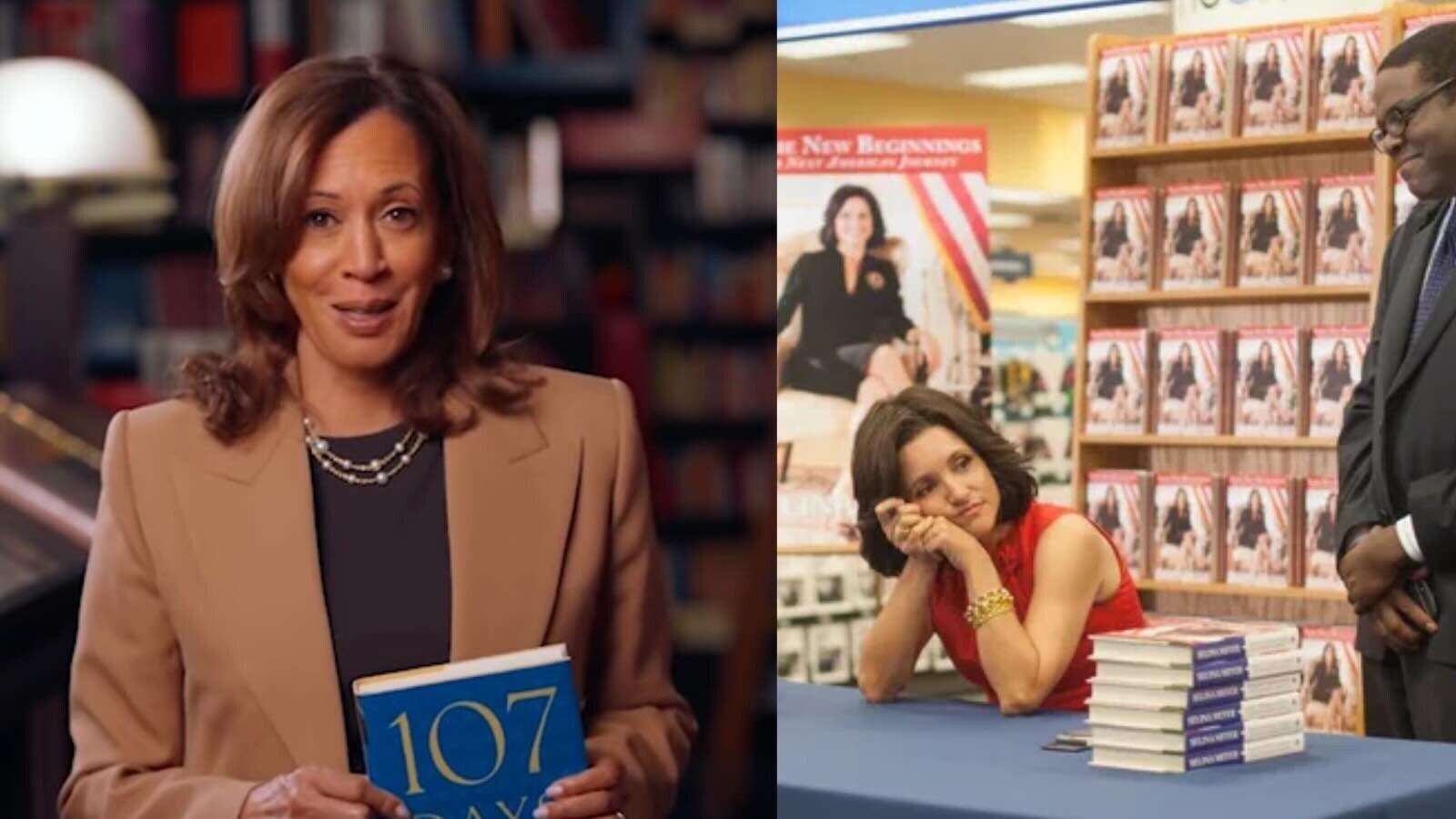
There are political memoirs that arrive like thunderclaps, political memoirs that arrive like campaign brochures with better paper, and political memoirs that arrive like someone in a Washington writers’ room said, “No, really, what if the vice president had 107 days to save the whole thing?” Kamala Harris’ book 107 Days lands squarely in that last category: serious in subject, dramatic in timing, and unintentionally perfect for anyone who ever watched Veep and thought, “This can’t possibly be how politics works.”
The joke, of course, is that modern politics keeps proving the writers of Veep were not exaggerating enough. Harris’ memoir covers her shortened 2024 presidential campaign after President Joe Biden ended his reelection bid on July 21, 2024. Election Day was November 5. That left Harris with 107 days to consolidate a party, define herself, build a national campaign, choose a running mate, escape the shadow of an unpopular administration, answer for four years of loyalty, and somehow convince voters that everything was under control. In other words: a normal Tuesday in prestige political comedy.
But 107 Days is not merely a campaign diary. It is a strange cultural artifact, a post-election autopsy, a brand reset, a score-settling document, and a reminder that the vice presidency remains one of the most awkward jobs in American life. You are close enough to power to be blamed for everything, far enough from power to control almost nothing, and visible enough to become a punchline when the machine breaks down.
Why the Title Already Sounds Like a Punchline
The title 107 Days is clean, memorable, and almost painfully literal. It refers to the number of days Harris had as the Democratic nominee after Biden withdrew from the race. As political branding, it works because it instantly frames the campaign as a race against time. As comedy, it works because it sounds like the title of a fake memoir Selina Meyer’s team would brainstorm during a panic meeting while someone spills iced coffee on a polling memo.
The number does a lot of emotional work. It suggests urgency. It implies unfairness. It invites sympathy. It also quietly asks the reader to judge the campaign on a curve. If a normal presidential campaign is a marathon, Harris’ was a marathon where someone handed her the baton at mile 22, pointed toward a hill, and said, “Good news, the cameras are already live.”
That is the classic Veep texture: the collision between historic stakes and ridiculous logistics. One moment, democracy is on the line. The next, everyone is arguing about who failed to return a phone call. In Harris’ case, the memoir reportedly digs into strained relationships inside the Democratic Party, frustrations with Biden’s team, the running mate selection process, and the difficulty of separating herself from an administration she had spent years defending.
The Vice Presidency: America’s Most Expensive Waiting Room
Part of why the Veep comparison sticks is that the show understood a brutal truth about the vice presidency: it is a job defined by proximity without full authority. The vice president attends the meetings, appears in the photos, breaks the Senate ties, smiles at the awkward events, and waits. Sometimes the waiting becomes destiny. More often, it becomes a slow-motion identity crisis in sensible shoes.
Harris’ rise and campaign collapse fit into that old institutional weirdness. She was the first woman, first Black woman, and first South Asian American to serve as vice president. That historic role gave her enormous symbolic power. Yet the actual job often placed her in politically difficult territory: immigration messaging, voting rights, reproductive rights, international diplomacy, and constant public scrutiny. When the Biden campaign collapsed after the disastrous 2024 debate, Harris inherited not a blank slate but a political house with the alarms already going off.
That is why 107 Days feels less like a normal memoir and more like a case study in impossible positioning. If Harris defended Biden too strongly, she looked tied to the past. If she separated herself too aggressively, she looked disloyal. If she ran as change, voters could ask why the change had not happened while she was vice president. If she ran as continuity, voters could ask why they should continue a direction they had already soured on. Somewhere in that maze, a Veep staffer would be screaming into a copier.
What Makes the Book Feel So “Veep”?
1. The Absurd Timing
A 107-day presidential campaign is already a political absurdity. Presidential campaigns usually take years of planning, donor cultivation, staff building, opposition research, and message testing. Harris had to do the compressed version while the entire country watched. Every speech, interview, and staff decision carried the heavy smell of emergency.
That is the kind of setup Veep loved: a situation so improbable that nobody needs to invent the joke. The premise is the joke. “Madam Vice President, the good news is you are now the nominee. The bad news is the election is basically tomorrow, the party is traumatized, your predecessor is still in the room, and everyone who says they support you is also quietly positioning for 2028.”
2. The Loyalty Trap
Harris’ memoir reportedly argues that Biden’s decision to seek reelection was reckless and that his team failed to fully reckon with the political damage caused by his age and public performance. That is a striking claim from someone who, while serving as vice president, publicly defended him. The tension is obvious: Harris had to be loyal until loyalty became a liability.
In political terms, this is tragic. In Veep terms, it is a staff meeting. The vice president spends years repeating the official line, only to discover that the official line has been turned into an anchor and tied to her ankles. When she finally gets the top job, the first question is not “What is your vision?” but “How long have you known the ship was leaking?”
3. The Running Mate Drama
The running mate selection process is one of the great rituals of American political theater. It is presented as sober statesmanship, but it also functions like a high-stakes group project in which every finalist knows they are being judged for ambition, geography, identity, television presence, donor comfort, and whether they can look normal eating fried food at a state fair.
Harris ultimately selected Minnesota Governor Tim Walz. But the reported discussions around other Democratic figures, including Pete Buttigieg, Josh Shapiro, Gavin Newsom, and others, created exactly the kind of intra-party drama that political media devours. A campaign memoir that names names is always going to feel less like closure and more like the group chat got published.
4. The “Everyone Is Helping, Nobody Is Helping” Problem
One of the funniest and most painful ideas in politics is that support can be technically real and practically useless. A politician may have endorsements, statements, fundraising links, and smiling photos, but still feel abandoned when the moment becomes dangerous. Harris’ account appears to include a version of this complaint: allies were present, but not always present in the way she needed.
That is another Veep-style dynamic. Everyone is “fully committed.” Everyone is “excited.” Everyone is “on board.” Then the hard call comes, and someone is hiking, someone is unavailable, someone is drafting a statement that says nothing, and someone is leaking to a reporter about how committed they are.
The Serious Story Under the Joke
It would be easy to treat the whole thing as pure comedy, but 107 Days also points to a serious problem inside modern American politics: institutions now move slower than crises. Parties build carefully managed narratives, but reality does not wait for message discipline. The Biden campaign’s collapse created a vacuum, and Harris had to step into it before anyone had properly cleaned the room.
The memoir’s central argument seems to be that Harris was handed an almost impossible assignment. There is truth in that. A candidate entering the race so late faces massive disadvantages. Voters had already formed opinions about the administration. Republicans had already spent years attacking Harris. Democrats were divided over Biden’s future, foreign policy, inflation, generational change, and the party’s overall direction. A hundred and seven days was enough time to create excitement, but not enough time to rewrite political gravity.
At the same time, the book cannot completely free Harris from responsibility. She was not an outsider parachuting into Washington. She was vice president. She was part of the administration. She had national name recognition, fundraising power, and the Democratic nomination. Her challenge was unfair, but politics is not a fairness machine. It is a weather system with consultants.
Why Political Memoirs Always Become Campaign Documents
Political memoirs are rarely just books. They are trial balloons with ISBN numbers. They explain the past, but they also audition for the future. They tell readers what happened, who failed, who betrayed whom, and why the author deserves another look. In that sense, 107 Days belongs to a long tradition of post-defeat memoirs, including Hillary Clinton’s What Happened, in which candidates try to make sense of losing without sounding like they are only making excuses.
That is a nearly impossible balance. If the author accepts too much blame, the book becomes a confession. If the author assigns too much blame, it becomes a grudge scrapbook. If the author is too polished, readers call it fake. If the author is too candid, former allies start checking the index. Harris’ memoir seems to live in that uncomfortable middle zone: candid enough to create headlines, controlled enough to still feel like part of a larger political strategy.
And yes, that is funny. Not because the stakes are small, but because the machinery is so human. Behind every grand statement about democracy, there are missed calls, bruised egos, bad debate prep sessions, and people pretending they are not furious while standing next to a step-and-repeat banner.
Kamala Harris, Selina Meyer, and the Danger of the Comparison
Comparing a real politician to a fictional satire character can be lazy if it stops at “woman vice president funny.” That is not the useful comparison here. Kamala Harris is not Selina Meyer. Harris is a real public figure with a long legal and political career. Selina Meyer is a fictional monster of ambition, vanity, insecurity, profanity, and comic timing. The more interesting comparison is not personality. It is structure.
Veep mocked a political system where everyone speaks in slogans while privately scrambling for survival. Harris’ memoir appears to show a real-world version of that same structure: loyalty becoming performance, ambition hiding behind unity, and historic symbolism colliding with brutal electoral math. The comedy is institutional. The punchline is not “Kamala is Selina.” The punchline is “Washington keeps building Selina-shaped situations.”
That distinction matters. A fair reading of 107 Days should acknowledge both the historic pressure Harris faced and the strategic limitations that hurt her campaign. It should recognize that racism and sexism shaped public perception, while also admitting that campaigns still need clear messages, strong answers, and believable distance from unpopular policies. Serious analysis can hold more than one idea at a time. Comedy can too, when it is sharp enough.
The Media’s Favorite Genre: Democratic Family Therapy
One reason the book attracted so much attention is that it offers the media a beloved storyline: Democrats arguing with other Democrats in public. Political reporters love this genre because it has everything: ambition, betrayal, generational tension, donor anxiety, and people denying they are angry in ways that make them sound extremely angry.
Harris’ reported criticism of Biden’s decision-making, Biden’s team, and other leading Democrats turned the memoir into more than a campaign recap. It became a map of unresolved party tension. Was Biden too slow to step aside? Was Harris set up to fail? Did Democratic leaders hesitate because they doubted her, because they feared Trump, or because they were protecting their own futures? These questions are not just gossip. They matter because the Democratic Party’s next presidential contest will likely be shaped by the same anxieties.
Still, the gossip is part of the appeal. Nobody buys a political memoir hoping every chapter ends with “and then everyone behaved professionally.” Readers want the scene behind the scene. They want the phone call, the awkward silence, the private complaint, the sentence that makes three governors text their communications directors before breakfast.
Why the Book Works as a Cultural Moment
Whether one admires Harris, dislikes her, or simply enjoys watching American politics behave like a malfunctioning office printer, 107 Days works as a cultural moment because it captures the speed of modern political collapse. A campaign that once seemed predictable became chaotic. A vice president who had spent years in a supporting role suddenly became the central figure. A party that talked constantly about saving democracy had to improvise its own rescue plan in real time.
That is why the “classic Veep joke” framing is so sticky. It gives readers a familiar lens for understanding something complicated. The 2024 campaign was not funny in its consequences, but parts of its internal logic were absurd: the sudden urgency, the blame shifting, the forced optimism, the consultants trying to manufacture momentum while the clock screamed from the wall.
Good satire does not make politics ridiculous. It reveals the ridiculousness already there. Harris’ book, intentionally or not, gives readers another reminder that the gap between prestige democracy and office comedy is often one bad meeting wide.
Experience Section: Watching the “Veep” Effect in Real Political Life
Anyone who writes about politics long enough eventually develops a strange reflex: when a major event happens, you do not only ask, “What does this mean?” You also ask, “Which abandoned sitcom subplot does this resemble?” That is not because politics is unserious. It is because politics is too serious to be left entirely to its official language. Press releases sand down the weird edges. Memoirs put some of them back.
The Harris book feels familiar to readers who have watched public figures try to explain a loss while preparing not to disappear. The tone of these moments is always delicate. The politician must sound reflective but not defeated, honest but not reckless, loyal but not submissive, wounded but not bitter, future-focused but not obviously campaigning. It is the verbal equivalent of walking across a frozen pond while carrying a birthday cake.
For readers, the experience can be oddly addictive. You open a campaign memoir expecting policy lessons, and soon you are reading it like a workplace drama. Who returned the call? Who did not? Who gave full-throated support? Who gave the kind of support that technically counts but spiritually feels like a voicemail? Who thought they were being strategic but accidentally looked cowardly? The human details make the institutional story easier to understand.
The Veep comparison also resonates because many people have experienced smaller versions of the same dysfunction at work. Maybe you have never been handed a presidential campaign with 107 days left, but you may have been given a failing project after the deadline was already impossible. You may have had a boss promise support, then vanish when the meeting turned difficult. You may have been told you were “empowered” while every real decision still required approval from people who were conveniently unavailable. That is why the story translates. Washington is unique in scale, not always in behavior.
There is also a lesson for communicators. Harris’ campaign struggled with one of the hardest branding problems in politics: how to represent change when you are visibly part of the current product. Companies face this too. So do media brands, celebrities, and institutions. You cannot simply announce a fresh start if the audience still associates you with the old problems. The message has to explain the pivot clearly, emotionally, and repeatedly. Otherwise, voters hear the slogan and mentally reply, “Okay, but where have you been?”
From a content perspective, 107 Days is powerful because the title itself does narrative work. It gives the audience a countdown, a conflict, and an excuse to enter the story. That is why the book became a conversation piece even among people who may never read every chapter. The title is a headline machine. It compresses the drama into two words and a number. In digital publishing, that matters. A political book must compete not only with other books but with podcasts, clips, reaction videos, newsletters, and the daily carnival of outrage. A clean hook travels farther.
Still, the biggest experience-related takeaway is emotional: voters are increasingly fluent in political stagecraft. They can sense when a memoir is also a positioning document. They can tell when candor has been focus-grouped just enough to remain safe. That does not mean the book lacks value. It means readers approach it with a double vision. They read the story of what happened, and they also read the strategy behind why the story is being told now.
That is the final Veep joke, and it is a good one: in modern politics, even the explanation of the disaster becomes part of the next campaign. The memoir is the autopsy, the therapy session, the media tour, the brand refresh, and maybe the first quiet step toward another run. Somewhere, a fictional staffer is whispering, “Great newswe tested ‘107 Days’ with suburban moderates, and the font is polling beautifully.”
Conclusion
Kamala Harris’ New Book Is A Classic ‘Veep’ Joke because the entire premise sounds invented by political satirists: a historic vice president, a collapsed reelection campaign, 107 frantic days, public loyalty turning into private frustration, and a memoir that tries to explain defeat while keeping the future door open. But beneath the joke is a serious portrait of American politics under pressure. Harris’ 107 Days is not just about one candidate’s abbreviated campaign. It is about how parties manage crisis, how vice presidents carry blame without full control, and how modern campaigns can become both history and farce at the same time.
The book’s real value may not be in proving Harris right or wrong about every grievance. Its value is in showing how quickly political narratives collapse when reality arrives early. That is why the Veep comparison endures. The show taught viewers that power is often less glamorous, less competent, and far more awkward than official Washington wants to admit. Harris’ memoir, intentionally or not, offers a real-world companion piece: democracy with a deadline, ambition with a stopwatch, and history trying very hard not to trip over its own microphone cable.