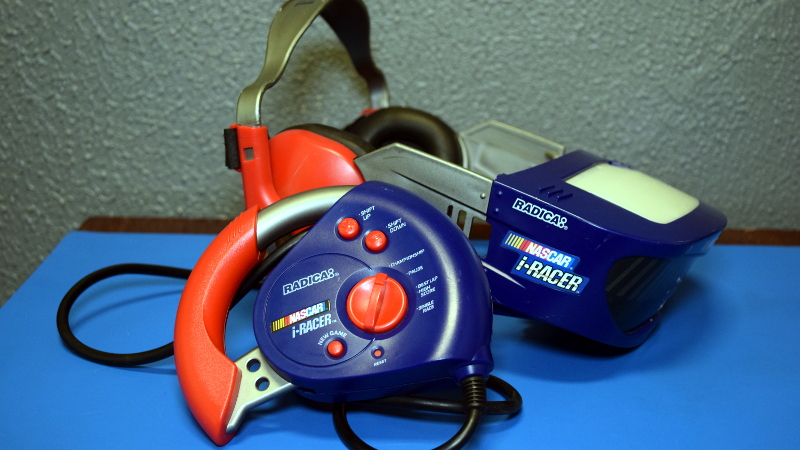
The RADICA I-Racer looks like what would happen if a late-1990s LCD handheld game swallowed a racing wheel, borrowed a headset from a low-budget sci-fi prop room, and confidently announced, “Yes, I am virtual reality now.” And honestly? That confidence is part of the charm.
Released as the NASCAR i•Racer around 1999, this strange and delightful electronic racing game sits at a fascinating intersection of retro gaming, toy engineering, early consumer VR dreams, and budget-conscious product design. It was not a Game Boy competitor. It was not a real racing simulator. It was certainly not the future of immersive motorsports. But it was something more interesting for teardown fans: a compact lesson in how toy companies squeezed stereo sound, vibration feedback, optical tricks, segmented LCD graphics, and a wearable cockpit fantasy into an affordable plastic package.
In this teardown-style deep dive, we will explore what the RADICA I-Racer was, how it worked, what made its design surprisingly clever, where it cut corners, and why collectors, hardware hackers, and retro-tech fans still find it worth discussing today. Grab your tiny screwdriver and prepare for a race where the engine is mostly imagination, the dashboard is liquid crystal, and the pit crew is probably a 9-year-old with two AA batteries.
What Is the RADICA I-Racer?
The RADICA I-Racer, officially known in many references as the NASCAR i•Racer or IRACER 8012, was a one-player electronic racing game designed for players ages 8 and up. Unlike a typical flat handheld LCD game, it came with two connected parts: a head-mounted viewing unit and a steering-style hand unit. The head unit placed the player inside a simulated cockpit view, while the hand unit handled steering, acceleration, braking, shifting, game selection, volume, and battery power.
The game’s goal was simple: race through an eight-track NASCAR-style circuit, finish in first place, manage fuel and damage, and avoid the kind of crashes that make a tiny vibrating plastic steering wheel feel very dramatic. In Championship Race Mode, players advanced from track to track. In Single Race Mode, they could practice individual courses. That sounds basic by modern racing-game standards, but for a self-contained toy built around LCD segments, it was a fairly ambitious setup.
The I-Racer also leaned hard into the language of “virtual vision.” It was not virtual reality in the modern sense, of course. There was no head tracking, no polygonal world, no OLED display, no positional audio engine, and no downloadable firmware update waiting to ruin your afternoon. Instead, the experience depended on a transparent LCD, printed overlays, optical reflection, stereo headphones, and a carefully arranged cockpit display. It was fake 3D in the best retro-toy tradition: not technically magical, but mechanically theatrical.
Why the I-Racer Matters in Retro Gaming History
RADICA was known for electronic handheld games, plug-and-play devices, and novelty toys that made simple hardware feel more exciting than it had any right to be. Before mobile phones turned every pocket into an arcade, companies like RADICA, Tiger Electronics, and others filled toy aisles with dedicated LCD games. These devices did not render worlds in the way cartridge-based consoles did. Instead, they used fixed LCD artwork where pre-shaped segments blinked on and off to suggest motion.
That limitation created a distinct kind of game design. A car did not smoothly drive across a fully rendered track; it appeared in predetermined positions. A speedometer did not animate with fluid graphics; it lit up through numbers and bars. A crash did not involve physics simulation; it triggered flashing lights, sound, and sometimes vibration. In other words, LCD games were less like tiny televisions and more like interactive dashboards with excellent dramatic timing.
The I-Racer stands out because RADICA did not simply put another racing LCD into a palm-sized shell. The company wrapped the experience around the player’s face. It turned a segmented display into a wearable cockpit and gave the player a physical controller shaped vaguely like a steering device. That design makes the RADICA I-Racer a memorable artifact from the era when toy makers were experimenting with immersion long before modern VR headsets became mainstream.
Exterior Design: A Toy That Wanted to Be a Simulator
From the outside, the RADICA I-Racer is wonderfully odd. The head unit resembles a chunky visor with integrated stereo headphones and adjustable straps. The front housing is large enough to look serious, but light enough to remind you that this was made for kids, not professional drivers preparing for Daytona.
The adjustability is one of the more thoughtful parts of the design. The headphones can slide closer or farther from the viewing unit, and the top strap and rear elastic strap help the headset fit different head sizes. A soft nose pad improves comfort, which is a nice touch considering the device asks players to press a plastic racing theater against their face.
The hand unit is where the controls live. It includes the battery compartment, steering wheel control, A and B buttons, gear shift buttons, selector dial, reset button, new game button, and volume control. The A button acts as accelerator, power, and enter; the B button handles braking. Shift Up and Shift Down buttons come into play when manual transmission is selected. The selector dial moves between modes such as Championship Race, Single Race, Pause, and high-score or best-lap viewing.
It is an excellent example of late-1990s toy design: everything has a job, nothing is elegant in the modern minimalist sense, and the entire control layout feels like a race car cockpit translated by someone whose design budget had already left the building.
Opening the Controller: Simple, Cheap, and Clever
The controller is where the teardown starts to reveal RADICA’s practical engineering. A modern controller might use a microcontroller, sensors, communication protocols, and firmware. The I-Racer hand unit is far simpler. Its internal circuit board is mostly passive components, with the key electronics placed elsewhere in the headset. The cable between the hand unit and head unit carries multiple conductors because the controller does not appear to send elegant digital messages; it directly routes signals.
One of the most interesting design choices is the steering mechanism. Instead of using a potentiometer to measure wheel position, the I-Racer relies on shaped pads on the PCB and a metal contact connected to the steering wheel. Turn the wheel, and different pads are shorted together in different combinations. This gives the game enough steering information without using a more expensive analog part.
That solution tells us a lot about the product. RADICA needed the I-Racer to feel physical, but it also had to remain affordable. A contact-pad steering system is not luxurious, but it is durable enough for a toy, easy to manufacture, and perfectly matched to a game that only needs a small range of steering states. In a segmented LCD racer, “left,” “right,” and “more right than before” can go a long way.
The controller also contains a small vibration motor driven through a simple transistor circuit. When the player crashes or scrapes the track edge, the motor shakes the hand unit. It is not force feedback in the modern racing-wheel sense. It will not tell you whether the rear tires are losing grip. But for a toy racing headset, the effect adds just enough drama to make a crash feel like an event rather than a quiet blinking symbol.
Inside the Head Unit: The Real Show
The head unit is the most visually interesting part of the teardown. Remove the screws around the eyepieces and the front shell slides away, revealing a layered optical and electronic assembly. The internal layout looks delightfully cyberpunk: boards, ribbon cable, wires, optics, plastic structures, and the unmistakable evidence of mass-market toy economics.
Instead of socketed chips with readable part numbers, the electronics use black epoxy blobs, also known as chip-on-board packaging. This was common in low-cost electronic toys because it reduced packaging cost and saved space. For repairers, it is disappointing. For manufacturing accountants, it is beautiful poetry.
The display system uses a transparent LCD paired with a color overlay. A clear top cover allows external light to pass through the LCD. That means the I-Racer is dependent on ambient light in a way that modern backlit screens are not. If the lighting is poor, the experience suffers. If the lighting is decent, the segments and printed artwork combine to produce the cockpit view.
This design is important because it shows how RADICA created “graphics” without a traditional screen. The track, dashboard, indicators, cars, gauges, lap counter, speed readout, RPM bars, fuel display, position indicator, and damage readouts are all part of a carefully planned visual system. Some elements are printed. Some are LCD segments. Some are seven-segment numerals. Together, they create the illusion of a racing interface.
The Optics: A Budget Head-Mounted Display
The RADICA I-Racer is not just a handheld LCD game with straps. Its head-mounted display uses optics to place the image in front of the player’s eyes. A mirror arrangement helps fold the optical path, allowing the display to sit in a compact position rather than needing a long straight viewing distance. This makes the headset bulkier than a normal toy, but more compact than it would be if the display were simply placed far in front of the eyes.
The stereoscopic effect is one of the most intriguing aspects. The I-Racer attempts to create a depth-like view by presenting the racing display through a headset rather than a flat screen. It is not comparable to modern VR, but it does succeed at making the player feel more enclosed in the game. The cockpit framing matters. The headphones matter. The fact that the world disappears behind the headset matters. Immersion is not only about resolution; sometimes it is about committing fully to the bit.
That said, the visual experience is still unmistakably rooted in old LCD technology. Cars appear in fixed positions. Track lines blink toward the player to suggest speed. Side scenery elements may flash by. Gauges update through bars and digits. The result is charming, readable, and deeply limited. It is like watching a racing game perform itself with a collection of tiny window blinds.
Gameplay: More Going On Than You Might Expect
The I-Racer’s instruction manual reveals a surprisingly detailed game structure. The Championship Race Mode includes an eight-race circuit, and the player’s objective is to place first on each track to maximize score. Single Race Mode lets players practice on any of the eight tracks. Each race is four laps long, and the player begins in 10th position.
The cockpit display includes a rearview mirror panel showing opponent cars approaching from behind, a track selection display, lap counter, position indicator, steering wheel display, speed display, RPM display, gear shift display, fuel gauge, transmission selection display, and time or points display. For a toy that relies on fixed LCD segments, that is a lot of dashboard information.
Manual transmission adds another layer. If the player chooses Manual Transmission mode, the Shift Up and Shift Down buttons matter. The RPM display warns the player when shifting is needed, and staying in the wrong range for too long can cause engine damage. Fuel also matters: each race consumes more than a full tank, so pit stops become necessary. Damage management matters as well, because ignoring the damage meter can end the race.
This is where the I-Racer deserves more respect than it often gets. Yes, the display is primitive. Yes, the cars are essentially LCD ghosts. But the game design tries to simulate more than left-right dodging. It asks the player to manage speed, shifting, fuel, position, lap progress, and car condition. It is a tiny NASCAR role-play machine hiding behind toy-store plastic.
Sound and Feedback: Tiny Immersion Tricks
The integrated stereo headphones are part of the I-Racer’s identity. They help isolate the player and make the toy feel more personal. Sound design on devices like this is necessarily simple, but even basic engine noises, beeps, alerts, and crash sounds become more effective when delivered directly to the ears.
The vibration motor adds a second sensory channel. When the controller shakes, the game stops being only visual. That is important because the display itself cannot show complex action. The player needs cues. A flash, a buzz, a tone, and a blinking damage bar can collectively say, “Congratulations, you have introduced your race car to a wall.”
These feedback systems are not sophisticated, but they are smart. They compensate for the limitations of the LCD. They make the toy feel alive. They also foreshadow design principles still used today: when visuals are limited, use audio and haptics to reinforce events.
Manufacturing Choices: Where the Budget Went
The teardown shows a product designed around cost control. The use of chip-on-board electronics, contact-pad controls, fixed LCD artwork, a simple motor for vibration, and a shared cable-heavy architecture all point to a device engineered for mass-market affordability.
But low cost does not mean careless. The adjustable headset, integrated headphones, optical path, printed overlay, vibration feedback, and layered cockpit display all required planning. RADICA spent money where the player would notice: the headset shape, the controls, the feeling of wearing the game, and the dashboard fantasy. It saved money where the average customer would not: hidden silicon packaging, simplified sensing, and reusable design elements.
That is what makes the I-Racer such a great teardown subject. It is not impressive because it is powerful. It is impressive because it tries to do a lot with very little. Every component feels like a negotiation between ambition and cost.
Repair and Restoration Considerations
If you find a RADICA I-Racer today, restoration usually begins with the basics. Check the battery compartment first. Because the hand unit uses AA batteries, old alkaline leakage is a common risk. Corroded contacts can prevent power from reaching the device, and cleaning them carefully may bring a dead unit back to life.
Next, inspect the cable between the hand unit and head unit. Since the controller sends multiple signals through a thick multi-conductor cable, damage at the strain relief points can cause buttons, steering, audio, or vibration to fail. A unit that powers on but behaves strangely may have a cable issue rather than a dead display.
The headset optics should be handled gently. Scratches, dust, or misalignment can affect the viewing experience. The transparent LCD and color overlay are especially important, because they create the actual game image. Unlike modern screens, these parts are not easy to replace with off-the-shelf equivalents.
The black epoxy chip-on-board package limits deep repair. If the main game logic fails, replacement is difficult unless another donor unit is available. However, many common faults in old electronic toys are mechanical or power-related: dirty contacts, cracked solder joints, loose wires, corroded battery terminals, and worn button pads.
Modding Potential: From Retro Toy to DIY Headset
The most exciting thing about the RADICA I-Racer today may not be playing it exactly as intended. It may be repurposing the headset. Because the device already has a wearable shell, lenses, mirrors, and a compact viewing arrangement, it can inspire DIY projects involving small modern displays.
A hardware hacker could imagine replacing the original LCD with small color screens, driving them with a microcontroller, and turning the shell into a custom stereoscopic display. The original controller could be rewired or upgraded. The vibration motor could be reused. The headset could become a retro-futuristic wearable display, an Arduino-style racing experiment, or a cosplay prop with functional electronics.
Of course, this is easier to imagine than to execute. The plastic is old, the interior space is awkward, alignment matters, and the optics were designed around the original display geometry. Still, the I-Racer offers a ready-made foundation that looks far more interesting than a plain project box. It has personality. It looks like it belongs in a movie where the future is powered by AA batteries.
Collector Appeal: Why People Still Care
The RADICA I-Racer appeals to several kinds of collectors. NASCAR memorabilia fans may enjoy the branding and racing theme. Retro gaming collectors may value it as an unusual LCD-era device. VR-history enthusiasts may see it as part of the broader wave of 1990s consumer experiments with head-mounted displays. Toy collectors may simply appreciate its weirdness.
Condition matters. A complete unit with the headset, hand controller, intact cable, clean battery compartment, working sound, working vibration, readable display, and original packaging will be more desirable than a loose or damaged example. The instruction manual is also useful because it explains modes, display symbols, and controls that are not always obvious at first glance.
But the I-Racer is not only collectible because it is rare or unusual. It is collectible because it captures a specific design mood. It came from a moment when “virtual” was a magic word, LCD toys were still common, and companies were willing to build strange dedicated devices instead of putting every game on the same touchscreen rectangle. That makes it feel refreshing now.
Hands-On Experience: What It Feels Like to Use One Today
Using a RADICA I-Racer today is a little like stepping into a time capsule that smells faintly of plastic, old batteries, and childhood optimism. The first surprise is the form factor. You expect it to feel ridiculous, and it does, but not in a bad way. The headset is lighter than its bulky shape suggests, and the adjustable parts make it more wearable than expected.
Once the display is visible, the second surprise is how much information RADICA tried to present. The cockpit layout is busy in a charming way. You have speed, RPM, position, laps, fuel, steering, track layout, damage, and shifting prompts all fighting for attention. Modern games spend millions rendering dashboards with reflections and leather stitching. The I-Racer says, “I have seven bars and a dream.”
The steering feels toy-like but satisfying. The control is not analog in a modern sense, but the physical wheel gives the game a stronger identity than simple left and right buttons would have. The accelerator and brake buttons are positioned for finger control, and the shift buttons add a little extra engagement when manual transmission is selected. It is not realistic, but it feels intentional.
The headset view is the main event. The player is not looking at a handheld screen from a normal distance; the player is enclosed by the device. That changes the psychology of the game. Even though the actual visuals are primitive, the act of wearing the display makes the toy feel more serious. You are not just playing a racing game. You are entering a tiny plastic racing booth.
The weaknesses appear quickly. The LCD action is limited, the scenery repeats, the sense of speed is more suggestion than simulation, and the display depends heavily on lighting. Long sessions can feel tiring because your eyes are focused into a fixed optical setup and your expectations have been trained by decades of high-resolution screens. The I-Racer is best enjoyed in short bursts, as a curiosity and a piece of design history rather than as a deep racing platform.
Still, the experience has warmth. There is a kind of honesty to dedicated electronic toys. They do one thing. They do it with physical controls. They do not ask you to create an account. They do not need Wi-Fi. They do not sell you a season pass. When you crash, the controller buzzes, the display blinks, and the game carries on with all the emotional range of a tiny dashboard calculator.
500-Word Experience Section: Living With the RADICA I-Racer as a Retro-Tech Project
Spending time with the RADICA I-Racer as a teardown subject is different from simply reviewing it as a game. As a game, it is dated. As an object, it is fascinating. The more you look at it, the more you notice the decisions hidden inside the plastic. It is a product built by people who knew exactly what they could not afford, then found playful ways to work around those limits.
The first real experience is discovery. You pick up the hand unit and expect a toy steering wheel, but then you notice how many controls are packed into it. The selector dial feels like something from a portable radio. The shift buttons suggest a level of racing seriousness that the display can barely support, but that mismatch is delightful. It is like putting racing gloves on a shopping cart.
The second experience is the battery test. Old electronics always have that suspenseful moment: will it power on, or will the battery compartment look like a science experiment that went legally unsupervised? When the I-Racer wakes up, the LCD segments feel alive in a way modern screens rarely do. A modern screen displays anything; a segmented LCD displays only what it was born to display. That limitation makes each blinking symbol feel specific and mechanical.
The third experience is opening the shell. Inside, the I-Racer reminds you that clever products are often simple products. The steering pads are not glamorous, but they are perfect for the job. The vibration motor is basic, but effective. The black epoxy blob is frustrating for anyone hoping to identify chips, but it tells a clear story about manufacturing priorities. The ribbon cable and optical parts look more dramatic than expected, like the device is trying to convince you it came from a cyberpunk pit lane.
The fourth experience is understanding the optics. This is where the I-Racer earns respect. The headset is not merely a gimmick strapped to a cheap game. The display, overlay, mirror, and viewing system work together to create an enclosed cockpit impression. It is low-resolution without having pixels. It is immersive without being truly interactive in 3D space. It is primitive, but not lazy.
The fifth experience is imagining what it could become. Many teardown projects end with parts in a tray and a quiet feeling of, “Well, that was neat.” The I-Racer invites more. Could the shell hold modern micro-displays? Could the controller become a USB input device? Could the vibration motor be driven by a small racing demo? Could the headset become a retro VR art project? The answer is usually “yes, but with patience,” which is the official motto of every hardware hacker who owns too many tiny screws.
Most of all, the RADICA I-Racer teaches a useful lesson: old toys are not just obsolete entertainment. They are design documents. They show how engineers solved problems under tight constraints, how marketers packaged technology dreams, and how children were invited to imagine more than the hardware could actually show. The I-Racer may not be fast, realistic, or comfortable for marathon play, but it still has something modern devices often lack: a sense of theatrical commitment. It wants to be a race car, a VR headset, and an arcade cabinet all at once. It does not fully succeed, but watching it try is half the fun.
Conclusion: A Weird, Wonderful Lap Around 1999
The RADICA I-Racer is not a forgotten masterpiece of racing simulation. It is something better for teardown fans: a wonderfully specific example of late-1990s toy engineering. It combines a wearable headset, LCD cockpit graphics, stereo sound, vibration feedback, manual-shift gameplay, fuel and damage systems, and a steering controller into a product that feels more ambitious than its components suggest.
Its limitations are obvious. The display is fixed and primitive. The electronics are difficult to repair at the chip level. The gameplay is repetitive by modern standards. The “virtual vision” branding is more imaginative than technical. Yet the I-Racer remains memorable because it transforms simple parts into an experience. It takes the language of racing, VR, and arcade immersion, then rebuilds it using plastic, mirrors, LCD segments, and just enough buzzing to make a crash feel personal.
For collectors, it is a conversation piece. For retro gamers, it is a playable artifact. For hardware hackers, it is a tempting shell for modification. For anyone interested in product design, it is a reminder that constraints often create the most interesting objects. The RADICA I-Racer may not win a modern race, but as a teardown subject, it absolutely earns a victory lap.