Black history is not a side chapter in American history. It is the plot, the conflict, the soundtrack, the courtroom transcript, the family recipe, the protest sign, and sometimes the footnote that should have been the headline. The best Black history books do more than list dates and famous names. They help readers understand how power works, how communities survive, how culture travels, and why the past keeps showing up at the front door wearing modern shoes.
This guide brings together 20 essential books about Black history, from classic slave narratives and civil rights memoirs to modern works on migration, medicine, incarceration, housing, feminism, and cultural memory. Some are scholarly. Some read like novels. A few may make you pause every ten pages and stare dramatically out the window like you are in a documentary. That is normal. Good history does that.
Whether you are building a Black History Month reading list, expanding a classroom library, or finally trying to understand the historical roots of today’s debates, these books offer a powerful place to begin.
Why Black History Books Matter All Year
Black History Month is important, but one month is not enough time to understand centuries of struggle, creativity, law, resistance, migration, music, family, faith, and political imagination. Reading Black history books throughout the year helps readers move beyond simplified versions of history. Instead of memorizing a handful of heroes, we meet full human beings: thinkers, parents, laborers, artists, organizers, students, fugitives, soldiers, writers, and ordinary people who did extraordinary things because ordinary survival was often made unfairly difficult.
The best Black history books also correct the “and then everything got better” version of history. They show that freedom has often arrived in stages, with paperwork attached, loopholes included, and new obstacles waiting around the corner. But they also show joy, humor, invention, and brilliance. Black history is not only pain; it is power, style, language, strategy, food, rhythm, scholarship, and an impressive ability to turn impossibility into a group project.
20 Best Black History Books to Read Now
1. The Warmth of Other Suns by Isabel Wilkerson
Isabel Wilkerson’s masterwork tells the story of the Great Migration, when millions of Black Americans left the South for northern and western cities during the 20th century. Instead of treating migration as a cold demographic chart, Wilkerson follows individual lives with the suspense of a novel and the depth of serious history. This is one of the best Black history books for understanding how Chicago, Los Angeles, New York, Detroit, Philadelphia, and many other cities became what they are today.
2. The New Jim Crow by Michelle Alexander
Michelle Alexander’s influential book argues that mass incarceration created a modern system of racial control after the civil rights era. It connects law, policing, sentencing, drug policy, and social stigma in a way that changed public conversation about criminal justice. Readers looking for essential books about Black history that explain the present should put this near the top of the stack.
3. Stamped from the Beginning by Ibram X. Kendi
This sweeping history traces the development of racist ideas in America, focusing on how those ideas were created, defended, repackaged, and challenged. Kendi’s central point is sharp: racist ideas did not simply appear out of ignorance; they often served political and economic interests. The book is big, bold, and not exactly a beach read unless your beach bag has excellent upper-body strength.
4. The 1619 Project: A New Origin Story edited by Nikole Hannah-Jones
This anthology expands the New York Times project that placed slavery and Black Americans at the center of the American story. Through essays, poetry, and historical analysis, the book examines democracy, capitalism, music, health, citizenship, and resistance. It is a strong choice for readers who want a multi-voice approach to Black history and its continuing influence.
5. Narrative of the Life of Frederick Douglass by Frederick Douglass
First published in 1845, Douglass’s autobiography remains one of the most powerful slave narratives in American literature. It documents his early life in bondage, his hunger for literacy, his escape, and his transformation into one of the nation’s greatest abolitionists. The book is short, but do not mistake short for small. It hits with the force of a courtroom argument and a thunderclap.
6. Incidents in the Life of a Slave Girl by Harriet Jacobs
Harriet Jacobs’s narrative is essential because it reveals the particular dangers faced by enslaved Black women. Written with courage and strategic restraint, it shows how slavery attacked family, motherhood, privacy, and bodily autonomy. For readers who have only encountered slavery through broad political summaries, Jacobs’s voice makes the history intensely personal.
7. The Souls of Black Folk by W.E.B. Du Bois
Du Bois’s classic collection of essays introduced enduring ideas about race, identity, education, and democracy. His concept of “double consciousness” remains central to discussions of Black life in America. The prose is elegant, sometimes poetic, and occasionally so dense it politely asks you to bring a dictionary. Bring one. It is worth it.
8. Black Reconstruction in America by W.E.B. Du Bois
This groundbreaking work challenged older historical interpretations that minimized Black political agency after the Civil War. Du Bois showed how formerly enslaved people helped reshape democracy during Reconstruction. Anyone trying to understand voting rights, public education, labor, and the long backlash against Black citizenship should read this book.
9. The Mis-Education of the Negro by Carter G. Woodson
Carter G. Woodson, often called the father of Black history, argued that education could either liberate the mind or train people to accept their own exclusion. Published in 1933, this book still feels surprisingly current in debates about curriculum, identity, and whose knowledge counts. It is a classic for readers interested in Black education and intellectual history.
10. The Fire Next Time by James Baldwin
Baldwin’s 1963 book is brief, brilliant, and blazing with moral clarity. Written as two essays, it examines race, religion, love, anger, and America’s unfinished promises. Baldwin does not waste words. Reading him is like listening to someone tune a piano while the house is on fire: beautiful, exact, and impossible to ignore.
11. Between the World and Me by Ta-Nehisi Coates
Written as a letter to his son, Coates’s book blends memoir, history, and social criticism. It explores the lived reality of race in America through the vulnerability of a parent trying to explain danger, beauty, and inheritance. The book is especially useful for readers who want contemporary Black nonfiction that feels intimate rather than textbook-like.
12. The Autobiography of Malcolm X by Malcolm X and Alex Haley
This is one of the most famous autobiographies in American history for good reason. It follows Malcolm X from childhood through incarceration, religious transformation, political leadership, and evolving thought. The book is not only about one man; it is about reinvention, discipline, rage, faith, language, and the search for dignity in a society determined to deny it.
13. Medical Apartheid by Harriet A. Washington
Harriet A. Washington examines the history of medical experimentation and unethical treatment of Black Americans by medical institutions. It is deeply researched and deeply unsettling, but it helps explain why distrust of the medical system did not appear from nowhere. For readers interested in health equity, public health, and racial justice, this is essential reading.
14. They Were Her Property by Stephanie E. Jones-Rogers
This important book examines the role white women played in American slavery, challenging the myth that they were merely passive bystanders. Jones-Rogers uses archival research to show how economic power, inheritance, and violence operated through gender as well as race. It is a serious reminder that history becomes clearer when we stop protecting comforting myths.
15. The Color of Law by Richard Rothstein
Rothstein explores how government policies helped create and maintain residential segregation in American cities and suburbs. The book explains redlining, zoning, public housing decisions, and federal policy in accessible language. If you have ever wondered why neighborhoods can remain unequal generations after discriminatory laws change, this book offers a strong answer.
16. At the Dark End of the Street by Danielle L. McGuire
McGuire’s book reframes the civil rights movement by centering Black women’s resistance to sexual violence and racial terror. It shows how women’s activism helped spark and sustain broader freedom struggles. This is one of the most important Black history books for readers who want a fuller, less sanitized understanding of civil rights organizing.
17. A Black Women’s History of the United States by Daina Ramey Berry and Kali Nicole Gross
This compact but wide-ranging history places Black women at the center of the American story. Berry and Gross cover activists, artists, laborers, intellectuals, mothers, organizers, and rebels across centuries. It is readable, powerful, and perfect for anyone whose old history textbook treated Black women like occasional guest stars instead of main characters.
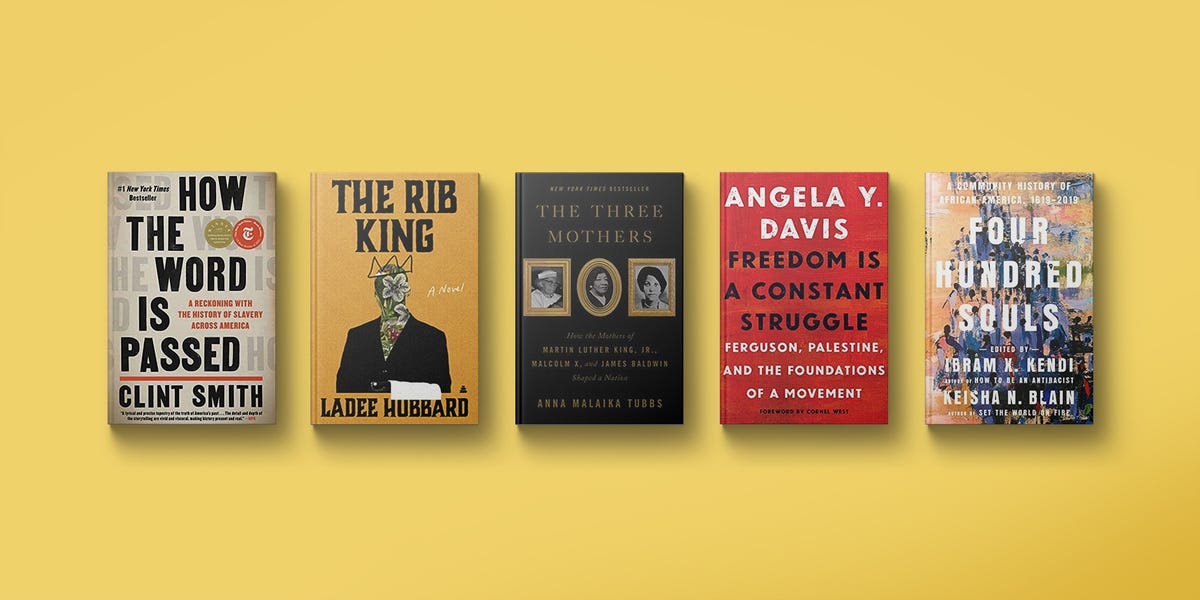
18. Four Hundred Souls edited by Ibram X. Kendi and Keisha N. Blain
This “community history” brings together many writers to tell 400 years of African American history in short, focused chapters. The structure makes it easy to read in pieces while still building a broad historical arc. It is especially useful for book clubs, classrooms, and readers who like variety without sacrificing depth.
19. Barracoon by Zora Neale Hurston
Based on Hurston’s interviews with Cudjo Lewis, one of the last known survivors of the transatlantic slave trade, Barracoon is a rare and intimate historical document. Hurston preserves voice, memory, grief, humor, and cultural survival. It is not a conventional history book, but that is exactly why it matters.
20. The Half Has Never Been Told by Edward E. Baptist
Baptist’s book examines slavery’s central role in the growth of American capitalism. It connects forced labor, cotton, finance, expansion, and national wealth. The book is challenging, but it helps readers understand slavery not as a regional tragedy sealed in the past, but as a system tied to the economic development of the United States.
How to Choose the Right Black History Book for You
If you are new to Black history books, begin with a topic that already interests you. Love biography? Start with Frederick Douglass, Malcolm X, or Baldwin. Interested in cities and housing? Choose The Warmth of Other Suns and The Color of Law. Curious about medicine and public health? Read Medical Apartheid. Want a broad overview? Four Hundred Souls or A Black Women’s History of the United States will give you a strong foundation.
Another smart approach is to pair books. Read Narrative of the Life of Frederick Douglass with Incidents in the Life of a Slave Girl to compare gender, literacy, and escape. Pair The New Jim Crow with The Color of Law to understand how law shapes life after the law books supposedly change. Read The Fire Next Time beside Between the World and Me and notice how two generations speak to America with different rhythms but similar urgency.
Reading Black History Without Turning It Into Homework
Let us be honest: some history books are thick enough to qualify as home fitness equipment. But reading Black history does not have to feel like punishment with footnotes. Try reading one chapter a day. Keep a notebook of names and questions. Watch a documentary after finishing a book. Join a discussion group. Read aloud when the prose deserves it, especially Baldwin, Douglass, and Du Bois. Some sentences were clearly built to leave the page and walk around the room.
Most importantly, do not read only to “be informed.” Read to be changed. A good Black history book should sharpen your memory, complicate your assumptions, and make the world look less accidental. Inequality has a history. So does resistance. So does joy.
Personal Reading Experiences: What These Books Teach Beyond the Page
Reading the best Black history books is often less like checking titles off a list and more like entering a long conversation where every author pulls up a chair. The first experience many readers have is surprise: not because the facts are obscure, but because so many of them were sitting in plain sight, politely ignored by traditional textbooks. You start to notice how often history was trimmed to fit a comfortable frame. Then a book like The Warmth of Other Suns comes along and widens the frame until entire families, train stations, kitchens, factory floors, and city blocks walk into view.
One of the strongest experiences these books offer is the feeling of connection. A reader may begin with policy and end with people. The Color of Law is about housing discrimination, yes, but it also changes how you look at a street, a school district, a mortgage, or a city map. Medical Apartheid is about medical ethics, but it also makes present-day conversations about trust sound less like confusion and more like memory. The New Jim Crow is about incarceration, but it pushes readers to ask how freedom can be limited long after a sentence ends.
Another experience is humility. Black history books remind us that courage is often more complicated than a statue suggests. Frederick Douglass did not become Douglass in a single dramatic moment. Malcolm X changed across time. Black women organizers carried movements while history often handed the microphone to someone else. Harriet Jacobs made impossible choices under impossible pressure. These stories resist the easy hero poster. They give us people instead: strategic, tired, brilliant, flawed, determined, and alive on the page.
Readers may also experience discomfort, and that is not a sign to stop. Discomfort can be the mind stretching. These books challenge familiar national myths: that progress is automatic, that racism is only personal prejudice, that education is always neutral, that neighborhoods simply “happen,” or that the past politely stays in the past. Spoiler alert: the past has terrible boundaries. It keeps texting the present.
But the experience is not only heavy. There is also admiration. There is the thrill of Baldwin’s sentences, the precision of Wilkerson’s storytelling, the intellectual architecture of Du Bois, the archival detective work of modern historians, and the deep humanity of Hurston listening carefully to Cudjo Lewis. Reading Black history can feel like discovering a hidden power grid beneath American culture. Suddenly music, food, law, sports, literature, religion, education, and politics connect in new ways.
The best reading experience comes when you let these books speak to one another. Put an older classic beside a modern work. Read a memoir after a policy book. Follow a historical overview with a focused study of women, health, housing, or migration. Over time, Black history stops being a shelf and becomes a lens. You do not just know more facts; you see more clearly. And once that happens, even the everyday world starts looking annotated.
Conclusion
The best Black history books are not just books about the past. They are tools for understanding the present and imagining a more honest future. From Frederick Douglass’s 19th-century testimony to modern studies of housing, incarceration, medicine, and migration, these essential books about Black history show how deeply Black life has shaped the United States.
If you are building your reading list, do not worry about finishing everything at once. Start with one book that calls to you. Then let it lead to the next. History, like a good library, rewards curiosity. And thankfully, unlike a group project, these authors have already done the hard part.