Your car’s differential is one of those hardworking parts that gets almost no attention until it starts humming, whining, leaking, or making every slow turn feel like a mechanical soap opera. That is a shame, because the differential plays a huge role in how your vehicle handles corners, sends power to the wheels, and survives the daily grind of commuting, hauling, towing, and the occasional pothole that looks suspiciously like a crater.
If you want long-term performance from your car, truck, SUV, or AWD crossover, differential maintenance deserves a spot on your automotive to-do list. The good news is that this is not complicated once you understand the basics. Most differential problems start the same way: old fluid, wrong fluid, low fluid, ignored leaks, or a driver who hears a strange noise and says, “That seems fine,” right before the repair bill arrives.
This guide explains how to maintain your car’s differential the smart way, including fluid changes, leak checks, warning signs, severe-service habits, and common mistakes to avoid. Whether you drive a daily commuter, a family SUV, a 4×4 truck, or an AWD vehicle that sees snow and road trips, these tips can help keep the gears inside your differential happy for the long haul.
What the Differential Actually Does
In plain English, the differential allows the wheels on the same axle to rotate at different speeds. That matters because when you turn, the outside wheel travels farther than the inside wheel. Without a differential, your tires would scrub, your drivetrain would complain loudly, and smooth cornering would become a distant memory.
Depending on the vehicle, you may have a rear differential, a front differential, or both. Many AWD and 4WD vehicles also have additional drivetrain components that work alongside the differentials, such as a transfer case or center coupling. More hardware means more opportunities for excellent traction, but also more fluid-filled parts that need proper maintenance.
Some vehicles use open differentials, while others use limited-slip or electronically controlled designs. That detail matters because different differential types may require different lubricants, friction modifiers, or service procedures. Translation: this is not the place for “close enough.”
Why Differential Maintenance Matters More Than Drivers Think
The differential lives a hard life. Inside the housing, gears and bearings work under load, heat, and friction. Over time, the gear oil breaks down, additives wear out, and tiny metal particles build up in the fluid. If the vehicle tows, climbs mountains, carries heavy loads, drives in deep water, or sees long highway miles in hot weather, the fluid has an even tougher job.
Fresh differential fluid does several important things at once. It lubricates the ring and pinion gears, protects bearings, helps reduce heat, and cushions the metal surfaces that are constantly meshing under pressure. When that fluid gets old or contaminated, wear speeds up. That can lead to noise, poor performance, overheating, gear damage, or, in the worst case, a very expensive failure that ruins your week and your budget.
In other words, changing differential fluid on time is a lot cheaper than replacing gears, bearings, seals, or an entire axle assembly. It is preventive maintenance in its purest, most wallet-friendly form.
The Smart Maintenance Routine for Long-Term Differential Performance
1. Follow the Owner’s Manual Before You Follow Anybody Else
The first rule of differential care is simple: trust the maintenance schedule and lubricant specification for your exact vehicle. Service intervals vary widely. One model may only call for inspection under normal driving, while another may call for a fluid replacement at a specific mileage. Severe driving conditions can also shorten the interval dramatically.
That means there is no universal “change it every X miles” answer that fits every vehicle on the road. If your manual gives a mileage or time interval, follow it. If it separates “normal” and “severe” service, pay attention. Many drivers accidentally qualify for severe service without realizing it.
2. Know Whether You Drive Under Severe Conditions
Severe service does not always mean desert racing or fording rivers like a commercial. It can include repeated towing, mountain driving, low-speed operation under load, deep snow, muddy conditions, stop-and-go driving with extra weight, or frequent short trips where drivetrain components never fully stabilize.
If you tow a trailer, carry heavy cargo, climb steep grades, or drive an AWD or 4WD vehicle in demanding conditions, your differential fluid may need to be changed much sooner than under gentle commuter use. This is one of the biggest reasons differentials get neglected: the owner assumes their driving is “normal,” while the vehicle quietly disagrees.
3. Use the Exact Fluid Specification
Gear oil is not a one-size-fits-all product. Different vehicles may require different viscosities, API ratings, synthetic formulas, or limited-slip-compatible lubricants. Some clutch-type limited-slip differentials also require a friction modifier or a gear oil that already includes the correct additive package.
Using the wrong fluid can lead to chatter in turns, abnormal wear, heat buildup, noise, or poor protection under load. That is why “I had a bottle in the garage” is not a maintenance strategy. When servicing the differential, match the fluid to the exact spec listed by the manufacturer, including whether a friction modifier is required.
4. Check for Leaks Before Fluid Becomes a Bigger Problem
Differentials do not consume fluid the way engines can consume oil. So if the fluid is low, something is usually leaking. Common leak points include axle seals, pinion seals, cover gaskets, drain plugs, and fill plugs. A small seep today can become a low-fluid disaster later, especially if the vehicle is driven hard or used for towing.
Look for wetness around the differential housing, fluid collecting near the axle ends, or spots on the driveway that smell like gear oil. Differential oil has a strong odor that does not exactly whisper “luxury.” If you spot a leak, do not just top it off and forget it. Fix the source.
5. Listen to the Sounds Your Drivetrain Is Making
Your differential often complains before it fails. A whining sound during acceleration or deceleration, clunking when the vehicle moves, rumbling at speed, vibrations through the floor, or binding and chatter during turns can all point to differential trouble or related drivetrain wear.
Not every strange noise means the differential is dying, but ignoring the warning signs is how small issues become giant repair estimates. If the sound changes with speed, load, or cornering, have it diagnosed sooner rather than later.
6. Do Not Ignore the Related Parts
Good differential maintenance is not only about fluid. It also means paying attention to the parts that work with it, including axle shafts, driveshaft components, U-joints, CV joints, mounts, and wheel bearings. Sometimes what sounds like a bad differential turns out to be a worn bearing or joint. Sometimes a failing supporting part puts extra stress on the differential itself.
That is why a complete drivetrain inspection is smart if you notice vibration, leaks, clunks, or tire wear that seems unusual.
7. Keep Service Records
This sounds boring because it is boring, but it is also useful. Record when the differential fluid was changed, what fluid was used, whether friction modifier was added, and whether any leaks or seal replacements were addressed. Good records help with future maintenance, support resale value, and prevent the classic mystery of “I think it was done a while ago?”
When Should You Change Differential Fluid?
The honest answer is: when your manufacturer says to. The practical answer is: sooner if your use is tough. Many vehicles fall somewhere in the broad range of occasional inspection under normal service, replacement around longer maintenance intervals, or much more frequent service under towing, mountainous driving, off-road use, or repeated heavy loads.
A smart owner does not guess. A smarter owner checks the manual, then adjusts for reality. If your vehicle works hard, your fluid works hard too. Treat severe use like severe use, not like a light Sunday cruise to buy coffee and regret your spending habits.
Warning Signs Your Differential Needs Attention
- Whining or howling noises: especially when accelerating or decelerating.
- Clunking sounds: often noticeable when taking off, shifting, or during low-speed motion.
- Vibration: felt through the seat, floor, or driveline, especially as speed increases.
- Chatter during turns: common when limited-slip fluid or additive needs are not being met.
- Fluid leaks: around the differential housing, seals, or plugs.
- Burnt smell or dirty fluid: a sign the lubricant may be overheated or overdue.
- Tire scrub or binding in corners: a clue that the differential is not behaving normally.
If you notice one symptom, do not panic. If you notice two or three, stop pretending your car is just “developing personality.” Get it checked.
DIY Differential Maintenance vs. Professional Service
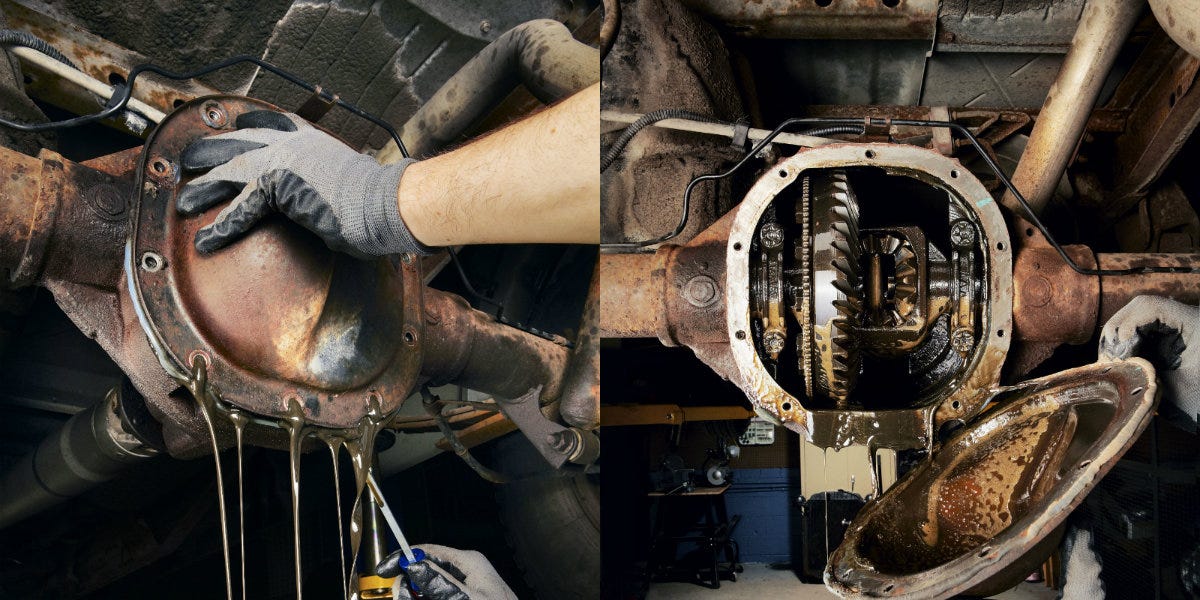
If you are comfortable working on cars, a differential fluid change can be a manageable DIY job on some vehicles. The basics usually include safely lifting the vehicle level, removing the fill plug first, draining the old fluid, cleaning any debris from the magnet if equipped, reinstalling the drain plug or cover correctly, and refilling with the exact specified amount and type of lubricant.
But there are good reasons to let a professional handle it. Some vehicles have awkward access, special procedures, torque requirements, or electronic systems tied to the drivetrain. A shop can also inspect for metal contamination, seal leaks, mount wear, damaged fasteners, and related problems while the vehicle is on the lift.
If your differential is already noisy, leaking badly, chattering, or vibrating, skip the guesswork and get a proper diagnosis instead of simply swapping fluid and hoping for magic.
Best Habits That Help a Differential Last Longer
- Change the fluid on schedule, not after the symptoms show up.
- Shorten intervals if you tow, haul, climb, or drive in harsh conditions.
- Use the exact fluid spec and correct additive requirements.
- Inspect the housing, seals, and plugs for leaks during routine service.
- Address drivetrain noise early while it is still a repair, not a rebuild.
- Avoid shock-loading the drivetrain with aggressive launches when possible.
- After deep-water exposure or hard off-road use, inspect the axle and fluid sooner.
- Keep the rest of the drivetrain healthy, because the differential does not work alone.
Common Differential Maintenance Mistakes to Avoid
Using the wrong gear oil: This is the classic error. Wrong viscosity, wrong rating, or missing friction modifier can cause noise and wear.
Ignoring small leaks: Small leaks become low fluid. Low fluid becomes expensive.
Waiting for dramatic symptoms: By the time the whining becomes loud, the internal wear may already be advanced.
Assuming all vehicles have the same interval: They do not. A truck used for towing and an urban commuter crossover do not live the same life.
Overlooking front differentials on AWD/4WD vehicles: Owners often remember the rear differential and forget the front one exists.
Skipping inspections during towing season: Towing adds stress to axle lubricant, seals, and gears. If you tow regularly, your maintenance routine should reflect that.
Practical Experiences Drivers Often Have With Differential Maintenance
One of the most common real-world experiences is that drivers do not think about the differential until a sound shows up. It usually starts small. Maybe there is a faint hum at 40 mph, a soft clunk when backing out of the driveway, or a weird chatter on tight turns in a parking garage. Most people do exactly what humans have done since the invention of expensive machines: they turn the radio up a little and hope the sound has a short life expectancy. Sadly, the sound is usually more committed than that.
Another common experience happens with used vehicles. A driver buys a used SUV or pickup that seems solid, the engine sounds fine, the transmission shifts okay, and everything feels normal on a quick test drive. Then a few months later, a shop opens the differential and finds dark, tired fluid that probably should have retired several road trips ago. This is why many experienced owners like to baseline their fluids after buying a used vehicle. It removes the guesswork and gives the drivetrain a clean starting point.
Towing also changes the story fast. Owners who start pulling a camper, boat, or utility trailer often notice that maintenance suddenly matters more than it used to. The vehicle may still drive fine, but the differential is working harder every mile. People who tow regularly tend to learn the same lesson: what counts as “normal” service on paper can become “work truck life” in the real world. Once they shorten their fluid service intervals, problems often become much less dramatic.
AWD owners have their own version of this lesson. Many assume the vehicle is mostly maintenance-free because it feels refined and easy to drive. Then they discover that smooth all-weather traction still depends on lubricants, seals, and service intervals. A quiet AWD system can hide neglect for a long time, which is nice until it suddenly is not.
There is also the limited-slip differential experience, which usually sounds like this: “My car feels strange in turns after the fluid change.” In many cases, the issue is not that the differential is failing. It is that the wrong fluid was installed, or the required additive was missed. This is one of those moments when exact specifications stop sounding picky and start sounding very smart.
Finally, many drivers who stay on top of differential maintenance report something wonderfully unexciting: nothing happens. No howl, no leak, no chatter, no giant repair bill, no dramatic tow truck entrance. And honestly, that is the dream. Good maintenance is often invisible. It does not create fireworks. It creates years of quiet, dependable performance. In the car world, boring can be beautiful.
Conclusion
If you want to maintain your car’s differential for long-term performance, the formula is simple: use the correct fluid, service it on schedule, inspect for leaks, pay attention to noise and vibration, and adjust your maintenance routine if your vehicle tows, hauls, climbs, or works hard. The differential may not be the flashiest part of your vehicle, but it is absolutely one of the parts that rewards consistency.
Take care of it before it complains, and your car will corner smoother, run quieter, and stand a much better chance of avoiding costly drivetrain repairs down the road. Ignore it long enough, and it will eventually send you a mechanical reminder with interest.