Spoiler warning: This article discusses major plot points from South Park Season 27 and Season 28, including the Season 28 finale, “The Crap Out.”
South Park has never been a show that politely knocks before entering the room. It kicks the door open, tracks mud across the carpet, insults the furniture, and somehow leaves behind a point sharp enough to make everyone uncomfortable. That is exactly what happened when the long-running Comedy Central series wrapped its wild Trump-focused Season 27/28 storyline with a dark, perfectly timed Jeffrey Epstein joke.
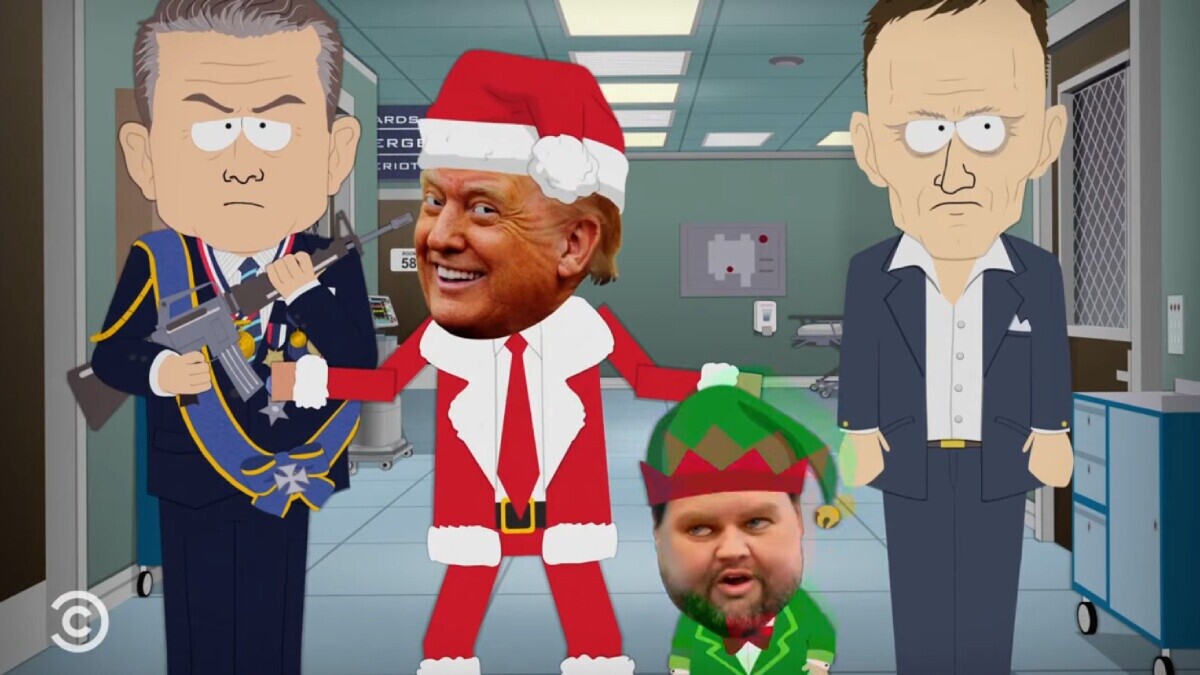
The animated satire spent much of its recent run building an absurd political soap opera around a fictionalized Donald Trump, Satan, JD Vance, Peter Thiel, Jesus, Fox News, and an unborn Antichrist. On paper, that sounds like a sentence written by a fever dream wearing a red hat. On screen, it became one of the show’s most aggressive extended political arcs in years.
By the time “The Crap Out” arrived, the story needed an ending big enough to match the madness. Instead of going louder, South Park went darker. The finale revealed that Satan and Trump’s unborn baby had apparently died by suicide in the womb, with a conveniently missing stretch of ultrasound footage. The joke was unmistakable: a direct parody of the public controversy, conspiracy theories, and media obsession surrounding Jeffrey Epstein’s death and surveillance footage.
It was shocking, tasteless, timely, and structurally neat. In other words, it was pure South Park.
How the Trump–Satan Arc Took Over Seasons 27 and 28
The Trump storyline began in Season 27 with “Sermon on the ’Mount,” an episode that immediately announced the show’s return to full-force political satire. The premiere featured Trump in a bizarre relationship with Satan, mocked corporate media pressure, referenced Paramount, and played with the idea that politics had become impossible to separate from entertainment.
That last part matters. South Park has always fed on whatever the culture cannot stop arguing about. In the late 1990s, that meant censorship, moral panic, and celebrity culture. In the 2000s, it meant religion, war, cable news, and internet chaos. In 2025, the show looked around and saw that politics was no longer just politics. It was branding, fandom, livestreaming, outrage marketing, meme fuel, and late-night monologue material.
So the show leaned in. Hard.
Across Season 27, the fictional Trump became less of a guest target and more of a recurring engine for the season’s chaos. The writers pushed the character through scandals, public spectacle, media spin, and increasingly grotesque attempts to avoid consequences. The arc escalated in “Wok Is Dead,” where Satan’s pregnancy was revealed, turning the Trump parody into a full-blown demonic family drama. By “Conflict of Interest,” Trump was trying to sabotage the pregnancy through increasingly cartoonish schemes, while JD Vance enabled the panic from the sidelines.
Season 28 then picked up the nightmare baton. “Twisted Christian” pushed the Antichrist angle. “The Woman in the Hat” used Stan’s complaints about the show becoming too political as a meta-commentary on the audience itself. “Sora Not Sorry” mixed AI deepfakes with political scandal, showing how easily reality and fake footage can melt into the same disgusting soup. By the finale, South Park had created a story world where every institution was compromised, every truth was mediated through screens, and every scandal came with a built-in excuse.
That is why the Jeffrey Epstein joke was not random. It was the logical punchline.
What Happens in “The Crap Out”?
“The Crap Out” is framed as a Christmas episode, which is already funny because nothing says holiday warmth like Satan preparing to give birth to the Antichrist while Trump and Vance scramble for damage control. The finale brings together several running pieces: Stan wants a Christmas miracle, Satan is emotionally invested in the baby, Trump wants out of responsibility, and Jesus has drifted into a strange political alignment that needs correcting.
At the White House, Satan prepares a nursery and appears ready to carry the pregnancy to term. Trump, meanwhile, is not exactly glowing with fatherly pride. He and Vance are involved in a plan to stop the birth, with Peter Thiel pulled into the plot after earlier chaos. Satan eventually learns about Trump’s betrayal and his affair with Vance, creating a rare moment where the show lets Satan be the wounded party rather than the villain.
Then comes the twist. The baby has died. The explanation? The fetus supposedly got hold of bedsheets and killed itself. The doctor says the video shows what happened, except for a couple of missing minutes. Fox News then analyzes the ultrasound in a way that treats the missing footage not as suspicious, but as confirmation that everything is perfectly normal.
The gag works because it compresses years of Epstein-related discourse into a single grotesque cartoon image. The real Jeffrey Epstein died in federal custody in 2019 while awaiting trial on sex-trafficking charges. His death was officially ruled a suicide, but missing, lost, disputed, or confusing surveillance footage became one of the biggest reasons the public remained skeptical. South Park takes that real-world atmosphere of distrust and turns it into an ultrasound joke so dark it practically needs its own tiny flashlight.
Why the Jeffrey Epstein Joke Lands So Hard
The joke is not subtle. A fetus, bedsheets, a missing-video gap, a media outlet rushing to validate the official story: the pieces are arranged like a neon sign. But South Park has rarely been interested in subtlety when blunt force trauma will do.
What makes the gag effective is not just the Epstein reference. It is the way the joke comments on narrative control. The finale asks a simple question: when powerful people benefit from an outcome, how quickly do institutions, media voices, and loyal supporters decide that no further questions are necessary?
That is the real target. The episode is not making a factual claim about Epstein’s death or accusing specific people of a real crime. It is parodying the cultural machine around suspicious explanations. When something outrageous happens, the public often does not simply debate the facts. It debates who gets to define reality. Was there missing footage? Was the footage missing for a technical reason? Who benefits from the explanation? Why does every answer feel like it came from a printer jammed with shredded documents?
South Park turns that whole information crisis into a ridiculous medical update. The ultrasound “craps out,” and suddenly the impossible becomes official. The absurdity is the point.
The Finale Gives Trump a “Miracle” and Satan the Tragedy
One of the smartest parts of “The Crap Out” is that the show does not let the finale become only a gross-out gag. Trump celebrates. Satan grieves. That contrast gives the ending its bite.
The fictional Trump treats the baby’s death as a political and personal victory. In the show’s logic, he has dodged responsibility again. The institutions around him help package the result as a miracle, or at least as something not worth questioning. Meanwhile, Satan looks back at the nursery and realizes he ignored every warning sign. He thought he might be treated differently. He was not.
That emotional beat matters because it prevents the episode from being only a headline-chasing stunt. South Park has used Satan for decades as a surprisingly tender character. He is ridiculous, dramatic, needy, and sometimes morally clearer than the humans around him. By making Satan the one who feels betrayed, the show flips the expected good-versus-evil script. The devil has a heart. The politicians have strategy.
It is a cruel joke, but it is not an empty one.
Why Fox News Parody Is Central to the Episode
The Fox News parody in “The Crap Out” is not just background noise. It is part of the punchline’s machinery. The show uses a fictional news segment to demonstrate how quickly media interpretation can turn uncertainty into certainty when the conclusion is politically convenient.
The fake broadcast does not treat the missing ultrasound footage as a red flag. Instead, it becomes part of the proof. The logic is backward, which is exactly why it feels familiar. In modern media culture, people often do not begin with evidence and then form a conclusion. They begin with a conclusion and then go shopping for evidence that fits like a cheap Halloween costume.
South Park has spent years mocking media ecosystems on both the right and left, but the Trump–Satan arc focuses heavily on the conservative media bubble because that is where this specific storyline lives. The show is less interested in one network alone than in the broader ritual of spin: take the absurd, flatten it into talking points, repeat it until it sounds official, and then accuse everyone else of being hysterical.
That is why the missing footage joke feels like such a clean closer. It transforms conspiracy, propaganda, scandal management, and political loyalty into one disgusting little news package.
Season 27/28 as a Meta-Joke About South Park Itself
One of the funniest moves in Season 28 was having Stan complain that South Park had become too political. That line was not just a joke aimed at critics. It was the writers admitting they could hear the audience groaning from the couch.
Some fans love when South Park goes straight at politics. Others prefer episodes about the boys doing dumb kid stuff, like launching schemes that spiral into town-wide disaster. The Trump arc intentionally walks into that tension. It asks whether the show can still be about childhood when adult politics has infected every corner of life, including schools, toys, apps, social media trends, and family conversations.
That is where the Season 27/28 arc becomes more interesting than a string of Trump jokes. The show is aware that it is trapped in the same culture it mocks. It wants to do classic South Park stories, but every road leads back to political spectacle. Even a Labubu doll plot becomes a tariff joke. Even a school betting-app story becomes a Gaza, FCC, and prediction-market satire. Even a Christmas episode becomes a referendum on accountability and media spin.
The finale’s Epstein gag functions as an escape hatch. It closes the pregnancy arc with a joke so outrageous and complete that the writers can step away from it. Whether they actually will is another question. This is South Park, after all. Closure is just a setup for the next mess.
The Joke Works Because It Is About Public Trust
At its core, the finale is about trust. Not trust in Trump specifically, not trust in Fox News specifically, and not even trust in any single official explanation. It is about the broader collapse of shared reality.
That collapse has been one of South Park’s favorite modern subjects. The show has mocked AI deepfakes, online mobs, corporate cowardice, celebrity politics, and the way institutions speak in polished nonsense while everything burns behind them. The Epstein-style ultrasound joke fits into that larger theme because it captures the public’s reflexive suspicion: if the footage is missing, the story is already broken.
And that is where the joke becomes bigger than the plot. The missing footage is not just a reference. It is a symbol. It stands for every edited clip, every “technical error,” every carefully worded statement, every scandal that evaporates into process language, and every viewer left wondering whether reality has been run through a legal department before broadcast.
In that sense, the joke is perfect because it is both stupid and sophisticated. It is a fetus with bedsheets. It is also a miniature thesis on political impunity. Congratulations, America: your media literacy exam has been delivered by a cartoon devil’s ultrasound.
Why This Ending Satisfies Both Fans and Critics
The finale does something surprisingly efficient: it gives fans of the Trump arc a huge payoff while giving exhausted viewers a possible off-ramp. If you loved the season’s political insanity, the Epstein joke is the grand finale you were waiting for. If you were tired of Trump, Satan, Vance, and the Antichrist, the joke clears the board.
That is why the ending feels so carefully engineered. The baby was the arc’s ticking time bomb. As long as Satan was pregnant, the show had to keep returning to the White House storyline. By ending the pregnancy with a dark joke about missing footage, Parker and Stone resolve the central conflict while also making the resolution feel suspicious, cynical, and very funny.
The result is a finale that does not simply stop the story. It comments on the way stories are stopped. In politics, scandals rarely end because everyone gets the truth. They end because attention moves on, institutions declare closure, supporters accept the preferred version, and critics are left yelling into the algorithmic void.
South Park understands that. It built an entire finale around it.
The Bigger Meaning Behind the Perfect Epstein Joke
Calling the joke “perfect” does not mean it is tasteful. It is not. It is deliberately offensive, and many viewers will reasonably find it too dark. But comedy does not always work by being polite. Sometimes it works by forcing audiences to confront why a reference is instantly recognizable.
Everyone understands the Epstein joke because the public discourse around Epstein’s death became a shorthand for distrust. The phrase, the memes, the missing footage stories, the official explanations, the counterclaims, the political finger-pointingall of it formed a cultural package. South Park did what it often does best: it grabbed that package, shook it violently, and made the ugliest possible Christmas ornament out of it.
The finale also captures the show’s long-standing belief that nobody in power deserves reverence. Presidents, media executives, billionaires, tech figures, religious icons, and cable-news hosts all get dragged into the same sewer. The joke’s brutality is equal-opportunity in spirit, even if its immediate target is the fictional Trump’s ability to escape accountability.
That is why the arc’s ending feels like more than a cheap shock. It is a final statement on a two-season political circus: in a world where the powerful can bend stories, even the most absurd explanation can survive if enough people repeat it with confidence.
Experience Section: What It Felt Like to Watch This Arc Unfold
Watching South Park during the Season 27/28 Trump arc felt less like following a normal animated comedy and more like checking a cultural pressure gauge every two weeks. Each episode seemed to arrive with a fresh reminder that the news cycle had become too ridiculous for parody, and then the show would somehow make it more ridiculous anyway. That is a strange viewing experience. You laugh, then you pause, then you wonder whether the joke is funny because it is exaggerated or because it is barely exaggerated at all.
For longtime viewers, the arc also brought back a familiar feeling: the thrill of South Park being dangerous. Not “dangerous” in the polished marketing sense, where every streaming platform calls a mildly sarcastic comedy “fearless.” Actually dangerous. The kind of dangerous where you can almost imagine executives staring at a rough cut and asking whether anyone has updated the legal insurance. The Trump–Satan storyline had that old-school electricity, the sense that Parker and Stone were not carefully threading a needle so much as throwing the needle at a portrait of American politics.
At the same time, the arc could be exhausting. That exhaustion was part of the point. Viewers who missed the boys simply being boys were not wrong. A season packed with Trump, Satan, Vance, Thiel, Jesus, Fox News, AI videos, prediction markets, and media scandals can feel like being trapped inside a comments section with animation. But the show seemed aware of that fatigue. Stan’s complaint that everything had become political sounded like something many fans had already said out loud. The joke was not just on politics. It was on the audience’s desire to escape politics while still clicking every political headline.
The finale’s Epstein gag landed because it captured that whole experience in one moment. It was uncomfortable, fast, and instantly readable. You did not need a lecture to understand the reference. The missing ultrasound footage did all the work. It made the viewer experience exactly what the season had been building toward: the horrible little laugh that happens when satire and reality shake hands in a dark alley.
That is the peculiar power of South Park. It can make a viewer laugh at something they might not want to admit is funny, then leave them thinking about why the joke was so easy to understand. “The Crap Out” did not merely close a plotline. It recreated the sensation of living through modern political media: disbelief, outrage, spin, confusion, memes, and finally the grim realization that everyone will move on before anything feels resolved.
As a viewing experience, that is not cozy. But it is memorable. And for South Park, memorable has always mattered more than polite.
Conclusion
South Park closed its Trump-focused Season 27/28 arc with a joke that was as ugly as it was precise. By turning the death of Satan and Trump’s unborn Antichrist into an Epstein-style missing-footage gag, the show did more than chase shock value. It summarized the entire arc’s obsession with power, media manipulation, public distrust, and the magical ability of institutions to turn suspicious gaps into official explanations.
The finale may not please everyone. That has never been the job of South Park. Its job is to find the taboo, poke it with a stick, and then make the stick talk in a silly voice. “The Crap Out” did exactly that. It ended a messy political storyline with one final, radioactive punchlineand somehow, in the twisted logic of the show, it was the cleanest ending possible.