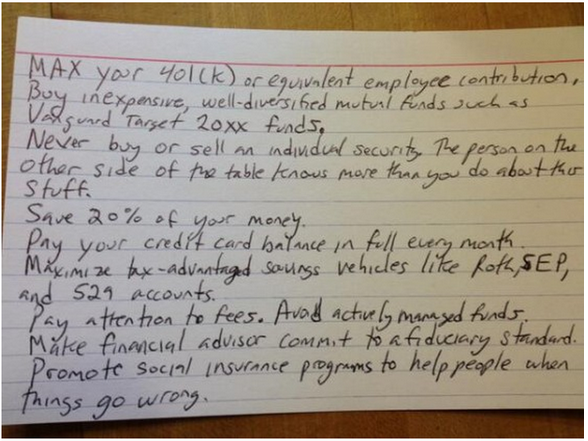
Personal finance has become an industry crowded with apps, podcasts, newsletters, gurus, charts, courses, and people shouting about the “one weird asset” that will supposedly make you rich before lunch. Yet the most useful financial advice is usually much less exciting. It is also much harder to sell because it fits on a notecard.
The notecard idea became famous after University of Chicago professor Harold Pollack argued that the essential rules of personal finance could fit on a small index card. He later developed the concept with financial journalist Helaine Olen. The appeal was not that money decisions are always easy. They are not. The appeal was that most households do not need a secret investing formula. They need a small number of sensible habits practiced for a very long time.
Research basis:
This updated notecard edition keeps that spirit while adding modern realities such as emergency savings, online fraud, rising medical costs, credit monitoring, and the temptation to turn a retirement account into a tiny casino. Grab a cardor the back of an unopened billand let us simplify your financial life.
The Financial Advice Notecard
- Spend less than you earn and automate the difference.
- Build an emergency fund before chasing exciting investments.
- Capture the full employer retirement match.
- Use tax-advantaged accounts whenever they fit your goals.
- Buy low-cost, broadly diversified investments.
- Avoid making individual stocks the foundation of your future.
- Pay credit cards in full and attack expensive debt.
- Understand every fee and every person giving you advice.
- Insure against financial disasters, not minor annoyances.
- Protect your credit, identity, and money from mistakes and scams.
That is the entire plan. Unfortunately, writing “do sensible things repeatedly” does not fill many conference halls, so let us unpack what each rule means.
1. Spend Less Than You Earnand Automate the Difference
The first rule sounds almost insultingly obvious. Income must exceed spending. Otherwise, debt or shrinking savings will eventually make the decision for you.
However, “spend less” does not mean you must live in darkness while eating generic oatmeal with a wooden spoon. It means deciding which expenses deserve your money and which ones are quietly stealing it. A budget is not punishment. It is a plan that prevents your priorities from losing a wrestling match against subscriptions, impulse purchases, and mysteriously frequent food-delivery orders.
Pay yourself before your lifestyle expands
Schedule automatic transfers on payday. Send part of each paycheck to savings, retirement, or debt repayment before the money reaches your everyday spending account. Automation turns a good intention into a default behavior.
A 20% savings rate is an admirable long-term target, but it is not a moral entrance exam. Someone beginning at 2% and increasing the rate each year is making real progress. The best savings percentage is the highest sustainable rate that does not make you abandon the plan three weeks later.
2. Build an Emergency Fund Before Chasing Exciting Investments
An emergency fund is money reserved for expenses you did not invite: a medical bill, broken transmission, urgent flight, job interruption, or water heater that chooses violence on a Sunday morning.
Without cash reserves, ordinary bad luck can become expensive debt. The Consumer Financial Protection Bureau describes emergency savings as one of the first protective steps consumers can take, while the FDIC recommends regular automatic deposits and using occasional windfalls to build the fund.
Research basis:
How much emergency savings do you need?
Begin with a starter target such as $500 or $1,000. Then work toward one month of essential expenses. A larger goal of three to six months may make sense for many households, especially when income is variable, employment is uncertain, or several people depend on one paycheck.
Keep this money somewhere safe, accessible, and separate from daily spending. A federally insured savings account is generally more appropriate than stocks because emergency money must be available when markets are having a dramatic emotional episode. Eligible deposits at an FDIC-insured bank are automatically insured within applicable limits, currently at least $250,000 per depositor, per insured bank, for each ownership category.
Research basis:
3. Capture the Full Employer Retirement Match
An employer match is part of your compensation. Failing to claim it is similar to telling your company, “Thank you, but I have already received quite enough money.”
Learn how your workplace plan operates. Some employers match a percentage of contributions up to a stated portion of pay. Others use different formulas or vesting schedules. Contribute enough to receive the full available match whenever your budget permits.
For 2026, the basic employee contribution limit for many 401(k), 403(b), and governmental 457 plans is $24,500. The IRA contribution limit is $7,500, with additional catch-up provisions for eligible older savers. These limits can change, so check current IRS guidance instead of trusting an old screenshot that has been circulating since flip phones were fashionable.
Research basis:
4. Use Tax-Advantaged Accounts Strategically
Taxes can significantly affect how much of your investment return you keep. Accounts such as traditional and Roth IRAs, workplace retirement plans, Health Savings Accounts for eligible participants, and 529 education plans may provide valuable tax advantages.
The best account depends on your income, tax situation, employer benefits, eligibility, withdrawal timeline, and goals. Traditional retirement contributions may offer a current tax benefit, while qualified Roth withdrawals can be tax-free. The details matter, but the main notecard principle is simple: do not invest exclusively through a taxable brokerage account while ignoring useful tax advantages available to you.
Choose the account before choosing the investment
People often ask, “Which fund should I buy?” before asking, “Which account should hold it?” Reverse that order. First define the goal and timeline. Next select the appropriate account. Then choose suitable investments inside it.
5. Buy Low-Cost, Broadly Diversified Investments
Diversification spreads your money across different companies, industries, and asset types. It does not guarantee a profit or prevent every loss, but it reduces the danger of allowing one company, sector, or enthusiastic CEO to determine your entire financial future.
Broad-market index funds, diversified mutual funds, exchange-traded funds, and target-date retirement funds can make diversification easier. A target-date fund may be especially useful for investors who prefer one professionally managed portfolio that gradually becomes more conservative as the target year approaches.
Research basis:
Let compound growth do the heavy lifting
Compound interest means earning returns not only on your original money but also on previous returns. Time is therefore one of an investor’s most valuable assets. Starting with modest contributions today can be more powerful than waiting for a future version of yourself who supposedly has extra cash, perfect discipline, and no surprise dental work.
Research basis:
6. Do Not Build Your Future Around Individual Stock Predictions
Buying a few individual stocks is not automatically irresponsible. Making them the foundation of your retirement is another matter.
A company can appear unstoppable and still face competition, regulation, accounting problems, technological disruption, bad management, or simple overvaluation. Employees should be particularly careful when company stock already influences their salaries, bonuses, and job security. Owning too much of the same company adds another layer of concentrated risk.
Use diversified funds for core long-term goals. Treat speculative investments as optional money that you can afford to lose without delaying retirement, missing rent, or explaining to your family that an internet stranger’s “guaranteed moonshot” experienced an unexpected gravitational event.
7. Pay Credit Cards in Full and Attack Expensive Debt
Credit cards can offer convenience, fraud protections, and rewards. They can also charge interest that overwhelms the value of every point, mile, and complimentary airport pretzel you earned.
Pay the statement balance in full by the due date whenever possible. When you already carry debt, stop focusing on rewards and start focusing on the interest rate. Continue making minimum payments on every account while sending extra money to one target debt.
Debt avalanche or debt snowball?
The debt avalanche method targets the highest interest rate first and usually minimizes total interest. The debt snowball method targets the smallest balance first, producing quicker psychological wins. Mathematically, the avalanche often wins. Behaviorally, the best system is the one you will follow until the balances are gone.
Before aggressively prepaying low-rate debt, consider whether you have a basic emergency fund and are receiving your full employer retirement match. Personal finance is a sequence of priorities, not a competition to make one number disappear at the expense of everything else.
8. Understand Fees and Anyone Giving You Advice
Investment fees may look small when expressed as percentages, but they reduce the amount of money remaining in your account to compound. Compare expense ratios, advisory fees, trading costs, administrative charges, sales loads, and other recurring expenses.
The SEC’s Investor.gov resources emphasize asking about total purchase, sale, and ongoing costs. FINRA’s Fund Analyzer also allows investors to compare how fund fees and expenses may affect account values over time. “Zero commission” does not necessarily mean zero cost; firms can earn money through other charges and services.
Research basis:
Ask the fiduciary question directly
When hiring a financial professional, ask whether the person will act as a fiduciary for you at all times and whether that commitment will be provided in writing. A fiduciary is required to manage another person’s money or property for that person’s benefit rather than the fiduciary’s own.
Research basis:
Also ask how the adviser is paid, what conflicts of interest exist, which services are included, and whether less expensive alternatives are available. A pleasant smile and an impressive office aquarium are not substitutes for transparent compensation.
9. Insure Against Financial Disasters
Insurance is designed to transfer risks that would be difficult or impossible for you to absorb personally. Health insurance, disability coverage, auto liability insurance, homeowners or renters insurance, and term life insurance for people with dependents can protect a financial plan from catastrophic loss.
Health coverage is especially important because serious medical care can create extremely high, unexpected costs. Marketplace plans also place limits on covered in-network out-of-pocket spending, although deductibles, coinsurance, networks, and exclusions still require careful review.
Research basis:
Insurance is generally less useful when it covers a tiny inconvenience you could comfortably pay for yourself. Extended warranties, narrow product-protection plans, and policies attached to inexpensive purchases can cost more than the risk deserves. Insure the financial earthquake. Save cash for the broken toaster.
10. Protect Your Credit, Identity, and Money
Review your credit reports for accounts you do not recognize, incorrect balances, outdated information, and other errors. AnnualCreditReport.com is the federally authorized website for obtaining reports from the three nationwide credit reporting companies. Free weekly online reports are currently available, and inaccurate information can be disputed without a filing fee.
Research basis:
Use strong, unique passwords, enable multifactor authentication, secure your email account, and consider a credit freeze when appropriate. Your email is often the reset key to your financial life, so protecting it with the password “password123” is roughly equivalent to locking your house and taping the key to the door.
Treat urgency as a warning sign
Investment scams commonly promise unusually high returns with little risk, pressure people to act immediately, or involve unlicensed sellers and unregistered firms. Never move money because an unexpected caller, message, social-media contact, or romantic interest insists that the opportunity will disappear within hours.
Pause, research independently, verify registrations, and discuss the proposal with someone who has no financial interest in your decision. Genuine investments can survive a night of sleep. Scams prefer you tired, excited, frightened, and clicking “send.”
Research basis:
Put the Rules in the Right Order
Financial advice becomes more practical when you apply it as a sequence rather than attempting everything at once:
- Cover essential expenses and make required minimum payments.
- Build a small emergency cushion.
- Contribute enough to receive your employer match.
- Pay down high-interest debt.
- Expand emergency savings.
- Increase retirement and long-term investing contributions.
- Fund additional goals such as education, a home, or early retirement.
Your exact order may change because of medical needs, unstable income, family responsibilities, taxes, or unusually favorable debt terms. The notecard provides direction, not individualized legal, tax, or investment advice.
As retirement approaches, review your expected spending, pension income, investment balances, health coverage, and estimated Social Security benefits. The Social Security Administration provides tools for comparing estimated benefits at different claiming ages. That estimate belongs in your plan; guessing does not.
Research basis:
A 30-Day Notecard Experiment: What It Feels Like in Real Life
The following experience is a composite example illustrating how ordinary households can apply the notecard rules.
On the first day, the notecard feels almost too simple. The imaginary participantlet us call her Mayawrites ten rules on a card and places it beside her laptop. She expects a cinematic financial transformation. Instead, she discovers three forgotten subscriptions, a retirement contribution below her employer’s matching threshold, and an impressive ability to spend $14.73 several times a week without remembering any of the purchases.
Maya does not create a budget containing 97 categories and a separate line for ceremonial candles. She reviews three months of bank and credit-card activity, identifies essential bills, and selects a realistic weekly spending amount. She cancels two subscriptions, keeps the one she actually enjoys, and automates a $40 transfer to savings every payday.
The first transfer is not glamorous. Her emergency account does not erupt in fireworks. Still, the money moves before she can spend it, which turns out to be more useful than motivation.
During the second week, Maya increases her workplace retirement contribution enough to receive the full employer match. She reviews the plan’s investment menu and realizes that she owns six funds with overlapping holdings, chosen mostly because their names sounded sophisticated. She switches future contributions to a diversified, low-cost target-date fund suitable for her expected retirement timeline. Her portfolio becomes less interesting, which is excellent. Retirement investments should ideally produce more sleep than conversation.
Next comes credit-card debt. Maya has two balances. One card has a smaller balance, while the other charges a much higher interest rate. She chooses the avalanche method, schedules minimum payments on both cards, and sends her freed subscription money to the higher-rate account. The amount is not heroic, but the system no longer depends on remembering every due date.
In week three, her car develops a suspicious noise. Previously, she might have delayed the repair or charged the entire bill. Her new emergency fund does not cover everything, but it absorbs part of the cost. The account balance falls, yet the experiment has not failed. This is precisely what emergency savings is for. She adjusts the next two months of spending and makes a plan to rebuild the fund.
The final week is devoted to financial housekeeping. Maya downloads her credit reports, corrects an outdated address, adds multifactor authentication to important accounts, updates beneficiaries on her retirement plan, and stores insurance information where her family could find it. She also checks an investment personality she has been following online. The person’s promise of enormous returns with “virtually no risk” suddenly sounds less like genius and more like a sentence the FTC would print in bold.
At the end of 30 days, Maya is not rich. Her debt has not vanished, and her retirement balance has not learned to tap dance. What changed is the structure around her money. Savings happen automatically. Fees are visible. Debt has a repayment order. Investments match a goal. Important documents are organized. Her finances require fewer daily decisions, which reduces the number of opportunities to make an expensive emotional choice.
That is the real experience of following notecard financial advice. Progress is usually quiet. It looks like an automatic transfer, a lower expense ratio, a paid statement balance, an ignored scam message, or a boring insurance policy renewed on time. None of these moments will go viral. Together, they can change a financial life.
Conclusion: Simple Advice, Repeated for Years
The best personal finance tips are not hidden behind complicated charts. Spend less than you earn. Save automatically. Build emergency reserves. Claim your employer match. Use tax-advantaged accounts. Invest in diversified, low-cost funds. Control expensive debt. Understand fees. Buy essential insurance. Protect yourself from fraud.
These rules will not eliminate every financial problem. Income matters. Housing and health-care costs matter. Family obligations, discrimination, disability, caregiving, and economic conditions matter. A notecard cannot repair an unfair system or manufacture money that is not there.
What it can do is remove unnecessary confusion. When income improves, you know where the next dollar should go. When markets fall, you have a long-term plan. When someone promises effortless wealth, you have a reason to walk away. When life produces an unpleasant surpriseas life enjoys doingyou have at least a little protection.
The notecard works because financial security is rarely built through one brilliant move. It is built through hundreds of ordinary decisions that point in the same direction.