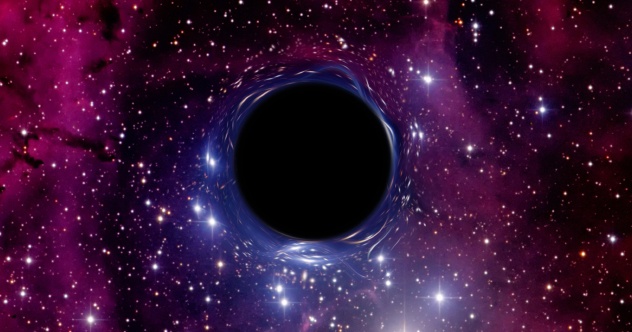
Black holes are the universe’s ultimate locked rooms. We can observe stars orbiting them, photograph the glowing material surrounding them, and detect the gravitational waves produced when two of them collide. What we cannot do is receive a postcard from the inside.
Once anything passes the event horizon, no ordinary signal can return to tell us what happened. That cosmic silence leaves physicists with equations, thought experiments, quantum paradoxes, and a collection of theories ranging from elegantly mathematical to magnificently unsettling.
Some ideas predict a crushing singularity. Others replace the traditional interior with strings, fire, holographic information, wormholes, or a newborn universe. None has been directly verified inside an astrophysical black hole, because the universe has apparently decided that peer review should have limits.
Here are 10 eerie theories about what happens inside a black hole, beginning with Einstein’s classical prediction and descending into the stranger territory of quantum gravity.
Why Nobody Knows What Happens Inside a Black Hole
A black hole is not simply a giant vacuum cleaner floating through space. It is a region where spacetime is curved so severely that, inside a boundary called the event horizon, every future-directed path leads farther inward.
The horizon is not necessarily a solid surface. For a sufficiently large black hole, an astronaut might cross it without noticing a sudden bump, flash, or “Welcome to the Black Hole” sign. However, crossing it would eliminate every possible route back to the external universe.
General relativity can describe much of this fall, but its equations eventually predict conditions so extreme that the theory appears to break down. Quantum mechanics, meanwhile, insists that physical information should not simply vanish. The disagreement between these two successful frameworks creates the black hole information paradoxand provides fertile ground for the theories below.
1. Everything Ends at a Singularity
Einstein’s Classical and Terrifying Answer
In the traditional general-relativity picture, matter that falls through the event horizon continues toward a black hole singularity. For a simple, nonrotating black hole, this singularity is often represented as a region where density and spacetime curvature become infinite.
Calling it a “point” can be misleading. Inside the horizon, reaching the singularity is less like traveling toward a location and more like moving toward an unavoidable future. Just as you cannot turn left and escape tomorrow, you cannot fire your engines and avoid the singularity once you are sufficiently deep inside.
The eerie part is that infinity usually signals a theory has been pushed beyond its proper range. Physicists generally do not believe nature literally stores infinite density in a mathematical dot. Instead, the singularity may be a warning label announcing, “Quantum gravity required beyond this point.”
Until a tested theory successfully combines gravity and quantum mechanics, the classical singularity remains both the standard answer and an admission that the answer is incomplete.
2. A Rotating Black Hole Contains a Ring and an Inner Horizon
The Kerr Black Hole Gets Complicated Quickly
Real black holes are expected to rotate. The mathematical solution describing an ideal rotating black hole is called a Kerr black hole, and its interior is much stranger than the simple spherical picture.
Instead of a pointlike singularity, the ideal Kerr solution contains a ring-shaped singularity. It also includes an inner boundary known as a Cauchy horizon, beyond which the equations allow deeply peculiar extensions of spacetime.
In an untouched mathematical model, those extensions can resemble paths toward other regions of spacetime. Science-fiction writers understandably saw this and immediately packed snacks. Unfortunately for interstellar tourism, real black holes are not perfectly isolated equations. They absorb radiation, dust, and disturbances from their surroundings.
Many calculations suggest that energy becomes violently amplified near the inner horizon through a process called mass inflation. The elegant inner passage may therefore become unstable, replacing a tidy cosmic gateway with a catastrophe of extreme radiation and curvature.
The Kerr interior remains important because it shows that the inside of a rotating black hole may be dynamically chaotic rather than a simple empty chamber ending at one central point.
3. Black Hole Complementarity Creates Two Conflicting Realities
Both Stories May Be CorrectBut Never Comparable
Black hole complementarity proposes that the infalling observer and the distant observer can tell apparently contradictory stories without producing a measurable contradiction.
From the astronaut’s perspective, crossing the event horizon of a large black hole might be locally uneventful. The astronaut continues inward, carrying matter and information through the horizon.
From the distant observer’s perspective, the astronaut’s information may be absorbed, scrambled, and effectively stored near a stretched horizon just outside the true event horizon. It can later be returned in highly scrambled Hawking radiation.
This sounds suspiciously like the astronaut has been copied: one version falls inside while another version remains encoded outside. Quantum mechanics strongly objects to perfect copying. Complementarity avoids the problem by arguing that no single observer can verify both copies. The exterior observer cannot inspect the interior, while the falling observer cannot return to compare notes.
Reality, in this view, depends on which side of the horizon describes it. The universe keeps its accounting consistent by ensuring that the two witnesses can never meet for coffee.
4. A Firewall Burns Everything at the Event Horizon
The “No Drama” Rule May Be Dramatically Wrong
General relativity predicts that a freely falling observer should experience nothing locally extraordinary while crossing a sufficiently large event horizon. This expectation is commonly called the no-drama principle.
The black hole firewall proposal throws that principle directly into an incinerator.
The argument grew from a conflict involving quantum entanglement. An outgoing particle of late Hawking radiation appears to need entanglement with both the earlier radiation and a partner mode behind the horizon. Quantum entanglement, however, cannot be freely shared among multiple independent systems in that way.
One possible escape is to break the entanglement across the horizon. Doing so could release enormous amounts of energy, producing a wall of high-energy particles at or near the event horizon.
An astronaut expecting a peaceful horizon would instead encounter a lethal quantum furnace. The firewall would destroy the smooth interior predicted by classical relativity and preserve certain rules of quantum information at a horrifying price.
Whether firewalls exist remains controversial. No accepted model has established that real black holes possess literal burning boundaries. Still, the firewall paradox demonstrates how difficult it is to preserve quantum mechanics, a smooth horizon, and ordinary spacetime locality simultaneously.
5. The Interior Is Encoded on a Holographic Boundary
A Three-Dimensional World Written in Two Dimensions
The holographic principle suggests that the information contained within a region of space can be represented by data associated with its boundary. This idea was strongly motivated by black hole entropy, which is proportional to the area of the event horizon rather than the volume behind it.
That is bizarre. In everyday life, storage capacity usually scales with volume. A large warehouse holds more boxes than a painted outline of the warehouse. Black holes seem to follow a different inventory system.
In holographic models, the black hole interior may emerge from quantum information encoded on a lower-dimensional boundary. The objects, distances, and gravitational geometry inside could be comparable to a three-dimensional image reconstructed from a two-dimensional surface.
This does not mean the interior is “fake.” Temperature and pressure are emergent properties too, yet touching a hot stove remains an effective way to regret your decisions. Instead, holography suggests that spacetime itself may not be fundamental. It may arise from a deeper network of quantum relationships.
If this theory captures reality, falling into a black hole could mean becoming part of information stored in a form radically different from the space you thought you occupied.
6. Information Islands Put Part of the Interior Outside
The Map of Reality Changes During Evaporation
Recent work on the black hole information paradox has produced one of the strangest modern ideas: information islands.
Hawking’s original calculation suggested that the entropy of emitted radiation would keep increasing until the black hole disappeared, leaving information apparently destroyed. A unitary quantum process should instead follow a Page curve. Radiation entropy rises initially, peaks, and then falls as information gradually becomes recoverable.
Calculations involving quantum extremal surfaces and replica wormholes can reproduce that Page curve. After enough evaporation, a region inside the black holean islandmust be included when calculating the quantum information contained in the external radiation.
In technical terms, the island becomes part of the radiation’s entanglement wedge. In less technical terms, a portion of what appears geometrically “inside” belongs to the information accessible from “outside.”
The theory does not offer a practical extraction device. Nobody is downloading a lost spaceship from Hawking radiation next Tuesday. Decoding the information may require an impossibly complex computation. Nevertheless, the island formula suggests that the boundary between interior and exterior is not as absolute in quantum gravity as classical geometry makes it appear.
7. The Interior Is Connected to Radiation by Wormholes
ER=EPR Links Geometry and Entanglement
The ER=EPR conjecture proposes a deep relationship between Einstein-Rosen bridges, or wormholes, and Einstein-Podolsky-Rosen entanglement.
Applied to black holes, the idea suggests that quantum entanglement between the black hole and its Hawking radiation may have a geometric description involving tiny, generally nontraversable wormhole connections.
This is not the familiar movie tunnel through which a spacecraft flies while the soundtrack becomes inspirational. Most versions do not permit usable faster-than-light travel. Instead, the wormholes represent how distant quantum systems are linked.
As a black hole emits radiation, its interior could become connected to an increasingly elaborate network of entangled particles outside. The interior would not be an isolated vault. It would be woven into the radiation through quantum geometry.
This proposal may help reconcile a smooth horizon with information preservation, but it remains conjectural. Its appeal comes from joining two of physics’ strangest featureswormholes and entanglementand suggesting they may be different languages describing the same underlying structure.
8. There Is No Empty InteriorOnly a Fuzzball
String Theory Replaces the Traditional Black Hole
The fuzzball theory proposes that a black hole is not an empty region with all its mass hidden at a central singularity. Instead, it is a complicated quantum object composed of strings and branes spread across a region roughly as large as the would-be horizon.
Imagine replacing the classic black hole with an enormous ball of tangled quantum string. The name “fuzzball” sounds like a rejected pet toy, but the underlying mathematics is serious.
Each possible fuzzball configuration represents a different microscopic state. The vast number of these states may account for black hole entropy. Because the fuzzball has physical quantum structure extending to its surface, radiation can carry information away without requiring information to emerge from a forbidden classical interior.
In many versions, there is no ordinary event horizon and no smooth, empty region behind it. An infalling object would encounter complex stringy structure near the location where classical relativity predicts a horizon.
Fuzzballs offer a concrete information-preserving mechanism within string theory, especially for certain idealized black holes. The challenge is showing that the full picture accurately describes the large, messy, rotating black holes found in our universe.
9. Quantum Gravity Creates a Planck Star and a White-Hole Bounce
Collapse May Reverse Before Reaching Infinity
Loop quantum gravity and related approaches suggest that matter may never reach an infinite-density singularity. Instead, quantum properties of spacetime could generate an effective repulsion when density approaches the Planck scale.
The collapsing matter would form an extremely compressed state sometimes called a Planck star. Rather than ending, the collapse could bounce and eventually transition into a white holethe time-reversed cousin of a black hole.
A black hole allows matter to enter but not leave. A theoretical white hole allows matter to leave but not enter. Combining the two creates a cosmic version of holding your breath for an absurdly long time and then exhaling everything at once.
Relativistic time dilation makes the scenario especially eerie. From the perspective of matter deep inside, the bounce might occur quickly. To an observer far away, the process could appear to require billions or vastly more years.
The information swallowed by the black hole would therefore not be destroyed. It would remain compressed until the black-to-white-hole transition released it. This idea is compelling but speculative, and physicists continue to debate the stability, timescale, and observable consequences of such a bounce.
10. A Black Hole Gives Birth to a Baby Universe
The Interior May Expand Somewhere Else
One of the most unsettling possibilities is that the crushing interior of a black hole does not simply terminate. It could branch away from our spacetime and become a new expanding regiona baby universe.
From our side, matter appears to collapse behind the event horizon. From the new region’s perspective, the same process might resemble an expanding cosmological beginning. What looks like an ending in one universe could become a beginning in another.
Some quantum-gravity models allow changes in spacetime topology, including branches that disconnect from the parent universe. Information falling into the black hole might survive in the baby universe even though observers in our universe could never retrieve it.
This creates a philosophical complication. Global information might be preserved across a larger multiverse, while information still appears permanently lost to observers remaining here. Quantum mechanics may balance its books, but it does not promise that customers receive readable statements.
There is no observational evidence that astrophysical black holes produce universes. The proposal remains highly theoretical. Yet it raises a haunting question: Could our own expanding universe be the hidden interior consequence of gravitational collapse in another cosmos?
Which Black Hole Theory Is Most Likely?
General relativity remains extraordinarily successful at describing black holes from the outside, including their horizons, orbital effects, mergers, and gravitational waves. Its prediction of a singularity, however, is widely interpreted as evidence that the classical theory becomes incomplete under extreme conditions.
Most researchers expect quantum mechanics to preserve information, but agreement on the exact mechanism is limited. Holography, Page curves, information islands, and replica wormholes have produced major theoretical progress. They show how information-preserving evaporation can emerge in controlled models, although connecting those models to realistic black holes remains an active challenge.
Firewalls, fuzzballs, quantum bounces, ER=EPR connections, and baby universes offer competing or partially overlapping pictures. Some may describe different mathematical limits of a deeper theory. Others may eventually join the respectable historical collection labeled “beautiful ideas nature declined to use.”
Conclusion: The Darkness Is Hiding a Problem Bigger Than Matter
The question of what happens inside a black hole is not merely about the fate of an astronaut, star, or unfortunate encyclopedia. It concerns the foundations of reality.
If information disappears, quantum mechanics may require revision. If a firewall exists, Einstein’s smooth spacetime fails at the horizon. If holography is correct, three-dimensional space may emerge from information stored on a boundary. If fuzzballs or Planck stars replace singularities, the conventional image of a black hole may be dramatically wrong.
Black holes force physics to confront its two greatest theories in the one place where they refuse to cooperate. The answer could reveal what spacetime is made of, how information shapes geometry, and whether an apparent cosmic ending can secretly become a beginning.
A Thought-Experiment Experience: Falling Into a Black Hole
No human has experienced the interior of a black hole and returned to describe it. The following scenario is therefore a scientifically informed thought experiment rather than a firsthand travel review. The accommodations are terrible, and checkout is unavailable.
Imagine approaching a quiet supermassive black hole. Choosing a supermassive one is important because the tidal forces near its horizon can be gentler than those surrounding a small stellar-mass black hole. Your spacecraft falls freely, so you initially feel weightless. The black hole does not pull on you like a rope attached to your chest. Instead, you and the spacecraft follow the curved geometry of spacetime together.
Outside your windows, the universe becomes optically distorted. Light from background stars bends around the black hole, creating warped arcs, duplicated images, and bright rings. The sky appears folded, as though reality has been reflected through an angry glass ornament.
Your colleagues observing from far away tell a different story. Signals from your spacecraft become increasingly redshifted, dimmer, and delayed. To them, your descent appears to slow near the event horizon. They never receive an image showing you casually crossing it. The last detectable photons fade into darkness.
Onboard, however, your clock continues normally. There is no universal alarm marking the horizon. If classical general relativity is correct and the black hole is large enough, you cross the boundary without feeling a physical impact. You have passed the point of no return without hearing so much as a click.
You attempt to send a message outward. Locally, the radio signal moves away from your antenna at the speed of light, exactly as expected. Yet spacetime itself is arranged so that every possible future route remains inside. The signal does not lose a race against gravity; it discovers that all roads labeled “future” lead inward.
As you descend, tidal gravity strengthens. The side of your body closer to the center accelerates differently from the side farther away. You begin to stretch along the direction of the fall and compress across it. This process is famously called spaghettification, proving that physicists occasionally name terrifying deaths while thinking about lunch.
What happens next depends entirely on which theory nature has selected.
In the classical picture, tidal forces become overwhelming and the singularity lies inevitably ahead. In the firewall scenario, your peaceful horizon crossing never occurred; high-energy particles destroyed you at the boundary. In the fuzzball picture, you collided with a surface of complicated stringy structure instead of entering an empty interior.
Under complementarity, your experience of falling inside remains valid, while the external universe treats your information as scrambled near the horizon. Both descriptions survive because you can no longer compare them.
In an information-island model, part of the region you occupy may eventually be encoded in the Hawking radiation outside. Your physical information is not erased, although reconstructing you from subtle radiation correlations would be vastly more difficult than reassembling a person after feeding the instructions through a cosmic paper shredder.
If ER=EPR captures the underlying physics, your interior surroundings may be linked through quantum entanglement to radiation scattered across the universe. The space around you could be supported by relationships that have geometric wormhole descriptions.
A Planck-star model offers another ending. Instead of reaching infinite density, collapsing matter encounters quantum resistance, compresses to an extraordinary state, and bounces. You would not personally enjoy the pressure, but the information composing you might eventually emerge through a white-hole phase.
The baby-universe scenario is stranger still. The direction you call inward could open into an expanding spacetime disconnected from the universe you left. Your final journey from one viewpoint might participate in a cosmological beginning from another.
Every version ends the same way for the traveler: no report returns. That is why black-hole interiors remain protected from direct observation. The horizon does not merely conceal an object. It conceals the arena where space, time, gravity, and quantum information may reveal that they were never separate things at all.