Some weeks arrive carrying deadlines, bad headlines, and the mysterious disappearance of every matching sock in the house. When the news feels especially heavy, uplifting stories provide more than a pleasant distraction. They remind us that courage, kindness, creativity, and scientific progress continue to unfold quietly alongside the chaos.
This collection revisits ten positive news stories that captured attention around May 5, 2019. They include brave children, an adventurous parrot, a record-breaking teddy bear, a lifesaving stranger, a determined traveler, and one pediatric rehabilitation session powered by the world’s most persistent children’s song.
These heartwarming stories happened in different countries and circumstances, but they share a reassuring message: ordinary people can create extraordinary moments, sometimes with little more than compassion, quick thinking, or a willingness to wave through a window every morning.
1. Hundreds of Students Gave the “Waving Granny” a Final Goodbye
For 12 years, Tinney Davidson greeted students walking past her home in Comox, British Columbia. She and her husband, Ken, began waving from their window after moving near Highland Secondary School in 2007. Students waved back, and a tiny daily gesture gradually became a neighborhood tradition.
After Ken died, Davidson continued the ritual. Generations of teenagers grew accustomed to seeing her smiling face on the way to school. When the 88-year-old prepared to move into an assisted-living residence, approximately 400 students gathered outside her house on April 25, 2019.
They carried flowers and handmade signs, called out their thanks, and delivered one enormous group wave. Davidson responded from outside her home, visibly overwhelmed by the celebration.
The story demonstrates how consistency can turn an ordinary action into a meaningful institution. Davidson did not launch a nonprofit organization or write a motivational bestseller. She simply noticed young people passing her window and decided to make their mornings friendlier. Apparently, changing a community can begin with a functioning wrist and excellent attendance.
2. A Low-Budget High School Play Attracted Hollywood Royalty
The drama students at North Bergen High School in New Jersey proved that imagination does not require a Hollywood-sized checking account. Using recycled materials and a limited budget, the students transformed their school into the terrifying science-fiction world of the 1979 film Alien.
Videos of their elaborate sets, costumes, and creature effects went viral after the first performances in March 2019. Director Ridley Scott praised the production and contributed $5,000 so the students could stage an encore honoring the film’s 40th anniversary.
The encore on April 26 delivered an even bigger surprise: Sigourney Weaver, who played Ellen Ripley in the original movie, attended the performance and met the cast backstage. For students who had recreated her character with cardboard, creativity, and probably several gallons of glue, meeting Weaver was the ultimate review.
The New York Conservatory for Dramatic Arts added another happy ending. Cast and crew members received $1,000 scholarships for a summer program, while graduating seniors were offered $10,000 college scholarships. The production became an inspiring example of how resourcefulness can attract opportunities that money alone cannot manufacture.
3. Freddy the Parrot Survived Yet Another Wild Adventure
Freddy Krueger, a turquoise-fronted Amazon parrot living at a zoo in Cascavel, Brazil, had already survived more drama than the average action-movie franchise.
Before arriving at the zoo, Freddy had reportedly been injured during a police raid involving his former owner. The bird suffered damage to his beak, burns to his feathers, and blindnessinjuries that inspired his horror-movie nickname. In April 2019, he survived a bite from a nonvenomous snake. Days later, armed thieves broke into the zoo and stole him.
Two days after the theft, staff members found Freddy near a tree beside his enclosure. No one could say with certainty whether he escaped, was released, or convinced his captors that kidnapping him was a spectacularly poor career decision.
Blood found near the bird fueled speculation that the famously aggressive parrot may have fought his way free. Whatever happened, Freddy returned home alive. His story is both amusing and genuinely inspiring: resilience does not always look graceful. Sometimes it has damaged feathers, a fierce attitude, and absolutely no interest in cooperating with villains.
4. An Eight-Year-Old Boy Saved His Sister From an Abduction
Outside Atrium Medical Center in Middletown, Ohio, Nita Coburn briefly left her great-grandchildren in her car while helping a sick family member into a wheelchair. A stranger suddenly entered the vehicle and began driving away with eight-year-old Chance and his ten-year-old sister, Skyler, still inside.
Coburn chased the car and grabbed the driver’s-side door handle. As she struggled to stop the vehicle, the driver grabbed Skyler. That distraction gave Chance an opportunity to act.
The boy pulled his sister away, opened a rear door, and helped both of them escape from the moving car. Surveillance video showed the children tumbling onto the pavement before running back toward their great-grandmother.
Police arrested a suspect nearby and publicly praised Chance’s bravery. His response was remarkable not because he felt no fear, but because he took decisive action despite it. Courage rarely arrives wearing a cape and announcing itself with dramatic background music. Sometimes it is an eight-year-old making one critical decision in a terrifying moment.
5. Two Families Found Each Other Through a Donated Heart
Donovan Bulger was 21 when he died following an accident in 2016. Because he had chosen to become an organ donor, his organs helped save several lives. His heart was transplanted into John Sueme, who had spent years receiving treatment for heart failure.
The donor’s relatives and Sueme’s family had exchanged anonymous letters, but privacy guidelines prevented them from sharing identifying details. That changed unexpectedly during a St. Louis Cardinals game on April 28, 2019.
Both families attended the team’s Transplant Awareness Day. Bulger’s siblings wore shirts displaying Donovan’s photograph, which Sueme’s daughter recognized from pictures enclosed in a previous letter.
The chance encounter quickly became an emotional reunion. Donovan’s relatives hugged Sueme and took turns listening to the beating heart inside his chest. The meeting offered no simple answer to grief, but it gave the family a tangible connection to the life their loved one had saved.
It was an extraordinary coincidence rooted in one deliberate decision: Donovan had made his wish to donate clear. His generosity continued speaking after he could no longer speak for himself.
6. Scientists Identified a Potential Box Jellyfish Antidote
Researchers from the University of Sydney published promising findings in April 2019 after investigating how venom from the Australian box jellyfish damages human cells.
The team used a genome-wide CRISPR screening process, disabling different genes in millions of cells and then observing which cells survived venom exposure. Their experiments highlighted the important role of cholesterol and related cell-membrane components in the venom’s destructive effects.
That discovery led the scientists to test cyclodextrin compounds that can alter or remove cholesterol from cell membranes. In laboratory cells and mouse experiments, one compound reduced pain responses and helped prevent local tissue death, even when administered shortly after venom exposure.
The research represented an encouraging early-stage discovery rather than a ready-to-use human cure. Further studies were needed to determine how the treatment might work in people and whether it could prevent the most severe cardiovascular effects of a sting.
Even with those limitations, the study illustrated science at its best: understand the mechanism, identify a vulnerable point, and see whether an existing compound can be repurposed. Jellyfish remain extremely rude, but researchers were beginning to understand their strategy.
7. A Mexican Community Built the World’s Largest Teddy Bear
Residents and craftspeople in Xonacatlán, Mexico, celebrated Children’s Day in 2019 by creating a teddy bear so large that cuddling it would require climbing equipment and possibly municipal approval.
The finished bear, commonly known as Xonita, measured 19.41 metersapproximately 63 feet, 8 inchesin length. It was made with materials comparable to those used in commercially produced stuffed animals, complete with a dress, tiara, eyes, and nose.
Guinness World Records officially measured the bear on April 28, 2019. The massive toy occupied a local stadium and represented months of coordinated sewing and construction. Its approximate volume was more than 451 cubic meters.
The record was wonderfully impractical, which was precisely its charm. Communities often unite around urgent problems, but there is value in collaborating simply to create joy. Xonita produced no electricity, shortened no commute, and did not organize anyone’s inbox. She did, however, give thousands of people a reason to smileand earned the title of world’s largest teddy bear while doing it.
8. A Young Irishman Rescued Two Tourists From a Sinking Car
Mike Moriarty was at the Royal Hotel in Knightstown on Ireland’s Valentia Island when a woman said she thought she had seen something enter the water near a slipway.
Moriarty investigated and spotted a silver car sinking nose-first with two American tourists, believed to be in their seventies, trapped inside. The 21-year-old had water-rescue experience and worked on a yacht in Malta, making him unusually prepared for the emergency.
He removed his phone and wallet, jumped into the water, and tried to open the driver’s door. Water pressure prevented it from moving. Moriarty then opened a rear door, allowing water into the vehicle so its position changed and the pressure equalized. He was subsequently able to open the front door and free the couple.
The tourists were shaken but escaped without serious injury. The rescue is a reminder that preparation can look like instinct when a crisis arrives. Moriarty’s actions were fast, but they were not reckless; he understood the water, recognized the pressure problem, and adjusted his approach when brute force failed.
9. Mikah Meyer Completed an Epic National Park Journey
On April 29, 2019, Mikah Meyer reached the Lincoln Memorial and completed a three-year journey to all 419 sites then administered by the National Park Service.
The undertaking carried him across all 50 states and several U.S. territories. He traveled by road, air, rail, boat, and foot, visiting national parks as well as monuments, historic sites, battlefields, seashores, preserves, and memorials.
Meyer began the journey partly in honor of his father, who died when Meyer was 19. His father had imagined taking major road trips after retirement but never received that opportunity. The loss convinced Meyer not to postpone his own meaningful ambitions indefinitely.
Friends, relatives, fellow park enthusiasts, and strangers who had followed the adventure gathered for his final walk to the Lincoln Memorial. The achievement was impressive as a travel record, but its deeper value came from the intention behind it.
Meyer transformed grief into motion. Instead of treating his father’s unfulfilled dream only as a source of sadness, he allowed it to become a reason to explore, connect, and act while time was available.
10. “Baby Shark” Helped Motivate a Toddler Learning to Walk
Two-year-old Harper Comparin was born with severe spina bifida and underwent multiple surgeries. Rehabilitation was necessary, but repeated medical procedures had understandably made her cautious around hospitals and unfamiliar exercises.
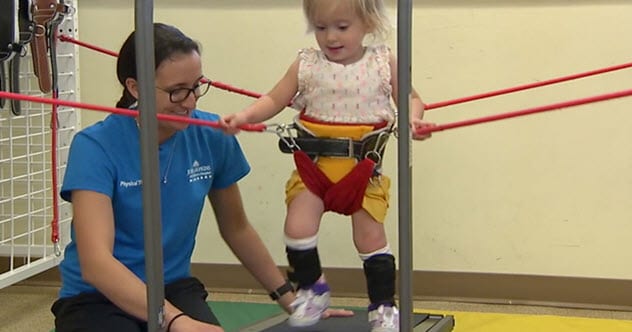
During therapy at Johns Hopkins All Children’s Hospital in St. Petersburg, Florida, pediatric specialist Michelle Schultz discovered an unusually effective motivational tool: “Baby Shark.”
When Schultz began singing the familiar “doo doo doo” rhythm, Harper understood that it was time to practice walking on the treadmill. The song helped create a positive routine around difficult physical work, encouraging her to participate in exercises that strengthened her movement.
The music did not cure spina bifida, nor was it a substitute for medical care. Its value came from helping a clinician form a trusting connection with a young patient. Rehabilitation often depends on repetition, and repetition becomes easier when it feels like play rather than punishment.
Harper eventually made significant progress, walking and playing with her older brother. Parents everywhere were forced to admit that the relentlessly catchy song had finally justified its existence.
Why These Uplifting Stories Still Matter
Although these events made headlines in 2019, their emotional value has not expired. Each story reveals a different form of hope. Tinney Davidson showed the cumulative power of small acts. The North Bergen students demonstrated what creativity can accomplish under tight constraints. Chance and Mike Moriarty showed courage in emergencies. Researchers pursued a medical breakthrough through patient experimentation. Mikah Meyer converted loss into purposeful action.
Positive news does not require pretending that suffering, danger, or grief do not exist. In fact, many of the most inspiring stories begin with something difficult. What makes them uplifting is the human response: someone helps, persists, creates, investigates, remembers, or refuses to abandon another person.
That distinction matters. Empty optimism says everything will somehow work out. Meaningful hope says circumstances may be hard, but our choices still matter.
Experiences and Lessons for Getting Through a Difficult Week
Look for Small Actions That Can Be Repeated
When a week feels overwhelming, people often search for one dramatic solution: a new career, a perfect vacation, an expensive purchase, or a complete personal reinvention scheduled conveniently between Tuesday afternoon and dinner. The waving-granny story offers a gentler alternative.
A repeated five-second gesture can become meaningful when it is sincere and dependable. Saying good morning to a neighbor, checking on a relative, thanking a coworker, or leaving an encouraging note may appear insignificant on the first day. Over months or years, those actions create familiarity and trust.
The practical lesson is to choose one manageable form of kindness and make it consistent. Grand gestures are memorable, but dependable gestures shape everyday life.
Use Creativity Before Complaining About Resources
The students behind Alien: The Play did not wait for professional equipment, a giant budget, or permission from Hollywood. They began with the materials and skills available to them. Their limitations forced them to become inventive, and that inventiveness became the production’s greatest strength.
This principle applies far beyond theater. A small business can test a simple campaign before purchasing expensive software. A family can create a memorable celebration without renting an elaborate venue. A beginner can practice with basic tools instead of postponing progress until the “perfect setup” arrives.
Resourcefulness is not about pretending resources do not matter. It is about refusing to let their absence become an automatic excuse.
Preparation Creates Calm During Emergencies
Chance’s actions came from remarkable instinct, while Moriarty’s rescue also drew upon technical knowledge. Together, the stories show why both awareness and preparation matter.
Useful experiences may include learning basic first aid, practicing emergency contacts with children, understanding how to respond around water, or reviewing what to do during a fire. These activities are not cheerful weekend entertainment, but they can transform panic into purposeful movement.
People often describe heroes as fearless. In reality, effective rescuers frequently experience fear while concentrating on the next necessary action. The goal is not to become emotionally invincible. It is to know enough to act without allowing fear to make every decision.
Give Difficult Work a Meaningful Rhythm
Harper’s rehabilitation demonstrates a principle familiar to parents, teachers, coaches, and anyone who has ever tried to persuade a toddler to wear shoes: motivation is personal.
A difficult task becomes more manageable when connected to music, play, companionship, visible progress, or a meaningful reward. Adults can use the same approach. Exercise may become easier with a favorite podcast. Administrative work may feel less painful in focused 20-minute sessions. A long-term savings goal becomes more motivating when linked to a specific future experience.
The work remains real, but the emotional environment changes. Sometimes progress needs discipline. Sometimes discipline needs a soundtrack.
Do Not Automatically Postpone the Important Things
Mikah Meyer’s journey began with the realization that “someday” is not guaranteed. That does not mean everyone should quit a job tomorrow and drive to every national monument before lunch. It means meaningful ambitions deserve more than indefinite postponement.
A practical response might be smaller: schedule the first weekend trip, begin the application, call the person you miss, take the introductory class, or set aside a modest monthly amount for a long-held goal.
Uplifting stories become most valuable when they lead to action. Their purpose is not merely to make readers feel better for five minutes. They can help us notice opportunities to be kinder, braver, more prepared, and more intentional during the week ahead.