History has a funny habit of arriving in black and white. Not because the past was allergic to color, of course, but because early cameras were better at catching light than capturing the red of a uniform, the dust-brown of a battlefield road, or the pale blue of a tired soldier’s eyes. That is exactly why colorized historic photos can feel so startling. They do not change the past, but they can change how quickly we recognize it as real.
“30 Historic Photos And The Stories Behind Them, Colorized By Cassowary Colorizations” is more than a gallery of old images with fresh paint. It is a reminder that every famous photographand every forgotten onebegan as a living moment. Cassowary Colorizations, led by colorizer Joel Bellviure, is known for restoring and colorizing black-and-white images with careful research, detailed captions, and a deep interest in the human stories hidden behind uniforms, faces, streets, animals, and artifacts.
The result is not merely “old photo, now prettier.” It is closer to historical detective work with a digital paintbrush. And yes, sometimes that paintbrush must make room for a soldier bear, a Civil War survivor with an unbelievable wound, and a piece of World War I body armor that looks like a medieval knight accidentally wandered into the machine-gun age.
Why Colorized Historic Photos Feel So Powerful
Black-and-white photography has its own dignity. It can be dramatic, elegant, and emotionally devastating. But for many modern viewers, monochrome creates distance. A person photographed in 1863 can feel like an artifact rather than someone who woke up hungry, had a favorite joke, and probably complained about the weather like the rest of us.
Colorization narrows that emotional gap. A colorized face can look less like “history” and more like a neighbor. A soldier’s coat, a child’s dress, or a dusty street suddenly becomes recognizable. That recognition is the magicand the responsibilityof historical photo colorization.
Good colorization does not simply guess. It studies. Researchers may examine uniforms, medals, landscapes, military records, painted portraits, period advertisements, museum objects, and surviving color references. The best work asks a serious question before choosing a shade: What color was this likely to be, and how do we know?
Who Is Cassowary Colorizations?
Cassowary Colorizations is a digital restoration and colorization project associated with Joel Bellviure, whose approach treats old photographs almost like archaeological sites. That comparison is useful. In archaeology, a broken pot is not just a broken pot. It can reveal trade, diet, class, technology, and belief. In a photograph, a helmet, a patch, a vehicle, a building sign, or even a chair can do the same.
Bellviure’s work stands out because the colorized images are usually paired with context. The caption matters. Without it, a viewer might say, “Interesting old soldier.” With it, the same person becomes a named individual, a witness to a specific conflict, or a survivor of a moment that should not be flattened into decoration.
That is why the phrase “the stories behind them” is so important. The color catches the eye, but the story keeps the mind from scrolling away.
30 Historic Photos, 30 Small Doors Into the Past
The original collection associated with Cassowary Colorizations includes a wide range of historical subjects: Civil War veterans, World War I experiments, World War II scenes, film history, military life, occupation, loss, humor, and survival. Instead of treating the images as isolated curiosities, it is more useful to see them as 30 doors. Each one opens into a different room of history.
1. Jacob C. Miller and the Civil War Wound That Refused to Be Forgotten
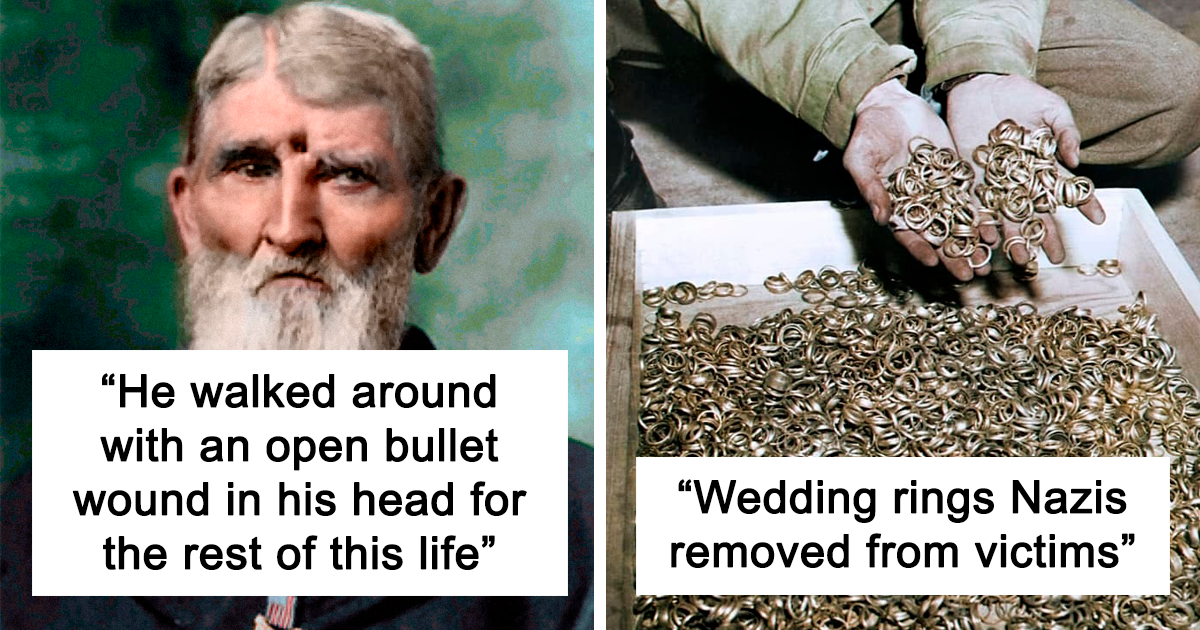
One of the most unforgettable examples is Jacob C. Miller, a Union soldier wounded in the head during the Battle of Chickamauga in 1863. His portrait is shocking even before colorization. After colorization, the injury feels less like a medical note and more like a human fact. Miller’s story reminds us that Civil War photography was not just about generals on horseback. It preserved the bodies and faces of ordinary soldiers who carried the war long after the firing stopped.
2. Wedding Rings Taken From Holocaust Victims
Some historic photographs should never be called “interesting” in a casual way. A photo of wedding rings removed from Holocaust victims near Buchenwald is one of them. Colorization here must be handled with gravity. The rings are not props; they are traces of marriages, families, ceremonies, and lives interrupted by industrialized murder. Color can make the metal gleam, but the purpose should never be aesthetic shock. The purpose is memory.
3. Wojtek the Bear, the Most Unusual Soldier in the Room
Then there is Wojtek, the Syrian brown bear adopted by Polish soldiers during World War II. His story sounds invented by a screenwriter who had too much coffee: a bear becomes a mascot, joins Polish troops, and is remembered for his role with the 22nd Artillery Supply Company. Yet the story is real, and colorization makes it even more delightfully strange. There is something irresistible about seeing a bear among soldiers and realizing history is not only tragedy. Sometimes it is also bizarre, tender, and deeply human.
4. Casablanca and the Question of Colorizing Cinema Icons
A colorized tribute connected to Casablanca raises a different kind of question. The 1942 film is one of Hollywood’s most beloved classics, preserved for its cultural and artistic importance. Colorizing film-related stills can be charming when done as homage, but it also reminds us that some black-and-white works were created with monochrome artistry in mind. Not all colorization has the same purpose. A battlefield photograph and a deliberately lit movie still ask for different kinds of respect.
5. The Brewster Body Shield and the Awkward March Toward Modern Armor
One image of a U.S. soldier wearing the Brewster Body Shield from World War I looks almost comical at first glance. The armor appears heavy, stiff, and more suited to a metal-plated scarecrow than a soldier who needs to move quickly. But the story behind it is serious. World War I forced armies to rethink protection in the face of machine guns, shrapnel, and industrial warfare. The Brewster Body Shield shows innovation in progressclumsy, brave, and not exactly runway-ready.
6. A Soldier Sharing Chocolate With a Child in Occupied Japan
Another powerful type of historical photo shows quiet contact between soldiers and civilians. A U.S. soldier sharing chocolate with a local girl in postwar Japan speaks to occupation, hunger, childhood, and the strange softness that sometimes appears after catastrophe. It is a small scene, but small scenes often carry the most emotional weight. A chocolate bar can say what a treaty cannot.
7. Dresden After the Bombing
Photos of Dresden after the Allied bombing in February 1945 are among the most difficult World War II images to process. Colorization can make ruined buildings and ash-filled streets feel immediate, but it must also avoid simplifying a complex event into a single emotional reaction. Dresden was a city of culture, civilians, war industry, propaganda, strategic calculation, and postwar controversy. A good caption does not pretend the moral questions are easy.
8. The Descent of Mombrone and the Nerve of Cavalry Training
Some old photographs are memorable because they look impossible. An Italian cavalry officer descending from the ruins of Mombrone during a riding exercise in the early 1900s belongs in that category. The image captures a world where horsemanship, military discipline, and theatrical courage overlapped. Color adds texture to the stone, the horse, and the uniformbut the real thrill is realizing someone looked at a drop from a ruined castle and said, “Excellent. Final exam.”
9. Mountain Troops, Uniform Details, and the Language of Clothing
Military portraits often depend on details: badges, collar tabs, ribbons, helmets, boots, and fabric. To a casual viewer, those details may seem decorative. To a historian or colorizer, they can identify a unit, date a photograph, or reveal the difference between ceremonial dress and field use. This is where Cassowary Colorizations’ research-heavy style matters. The wrong color on a uniform is not just a minor artistic choice; it can distort the historical setting.
10. War Photos That Show Exhaustion Instead of Glory
Some of the strongest historic images are not heroic in the poster sense. They show tired men, dirty faces, hollow eyes, and bodies pushed far beyond ordinary endurance. Colorization can intensify that fatigue. Mud becomes mud, not gray texture. Blood is no longer an abstract dark stain. Skin looks fragile. These photos interrupt the polished mythology of war and replace it with something harder to dismiss.
The Art and Ethics of Historical Photo Colorization
Colorization sits between art, restoration, and interpretation. That makes it exciting, but also tricky. A black-and-white original is a primary source. A colorized version is a historically informed interpretation of that source. The difference matters.
Responsible colorizers do not present their work as a replacement for the original photograph. Instead, they create a bridge for modern viewers. The best practice is to preserve the original, label the colorized version clearly, research the colors carefully, and avoid altering expressions, objects, or context. Adding color is one thing. Inventing a smile on a victim of violence is another. History does not need digital plastic surgery.
This is especially important now that artificial intelligence can colorize images in seconds. Speed is convenient, but history is not a microwave dinner. Automated tools may produce skin tones, uniforms, flags, or landscapes that look believable but are historically wrong. Human research still matters because a convincing mistake can travel faster than a boring truth.
Why Captions Matter as Much as Color
A photo without context invites guessing. A photo with context invites learning. That is why the story behind each image is essential. When viewers learn that a pile of rings came from Holocaust victims, the image changes. When they learn that Wojtek was not a cartoon mascot but part of a real wartime unit’s memory, the image changes. When they learn that a strange armored soldier represents early attempts to protect troops from modern weapons, the image changes again.
Captions also prevent colorized photos from becoming visual clickbait. Historical images can easily be consumed as “wow” content: wow, that armor is weird; wow, that bear is funny; wow, that wound is unbelievable. A thoughtful caption slows the viewer down. It says: look closer, but also think harder.
How Colorized Photos Improve Historical Understanding
Colorized historic photos work well because they activate curiosity. A reader who might ignore a paragraph about World War I body armor may stop for a colorized image of a soldier wearing a steel suit. A student who thinks the Civil War is ancient may pause at a colorized veteran’s face. A museum visitor who has seen dozens of black-and-white World War II images may suddenly notice the human details in one restored frame.
That does not mean colorization is necessary for every image. Some photographs are stronger in their original form. Others were composed with shadows and contrast that color might weaken. But when done with restraint, colorization can support education, family history, journalism, museum interpretation, and public memory.
The Human Thread Running Through the Collection
The reason Cassowary Colorizations’ historic photos are so engaging is not simply technical skill. It is the range of human experience they reveal. The collection moves from battlefield survival to civilian suffering, from military absurdity to cultural memory, from grief to humor. That range matters because history is never only one mood.
People in the past laughed, panicked, posed awkwardly, loved animals, feared death, misunderstood orders, carried snacks, wore uncomfortable equipment, and occasionally made decisions that now seem wildly dramatic. Colorized photos remind us that the people before us were not black-and-white symbols. They were complicated, colorful humans living through circumstances they did not always understand.
Experiences Related to Viewing “30 Historic Photos And The Stories Behind Them, Colorized By Cassowary Colorizations”
Viewing a collection like this is a different experience from reading a standard history article. A textbook usually moves in a straight line: date, event, consequence, quiz on Friday. A colorized photo collection moves emotionally. You may begin with curiosity, then feel admiration, discomfort, surprise, sorrow, and even a guilty laugh when history throws something wonderfully odd at you. The emotional variety is part of the learning.
One of the strongest experiences is the feeling of recognition. A colorized portrait can make a 19th-century soldier look like someone you might pass in a grocery store. That can be unsettling. We are used to keeping the past at a safe distance. Color removes some of that distance and quietly says, “These people were not born historical. They were just alive.”
Another experience is the urge to investigate. A viewer may see a uniform badge and wonder what it means. A ruined city may lead to questions about strategy, civilian casualties, and memory. A soldier sharing chocolate with a child may open a conversation about occupation and everyday survival after war. A bear in uniformbecause history apparently enjoys surprise partiesmay lead someone into the story of Polish soldiers displaced by World War II. In this way, colorization becomes a doorway rather than a destination.
For families, colorized photos can also change how old relatives are perceived. Many people have boxes of black-and-white family pictures where grandparents look formal, distant, and almost statue-like. When similar images are carefully restored or colorized, the people in them can suddenly feel young again. A grandmother’s dress, a grandfather’s work jacket, or the color of a porch can make family history feel less like genealogy homework and more like a conversation waiting to happen.
Teachers and writers can use colorized historical photos as discussion starters, but they should pair them with the original images and reliable context. Ask students what changes when color is added. Ask what might be gained and what might be lost. Ask whether the image feels more “real,” and then ask why. The goal is not to make students worship colorization. The goal is to make them think critically about evidence, emotion, and interpretation.
For online readers, the experience is also shaped by speed. Social media encourages quick reactions, but historic photos deserve slow looking. The best way to view Cassowary Colorizations’ work is to pause after each image. Read the caption. Look at the face. Notice the objects. Ask what was happening just before and just after the shutter clicked. History becomes richer when we resist the urge to scroll as if the past were just another snack tray of content.
Ultimately, the experience of this collection is a reminder that color is not the whole story. It is an invitation to the story. The real value lies in the combination of image, research, restraint, and empathy. When those elements work together, a colorized photograph can do something rare: it can make the past feel close without pretending it is simple.
Conclusion
“30 Historic Photos And The Stories Behind Them, Colorized By Cassowary Colorizations” shows why historical photo colorization continues to fascinate readers, educators, artists, and casual history fans. The color draws us in, but the stories make us stay. Whether the subject is a Civil War survivor, a Holocaust artifact, a World War II bear, a ruined city, or an experimental suit of armor, each image reminds us that history was lived in full color long before cameras could capture it that way.
The best colorized historic photos do not replace the originals. They sit beside them, offering a new path into memory. When handled with research and respect, colorization can make old photographs more accessible, more emotionally immediate, and more useful for public understanding. It is not time travel, but it is a powerful form of historical translationand sometimes, translation is exactly what a distant image needs.