If you finished The Hunger Games trilogy and immediately stared at your bookshelf like it had personally betrayed you, welcome to the club. Suzanne Collins gave readers a near-perfect storm: a deadly competition, a corrupt government, a sharp heroine, political rebellion, emotional damage with excellent pacing, and just enough romance to make everyone choose a team at lunch.
The good news is that there are plenty of books like The Hunger Games that deliver high-stakes survival, dystopian worlds, rebel energy, morally messy choices, and characters who absolutely did not sign up to become symbols of revolution. Some lean more into action. Some focus on government control, class inequality, or reality-show horror. A few are darker, older, or more romantic. All of them understand the delicious reader panic of asking, “How are they getting out of this?” while refusing to go to sleep.
Below are 20 strong read-alikes for fans of Katniss Everdeen, Panem, arena-style danger, young adult dystopian fiction, and stories where the ruling class needs a group project on basic human decency.
What Makes a Book Feel Like The Hunger Games?
The best Hunger Games read-alikes usually share several ingredients: a controlled society, teenagers forced into impossible choices, public performance as punishment, survival under pressure, and a protagonist who becomes dangerous because they still care. That last part matters. Katniss is not powerful because she gives speeches like a polished politician. She is powerful because she protects Prim, questions the Capitol, and keeps surviving even when the cameras are hungry for her pain.
So this list is not just “20 random dystopian books.” These recommendations connect to The Hunger Games through competition, rebellion, propaganda, social class, surveillance, sacrifice, or emotional survival. Think of it as a literary supply crate. Hopefully, no tracker jackers included.
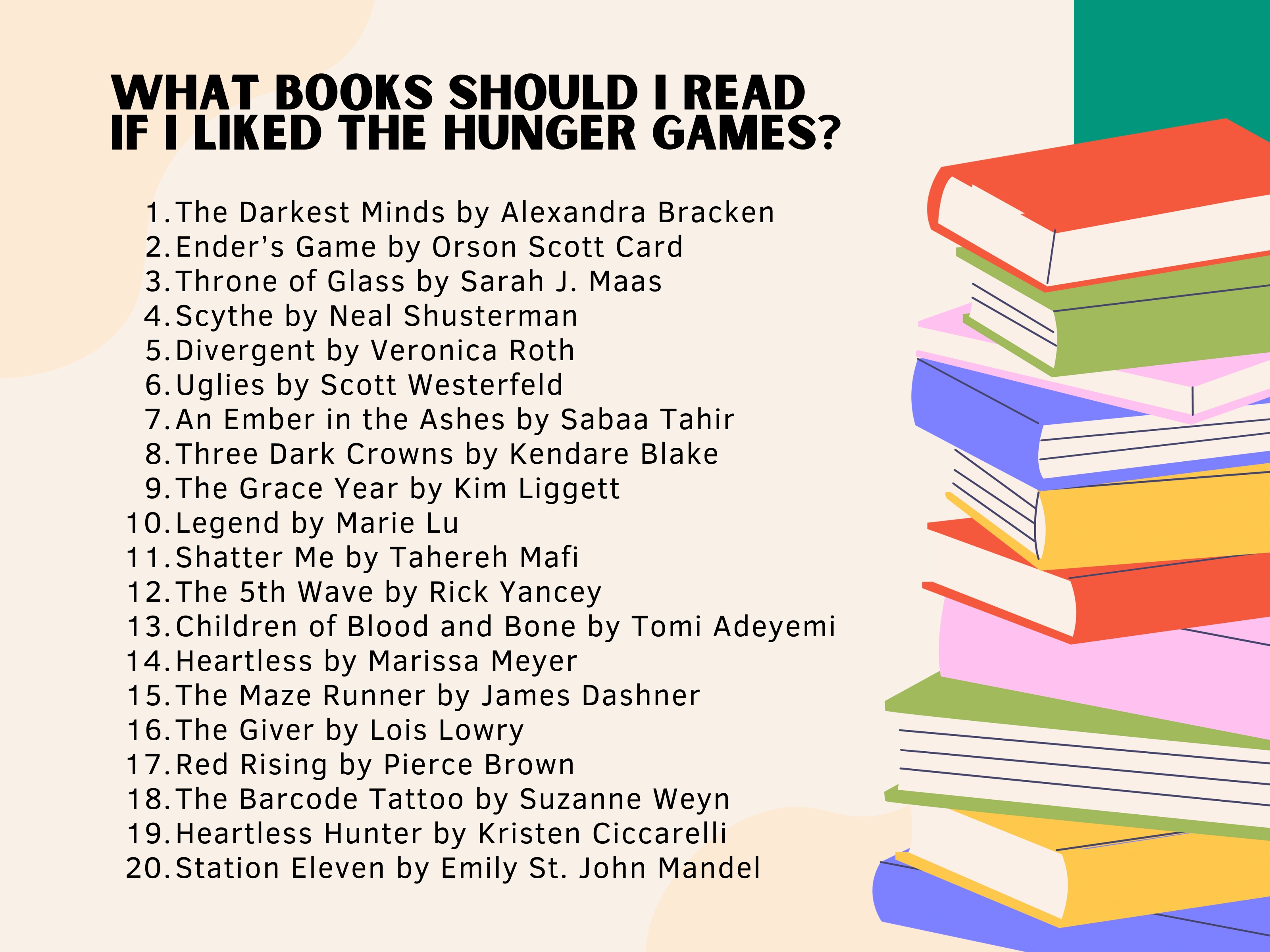
20 Books Like The Hunger Games Trilogy
1. Divergent by Veronica Roth
Divergent is one of the most obvious recommendations for readers who want another fast-paced YA dystopian series. Set in a future Chicago divided into factions based on virtues, the story follows Beatrice “Tris” Prior as she chooses a new identity and discovers that being different can be deadly. Like Katniss, Tris is pushed through a brutal system that pretends to create order while quietly crushing anyone who does not fit.
Fans of training scenes, faction politics, identity struggles, and high-pressure choices will find plenty to enjoy here. It is a strong pick if you liked the “ordinary girl becomes a threat to the system” arc.
2. The Maze Runner by James Dashner
In The Maze Runner, Thomas wakes up with no memory in a strange place called the Glade, surrounded by other boys and an enormous shifting maze. The danger is immediate, the rules are mysterious, and escape feels nearly impossible. Instead of an arena designed for television, the maze becomes a survival machine built on fear, experimentation, and secrecy.
This is a great next read if your favorite parts of The Hunger Games were the arena strategy, the alliances, and the constant feeling that someone powerful is watching from behind the curtain.
3. Legend by Marie Lu
Legend is set in a militarized future version of the western United States, where June is a government prodigy and Day is the Republic’s most wanted criminal. Their paths collide after a murder investigation, but the real story is much bigger than one crime. Like The Hunger Games, this book explores propaganda, class division, state violence, and what happens when a loyal citizen begins to question the official story.
Marie Lu keeps the chapters short and sharp, making this a smooth, addictive read. It is especially good for readers who enjoy dual perspectives and enemies-to-allies tension.
4. Uglies by Scott Westerfeld
Before Panem made televised death fashionable in the worst way possible, Uglies was already asking big questions about beauty, conformity, and social control. In Tally Youngblood’s world, everyone undergoes surgery at sixteen to become “pretty.” At first, this sounds like a dream. Then Tally discovers the cost of perfection, and suddenly the makeover package looks a little less glamorous.
If you liked how The Hunger Games criticized spectacle and image-making, Uglies is a smart choice. It swaps the arena for cosmetic conformity but keeps the rebellion simmering underneath.
5. Red Queen by Victoria Aveyard
Red Queen gives readers a world divided by blood. Reds are commoners. Silvers are elites with supernatural powers. Mare Barrow is a Red girl who unexpectedly displays power of her own, making her both useful and terrifying to the ruling class. Naturally, the palace responds with lies, manipulation, and fancy outfits, because dystopian elites never miss a chance to accessorize oppression.
This book is ideal for readers who want class conflict, court politics, betrayal, rebellion, and a heroine forced to perform a role for public consumption.
6. The Giver by Lois Lowry
The Giver is quieter than The Hunger Games, but its dystopian power is enormous. Jonas lives in a society that appears peaceful because it has removed pain, memory, color, and deep emotion. When he is chosen to become the Receiver of Memory, he learns what his community has sacrificed in the name of order.
This is a must-read for anyone interested in the philosophical side of dystopian fiction. It asks the same kind of question Panem asks: What does a society become when comfort matters more than truth?
7. Scythe by Neal Shusterman
In Scythe, humanity has conquered death, disease, and many forms of suffering. Unfortunately, population control still exists, and specially appointed Scythes are responsible for ending lives. Two teens, Citra and Rowan, are chosen as apprentices to this grim profession.
Like The Hunger Games, the book examines power, morality, public duty, and the danger of institutions that turn death into procedure. It is thoughtful, chilling, and packed with ethical dilemmas that will make your brain pace around the room.
8. Unwind by Neal Shusterman
Unwind imagines a future America where unwanted teenagers can be legally “unwound,” meaning their body parts are harvested for others. The story follows three teens trying to survive a society that has made cruelty sound bureaucratic. That is the scariest kind of cruelty, because it comes with paperwork.
This book is darker and more disturbing than many YA dystopian novels, but it is powerful. Fans of The Hunger Games who appreciated its moral weight and social commentary should consider it.
9. The 5th Wave by Rick Yancey
The 5th Wave trades Capitol oppression for alien invasion, but the survival tension will feel familiar. Cassie Sullivan is trying to stay alive after multiple waves of attacks devastate Earth. Trust becomes dangerous, children are used in war, and every choice carries risk.
If you loved Katniss’s protective instincts toward Prim, Cassie’s mission to find her younger brother may hit the same emotional nerve. It is a strong pick for readers who want dystopian survival with science-fiction stakes.
10. An Ember in the Ashes by Sabaa Tahir
Inspired by ancient Rome, An Ember in the Ashes follows Laia, who becomes a spy inside a brutal military academy to save her brother, and Elias, a soldier who wants out of the empire’s machinery. The world is harsh, the danger is constant, and rebellion comes with terrible costs.
This recommendation is perfect for readers who want the emotional intensity of The Hunger Games with more fantasy atmosphere, dual narration, and a deeply oppressive empire.
11. The Selection by Kiera Cass
Imagine if the Capitol replaced the Hunger Games with a royal dating competition and still somehow managed to be deeply political. That is part of the appeal of The Selection. America Singer is chosen to compete for Prince Maxon’s hand in a caste-based society where glamour hides inequality.
This book is lighter and more romantic than The Hunger Games, but it shares themes of televised performance, social hierarchy, and a young woman learning how much power she has when everyone is watching.
12. Matched by Ally Condie
In Matched, the Society controls nearly every part of life, including who people marry. Cassia trusts the system until a strange mistake shows her another possible match and opens the door to forbidden questions. The rebellion here begins quietly, with poetry, memory, and choice.
Readers who enjoyed the emotional and political awakening in The Hunger Games may appreciate this slower, more romantic dystopian story about free will.
13. The Grace Year by Kim Liggett
The Grace Year follows girls in Garner County who are banished for one year because their society believes they possess dangerous magic. The wilderness becomes a brutal test of survival, but the deeper horror lies in how fear is used to control women.
This is a fierce recommendation for older teens and adults who want a darker, feminist read-alike. It has survival, social control, female alliances, and the terrifying realization that the system is not broken. It is working exactly as designed.
14. The Testing by Joelle Charbonneau
In The Testing, promising students compete for a chance to attend university and become future leaders after war has damaged the world. Cia Vale is honored to be chosenuntil she realizes the exams are dangerous, secretive, and possibly deadly.
This is one of the closest matches for readers who want competition, government manipulation, and academic pressure turned into a survival nightmare. Suddenly, pop quizzes do not seem so bad.
15. Battle Royale by Koushun Takami
Battle Royale is a much darker, more violent predecessor to many modern survival-competition stories. A class of students is forced by an authoritarian government to fight until only one remains. Because of its intensity, it is best suited for mature readers.
If you are interested in the deadly-game concept taken to its most brutal form, this novel is impossible to ignore. It is not YA comfort reading; it is dystopian horror with sharp teeth.
16. Red Rising by Pierce Brown
Red Rising begins with Darrow, a lowborn Red miner on Mars, discovering that his life has been built on lies. To challenge the ruling Gold caste, he infiltrates their elite training institute, where competition is violent, political, and designed to produce rulers.
This is an excellent choice for older readers who want The Hunger Games energy scaled into space opera. Expect class warfare, brutal trials, revenge, strategy, and a revolution with very sharp edges.
17. The Knife of Never Letting Go by Patrick Ness
In The Knife of Never Letting Go, Todd Hewitt lives in a world where everyone can hear everyone else’s thoughts in a constant stream called Noise. When Todd discovers silence, he realizes his town has been hiding something terrible.
This book is tense, original, and emotionally intense. Like The Hunger Games, it follows a young person on the run from adults who have built a violent society and called it normal.
18. Delirium by Lauren Oliver
Delirium imagines a society where love is treated as a disease and citizens are “cured” when they reach adulthood. Lena believes in the cure until she experiences the emotion her world has taught her to fear.
This recommendation works well for readers who liked the romance and rebellion in The Hunger Games. The danger is less arena-based, but the central conflict is familiar: a government controls the story, and one girl’s heart refuses to cooperate.
19. Their Vicious Games by Joelle Wellington
Their Vicious Games brings the deadly competition setup into a contemporary thriller framework. Adina Walker, a Black scholarship student whose Ivy League future collapses after one mistake, enters an elite contest called the Finish. The prize is opportunity. The cost may be survival.
This book is a smart modern pick for fans of arena-style tension, class privilege, racial inequality, and competitions where smiling for the powerful can be just as dangerous as fighting them.
20. Snowglobe by Soyoung Park
Snowglobe is set in a frozen world where only the people inside a warm, glass-domed city live in luxury. Their lives are broadcast as entertainment to those outside. When Chobahm is offered a chance to enter Snowglobe, she discovers that fame, warmth, and safety come with ugly secrets.
This is a terrific choice for readers who loved the media criticism in The Hunger Games. It asks who benefits when suffering becomes content, which is basically Panem’s business plan with better climate control.
How to Choose Your Next Hunger Games-Style Read
If you want the closest match to the arena experience, start with The Testing, The Maze Runner, Battle Royale, or Their Vicious Games. These books place characters inside structured competitions where the rules are cruel and survival depends on intelligence as much as strength.
If you are more interested in rebellion against a controlling society, pick up Legend, Red Queen, An Ember in the Ashes, or Red Rising. These stories widen the lens from personal survival to political revolution, which is exactly what made Katniss’s journey grow from one girl with a bow into a national symbol.
If you prefer quieter but deeply unsettling dystopias, choose The Giver, Matched, Delirium, or Uglies. These books prove that a society does not need an arena to be terrifying. Sometimes the scariest cage is the one everyone has agreed to call “normal.”
Reading Experiences: Why Books Like The Hunger Games Stay With Us
Part of the reason readers keep searching for books like The Hunger Games is that the trilogy creates a very specific reading experience. It is not just about action, although the action is excellent. It is about watching a character survive a system that keeps changing the rules and then realizing the game was never only inside the arena. That feeling sticks. You close the book, look at advertisements, politics, celebrity culture, and reality television, and suddenly the Capitol feels less fictional than it should. Very rude of literature to make us think.
These read-alikes offer similar experiences in different flavors. Reading The Maze Runner feels like waking up inside a puzzle box while someone else holds the instructions. Reading Scythe feels like sitting in an ethics class taught by a thunderstorm. Reading The Selection is more like eating glittery cake and then discovering the cake has a caste system baked into the frosting. Each book gives readers a new way to explore power, performance, and choice.
One of the most satisfying experiences in dystopian fiction is the moment when the protagonist sees through the lie. Katniss realizes the Capitol’s pageantry is a weapon. Jonas in The Giver learns that peace without memory is not true peace. Tally in Uglies discovers that beauty can be another form of obedience. Cassia in Matched begins to understand that a perfect life chosen by someone else is still a cage. These moments are exciting because they mirror real growing up: the instant when a person notices that the world is not as fair, simple, or honest as adults promised.
Another reason these books work so well is that they turn ordinary emotions into revolutionary forces. Love, grief, loyalty, anger, curiosity, and embarrassment all become dangerous. Katniss volunteering for Prim is an act of love, but it becomes a political event because the Capitol cannot fully control what love means. In Legend, June’s grief pushes her toward the truth. In An Ember in the Ashes, Laia’s love for her brother forces her into courage she never expected to need. In the best dystopian books, feelings are not decorations. They are sparks near gasoline.
Reading these novels can also be strangely comforting. That may sound odd, considering how many governments collapse, teenagers run for their lives, and adults make decisions that suggest they should not be allowed to organize a bake sale, let alone a nation. But the comfort comes from seeing characters resist. They are frightened, confused, injured, manipulated, and often wildly underqualified. Still, they act. They protect someone. They tell the truth. They refuse to become what the system wants. For readers, especially young readers, that matters.
The best way to enjoy this list is to follow your favorite feeling from The Hunger Games. If you miss the suspense, choose a survival competition. If you miss Katniss’s defiance, choose a rebellion story. If you miss the social commentary, choose a quieter dystopia with a sharp idea at its center. And if you simply miss the emotional chaos of caring too much about fictional teenagers in terrible governments, congratulations: every book on this list is ready to ruin your bedtime in a productive way.
Conclusion
The Hunger Games trilogy remains one of the defining YA dystopian series because it combines page-turning danger with serious questions about power, media, inequality, and resistance. The 20 books above do not simply copy Panem. They expand the conversation. Some send characters into mazes, trials, palaces, frozen cities, military academies, or societies obsessed with beauty and control. Others examine love, memory, death, class, and survival from fresh angles.
Whether you want another fierce heroine, a deadly competition, a corrupt regime, a slow-burn rebellion, or a world that makes you whisper “absolutely not” at least once per chapter, these books like The Hunger Games are worth checking out. Stock snacks, charge your reading lamp, and prepare to distrust fictional governments all over again.