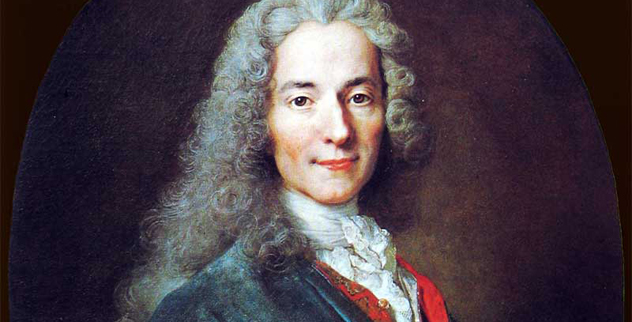
Voltaire could compress an entire argument into one sentence and still leave enough room for a raised eyebrow. The French Enlightenment writer, born François-Marie Arouet in 1694, produced plays, histories, philosophical essays, poems, letters, and the enduring satirical novella Candide. He became famous for challenging fanaticism, censorship, injustice, intellectual laziness, and anyone who treated authority as a substitute for evidence.
The best Voltaire quotes still sound surprisingly modern because their targets have not exactly disappeared. People continue to quarrel over opinions, pursue impossible perfection, defend comfortable prejudices, and attend meetings that could have been emails. Voltaire saw these habits in the eighteenth century and attacked them with wit sharp enough to pass through customs unnoticed.
Why Voltaire’s Quotes Remain Relevant
Voltaire was not a philosopher who built one enormous, perfectly organized system. He was closer to an intellectual emergency-response team. When he encountered intolerance, judicial cruelty, superstition, censorship, or pompous reasoning, he reached for satire, historical evidence, public argument, and occasionally a joke with the force of a small cannon.
His quotations are memorable because they rarely behave like decorative motivational slogans. They ask readers to do something: examine an assumption, tolerate disagreement, finish useful work, question authority, or recognize the difference between an appealing theory and an uncomfortable reality.
15 Famous Voltaire Quotes and What They Mean
1. “We must cultivate our garden.”
This concluding idea from Candide is probably Voltaire’s most useful piece of life advice. After surviving war, disaster, exploitation, disease, and a truly impressive parade of human foolishness, Candide stops trying to explain everything through grand theories. He chooses practical work instead.
The “garden” can represent your career, relationships, community, health, education, or literal tomatoes. Voltaire’s point is not that people should ignore the world. It is that endless speculation becomes an excuse when it replaces meaningful action. Improve the small territory for which you are responsible. Philosophy is excellent, but the weeds are not impressed by it.
2. “Let us work without disputing; it is the only way to render life tolerable.”
Also found near the end of Candide, this quote does not condemn every disagreement. Voltaire spent much of his life disagreeing professionally. The target is fruitless argumentthe kind that generates heat, pride, and several thousand words but no useful result.
In modern life, the lesson applies to workplaces, family discussions, online debates, and committee meetings. Discussion is valuable when it clarifies a problem or guides action. When everyone has repeated the same position three times, it may be time to close the laptop and cultivate something.
3. “Our labor preserves us from three great evilsweariness, vice, and want.”
In one English translation of Candide, an old farmer explains that productive labor protects his family from boredom, destructive behavior, and poverty. He is neither a king nor a famous scholar, yet he understands daily happiness better than many of the novel’s grand thinkers.
Voltaire is not glorifying exhaustion or suggesting that every job is automatically noble. He is describing the stabilizing power of purposeful activity. Cooking, repairing, learning, building, caring, and creating give time a shape. Useful work cannot solve every human problem, but it leaves fewer empty rooms in which trouble can set up furniture.
4. “All is for the best in the best of all possible worlds.”
This famous line requires context. In Candide, it represents the relentlessly optimistic philosophy taught by Pangloss. Voltaire places the claim beside wars, earthquakes, executions, and personal catastrophes, turning it into satire rather than sincere reassurance.
The quote warns against theories that explain suffering so neatly that they no longer notice the people who are suffering. Optimism can encourage resilience, but automatic optimism may become moral laziness. Sometimes a bad situation is not secretly perfect. Sometimes it is simply bad and needs to be changed.
5. “The best is the enemy of the good.”
Appearing in Voltaire’s poem La Bégueule, this maxim is often modernized as “Perfect is the enemy of good.” It describes the danger of rejecting a useful result because it falls short of an imaginary ideal.
Writers postpone publishing, businesses delay improvements, and people abandon healthy routines because they cannot follow them flawlessly. Voltaire’s advice is not an invitation to produce sloppy work. It is a reminder that a completed good project often creates more value than a perfect project living permanently inside a planning document.
6. “If God did not exist, it would be necessary to invent him.”
Voltaire wrote this line in a verse epistle responding to an atheistic work known as the Book of the Three Impostors. Although Voltaire fiercely criticized organized religious intolerance, he was not simply declaring religion foolish. He believed in a supreme intelligence and viewed belief in moral order as socially significant.
The quotation therefore contains more complexity than its meme-sized form suggests. It asks what functions religious belief serves: moral accountability, social stability, consolation, meaning, or political control. Readers may disagree with Voltaire’s answer, but the question remains lively.
7. “The secret of being a bore is to tell everything.”
Voltaire included this wonderfully impolite observation in his verse discourses on humanity. The idea is especially relevant in an age of endless posts, presentations, podcasts, status updates, and recipes that begin with a complete family history.
Good communication depends partly on selection. A storyteller must know what to leave unsaid. A speaker should recognize when the audience has received the point. A writer must occasionally release a beloved paragraph back into the wilderness. Brevity does not mean having fewer thoughts; it means respecting the listener’s remaining lifespan.
8. “Prejudice is an opinion without judgment.”
In the Philosophical Dictionary, Voltaire defines prejudice as an opinion accepted before genuine examination. He observes that societies place beliefs into children’s minds long before those children possess the ability to evaluate them.
This makes the quotation more than a criticism of obviously hateful ideas. It applies whenever inherited assumptions escape scrutiny. Voltaire encourages us to ask where an opinion came from, what evidence supports it, and whether we would have adopted it without pressure from family, tradition, politics, or the loudest person in the room.
9. “Let us read, and let us dance; these two amusements will never do any harm to the world.”
This line, associated with the Philosophical Dictionary, shows Voltaire in a lighter mood. Reading enlarges the mind; dancing reminds the mind that it is attached to a body. Together they offer curiosity, pleasure, imagination, and a welcome break from people who insist that enjoyment must submit a quarterly report.
The quote also reflects a balanced idea of culture. Intellectual life does not have to be gloomy to be serious. A person can study history in the afternoon and dance badly in the evening. In fact, the dancing may make the history more bearable.
10. “A witty saying proves nothing.”
Voltaire was one of history’s finest producers of witty sayings, which makes this warning particularly credible. A clever sentence may expose a contradiction or make an idea memorable, but cleverness is not evidence.
This principle matters in politics, advertising, social media, and everyday arguments. A slogan can sound decisive while avoiding the real issue. A sarcastic reply may win applause without establishing truth. Before accepting a brilliant one-linerincluding one by Voltaireask whether the reasoning survives after the laughter stops.
11. “It is difficult to free fools from the chains they revere.”
Voltaire understood that people do not always experience false beliefs as burdens. Sometimes an idea becomes part of a person’s identity, community, status, or sense of safety. Removing it may feel less like liberation and more like an attack.
This explains why facts alone often fail to change minds. Successful persuasion may require patience, trust, better alternatives, and an understanding of what the belief provides emotionally. Calling someone a fool, incidentally, is rarely the trust-building stage of the operation.
12. “If there were but two religions, the people would cut one another’s throats; but as there are such a multitude, they all live happy and in peace.”
In his Letters on England, Voltaire argued that religious diversity could reduce the power of any single group to dominate society. His complete comparison begins by suggesting that one religion may encourage arbitrary government, while numerous religions must learn to coexist.
The statement is humorous and deliberately exaggerated, but its political insight is serious. Pluralism can protect liberty by distributing power. When no faction can easily silence everyone else, negotiation becomes more attractive than persecution.
13. “Indeed, history is nothing more than a tableau of crimes and misfortunes.”
This bleak assessment appears in Voltaire’s story L’Ingénu. Voltaire helped broaden historical writing beyond royal genealogies and battlefield celebrations, yet he remained painfully aware that conventional history was crowded with conquest, persecution, betrayal, and suffering.
The quote should not be taken as a complete definition of history. Human history also contains discovery, cooperation, art, reform, and kindness. Its force lies in challenging sanitized narratives. A mature understanding of the past must examine both celebrated achievements and the people who paid for them.
14. “All styles are good except the tiresome kind.”
Voltaire’s comment from the preface to The Prodigal Son offers excellent advice for writers, artists, speakers, and content creators. He refuses to declare one artistic style universally superior. The real failure is not choosing comedy instead of tragedy, simplicity instead of ornament, or tradition instead of experiment. The failure is losing the audience through lifeless execution.
Clear writing may be formal or conversational, elegant or blunt. What matters is whether it communicates something worth receiving. Style should serve the subject rather than stand in front of it waving for attention.
15. “We all look for happiness, but without knowing where to find it: like drunkards who look for their house, knowing dimly that they have one.”
This line from Voltaire’s notebooks compares the search for happiness to a confused journey home. People sense that contentment exists, but they often search in directions chosen by habit, advertising, envy, or social pressure.
The image is funny because it is uncomfortably recognizable. Someone pursues status, obtains it, and immediately notices a person with more. Another delays happiness until the next promotion, purchase, relationship, or perfectly organized kitchen. Voltaire suggests that the destination may be real while our navigation remains questionable.
Experiencing Voltaire’s Wisdom in Everyday Life
Finishing a Project Instead of Worshiping Perfection
The quote “The best is the enemy of the good” becomes real whenever a project refuses to leave the draft stage. Imagine preparing a presentation for work. The main argument is clear, the evidence is solid, and the slides are readable. Yet another evening disappears while you adjust icon sizes, rewrite the same heading, and debate whether “blue-gray” communicates greater authority than “gray-blue.”
Applying Voltaire’s advice means defining what “good and complete” looks like before perfectionism takes control. You review the facts, correct genuine problems, deliver the presentation, and allow experience to improve the next one. The result may not belong in a design museum, but it performs its actual job.
Choosing Useful Action During an Overwhelming Week
“We must cultivate our garden” is particularly helpful when the news, workplace, or world feels too large to influence. The phrase does not require indifference. It redirects helpless anxiety toward responsible action.
A person might volunteer locally, help a struggling colleague, call an isolated relative, repair something broken, or spend an hour learning a practical skill. These actions do not solve every global problem. They do create a small area of competence and care. Afterward, the world may remain complicated, but one corner of it is less neglected.
Recognizing a Fruitless Argument
Most people have experienced a debate in which neither participant is listening. Each person waits for a pause, reloads the same opinion, and fires it again with slightly increased volume. Voltaire’s recommendation to work “without disputing” offers an exit.
You can ask what evidence would change either person’s mind. When the honest answer is “nothing,” continuing is usually theater rather than inquiry. The better choice may be to identify the small point of agreement, decide what action is possible, and move on before dinner becomes a historical crime or misfortune.
Questioning an Inherited Assumption
“Prejudice is an opinion without judgment” becomes personal when we notice a belief that has never faced examination. Perhaps we assume a certain career is impractical, a neighborhood is unsafe, a generation is lazy, or a cultural practice is strange. Then direct experience contradicts the assumption.
The uncomfortable but valuable response is curiosity. Where did the belief originate? Was it based on evidence, one anecdote, or repeated hearsay? Replacing prejudice does not require pretending that every judgment is false. It requires earning judgments through observation, context, and honest reasoning.
Learning When to Stop Talking
Voltaire’s warning about telling everything can transform ordinary communication. Consider answering a simple question at work. The listener needs a decision and two supporting reasons. Instead, you provide the complete history of the project, three abandoned alternatives, the emotional condition of the spreadsheet, and a detailed account of Tuesday.
Practicing selective communication means leading with the essential point. Additional detail can follow when it is useful. This approach improves emails, meetings, stories, instructions, and relationships. It also reduces the risk that someone will stare past your shoulder while quietly reconsidering every choice that brought them into the conversation.
Taken together, these experiences reveal why famous Voltaire sayings remain useful. They are not antique decorations from the Enlightenment. They are compact tools for managing work, disagreement, uncertainty, creativity, and the stubbornly comic business of being human.
Conclusion
The greatest Voltaire quotes combine humor with intellectual pressure. They make readers smile, then quietly remove the chair from beneath a comfortable assumption. Whether he is criticizing blind optimism, defending pluralism, exposing prejudice, or recommending useful work, Voltaire asks us to think clearly without becoming unbearably solemn.
His most durable lesson may be the simplest: cultivate what you can improve. Read widely, question inherited opinions, tolerate human frailty, finish worthwhile work, and remember that a clever sentence is only the beginning of an argument. Then, as Voltaire also advised, make a little time for dancing.