Human history is basically one long group project where everyone occasionally forgot to check the facts. Before microscopes, space telescopes, genetics, modern medicine, and decent public Wi-Fi, people did their best to explain a confusing world with the tools they had: observation, tradition, religion, philosophy, gossip, and, in several unfortunate cases, a very confident man with a beard.
Some old beliefs now sound hilarious. Others are disturbing. Many were completely understandable for their time. After all, if you had never seen bacteria, a plague arriving after a wave of terrible smells might seem like the work of “bad air.” If the Sun appeared to rise and set around you every day, Earth as the center of the universe did not sound ridiculous. And if a pig killed someone in a village, apparently someone had to call a lawyer. Medieval Europe was not playing around.
This article explores ten seriously strange beliefs humans held throughout history, from medical myths and courtroom animals to royal healing powers and skull-reading pseudoscience. The goal is not to laugh at the past like we are immune to weird ideas. It is to understand how culture, fear, limited evidence, and social pressure can make even bizarre claims feel perfectly reasonable.
1. The Earth Was the Center of Everything
The geocentric model made humans the VIP section of the cosmos
For centuries, many scholars accepted the geocentric model: the belief that Earth sat motionless at the center of the universe while the Sun, Moon, planets, and stars moved around it. Claudius Ptolemy’s second-century system was especially influential because it offered a complex mathematical explanation for planetary motion. It was wrong, but it was not lazy. It had gears, circles, epicycles, and enough geometry to make a modern student quietly close the textbook.
The belief made sense to the naked eye. The ground feels still. The Sun appears to travel across the sky. Stars seem to rotate above us. Without modern instruments, Earth-centered astronomy felt obvious. Then came the heliocentric model, most famously associated with Nicolaus Copernicus, which placed the Sun near the center and turned Earth into one planet among others. That idea was revolutionary not only because it changed astronomy, but because it bruised humanity’s ego. We were not the center of everything. We were just spinning through space with excellent confidence.
2. Disease Came from Bad Smells
Miasma theory blamed illness on “bad air”
Before germ theory became widely accepted, many people believed disease spread through miasma, or poisonous bad air rising from rotting matter, sewage, swamps, and general stinkiness. This belief influenced medical thinking for centuries and became especially important during outbreaks of cholera, plague, and other epidemics.
To be fair, the idea was not entirely foolish. Filthy environments often did produce terrible smells, and those same places were frequently full of contaminated water, waste, insects, and pathogens. The smell was not usually the direct cause, but it was often standing near the real culprit wearing a suspicious hat.
Miasma theory encouraged sanitation reforms, cleaner cities, better ventilation, and waste removal. So even though the theory misunderstood disease transmission, it sometimes pushed society toward healthier environments. Eventually, the work of scientists and physicians such as Louis Pasteur, Robert Koch, and John Snow helped shift public health away from bad air explanations and toward microbes, contaminated water, and evidence-based epidemiology.
3. The Body Ran on Four Humors
Ancient medicine treated health like a soup recipe
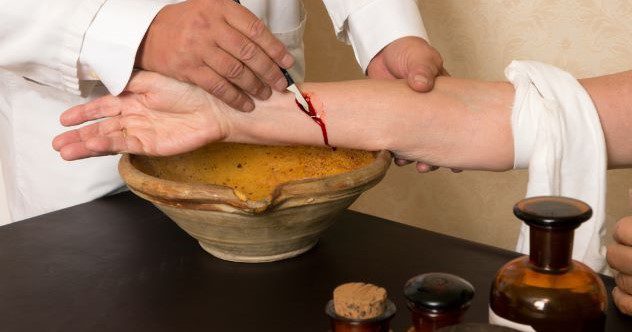
For much of Western medical history, health was explained through the theory of the four humors: blood, phlegm, yellow bile, and black bile. Ancient Greek and Roman physicians believed these fluids shaped a person’s body, personality, emotions, and illnesses. A healthy person had balanced humors. A sick person had too much or too little of one humor, like a badly seasoned stew.
This belief influenced treatments such as bloodletting, purging, special diets, and leeching. If you were ill, a physician might decide you had too much blood and remove some of it. Today, that sounds like fixing a leaking roof by removing the living room. But in a world without modern anatomy, biochemistry, or laboratory tests, the four humors offered a complete system that connected the body, mind, seasons, food, and temperament.
The theory also left marks on language. Words like “melancholy,” “sanguine,” “choleric,” and “phlegmatic” still echo humoral thinking. The science is gone, but the vocabulary is still hanging around like an old guest who refuses to leave after dinner.
4. Life Could Spontaneously Appear from Rotting Stuff
Spontaneous generation made maggots seem like magic
For a very long time, many people believed in spontaneous generation: the idea that living creatures could arise from nonliving matter. Maggots appeared on meat, so perhaps meat produced maggots. Mice appeared near grain, so perhaps grain and cloth could create mice. It was nature’s worst recipe book.
The belief was understandable because people could observe organisms appearing in places where they had not noticed eggs, larvae, or microbes. Without microscopes and controlled experiments, the process looked mysterious. In the seventeenth century, Francesco Redi showed that maggots came from flies laying eggs on meat. Later, Louis Pasteur’s famous swan-neck flask experiments helped disprove spontaneous generation at the microbial level by showing that microorganisms came from other microorganisms, not from broth magically deciding to become crowded.
This belief is a great example of how observation alone can mislead. People saw real events but drew the wrong conclusion. Science improved the answer by asking a better question: what happens when we control the conditions?
5. Human Remains Could Be Medicine
Corpse medicine was disturbingly popular in early modern Europe
One of the strangest historical medical beliefs was corpse medicine: the use of human bones, blood, fat, and powdered mummies as remedies. In parts of early modern Europe, people consumed preparations made from human remains to treat headaches, bleeding, epilepsy, bruises, and other illnesses. Yes, this was real. No, it does not pair well with lunch.
Powdered mummy, sometimes called “mumia,” became a prized ingredient. Human fat was used in ointments. Blood from executed people was sometimes believed to carry vitality. The logic often mixed medicine, magic, symbolism, and the belief that the body contained transferable life force.
The practice also reveals a historical double standard. Europeans sometimes condemned cannibalism in other cultures while using human remains in their own pharmacies. That contradiction is not just strange; it is a reminder that people often fail to recognize their own cultural blind spots. The medicine cabinet, apparently, needed both labels and self-awareness.
6. Kings and Queens Could Heal with a Touch
The royal touch promised divine healthcare
In medieval and early modern England and France, many people believed monarchs could heal scrofula, a form of tuberculous swelling of the lymph nodes, through touch. The disease became known as “the King’s Evil,” and royal touching ceremonies were performed for centuries.
The ritual was not only medical; it was political and religious. If a king could heal by divine gift, that suggested his rule was blessed. A public healing ceremony turned monarchy into a sacred performance. It was branding, but with swollen glands.
Some cases may have seemed successful because scrofula could sometimes improve or go into remission on its own. In a time before modern knowledge of tuberculosis, spontaneous improvement looked like proof of royal power. The belief eventually faded as medicine advanced and political attitudes toward monarchy changed. Still, it remains one of history’s clearest examples of how power can wrap itself in miracle language.
7. Skull Bumps Revealed Personality
Phrenology turned heads into personality maps
In the nineteenth century, phrenology became a popular pseudoscience. Its supporters believed that personality traits, intelligence, morality, and abilities could be read by feeling bumps and depressions on a person’s skull. A phrenologist might examine your head and confidently announce your talents, weaknesses, and moral tendencies. It was like a personality quiz, except someone touched your scalp and charged a fee.
Phrenology was based partly on one valid idea: different parts of the brain do have specialized functions. Unfortunately, phrenologists leaped from that idea into a swamp of unsupported claims. Skull shape does not provide a reliable map of character.
The belief had harmful consequences. It was used to support racist, sexist, and class-based assumptions by pretending prejudice was scientific measurement. Phrenology reminds us that bad science can become especially dangerous when it flatters existing social hierarchies. A measuring tool does not make a false belief objective. Sometimes it just gives nonsense a ruler.
8. Witches Could Attack People Through Dreams and Visions
Spectral evidence made nightmares legally dangerous
During witch trials in early modern Europe and colonial America, some courts accepted forms of evidence that sound shocking today. In the Salem witch trials of 1692, for example, spectral evidence played a major role. This meant witnesses claimed that the spirit or apparition of an accused person appeared to them in a dream or vision and caused harm.
To modern readers, that sounds like convicting someone because they appeared in a bad dream wearing suspicious shoes. But within the religious worldview of the time, many people believed Satan and witches could operate through invisible forces. Fear, social conflict, illness, political anxiety, and religious pressure combined into a deadly legal environment.
The Salem crisis led to executions, imprisonment, and lasting shame. It also became a warning about courts accepting claims that cannot be tested. When fear becomes evidence, justice tends to pack a suitcase and leave town.
9. Animals Could Be Put on Trial
Medieval courts sometimes treated pigs like criminals
In parts of medieval and early modern Europe, animals were sometimes put on trial for crimes. Pigs, rats, insects, dogs, and other animals could be accused in formal proceedings. Some animals were tried for injuring or killing humans. Others, such as crop-destroying pests, could face church-related legal action.
The practice sounds absurd now, but it reflected a world where law, religion, morality, and community order were closely connected. If a pig killed a child, a public trial and punishment may have helped a community feel that justice had been restored. It also reinforced the idea that all creation existed within a moral order.
Of course, from a modern legal perspective, animals lack the moral intent required for criminal guilt. A pig cannot form criminal mens rea, hire a defense attorney, or object to leading questions. Still, animal trials reveal how societies use legal rituals not only to solve problems, but to make chaos feel manageable.
10. The Womb Could Wander Around the Body
The “wandering womb” blamed women’s symptoms on reproductive organs
Ancient and later medical writers sometimes believed that the uterus could move around the body and cause illness. This “wandering womb” theory was connected to early ideas about hysteria, a term rooted in the Greek word for uterus. Symptoms such as choking, anxiety, pain, fainting, or emotional distress could be blamed on a restless womb supposedly traveling where it did not belong.
The belief was anatomically wrong, but it had a long afterlife because it fit cultural assumptions about women’s bodies and emotions. Women’s pain and distress were often interpreted through reproductive biology rather than taken seriously on their own terms.
The wandering womb is more than a strange medical mistake. It is a reminder that bad beliefs can shape real treatment, social roles, and credibility. When medicine begins with a stereotype, patients suffer. Thankfully, anatomy eventually told the wandering womb to sit down and stop causing rumors.
What These Strange Historical Beliefs Teach Us Today
It is tempting to read about these strange historical beliefs and feel superior. We have satellites, antibiotics, peer-reviewed journals, genetic testing, and the ability to look up “why does my eye twitch” at 2:00 a.m. and immediately regret it. But the more useful response is humility. People in the past were not stupid. They were human. They built explanations from the evidence available to them, the authorities they trusted, and the fears that shaped their lives.
That experience is still familiar. Modern people also believe things because they feel intuitive. We trust patterns that look obvious. We accept claims from confident voices. We confuse correlation with causation. If everyone around us repeats the same idea, it begins to sound like reality wearing a name tag.
Studying strange beliefs throughout history can make us better thinkers. Miasma theory shows that a wrong explanation can still point toward a useful observation: dirty environments really were dangerous, even if smell was not the true cause of infection. Phrenology shows how dangerous it is when social bias dresses up as science. Witch trials show what happens when fear becomes evidence. Animal trials show that legal systems can reflect emotional needs as much as rational principles. The royal touch shows how political power can benefit from miracle stories. Corpse medicine shows that even educated societies can normalize practices that later generations find horrifying.
There is also something oddly comforting about these beliefs. They show that humans have always wanted the world to make sense. When disease struck, people wanted causes. When crops failed, communities wanted someone or something to blame. When the sky moved, astronomers built models. When bodies behaved mysteriously, physicians created systems. Some explanations failed spectacularly, but the desire behind them was deeply human: make the unknown less terrifying.
The best lesson is not “people used to believe weird things.” The best lesson is “people can believe weird things when evidence is limited, incentives are distorted, or authority goes unquestioned.” That applies in every century. Our strange beliefs may not involve royal scrofula ceremonies or courtroom pigs, but future generations will almost certainly find some of our assumptions amusing. With luck, they will laugh kindly.
So the next time a historical belief sounds ridiculous, pause before mocking it. Ask what made it believable. Ask who benefited from it. Ask what evidence finally changed people’s minds. That habit turns a funny list of strange beliefs into something more useful: a guide to critical thinking. History is full of wrong answers, but it is also full of people slowly learning how to ask better questions.
Conclusion
The history of strange beliefs is not just a cabinet of curiosities. It is a mirror. From the geocentric universe to the wandering womb, from bad air to skull bumps, humans have repeatedly tried to explain mystery with whatever knowledge, fear, and imagination were available. Some ideas were harmlessly odd. Others caused suffering. Many were eventually replaced by better evidence.
That is the hopeful part. Human beings are capable of believing nonsense, but we are also capable of correcting it. The story of strange beliefs throughout history is really the story of curiosity growing sharper over time. We observe, we guess, we argue, we test, we revise, and occasionally we apologize to the pig.
Note: This article is original, web-ready content synthesized from reputable historical, medical, scientific, museum, and educational references. It is written for SEO readability while avoiding plagiarism, keyword stuffing, and unnecessary source-code elements.