History isn’t just dates, crowns, and the occasional war. It’s also people
sitting down at tables groaning under mountains of meat, questionable
delicacies, and enough wine to float a small boat. When rulers wanted to
show off power, wealth, or just an impressive lack of restraint, they
didn’t give a PowerPoint presentation they threw a feast.
From Roman emperors obsessed with flamingo tongues to kings who installed
wine fountains and cooked peacocks in full feather, these outrageous
historical feasts turned the dining room into a stage. Let’s pull up a
(sturdy) chair and look at ten of the wildest banquets ever served and
what they reveal about the people who hosted them.
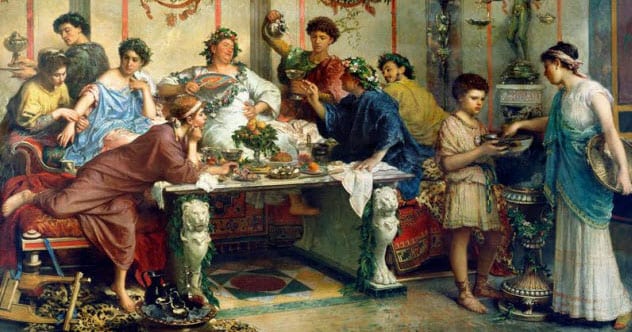
1. Vitellius and the “Shield of Minerva” – Rome’s Infamous Gut-Buster
Aulus Vitellius, briefly emperor in the chaotic Year of the Four Emperors
(69 CE), is remembered less for his policies and more for his appetite.
Ancient writers loved to paint him as gluttony in a toga, and modern
historians agree his reputation for excess was at least partly earned.
The Dish That Went Down in History
Vitellius supposedly served a single, legendary dish known as the
“Shield of Minerva.” This wasn’t just a big plate of pasta. It was a
giant platter piled with pike livers, pheasant and peacock brains,
flamingo tongues, and lamprey milt. The ingredients were shipped from
across the empire, turning dinner into a kind of edible map of Roman
conquest.
Why It Was Outrageous
To the Romans, banquets were political theater. Vitellius used food to
send a message: he could command rare animals, distant provinces, and
enormous wealth, all for one meal. Even in an empire famous for
indulgence, ancient authors treated this feast as over the top a
symbol of a ruler who let consumption replace competence.
2. Nero’s Golden House Dinners – Petals, Perfume, and Spectacle
If Vitellius went big on ingredients, Nero went big on atmosphere. After
the Great Fire of Rome, Nero built the Domus Aurea, the “Golden House,”
an extravagant pleasure palace with a revolving dining room and ceilings
designed for stagecraft-level dining experiences.
Dining Under a Moving Sky
Roman sources describe ceilings that could sprinkle diners with perfumes
and shower them with flower petals. Imagine trying to eat while hoping a
falling rose petal didn’t land in your soup. The revolving dining room
gave guests the feeling of eating under a constantly changing sky
basically the ancient version of immersive dining.
Why It Was Outrageous
Nero’s feasts weren’t just about food; they were about godlike power.
He turned dinner into a special effects show, blurring the line between
mortal banquet and divine celebration. For many Romans, it was less
“cute date night” and more “this guy thinks he’s Apollo.”
3. The Feast of the Pheasant – Burgundy’s Ultimate Medieval Flex (1454)
In 1454, Philip the Good, Duke of Burgundy, threw the Feast of the
Pheasant in Lille. Officially, it was meant to rally European nobles to
a crusade after the fall of Constantinople. Unofficially, it was a
medieval “look how rich I am” showcase with feathers, oaths, and
theatrical stunts.
Elephants, Giant Pies, and Musical Surprises
Contemporary accounts describe elaborate pageantry: jousts, symbolic
performances, and an actor dressed as the personified Church of
Constantinople, riding in on an “elephant” and pleading for help. Musicians
supposedly appeared from inside a giant pie, and “bird oaths” were sworn
over a roasted pheasant dressed in jewels and armor.
Why It Was Outrageous
This wasn’t just dinner; it was a political spectacle in multiple acts.
Food, costumes, animals, and music formed one coordinated message:
Burgundy was wealthy, cultured, and morally serious or at least very,
very good at throwing themed parties.
4. Henry VIII’s Tudor Banquets – Peacock, Swan, and Live-Bird Pies
Tudor England took feasting seriously, and no one leaned into that more
than Henry VIII. His court routinely devoured massive spreads of roasted
game, sugar sculptures, and elaborately decorated pies.
What Was on the Table?
Records from Tudor kitchens describe dishes like roasted swan and
peacock, often re-dressed in their original feathers for maximum drama.
There were pies filled with live birds, which would burst out when the
crust was cut a real-life version of the nursery rhyme “four and
twenty blackbirds baked in a pie.” Feasts could stretch for hours, with
musicians, jesters, and masques in between courses.
Why It Was Outrageous
Feasts at Henry’s court weren’t just about indulgence; they quietly
reinforced hierarchy. Only the top tier got the rarest meats or the most
elaborate dishes. The message was simple: if you had a front-row seat at
the peacock table, you mattered.
5. The Field of the Cloth of Gold – Diplomacy with Wine Fountains (1520)
In 1520, Henry VIII of England and Francis I of France met near Calais
for a diplomatic summit so fancy it was named after the glittering
fabrics of the pavilions: the Field of the Cloth of Gold. Along with
jousts, tournaments, and displays of royal fashion, the food and drink
situation was completely over the top.
Feeding 12,000 People
Around 12,000 attendees had to be fed, which meant entire temporary
kitchen complexes, bread ovens, and a constant stream of supply wagons.
Contemporary reports mention fountains flowing with wine and staggering
quantities of beer roughly 66,000 liters ordered for the event. If
you’ve ever tried catering for 50 people and nearly lost your mind,
imagine doing it for a small city.
Why It Was Outrageous
The Field of the Cloth of Gold wasn’t just a summit; it was a flex
contest. Every roasted ox and gilded pavilion said, “My kingdom is
richer and more refined than yours” ideally without actually starting
another war.
6. Versailles Under Louis XIV – The Sun King’s Grand Banquets
Fast-forward to 17th-century France and the court of Louis XIV, the Sun
King. Versailles wasn’t just a palace; it was a stage for ritualized
eating known as the grand couvert, where the king’s formal meals
were partly public events.
Ritual on a Plate
Louis XIV’s feasts featured carefully sequenced courses, precise table
etiquette, and endless silverware. Servants hovered with trays of wine
and diners had to drain each glass in one go before returning it. Food
ranged from rich roasts and game to elaborate pastries, with everything
designed to be visually stunning as well as filling.
Why It Was Outrageous
At Versailles, the food was almost secondary to the message: the king is
the sun, and everyone else orbits around him. Being allowed to watch him
eat was considered an honor. Today, the idea of strangers standing around
your dinner table just to see you chew sounds like a nightmare, but at
Versailles, it was peak status.
7. The Qianlong Emperor’s “Feast of the Thousand Old Men”
In 18th-century Qing China, the Qianlong emperor hosted massive
state-sponsored banquets honoring elderly subjects, known as the “Feast
of the Thousand Old Men” (Qiansouyan). One account from 1785 describes a
celebration in Beijing for roughly 3,000 senior guests brought from
across the empire.
Feasting as Imperial PR
The emperor treated these banquets as a display of filial piety on an
imperial scale. Guests were served lavish multi-course meals, presented
with gifts, and honored with music and ceremony. The menu included
luxurious meats, fine pastries, and symbolic dishes meant to signal long
life and prosperity.
Why It Was Outrageous
Logistically, feeding thousands of seniors inside the Forbidden City was
a feat of organization. Politically, it was brilliant: by honoring the
elderly, Qianlong projected himself as a benevolent, fatherly ruler,
even as the state tightly controlled everyday life. It was part feast,
part empire-wide PR campaign.
8. Mansa Musa’s Golden Hospitality on the Road to Mecca
Mansa Musa, 14th-century ruler of the Mali Empire, is often described as
one of the richest people in history. His 1324–1325 pilgrimage to Mecca
turned into a traveling mega-feast that stunned the Mediterranean world.
Feeding an Army of Pilgrims
Musa reportedly traveled with thousands of attendants and dozens of
camels loaded with gold. Along the way, he fed not only his own people
but also many of the poor in the regions he passed through, especially
in Cairo. Contemporary Arabic writers describe his generosity and
large-scale distribution of food and alms, which effectively turned the
pilgrimage route into one long, moving banquet.
Why It Was Outrageous
Musa’s “feast” wasn’t confined to one table; it spread across countries.
His extravagant spending and gift-giving were so intense that some
accounts claim he disrupted local gold markets. This was hospitality as
foreign policy: by feeding and enriching people far beyond his borders,
he advertised Mali’s power more effectively than any speech.
9. The “Three Emperors Dinner” – 16 Courses, 8 Wines, 8 Hours (1867)
On June 7, 1867, during the Paris Exposition, the Café Anglais hosted
one of the most famous banquets in restaurant history: the “Dinner of
the Three Emperors.” Prepared by chef Adolphe Dugléré, it was arranged
for King William I of Prussia, Tsar Alexander II of Russia, the
Tsarevitch (future Alexander III), and Otto von Bismarck.
What They Ate
The dinner lasted about eight hours and featured 16 courses and eight
different wines, including rare vintages of Château d’Yquem, Lafite,
Latour, and more. Dishes ranged from delicate fish and soufflés to duck,
ortolans, and elaborate desserts, all perfectly paired with wine. The
cost per person would translate to thousands of modern dollars, much of
it in the wine cellar alone.
Why It Was Outrageous
This feast was the Gilded Age in microcosm: luxury, status, and power
packed into a single evening. The fact that a restaurant not a royal
palace staged it also showed how fine dining was becoming a prestige
industry in its own right.
10. Talleyrand’s Congress of Vienna Banquets – Diplomacy by Dinner (1814–1815)
During the Congress of Vienna, when Europe’s leaders gathered to
rearrange the continent after Napoleon, French diplomat Charles-Maurice
de Talleyrand used the dinner table as his secret weapon. His banquets
were so famous that many attendees joked more real negotiation happened
over dessert than in official sessions.
Food as Soft Power
Talleyrand worked with top chefs to create meals that were elegant but
not overwhelming, giving guests space to talk and build alliances. His
dinner parties became must-attend events, where political enemies could
share a table, a bottle, and occasionally a compromise.
Why It Was Outrageous
Compared with flamingo tongues and wine fountains, these feasts were
relatively restrained. What made them outrageous was their influence:
menus shaped maps. Talleyrand showed that, in the right hands, a dining
room could be just as powerful as a battlefield.
What These Wild Feasts Tell Us
Taken together, these outrageous banquets have a few things in common.
First, they were never just about eating. Whether it was Vitellius
flaunting imperial reach, Philip the Good staging a crusading drama, or
Qianlong honoring elders while shoring up loyalty, food was a tool
one that could be as symbolic as any royal proclamation.
Second, scarcity always plays a starring role. Exotic animals, rare
wines, and massive quantities of everyday staples all said the same
thing: “I can control what you can’t.” That’s why peacocks, flamingos,
and live-bird pies keep turning up in these stories. It wasn’t just
about taste; it was about proving you had access to the unusual, the
distant, and the expensive.
Finally, these feasts show how people in power understood one simple
truth: it’s hard to say no to someone who’s just handed you a plate of
something spectacular. Whether that leads to justice, peace, or just a
legendary stomachache is another question.
Experiencing “10 Outrageous Feasts From History” Today
So what would it actually feel like to attend one of these feasts? Let’s
imagine stepping into a few of them hopefully with modern plumbing and
antacids available afterward.
At Vitellius’s table, the first thing you’d notice isn’t the glamour but
the intensity. The air would be thick with the smell of roasted meat and
spiced sauces. Slaves and servants would move constantly, refilling cups
and bringing in strange dishes you might not even recognize. You’d be
torn between curiosity (“What does flamingo tongue even taste like?”)
and the nagging feeling that you’re watching an emperor eat his way into
trouble.
At the Feast of the Pheasant, you’d be overwhelmed by spectacle. Before
you even got to the main course, you’d see jousts, allegorical
performances, and costumed figures making solemn vows over a jeweled
pheasant. The food would be rich and heavy multiple courses of meat,
pastries, and sugar creations but the real flavor would be the
political pressure. Everyone around you would know they’re being watched
as much as they’re being fed.
At the Field of the Cloth of Gold, the sensory overload would reach a
new level. Imagine walking between pavilions made of glittering fabric,
hearing the clatter of armor and the music of court bands, and smelling
roast meat cooking in enormous temporary kitchens. You’d pass barrels of
beer, fountains of wine, and lines of workers hauling bread and food for
thousands. It wouldn’t feel like a dinner party; it would feel like a
pop-up city fueled entirely by calories and rivalry.
Versailles under Louis XIV would feel different again less chaotic,
more choreographed. You might spend more time watching than eating,
observing how close people could get to the king, who got served first,
and who maneuvered for the best conversational spots. The food would be
elegant and refined, but your appetite might be slightly ruined by the
constant awareness that your every gesture is part of a social script.
The Qianlong emperor’s feast for thousands of elders would feel warmer
and more communal but no less orchestrated. You’d see row after row of
elderly guests seated with care, served symbolic dishes meant to
celebrate long life and imperial grace. The sheer number of people would
be awe-inspiring. Instead of an intimate dinner, it would feel like a
national ceremony disguised as a banquet.
At Talleyrand’s table in Vienna, the mood would be subtler: fewer
fireworks, more eyebrow raises. You’d sit between a general and a duke,
or a minister and a prince, and realize that every casual joke and every
refill of wine is part of a larger game. The courses would be perfectly
balanced not too rich, not too heavy designed to keep people
talking, not snoozing. You might leave hungry for dessert but very full
of political gossip.
What ties all these imagined experiences together is the way food shapes
memory. We rarely remember every detail of an official speech, but we do
remember the atmosphere of a special meal who sat where, what we
tasted, and how it made us feel. For rulers throughout history, that
emotional imprint was the point. These outrageous feasts weren’t
throwaway indulgences; they were carefully staged events designed to
stick in people’s minds long after the last plate was cleared.
If there’s a takeaway for modern readers, it’s this: every time we
gather around a table, we’re doing a tiny, humble version of what these
emperors and kings did on a grand scale. We use food to celebrate,
persuade, impress, and connect. Hopefully, we just skip the peacock
brains.