Say “ancient architecture” and the usual celebrities immediately report for duty: the Pyramids of Giza, the Colosseum, the Parthenon, perhaps Machu Picchu if the casting director wants dramatic mountains. They deserve their fame, of course. But human civilization did not spend several thousand years building only the monuments printed on souvenir mugs.
Across Europe, Asia, South America, and the Middle East are extraordinary little-known historical structures that can compete with the world’s most famous landmarks in engineering, artistry, scale, or sheer audacity. Some were centers of religion and education. Others guarded imperial frontiers. One sits on a windswept Greek headland, another rises like a brick mountain in Sri Lanka, and several demonstrate that ancient architects regarded the phrase “that seems difficult” as a personal challenge.
This collection explores ten magnificent structures that deserve a much larger place in the architectural spotlight. Several are UNESCO-recognized heritage sites, while others survive almost casually beside better-known attractions. Together, they offer an unusually vivid tour through ancient engineering, sacred architecture, forgotten civilizations, and the remarkable human habit of building things that outlive their builders by centuries.
10. Incallajta, Bolivia
An Inca stronghold beyond the familiar tourist trail
Machu Picchu has become such a powerful symbol of Inca civilization that it can accidentally make the rest of the empire look like supporting scenery. Incallajta, also written Inkallaqta, provides a useful correction.
Located in Bolivia’s Cochabamba region, Incallajta was established during the expansion of the Inca Empire into the eastern valleys in the second half of the 15th century. The archaeological complex covers roughly 67 hectares and combines defensive, residential, ceremonial, administrative, and agricultural features. Researchers have therefore interpreted it as much more than a lonely fortress.
Its star attraction is the enormous kallanka, a long rectangular hall associated with state gatherings and imperial administration. At roughly 78 meters long and 25 meters wide, it demonstrates the ability of Inca builders to create substantial covered public spaces without modern structural systems. The site also contains an ushnu, or ceremonial platform, walls, terraces, and other structures that reveal how imperial authority was expressed through architecture.
What makes Incallajta especially fascinating is its location. This was a frontier landscape where highland Inca power met the warmer eastern valleys. The complex therefore feels less like an isolated ruin and more like a carefully positioned statement: the empire had arrived, and it had brought masons.
9. Temple of Hercules Victor, Rome, Italy
The round Roman temple people walk past
Rome has a difficult problem that most cities would happily borrow: it contains so many ancient monuments that a perfectly extraordinary Roman temple can become background decoration.
The Temple of Hercules Victor stands in the Forum Boarium near the Tiber River. Dating to the late second century BCE, it is a circular, Greek-influenced temple surrounded by Corinthian columns. Nineteen of its original twenty columns survive, making the structure remarkably complete for its age.
Its marble construction is particularly significant. The temple is generally regarded as the oldest surviving marble building in Rome. Its rounded design also distinguishes it sharply from the rectangular temple form most visitors expect from Roman architecture.
For centuries, people incorrectly associated the building with Vesta, largely because its circular form resembled temples devoted to that goddess. Its preservation owes much to one of history’s most effective architectural survival strategies: reuse. During the medieval period it was converted into a Christian church, helping spare it from the wholesale dismantling that reduced many Roman buildings to convenient quarries.
Today it stands quietly near monuments that attract considerably more attention. Rome, apparently, is the sort of place where a 2,000-year-old marble temple can suffer from poor brand recognition.
8. Mỹ Sơn Sanctuary, Vietnam
The sacred brick towers of the Champa kingdom
Hidden in a green valley in central Vietnam, Mỹ Sơn Sanctuary preserves the architectural legacy of Champa, a civilization that once controlled extensive territories along what is now the Vietnamese coast.
The sanctuary developed over many centuries, beginning around the fourth century CE. Unlike some older descriptions that mistakenly characterize Mỹ Sơn as primarily Buddhist, the complex was fundamentally connected with Hindu worship, particularly devotion to Shiva. Its tower-temples symbolically evoked Mount Meru, the sacred cosmic mountain of Hindu tradition.
The surviving buildings are constructed largely from fired brick, accented with stone columns and sandstone carvings depicting religious figures and episodes from Hindu mythology. The brickwork has long attracted attention because of the remarkably tight joints between individual bricks.
Mỹ Sơn also carries the visible scars of modern history. Warfare during the 20th century severely damaged the sanctuary, destroying or compromising numerous structures. Conservation efforts have since focused on stabilizing surviving monuments while improving knowledge of Cham construction techniques.
The resulting landscape has a haunting quality: reddish towers emerge against densely forested mountains, some intact enough to communicate their original grandeur and others reduced to fragments. Mỹ Sơn is not merely an architectural attraction. It is evidence of a sophisticated Southeast Asian civilization whose artistic language connected local traditions with the wider cultural world of India and maritime Asia.
7. Temple of Poseidon at Sounion, Greece
A temple built where land dramatically runs out
The Parthenon gets the postcards, but roughly 70 kilometers southeast of Athens another classical Greek temple occupies a location that may be even harder to forget.
The Temple of Poseidon at Cape Sounion rises above the Aegean Sea on the southern tip of Attica. The surviving marble temple dates to approximately 444–440 BCE, during the great building era associated with Periclean Athens. It replaced an earlier sanctuary damaged during the Persian invasions.
The choice of location was beautifully appropriate. Poseidon was god of the sea, and Sounion controlled a strategically important maritime approach to Athens. Sailors approaching Attica could recognize the sanctuary from the water, making architecture, religion, geography, and navigation part of the same experience.
The temple follows the Doric order, with slender columns that appear particularly graceful against the open horizon. Although much of the building has disappeared, the remaining colonnade creates one of classical architecture’s great visual tricks: relatively simple geometry becomes spectacular when placed in exactly the right landscape.
Sounion is also mentioned in Homer’s Odyssey, where Menelaus stops at the sacred cape after the death of his helmsman. Thousands of years later, visitors still gather here at sunset. Poseidon may have lost his formal worshippers, but his real estate remains outstanding.
6. Chogha Zanbil, Iran
A monumental Elamite ziggurat in the Iranian plain
The ancient Near East produced some of humanity’s earliest cities, writing systems, and monumental religious architecture. Yet public imagination tends to compress the entire region into a few familiar names: Babylon, Ur, Nineveh. Chogha Zanbil reminds us that another major civilization, Elam, deserves a seat at the table.
Located in modern Khuzestan, Iran, the sacred city was founded by the Elamite ruler Untash-Napirisha during the 13th century BCE. At its center stood a huge stepped ziggurat dedicated principally to the gods Inshushinak and Napirisha. The city was enclosed by a series of concentric walls containing temples, palatial areas, and other structures.
The ziggurat originally rose in several diminishing levels and may have reached roughly 50 meters in height. Although only part of the original monument survives, Chogha Zanbil remains one of the best-preserved examples of this architectural form. UNESCO describes the site as containing exceptional evidence of ancient Elamite culture.
Its importance extends beyond architecture. Elam developed beside, and interacted extensively with, the civilizations of Mesopotamia while maintaining its own languages, religious systems, political traditions, and artistic identity.
Standing before a ziggurat built more than three millennia ago is an effective cure for anyone who believes modern humans invented ambitious construction projects.
5. Jetavanaramaya, Anuradhapura, Sri Lanka
The ancient brick giant hiding in plain sight
Imagine constructing a building roughly as tall as a modern 30- or 40-story tower using ancient technology and an almost absurd quantity of brick. That gives some sense of the achievement represented by Jetavanaramaya.
This enormous Buddhist stupa dominates the ancient sacred city of Anuradhapura in Sri Lanka. Construction began under King Mahasena, who ruled during the late third and early fourth centuries CE. Scholars estimate that the structure originally reached about 122 meters, or 400 feet, making it one of the tallest buildings anywhere in the ancient world.
A stupa is not an interior building in the conventional Western sense. It is a solid religious monument associated with Buddhist relics and devotional practice. Jetavanaramaya therefore transforms mass itself into sacred architecture: an immense brick dome rising from a broad platform toward a tapering spire.
Anuradhapura served as a major political and religious center for approximately 1,300 years, developing palaces, monasteries, reservoirs, stupas, and sacred landscapes on a tremendous scale. After political changes and invasions, sections of the ancient city were gradually reclaimed by vegetation before archaeological and conservation work returned them to view.
Jetavanaramaya has lost part of its original height, but not its visual authority. It remains one of the world’s great demonstrations of what ancient brick construction could achieve when someone decided that “large” was merely the opening suggestion.
4. Nalanda Mahavihara, India
A university city centuries before the modern campus
Universities are often imagined as a European medieval invention, complete with stone quadrangles and students discovering creative reasons for missing morning lectures. Nalanda complicates that story considerably.
Located in present-day Bihar, Nalanda Mahavihara developed into one of ancient and medieval Asia’s greatest centers of Buddhist learning. Archaeological evidence at the site extends back to the centuries BCE, while the major monastic-scholastic institution flourished particularly from around the fifth century CE onward. UNESCO identifies remains spanning approximately the third century BCE to the 13th century CE.
The excavated complex includes monasteries, shrines, stupas, residential spaces, educational buildings, sculpture, and carefully organized brick architecture. Rather than one giant monument, Nalanda is magnificent because it functioned as an intellectual city.
Traveling scholars came from across Asia. The seventh-century Chinese monk Xuanzang famously studied there and described rigorous scholarship and a broad curriculum. Surviving works associated with Nalanda also demonstrate its importance as a center of Buddhist art and philosophical exchange.
The institution eventually declined amid political upheaval and was devastated around the end of the 12th and beginning of the 13th centuries. Today, rows of reddish brick monasteries and temples make the abstract phrase “ancient center of learning” wonderfully concrete. You can walk through spaces where international students debated philosophy more than a thousand years before anyone complained about campus Wi-Fi.
3. Vézelay Abbey, France
A Romanesque masterpiece on a Burgundian hill
France has enough celebrated churches to fill an architectural encyclopedia before lunch, which partly explains why Vézelay Abbey receives less international attention than Notre-Dame de Paris, Chartres Cathedral, or Mont-Saint-Michel.
Its Basilica of Sainte-Marie-Madeleine is nevertheless one of the great surviving masterpieces of Romanesque architecture. Rising above the Burgundy countryside, Vézelay became an important medieval pilgrimage center after the abbey claimed relics associated with Mary Magdalene.
The present church is especially admired for its 12th-century architecture, sculpted capitals, and monumental portal. Its nave demonstrates the muscular clarity of Romanesque construction: broad arches, rhythmic piers, alternating stone tones, and carefully controlled proportions create an interior that feels both monumental and surprisingly luminous.
Vézelay was also connected with major events in medieval European history. Bernard of Clairvaux preached the Second Crusade there in 1146, and Richard the Lionheart and Philip II Augustus assembled at Vézelay before departing on the Third Crusade in 1190.
The abbey later suffered neglect and damage before a major 19th-century restoration led by Eugène Viollet-le-Duc. The result is a building that functions almost like an architectural bridge between periods: Romanesque mass and sculpture gradually give way to Gothic ideas in later sections.
It is the kind of place that makes the phrase “old church” seem comically inadequate.
2. Temple of Hephaestus, Athens, Greece
The Greek temple that survived unusually well
Visitors climbing the Acropolis naturally focus on the Parthenon. Look toward the Ancient Agora, however, and another classical temple appears almost suspiciously intact.
The Temple of Hephaestus, or Hephaisteion, stands on a low hill overlooking the Agora. Construction began during the fifth century BCE, and the building was dedicated principally to Hephaestus, god of metalworking and craftsmanship, with Athena also associated with the sanctuary.
The temple is among the best-preserved Doric temples on the Greek mainland. Its columns, entablature, pediments, and substantial portions of the interior structure survive, allowing visitors to appreciate classical Greek architecture as a building rather than as a romantic arrangement of disconnected columns. The American School of Classical Studies at Athens describes it as the best-preserved example of a Doric temple on the Greek mainland.
Why did it survive so well? Once again, adaptive reuse helped. The temple was converted into a Christian church, protecting much of its fabric through later historical periods. For a time it even served as a burial place for non-Orthodox Europeans in Athens.
Its setting adds another layer of meaning. Hephaestus was patron of craftsmen, while the nearby Agora was filled with commercial and manufacturing activity. The temple therefore belonged naturally to the economic and civic world beneath it.
The irony is delicious: one of Greece’s most complete ancient temples remains less famous partly because it happens to live in the same neighborhood as the Parthenon.
1. Meteora, Greece
Monasteries between the earth and sky
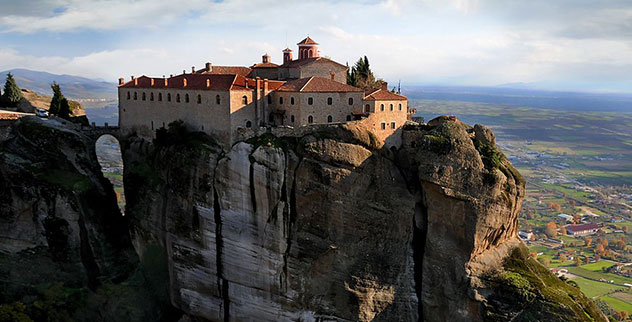
If someone described Meteora without photographs, the description might sound like architectural fantasy: enormous rock pillars rise abruptly from the Thessalian landscape, and medieval monasteries somehow occupy their summits.
Yet that is precisely what generations of Orthodox monks created.
Hermits were living among the caves and rock formations of Meteora by roughly the 11th century. During the later Middle Ages, larger organized monastic communities developed on the nearly inaccessible peaks. Eventually, 24 monasteries were established across the rock formations. Six historic monasteries constitute the surviving monumental core recognized today.
Building them required extraordinary logistics. Materials, food, and people once had to be raised using ladders, ropes, nets, and lifting systems. Accessibility was deliberately difficult: isolation provided security as well as spiritual separation from ordinary life.
The monasteries themselves preserve churches, monastic quarters, courtyards, refectories, manuscripts, religious objects, and important fresco cycles. Their architecture alone would justify attention. Combined with the geology beneath them, however, Meteora becomes something much rarera cultural landscape in which human construction seems to complete a natural composition.
Meteora literally appears suspended between worlds. Buildings cling to stone pinnacles while broad plains and mountains stretch below. The effect is so improbable that photographs initially look manipulated. Then you realize medieval builders actually looked at those cliffs and thought, “Yes, the top seems convenient.”
Why These Lesser-Known Architectural Wonders Matter
The real lesson of these magnificent structures is not that famous monuments are overrated. The Parthenon, pyramids, and Colosseum remain famous for excellent reasons. The lesson is that architectural history is much larger than its greatest hits.
Incallajta reveals the administrative reach of the Inca world. Mỹ Sơn preserves the Hindu heritage of Champa. Chogha Zanbil opens a window onto ancient Elam. Jetavanaramaya transforms millions of bricks into an almost geological Buddhist monument. Nalanda demonstrates the sophisticated educational networks of medieval Asia. Vézelay embodies Romanesque spirituality, while the temples of Sounion and Hephaestus show how different contexts could transform the same broad classical architectural tradition.
Then there is Meteora, where architecture essentially challenges gravity to file a formal complaint.
These places also show why preservation matters. Buildings are unusually effective historical documents. Walls reveal technologies; decoration records religious beliefs; city plans expose political priorities; construction materials trace trade and craftsmanship. Lose the monument, and an entire chapter of human experience becomes harder to read.
Experiencing 10 Magnificent But Little-Known Structures
Why visiting an overlooked monument can feel different
There is a particular pleasure in encountering a historical structure without having seen it reproduced ten thousand times beforehand. Famous landmarks arrive with enormous cultural baggage. By the time a traveler reaches the Colosseum or the Parthenon, the building has already appeared in textbooks, movies, advertisements, social feeds, desktop backgrounds, and probably on somebody’s refrigerator magnet.
A lesser-known site can deliver something different: surprise.
Imagine entering the Ancient Agora in Athens after spending hours around the heavily photographed Acropolis. You follow a path through trees and suddenly the Temple of Hephaestus appears ahead, astonishingly complete. The first reaction may be confusion: Why isn’t everyone constantly talking about this? That question is part of the experience.
Meteora creates a different emotional rhythm. The monasteries are impressive individually, but the landscape does most of the theatrical work. Roads curve between towering rocks, viewpoints reveal buildings perched above enormous drops, and the relationship between human scale and geological scale changes every few minutes. Seeing one monastery explains little; seeing several scattered across the pinnacles explains why the entire landscape became sacred.
At Mỹ Sơn, the strongest impression can come from contrast. Brick towers stand against intensely green vegetation, while damaged foundations reveal how much has disappeared. A visit therefore combines admiration with an awareness of fragility. The ruins are beautiful, but they also demonstrate how quickly centuries of cultural heritage can be damaged by modern conflict.
Nalanda produces yet another kind of experience. Instead of staring at one heroic monument, a visitor moves through repeated monasteries, courtyards, shrines, corridors, and brick foundations. Gradually, the site begins to behave like a campus again in the imagination. You picture monks crossing courtyards, scholars arguing over philosophy, manuscripts being copied, international visitors arriving after difficult journeys, and generations of students discovering that academic deadlines were probably annoying even before spreadsheets existed.
Remote locations also change how historical architecture is understood. Incallajta makes far more sense when viewed within its mountainous frontier environment. Sounion becomes unforgettable because of the sea surrounding its promontory. Chogha Zanbil gains power from the flat landscape around its rising mass. Architecture is never merely the object standing in front of you; it is also the route taken to reach it, the climate around it, the horizon behind it, and the civilization that chose that particular location.
How to get more from an architectural journey
For travelers interested in hidden architectural wonders, slowing down is usually more rewarding than collecting sites at speed. Walk around a building before photographing it. Look at construction materials. Notice where entrances face, how sunlight reaches the interior, where water would have come from, and how builders responded to the surrounding terrain.
It also helps to ask practical questions. How were those stones moved? How was a roof supported? Who paid for the building? Who maintained it? Why was this location chosen? Why did one structure survive while neighboring buildings vanished?
Those questions transform ruins into evidence.
A stone wall suddenly becomes a record of labor. A column becomes proof of quarrying, transportation, geometry, and specialized craftsmanship. A monastery on a cliff becomes a logistical system as well as a religious statement. A university ruin becomes evidence that ideas once traveled enormous distances without airplanes, email, or online registration portals.
That is ultimately the best experience these little-known structures offer. They make history physical. Dates and dynasties stop being paragraphs in a book and become bricks, stairways, carvings, columns, platforms, and improbable buildings still occupying the same landscapes centuries later.
Conclusion
The world’s architectural heritage is far richer than the handful of landmarks that dominate travel advertising. From Incallajta’s Inca halls and Mỹ Sơn’s Cham towers to the immense brick mass of Jetavanaramaya and the cliff-top monasteries of Meteora, these ten magnificent but little-known structures reveal civilizations experimenting with engineering, symbolism, geography, religion, and political power.
Some survive because they were remote. Others survived because later generations reused them. Several endured warfare, abandonment, vegetation, earthquakes, religious change, or simple neglect. What remains is enough to prove that architectural greatness has never depended on modern fame.
So the next time someone begins listing the world’s great monuments and stops after the usual suspects, there is good news: humanity left behind a much longer sightseeing list. You just have to wander a little farther down it.
SEO Tags
Note: Historical details were cross-checked against contemporary archaeological, museum, heritage, and architectural references. Older claims associated with this topic were corrected where necessary, particularly regarding the Hindu character of Mỹ Sơn, the chronology of Nalanda, and the heritage status of Incallajta. Research included UNESCO heritage records, the Metropolitan Museum of Art, Smithsonian Magazine, National Geographic, and the American School of Classical Studies at Athens.