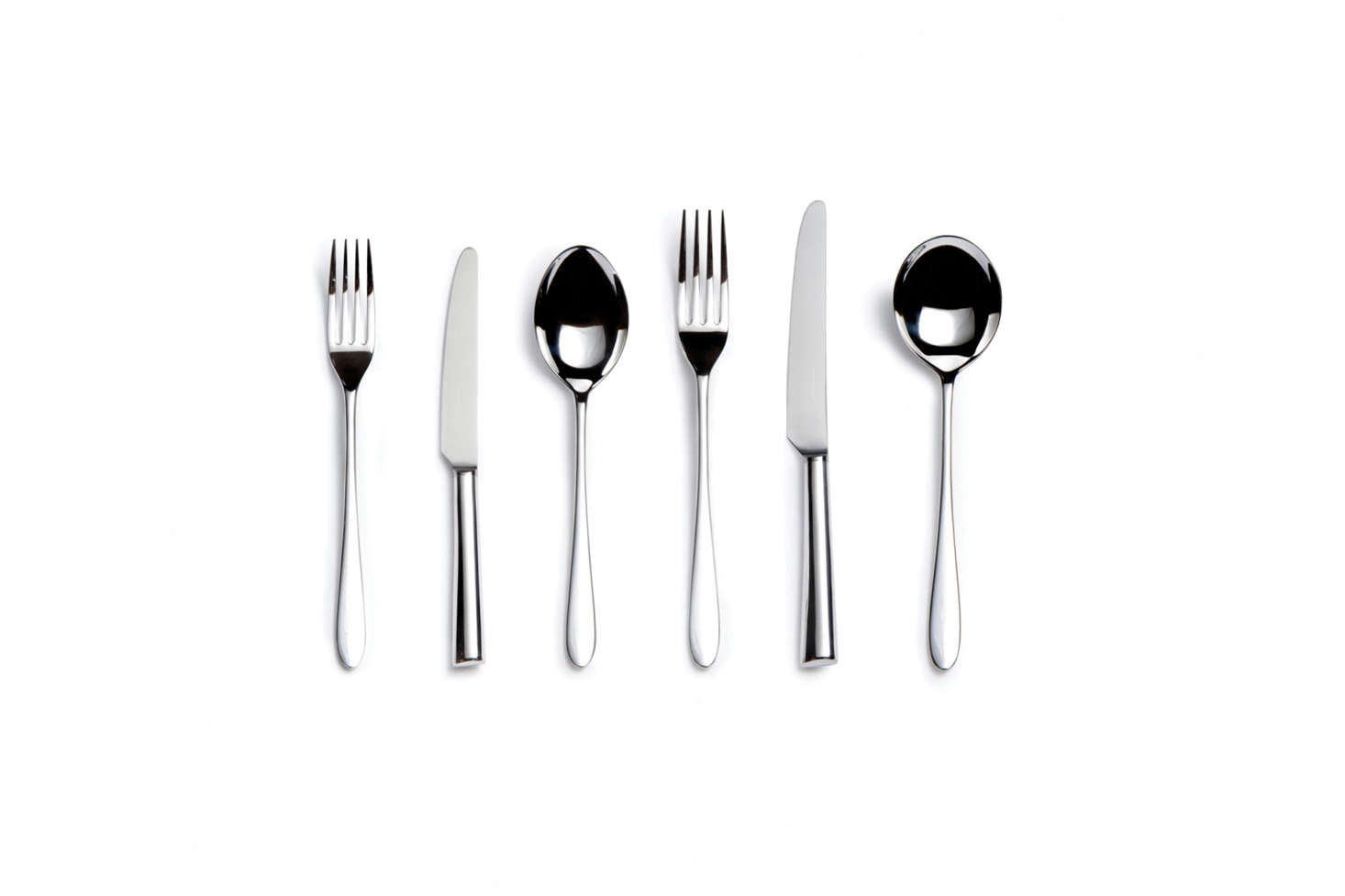
Midcentury flatware proves that even a teaspoon can have architectural ambitions. During the decades surrounding World War II, designers began stripping utensils of scrollwork, floral borders, and the sort of decoration that made a dinner fork look as though it had inherited a country estate. In their place came streamlined silhouettes, balanced proportions, exposed materials, and handles that felt as carefully considered as the chairs around the table.
The movement drew energy from Scandinavian functionalism, European modernism, American industrial design, and advances in mass production. Stainless steel became especially important because it was durable, practical, and visually suited to the era’s fascination with honest materials. Midcentury modern design flourished in the United States from roughly the mid-1940s through the late 1960s, although several influential flatware patterns appeared slightly earlier and helped establish the style.
What makes the best midcentury flatware so appealing today is its refusal to behave like a museum piece. These designs may have pedigrees, famous creators, and places in permanent collections, but they are still meant to scoop oatmeal, spear roasted potatoes, and rescue the final olive from a suspiciously deep bowl. Here are ten outstanding examples, ranging from restrained stainless-steel classics to hand-forged silver with enough presence to make Tuesday dinner feel like an opening-night party.
What Defines Midcentury Modern Flatware?
Midcentury modern flatware usually favors clean lines, reduced ornamentation, functional shapes, and materials that are allowed to look like themselves. Stainless steel appears as stainless steel rather than pretending to be aristocratic silver. Wood handles display their grain. Satin finishes soften reflections, while polished surfaces emphasize sculptural curves.
The period also produced tremendous variety. Some designers created gentle, ergonomic utensils that almost disappear in the hand. Others treated the knife, fork, and spoon as tiny pieces of futuristic sculpture. Arne Jacobsen’s 1957 cutlery, for example, eliminated unnecessary details so aggressively that it still looks unconventional decades later. MoMA’s design collection includes Jacobsen’s flatware as well as important stainless-steel work by Russel Wright, Tapio Wirkkala, and Peter Raacke.
10 Easy Pieces for a Midcentury Table
1. David Mellor Pride Flatware
David Mellor’s Pride flatware is an excellent place to begin because it captures the confidence of postwar British modernism without looking severe. Introduced in the 1950s, the pattern has elongated handles, softly rounded transitions, and a pleasing sense of weight. The spoon bowls and fork heads feel generous rather than dainty, making the design useful for real meals instead of ceremonial parsley rearrangement.
Pride works especially well with stoneware, linen napkins, pale woods, and simple glassware. It has enough polish for a formal table but not so much formality that everyone suddenly feels required to discuss municipal bonds. For shoppers who want an authentic midcentury pattern that remains comfortable and familiar, Pride is one of the safest long-term choices.
2. Grethe Meyer Copenhagen Flatware
Danish architect and designer Grethe Meyer approached household objects with remarkable discipline. Her Copenhagen flatware for Georg Jensen uses careful proportions and understated curves rather than decorative flourishes. Each piece appears simple at first glance, but the simplicity is highly calculated: handles taper gently, eating surfaces feel balanced, and the overall profile remains elegant without becoming fragile.
Copenhagen is commonly associated with both matte and polished stainless-steel finishes. The matte version has a quiet, architectural character, while the polished version brings more light to the table. Either works beautifully with Scandinavian interiors, but the pattern is adaptable enough for rustic ceramics, colorful glass, or contemporary white porcelain. It is the flatware equivalent of a beautifully cut navy jacket: calm, useful, and almost impossible to embarrass.
3. Jens Quistgaard Fjord Flatware
Jens Quistgaard’s Fjord pattern is among the most recognizable examples of Danish modern tableware. Designed for Dansk in the 1950s, it combines stainless-steel eating surfaces with warm wood handles. That material contrast gives the utensils a handcrafted character even though Dansk helped introduce modern Scandinavian housewares to a broad American audience. Vintage examples have become particularly desirable among collectors.
Fjord brings warmth to a table dominated by metal, glass, or white ceramics. The wood handles feel tactile and domestic, while the slender steel elements keep the design visually light. The practical warning is equally important: vintage wood-handled flatware generally prefers gentle hand-washing and prompt drying. A dishwasher may be convenient, but it has all the sensitivity of a small tornado.
4. Allen Adler Round End Flatware
Los Angeles silversmith Allen Adler created modern flatware with the authority of sculpture and the intimacy of handwork. His Round End design, associated with the 1940s, replaces elaborate ornament with broad, clean handles and subtly modeled surfaces. The result feels substantial without being bulky and luxurious without relying on decorative excess.
Hand-forged silver develops a softer, more individual character than factory-perfect stainless steel. Small variations and marks of use become part of the object’s history. Round End is therefore a choice for buyers who see flatware as an heirloom rather than a kitchen accessory. It pairs naturally with California modern interiors, handmade pottery, and tables where the serving bowls are casually placed but suspiciously expensive.
5. Arne Jacobsen AJ Cutlery
Designed in 1957, Arne Jacobsen’s AJ cutlery is the rebellious genius of this list. Its flattened forms, rounded ends, and radically reduced silhouettes challenged conventional ideas about how utensils should look. Jacobsen developed the cutlery for Copenhagen’s SAS Royal Hotel, and its futuristic appearance later made it a natural fit for the visual world of 2001: A Space Odyssey.
The pattern is typically produced in matte stainless steel, which emphasizes shape rather than sparkle. AJ cutlery looks spectacular beside crisp white plates, smoked glass, or minimalist dinnerware. Its unconventional knife and shallow spoon may require a brief adjustment, so this is not the set for anyone who believes a fork should look exactly as it did in 1894. For design lovers, however, that strangeness is the entire point.
6. Geweso Spaten Flatware
Spaten flatware demonstrates how midcentury designers could reinterpret tradition rather than simply erase it. The pattern draws on the classic spade-shaped handle but simplifies its outline, removes unnecessary embellishment, and gives the silhouette a cleaner modern rhythm. Produced in Solingen, Germany, versions of the pattern have been made in corrosion-resistant stainless steel with a restrained satin finish.
This design is a smart bridge between modern and traditional dining rooms. It does not look aggressively futuristic, yet it avoids the fussy borders and floral motifs associated with older formal silverware. Spaten can sit comfortably beside heirloom china, modern stoneware, or a mixed table assembled from flea-market discoveries. It is refined without behaving as though it needs its own velvet-lined drawer.
7. Carl Mertens Worpswede Flatware
Carl Mertens’ Worpswede pattern dates to the early 1930s, making it a precursor to the postwar midcentury boom. Its streamlined construction and hollow handles demonstrate how modernist principles were already transforming tableware before the style reached peak popularity. The shapes are controlled and practical, with a balance of rounded edges and crisp transitions.
Worpswede feels particularly appropriate in kitchens that combine Bauhaus influences with warmer natural materials. Its form is disciplined but not cold, and the hollow-handle construction can provide a lighter sensation than the design’s substantial appearance suggests. It is a useful reminder that modern flatware did not suddenly arrive with the first avocado-colored refrigerator; designers had been quietly sharpening the idea for years.
8. Alessi Caccia Flatware
Designed by Livio Castiglioni and Pier Giacomo Castiglioni in 1938, Caccia was presented at the 1940 Milan Triennale and later produced by Alessi. The pattern helped establish an elegant Italian interpretation of modern tableware. Its handles are slender and fluid, while the spoon bowls and fork heads have enough softness to prevent the set from feeling mechanically austere.
Caccia is ideal for people who want modernist flatware with a graceful, almost formal profile. It complements marble, polished wood, delicate glassware, and porcelain with narrow rims. Unlike more dramatic space-age patterns, it does not demand attention. Instead, it makes the table look quietly better, which is often the most expensive-looking trick a household object can perform.
9. Gio Ponti Sambonet Flatware
Architect Gio Ponti brought the same inventive elegance to tableware that he applied to buildings, furniture, and interiors. His flatware design for Sambonet originated in the early 1930s and was subsequently reissued. Its elongated proportions and refined surfaces represent the sophisticated Italian branch of modernism: functional, certainly, but never allergic to glamour.
Depending on the edition, the pattern may be found in stainless steel or silver-plated finishes. The silver-toned versions are especially effective for dinner parties because they reflect candlelight without introducing traditional ornament. This is flatware for a table with excellent pasta, a chilled bottle waiting nearby, and at least one guest who claims to understand obscure Italian cinema.
10. Allen Adler Town & Country Flatware
Allen Adler’s Town & Country design combines hand-forged silver with dark wood handles, producing a rich contrast between cool metal and organic material. Associated with Adler’s work in the 1940s, the pattern embodies a distinctly American version of modern luxury. It is less industrial than all-stainless flatware and more sculptural than ordinary wood-handled utensils.
The design works best when allowed to be the star of the table. Plain plates, natural linens, and restrained serving pieces prevent the setting from becoming visually crowded. As with other fine wood-handled flatware, careful cleaning is essential. Town & Country is not a low-maintenance purchase, but neither is a vintage sports car, and nobody buys one because the cup holders are sensible.
How to Choose Midcentury Flatware
Consider How the Pieces Feel
A beautiful fork can still be irritating if its handle digs into the palm or its weight pulls awkwardly toward the head. Before investing in a full service, purchase or handle one place setting whenever possible. Pay attention to balance, handle thickness, tine length, spoon depth, and the way the knife rests against the index finger.
Minimalist designs can vary dramatically in use. Some feel almost weightless, while others are deliberately substantial. Neither approach is automatically better. The right flatware should suit your grip, your dinnerware, and the kinds of food you regularly serve.
Understand Stainless-Steel Grades
Modern flatware is often labeled 18/10 or 18/8 stainless steel. These numbers generally refer to the approximate percentages of chromium and nickel in the alloy. Chromium contributes corrosion resistance, while nickel can improve luster and durability. Construction quality, thickness, finishing, and care remain important, so the grade alone should not be treated as a magical certificate of perfection.
Choose Between Vintage and Reissued Designs
Vintage midcentury flatware offers authenticity, patina, and the thrill of finding discontinued serving pieces. It can also bring scratches, missing utensils, loosened handles, and the sudden realization that your “complete service” contains seventeen teaspoons but no dinner knives.
Authorized reissues are generally easier to replace and may be better suited to daily use. When purchasing a famous pattern, check the manufacturer, production marks, materials, and dimensions. Reissues sometimes alter weight, finish, or construction even when the silhouette remains faithful to the original.
Match the Finish to Your Table
Matte flatware has a calm, contemporary appearance and tends to conceal minor fingerprints. Mirror-polished utensils add brightness and can make a simple table feel more formal, though they eagerly record every touch. Mixed-material designs introduce warmth but usually require more careful maintenance.
There is no requirement to coordinate every object by decade. Midcentury flatware can look excellent with farmhouse pottery, antique china, contemporary glass, or inexpensive restaurant-style plates. A successful table needs visual conversation, not historical reenactment.
The Living-With-It Experience: What Midcentury Flatware Is Really Like
Using midcentury flatware every day changes the table in a way that photographs do not fully explain. The appeal is not limited to how the pieces look beside a carefully folded napkin. It begins when a utensil is lifted. A tapered handle can make an ordinary fork feel unusually precise, while a broad forged handle adds a reassuring sense of weight. Even small differences in spoon depth become noticeable once the set is used for soup, cereal, ice cream, and the unofficial midnight tasting of whatever is left in the refrigerator.
The most sculptural designs create a brief period of adjustment. Arne Jacobsen’s flatware, for example, may appear more like a set of elegant tools from a lunar research station than familiar silverware. Guests occasionally turn a piece over or examine the knife before using it. That moment of curiosity is part of the experience. Good design interrupts habit just enough to make people notice an object they would normally ignore.
Wood-handled flatware produces a different response. Patterns such as Dansk Fjord or Allen Adler’s Town & Country feel warmer and less institutional than solid steel. They also encourage better kitchen behavior. The pieces should be washed rather than abandoned in cloudy water, dried instead of left in a rack overnight, and kept away from punishing dishwasher cycles. This routine sounds demanding until it becomes automatic. A few extra minutes of care can feel less like a chore and more like maintaining a favorite cutting board.
Weight is another surprisingly personal issue. Heavy flatware can make a table feel luxurious, but an oversized dinner fork may become tiring during a long meal. Extremely light utensils are easy to handle but may feel flimsy if their proportions are poorly resolved. The most successful midcentury designs distribute weight so naturally that the user stops noticing it. That disappearance is a major achievement: the object looks distinctive on the table yet becomes quiet in the hand.
Living with vintage pieces also teaches flexibility. A secondhand service may include mismatched production marks, slight variations in finish, and one spoon that has clearly survived a more adventurous life than the others. These differences rarely diminish the setting. They soften it. Instead of resembling a showroom display, the table gains evidence of use and history.
Midcentury flatware is particularly rewarding in small homes because it adds character without consuming extra space. A bold chair needs floor area. A sculptural lamp needs an outlet and may start a domestic argument about glare. Flatware waits peacefully in a drawer, emerging at dinner to provide a concentrated dose of design. It is one of the simplest ways to introduce authentic modernism into daily life without purchasing a credenza the size of a delivery van.
The best experience comes from refusing to save the set exclusively for special occasions. Stainless-steel classics are made to work, not merely pose. Use them with takeout noodles, birthday cake, scrambled eggs, and elaborate holiday dinners. Over time, small scratches blend into a soft working patina, and the pieces become associated with meals rather than product photographs. That is when flatware stops being a design purchase and becomes part of the household.
Final Thoughts
The finest midcentury flatware combines usefulness with a clear design point of view. David Mellor and Grethe Meyer refined familiar forms through proportion. Jens Quistgaard and Allen Adler introduced the warmth of wood. Arne Jacobsen pushed utensils toward the future, while Caccia and Gio Ponti’s Sambonet design gave modernism an unmistakably Italian elegance.
Choosing among them depends on how much experimentation, maintenance, and visual drama you want at the table. For everyday versatility, begin with a balanced all-stainless pattern such as Pride, Copenhagen, or Caccia. Choose Fjord for warmth, AJ for conversation, or hand-forged Adler silver when the goal is an heirloom. Whatever the selection, use it regularly. Great flatware deserves more than a quiet retirement beneath the “good napkins.”
SEO Data
Editorial note: Product availability, finishes, dimensions, and production details can change. Confirm current specifications with the manufacturer or authorized retailer before purchasing.