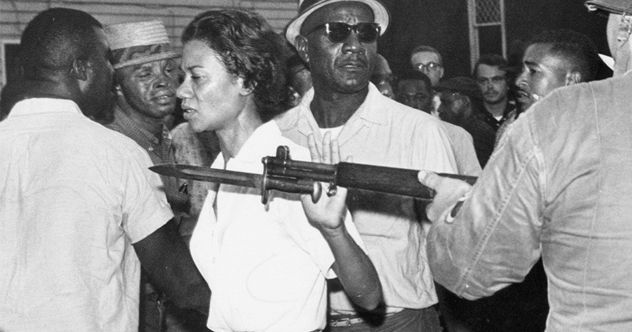
History isn’t just made by kings, generals, and people who owned extremely dramatic hats. It’s also shaped by ordinary humans who, in a critical moment, decided: “Nope.” Not a polite nope. Not a “let’s circle back” nope. A full-bodied, spine-straightening, consequences-be-darned kind of defiance.
These moments of resistance come in many formssilent stares, pamphlets, marches, uprisings, and yes, the occasional tea-related vandalism. Some lasted seconds. Others stretched across weeks and years. What they share is a refusal to accept an unjust “normal,” and the courage to act even when the odds looked like a bad joke written by fate.
Below are ten historic acts of defiance that still ripple through modern lifeproof that a single decision can become a movement, and that “I can’t” sometimes transforms into “watch me.”
1) Spartacus and the Gladiators Who Refused to Stay Enslaved
In ancient Rome, enslaved people and gladiators were expected to entertain the publicoften by dying on schedule. Around 73 BCE, Spartacus and a small group of fellow gladiators escaped their training school in Capua, initially using whatever they could grab as weapons (because nothing says “revolt” like improvising with kitchen gear).
What started as a breakout became a massive slave revolt that embarrassed Rome and forced it to treat “the people we pretend don’t matter” as an actual military threat. Even though the uprising was ultimately crushed, Spartacus became an enduring symbol of resistance: proof that an oppressive system is never as stable as it claims.
Why it mattered
Spartacus represents a recurring historical truth: oppression often relies on the idea that resistance is impossible. When people visibly reject that ideaespecially at scaleempires suddenly develop stress fractures.
2) The Boston Tea Party: A Protest With Zero Chill (and 342 Chests)
In 1773, American colonists were furious about British taxes and trade controlsespecially the kind that felt like “pay up, but you don’t get a vote.” On December 16, a group of protesters boarded ships in Boston Harbor and dumped hundreds of chests of British East India Company tea into the water.
Was it orderly civic engagement? Not exactly. Was it unforgettable? Absolutely. The Boston Tea Party became a famous act of defiance against imperial authority and helped accelerate the tensions that erupted into the American Revolution.
Why it mattered
This wasn’t just a tantrum with leaves. It was a message: legitimacy requires consent. When people feel governed without representation, the social contract starts to look like a one-sided subscription you never agreed to.
3) Harriet Tubman’s Repeated Returns Into Danger
Harriet Tubman escaped slaverythen did something that still feels almost impossible to comprehend: she went back. Again and again. Tubman returned to slave-holding territory to guide others to freedom via the Underground Railroad, taking enormous risks under laws and social systems designed to punish resistance.
Tubman’s defiance wasn’t a single headline moment. It was sustained courage in the form of repeated choices: prioritize freedom, protect others, and outsmart a machinery built to capture and silence.
Why it mattered
Tubman shows how defiance can be strategic and ongoingnot just dramatic. The most powerful resistance often looks like persistence: one rescue, one route, one safe house, one more person refusing to accept bondage as destiny.
4) Gandhi’s Salt March: Nonviolence With Maximum Sting
In 1930, Mohandas Gandhi led a march that made a basic household ingredient into a political weapon. British colonial authorities controlled salt production and taxed itmeaning even the poor were forced to pay for something essential.
Gandhi and thousands of followers walked roughly 240 miles from near Ahmedabad to the coast at Dandi. The point wasn’t cardio. It was civil disobedience: openly defying unjust laws through disciplined nonviolence, and inviting the world to witness the moral imbalance of the system.
Why it mattered
The Salt March demonstrated how symbolic action can unify people. It translated complex colonial injustice into a simple, relatable message: when power controls necessities, resisting becomes survivaland protest becomes personal.
5) The White Rose: Students vs. a Brutal Regime
In Nazi Germany, opposition was dangerous in the most literal sense. The White Rose was a student-led resistance group, including siblings Hans and Sophie Scholl, that distributed leaflets denouncing the regime and urging moral awakening.
Their methods were nonviolentwords, printing, and the stubborn insistence that truth still mattered. That simplicity was the point: they were defying a government that demanded silence and complicity. Several members were arrested and executed in 1943.
Why it mattered
The White Rose reminds us that defiance isn’t only physical. In societies built on propaganda and fear, telling the truth becomes an act of rebellionand courage can look like a leaflet in the wrong hands at the wrong time.
6) The Warsaw Ghetto Uprising: Fighting Back Against the Unthinkable
In April 1943, Jewish fighters in the Warsaw ghetto resisted German forces attempting to deport the remaining population. The uprising was a desperate stand against annihilation, waged under horrifying conditions and overwhelming power imbalance.
It was also a declaration: even in the face of almost certain defeat, people can choose to resist dehumanization. The uprising lasted weeks and became one of the most significant acts of Jewish armed resistance during World War II.
Why it mattered
The Warsaw Ghetto Uprising is a stark lesson in human dignity: defiance can exist even when victory is unlikely. Sometimes resistance is the refusal to let an oppressor write the final chapter unchallenged.
7) The Bonus Army: Veterans Demanding What They Were Promised
During the Great Depression, thousands of World War I veterans marched on Washington, D.C., demanding early payment of a bonus that had been promised for later years. They weren’t looking for applausethey were looking for rent money and groceries in an era when desperation was nationwide.
The protest became a major political flashpoint. In July 1932, federal forces moved to remove the marchers and their camps, and parts of the encampments burned. The image of veterans being pushed out by the government they served left a deep mark on public opinion.
Why it mattered
Defiance isn’t always against distant empires; sometimes it’s against broken promises at home. The Bonus Army showed how protest can force a nation to confront who it helps, who it forgets, and what “service” is supposed to mean.
8) Rosa Parks and the Seat That Shook a System
On December 1, 1955, Rosa Parks refused to give up her seat on a segregated bus in Montgomery, Alabama. It was a simple action that collided with an entire architecture of Jim Crow laws and everyday humiliation.
Parks’ arrest helped ignite the Montgomery Bus Boycott, a sustained campaign that forced the country to watch ordinary people challenge legalized inequality with discipline and coordination. It also accelerated legal challenges that ended bus segregation in Montgomery.
Why it mattered
Parks’ defiance is a masterclass in how “small” actions aren’t actually small when the system is built to enforce submission. Sometimes the most disruptive word in history is a calm, well-timed “no.”
9) Stonewall: When “Enough” Became a Turning Point
In the early hours of June 28, 1969, a police raid on the Stonewall Inn in New York City sparked spontaneous resistance. For many LGBTQ+ people, harassment and raids were routinean exhausting loop of being treated like a problem that needed “cleaning up.”
Stonewall disrupted that routine. The pushback grew into days of unrest and galvanized a modern movement for LGBTQ+ rights. It didn’t create the struggle from nothing, but it helped concentrate it into visible, collective defiance.
Why it mattered
Stonewall illustrates how a community’s breaking point can become a beginning. When people stop accepting mistreatment as “normal,” history loses the ability to quietly continue as it was.
10) The 1968 Olympic Podium Protest Seen Around the World
At the 1968 Summer Olympics in Mexico City, U.S. sprinters Tommie Smith and John Carlos raised gloved fists during the national anthem after winning medals in the 200-meter race. The gesturepaired with deliberate symbolism in how they appeared on the podiumturned one of sports’ most “apolitical” stages into a platform for human rights.
The backlash was swift, but the image endured. It remains one of the most iconic examples of athlete activism and a reminder that visibility is power: the world can’t unsee what you put in front of it.
Why it mattered
This was defiance with a stopwatch. It challenged the idea that public figures should stay “neutral” in the face of injustice, and it proved that a silent gesture can be louder than a stadium.
11) Tank Man: One Person, Four Tanks, Infinite Symbolism
In June 1989, after a violent crackdown on pro-democracy demonstrations in Beijing, an unidentified personoften called “Tank Man”stood in front of a line of tanks and refused to move. The scene was captured by cameras and broadcast around the world, becoming a lasting symbol of individual courage in the face of state power.
Tank Man’s identity and fate remain unclear, which somehow makes the image even more haunting. The moment holds a mirror up to authority: what happens when brute force meets a person who won’t cooperate with fear?
Why it mattered
Tank Man distilled defiance into a single frame. It’s proof that even when a system is enormous, it can be interruptedif only for a momentby one human being acting like their life (and everyone else’s) actually matters.