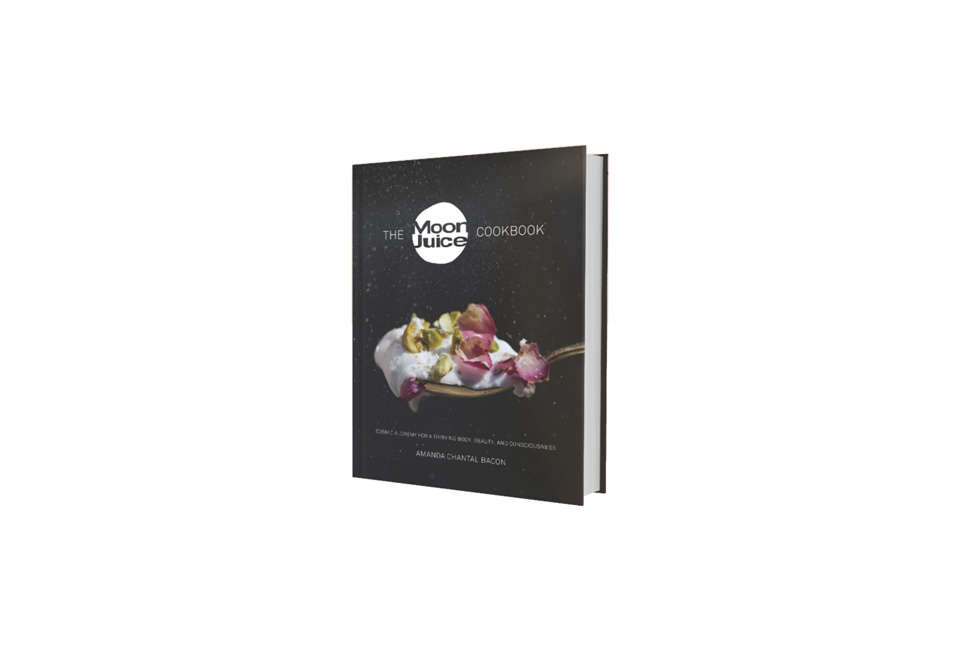
There are cookbooks that teach you how to roast a chicken, cook a respectable pot of beans, or finally stop abusing scrambled eggs. Then there is The Moon Juice Cookbook, a book in which your kitchen may contain medicinal mushrooms, activated nuts, homemade plant milks, fermented foods, flower-infused sweets, and enough mysterious powders to make your spice cabinet look as though it has enrolled in wizard school.
Published in 2016, Amanda Chantal Bacon’s first cookbook translated the philosophy of her Los Angeles wellness brand, Moon Juice, into more than 75 recipes for drinks, snacks, cultured foods, plant-based sweets, and other so-called functional foods. The publisher describes a system built around milks, juices, cultured preparations, “unbakery” doughs and creams, adaptogenic herbs, raw ingredients, and pantry components designed to be combined in different ways.
That combination made The Moon Juice Cookbook more interesting than an ordinary collection of healthy recipes. It became part cookbook, part wellness manifesto, part kitchen laboratory, and part cultural artifact from the mid-2010s wellness boom. Some readers saw inspired plant-based cooking. Others saw expensive powders wearing tiny capes and promising enlightenment. Both reactions help explain why the book remains memorable.
What Is The Moon Juice Cookbook?
The Moon Juice Cookbook: Cook Cosmically for Body, Beauty, and Consciousness was created by Amanda Chantal Bacon, founder of the Los Angeles-based Moon Juice brand. Bacon had professional culinary training before becoming associated with juices, herbal powders, adaptogens, and alternative wellness. Food-industry coverage has noted that her background included culinary school and work in respected restaurant kitchens before she created Moon Juice.
That detail matters because underneath the crystals, cosmic vocabulary, and ingredients that may require a determined online-shopping session, the book is built around recognizable culinary principles. It uses texture, acidity, sweetness, fat, fermentation, dehydration, soaking, blending, seasoning, and contrasting flavors in deliberate ways.
The result is not simply “put kale in blender, experience transcendence.” There is an actual kitchen system behind the spectacle.
A Cookbook Built Around Components
One of the smartest ideas in The Moon Juice Cookbook is its component-based approach. Instead of treating every dish as an isolated project, Bacon encourages readers to prepare foundational foods that can become building blocks for later recipes.
Plant milks can become drinks or creamy bases. Nut and seed preparations can supply richness. Cultured foods bring acidity and depth. Raw doughs can be transformed into different sweets. Sauces, fillings, jams, and creams can move between recipes instead of dying lonely deaths in the back of the refrigerator.
This modular system is practical even if you have absolutely no intention of constructing a kitchen altar or discussing your breakfast’s vibrational frequency.
The Food Philosophy Behind Moon Juice
The Moon Juice approach sits at the intersection of plant-based cooking, raw-food traditions, fermentation, herbalism, and the modern functional-food movement. Ingredients are frequently selected not only for flavor but also for what they are traditionally believed or commercially claimed to support.
That distinction is important. A delicious almond-based drink can be judged fairly easily: either you want another glass or you quietly introduce it to the sink. Claims about immunity, hormonal balance, cognitive performance, stress reduction, or disease prevention require considerably more evidence.
Enter the Adaptogens
Adaptogens are among the ingredients most closely associated with the Moon Juice universe. Herbs and mushrooms such as ashwagandha, reishi, cordyceps, and related botanicals have long histories in traditional systems of medicine, while contemporary wellness companies often package them as tools for dealing with stress, energy, sleep, or performance.
Scientific support varies dramatically by ingredient and claimed benefit. For example, the National Center for Complementary and Integrative Health says that certain ashwagandha preparations have shown some evidence for stress and insomnia, while evidence for many other uses remains insufficient. NCCIH also warns about side effects, medication interactions, pregnancy concerns, thyroid and autoimmune conditions, and rare reports of liver injury.
Reishi has similarly accumulated a much larger reputation than the clinical evidence can consistently support. Memorial Sloan Kettering notes both traditional uses and areas of investigation while warning that supplements can interact with medications and may pose risks for some people.
In other words, an adaptogen is not magical parsley. Readers interested in the cookbook can enjoy its culinary creativity without assuming every wellness promise has been established in controlled human trials.
What Kind of Recipes Are in The Moon Juice Cookbook?
The recipe list is where the book’s personality truly goes into orbit. Examples highlighted by its publisher include Strawberry Rose Geranium Bars, Hot Sex Milk, a savory tart with cheese and tomato filling, Pulp Brownies with Salted Caramel Sauce, Yam Julius Milk, and Chocolate Chaga Donuts.
The names are playful, theatrical, and unmistakably branded. You will not confuse this cookbook with a church-basement collection titled 101 Sensible Uses for Ground Beef.
Plant Milks and Functional Drinks
Drinks form an important part of the Moon Juice identity. Rather than regarding a beverage as merely something wet to accompany lunch, the book often treats it as a meal component or a delivery system for nuts, seeds, spices, cacao, herbs, and specialty powders.
For home cooks, the most transferable lesson is the use of plant milk as a flavor canvas. Once you understand how nuts, seeds, water, salt, spices, and sweeteners interact, you can create dozens of variations without buying every ingredient mentioned in the book.
Cinnamon, vanilla, cacao, ginger, turmeric, cardamom, dates, and nut butter can make an ordinary homemade drink feel luxurious long before anybody invites cordyceps to the party.
The Moon Juice “Unbakery”
One of the book’s distinctive sections explores uncooked or dehydrated alternatives to conventional baked sweets. Nuts, oats, coconut products, maple syrup, fruit, nut butter, seeds, and other ingredients are manipulated into doughs, fillings, bars, cookies, creams, and desserts.
Vogue published examples connected with the cookbook, including cinnamon-cherry thumbprints and strawberry-rose-geranium bars, illustrating the book’s reliance on nut-based doughs, naturally sweet ingredients, dehydration, fruit fillings, herbs, and floral flavors.
Whether these desserts should replace classic pastry is a question best answered diplomatically while standing at least six feet away from a French baker. But as a separate style of dessert, the techniques can be genuinely creative.
Fermentation, Activation, and Preparation
The Moon Juice kitchen also asks more of ingredients before dinner than many employers ask of new hires. Nuts may be soaked. Foods may be cultured. Ingredients can be dehydrated. Bases may need advance preparation.
This can frustrate readers expecting a 20-minute cookbook. On the other hand, it encourages planning and teaches that texture and digestibility can be manipulated through more than heat alone.
Why The Moon Juice Cookbook Became a Cultural Phenomenon
The book arrived during a period when wellness culture was rapidly migrating from health-food stores into fashion, beauty, social media, restaurants, and mainstream retail. Moon Juice was unusually good at giving old ingredients futuristic identities. Traditional herbs became “dusts.” Smoothies became potions. Eating became ritual.
TASTE observed that Bacon helped repackage ingredients associated with Chinese and Ayurvedic traditions into a highly recognizable modern wellness aesthetic. Eater, meanwhile, described the tension between Bacon’s legitimate culinary background and a brand image that some food-world observers viewed more as lifestyle marketing than conventional cooking.
That branding is arguably the book’s greatest strength and biggest weakness.
It makes healthy cooking seem imaginative rather than punitive. Nobody wants to hear that wellness requires chewing plain celery while thinking positive thoughts. Moon Juice instead offers color, unusual flavors, playful names, sensuality, and visual drama.
But the same theatricality can make simple food appear unnecessarily complicated or exclusive.
What The Moon Juice Cookbook Gets Right
1. Healthy Food Is Allowed to Be Fun
The book refuses the idea that health-conscious food must resemble a punishment issued by a disappointed gym teacher. Its desserts, drinks, colorful ingredients, spices, flowers, and unusual combinations create a sense of experimentation.
2. Pantry Preparation Can Save Time
The foundational-component approach remains useful. Make one versatile plant milk, sauce, cream, or fruit preparation and several meals become easier.
3. Flavor Matters
Bacon’s culinary background shows most clearly when the wellness vocabulary is stripped away. Salt, fat, acidity, spice, sweetness, texture, and aroma are treated as meaningful parts of the recipe instead of inconveniences standing between the reader and perfect health.
4. It Encourages Kitchen Curiosity
The cookbook can introduce readers to fermentation, raw desserts, homemade nut milks, medicinal mushrooms, seeds, unfamiliar herbs, and alternative preparation methods. You may not keep everything. That is fine. A useful cookbook should expand your vocabulary, not demand lifelong allegiance.
Where The Moon Juice Cookbook Becomes Difficult
Specialty Ingredients Can Be Expensive
A basic smoothie is cheap. A smoothie containing several premium powders, activated nuts, specialty herbs, organic ingredients, and exotic superfoods can begin behaving financially like a minor home renovation.
Criticism of Moon Juice has frequently centered on accessibility and the economics of high-end wellness. The New Yorker, for example, questioned how realistic such elaborate routines are for ordinary consumers and examined the broader consumer culture surrounding the brand.
The easiest solution is not to treat the cookbook as a sacred ingredient checklist. Use its formulas rather than buying every branded or obscure component.
Some Recipes Require Equipment and Time
A strong blender is extremely helpful. A dehydrator expands your options. Nut-milk bags, fermentation containers, a food processor, and pantry storage can also become useful.
If your current cooking equipment consists of one scratched saucepan and a fork you stole from college, there may be an adjustment period.
Wellness Language Should Not Replace Medical Evidence
This is the most important limitation. Foods can certainly contribute to an enjoyable, nutrient-rich diet, but dramatic health outcomes should not automatically be attributed to individual powders or herbs. Traditional use, personal experience, marketing claims, laboratory studies, and strong clinical evidence are not interchangeable categories.
Anyone taking medications, managing a medical condition, undergoing treatment, or considering concentrated herbal supplements should check for contraindications and interactions with an appropriate healthcare professional.
How to Use The Moon Juice Cookbook Without Spending a Fortune
You do not need to recreate the Moon Juice pantry molecule by molecule. A more practical approach is to choose a handful of techniques that fit your normal cooking routine.
- Start with one homemade almond, cashew, oat, or seed milk.
- Keep versatile ingredients such as cacao, cinnamon, ginger, chia seeds, coconut, dates, oats, and nut butter.
- Try one raw dessert technique before buying a dehydrator.
- Experiment with fermentation only when you are comfortable following safe preparation methods.
- Add specialty herbs one at a time rather than purchasing an entire botanical pharmacy.
- Judge recipes by flavor, convenience, affordability, and how they make your overall diet easier to enjoy.
This transforms the cookbook from an intimidating wellness constitution into what it works best as: a source of ideas.
Is The Moon Juice Cookbook Still Worth Reading?
Yes, particularly for readers interested in plant-based food, wellness culture, raw desserts, functional ingredients, homemade drinks, and the evolution of modern Los Angeles health cuisine.
It is also useful as a snapshot of a particular cultural moment. By 2017, Eater was already examining why Moon Juice had become hugely visible in fashion and wellness circles while receiving a more complicated reception from traditional food media. Years later, the vocabulary of adaptogens, mushroom drinks, functional beverages, stress-support powders, and plant-based indulgence has become substantially more familiar.
Some of the book’s health language deserves skepticism, but many of its culinary ideas have aged better than the jokes surrounding them. Homemade plant milks are mainstream. Cacao-based energy bites are everywhere. Fermented foods have enormous audiences. Mushroom beverages occupy supermarket shelves. Raw desserts no longer require explaining to your relatives that, yes, technically it is still cake.
Experience Notes: What Cooking the Moon Juice Way Can Feel Like
The most revealing way to approach The Moon Juice Cookbook is not to attempt an overnight conversion. Imagine using it as inspiration for a week of experiments instead.
On the first morning, homemade nut milk immediately changes the mood of breakfast. It is richer than many packaged varieties and surprisingly simple once you accept that your blender will require cleaning before coffee has fully activated your personality. Add cacao, cinnamon, vanilla, a date, or nut butter and it becomes something halfway between breakfast and dessert.
The second discovery is that the cookbook encourages preparation rather than spontaneous hunger management. Soaked nuts are useful only if you remembered yesterday that Tomorrow You would want them. Fermentation takes time. Dehydrated foods operate on a schedule usually associated with geological events.
At first this feels inconvenient. After a few preparations are waiting in the refrigerator, however, the logic becomes clearer. A milk becomes a smoothie base. A fruit mixture becomes a dessert filling. A nut cream works in several dishes. Preparing components ahead can make later meals faster.
The third experience is ingredient triage. You encounter a recipe containing three familiar foods, two ingredients you vaguely recognize, and one substance whose name appears to have been generated by an intergalactic pharmaceutical company. This is where practical readers benefit from relaxing.
You do not need every powder.
Removing the most exotic ingredients often reveals a perfectly understandable culinary structure underneath: creamy nuts, sweet fruit, aromatic spice, bitterness from cacao, acidity from citrus, texture from seeds, and a little salt. Once the underlying formula becomes visible, experimentation gets easier.
Dessert may produce the biggest surprise. Raw and dehydrated sweets are not identical to baked cookies, brownies, or pastries, and pretending otherwise sets everybody up for disappointment. A nut-and-date brownie will never wake up one morning and discover that it has become a flour-and-butter brownie.
But evaluated on its own terms, the combination of nuts, cacao, fruit, coconut, seeds, and salt can be intensely satisfying. The density means small portions often feel substantial, while herbs, spices, floral notes, and fruit prevent everything from tasting like the same energy bar wearing different accessories.
By the end of a week, the most valuable lesson is unlikely to be that every meal requires adaptogens. It is that health-oriented cooking becomes easier to sustain when it feels creative.
You might keep homemade nut milk and abandon the dehydrator. You might fall in love with cacao and decide reishi tastes like your garden shed. You may start soaking nuts regularly but remain spiritually unavailable for kitchen altars. All of those outcomes are perfectly reasonable.
The cookbook works best when treated as permission to experiment rather than instructions for achieving culinary purity. Borrow the methods that improve your meals. Ignore the ingredients that wreck your grocery budget. Keep the flavors you genuinely enjoy.
That approach turns Moon Juice from a lifestyle to imitate into a toolboxand toolboxes are considerably more useful than commandments.
Final Thoughts on The Moon Juice Cookbook
The Moon Juice Cookbook is unusual, ambitious, occasionally impractical, frequently beautiful, and difficult to forget. Amanda Chantal Bacon created more than a recipe collection: she translated the aesthetics and philosophy of the Moon Juice brand into a complete kitchen universe.
Its lasting value does not depend on believing that a particular mushroom powder will unlock radiant immortality before lunchtime. The more durable lessons are culinary ones: prepare versatile components, explore plants beyond salad, use spices boldly, treat texture seriously, experiment with fermentation, make dessert interesting, and create food you actually look forward to eating.
Readers who approach its wellness claims critically while embracing its creativity will probably get the most from it. You can enjoy Chocolate Chaga Donuts without asking a donut to become your primary-care physician.
Note: References to adaptogens, herbs, mushrooms, immunity, stress, energy, or other wellness effects describe traditional uses, published research, or claims associated with the ingredients and book. They should not be interpreted as guarantees of medical benefit or substitutes for professional medical care.