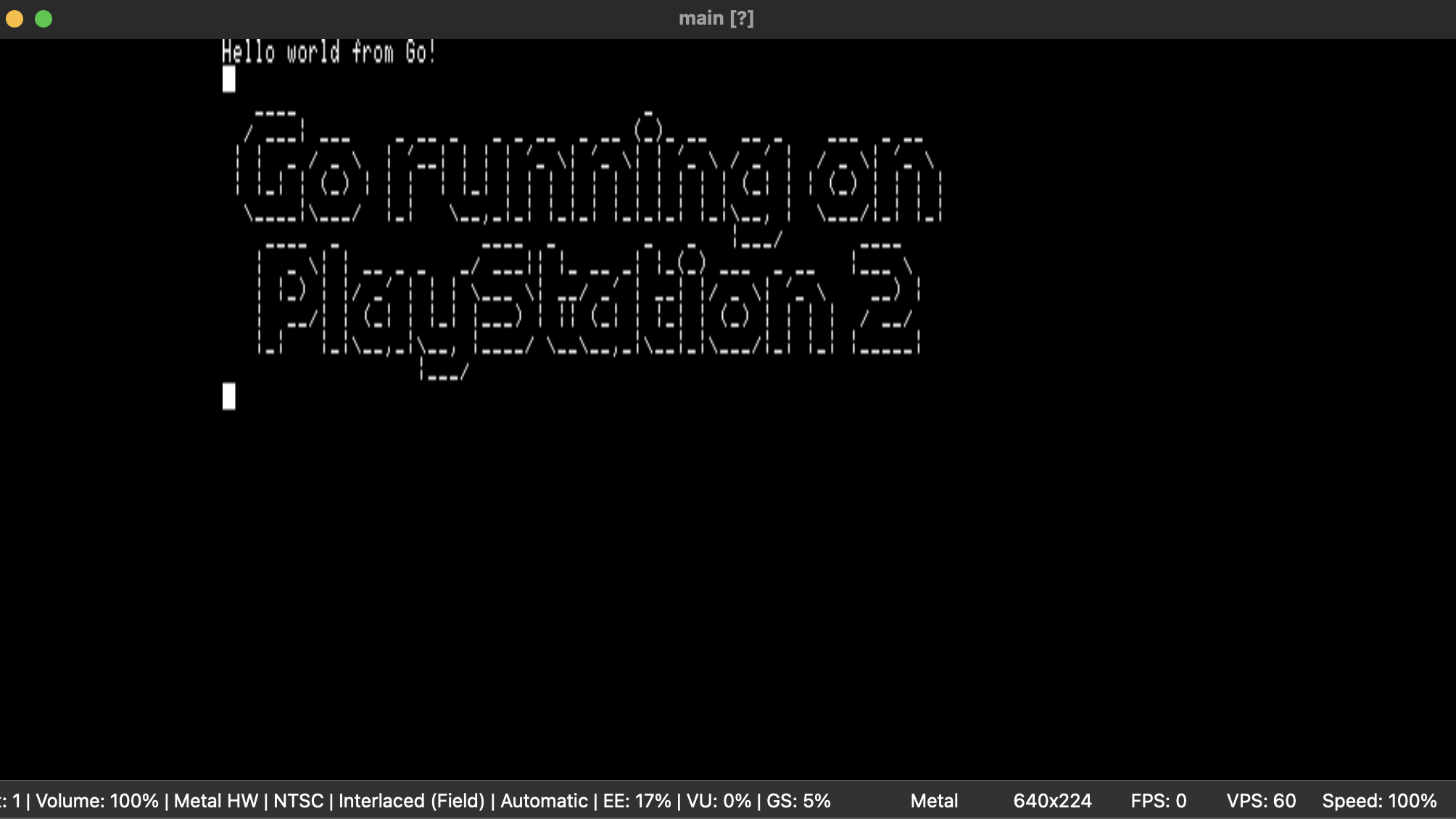
Putting Golang on the PS2 sounds like the kind of idea that begins with “hear me out” and ends with three terminals open, a custom compiler build, and a PlayStation 2 judging you from across the room. Yet that is exactly why the project is so fascinating. The PlayStation 2 was built for a world of C, C++, assembly, DMA transfers, vector units, and game developers with nerves made of titanium. Go, meanwhile, was designed decades later to make modern software development feel less like juggling chainsaws in a dark room.
So why would anyone try to run Go on Sony’s legendary 2000-era console? Because the PS2 is still one of the most interesting machines ever released, and Go is one of the most approachable compiled languages in modern programming. Combining them is not practical in the ordinary “ship a commercial game tomorrow” sense. It is practical in the far better sense: it teaches us how compilers, hardware, runtimes, and homebrew development actually work.
This article explores what “Golang on the PS2” really means, how TinyGo makes the experiment possible, why the PlayStation 2 is such a strange target, and what developers can learn from squeezing a modern language into a console that once made developers whisper nervously about vector pipelines.
What Does “Golang On The PS2” Mean?
When people say “Golang on the PS2,” they usually do not mean installing a normal Go toolchain on a PlayStation 2 and typing go run main.go from a cozy terminal. The standard Go compiler targets a defined set of modern operating systems and architectures. A stock PlayStation 2 is not on that guest list. The PS2 does not provide the kind of operating system services that normal Go programs expect, such as standard process management, full filesystem assumptions, conventional threading support, or the runtime environment Go usually enjoys.
Instead, the practical route is cross-compilation. You write Go code on a modern computer, compile it into machine code that the PS2 can understand, link it with PS2 homebrew libraries, package it as an executable, and run it on real hardware or an emulator. The console itself is the destination, not the development workstation.
This is where TinyGo becomes the hero of the story. TinyGo is a Go compiler built for “small places,” including microcontrollers, WebAssembly, and embedded systems. Instead of behaving exactly like the main Go compiler, TinyGo uses LLVM as part of its compilation pipeline. That matters because LLVM can target many architectures and makes experimental platforms more realistic than they would be with the standard Go toolchain alone.
Why The PlayStation 2 Is A Weird But Wonderful Target
The PlayStation 2 is not just “an old game console.” It is an architectural adventure with a disc drive. Its main CPU, the Emotion Engine, is based on the MIPS R5900 and runs at roughly 294 MHz. That number looks tiny next to modern desktop CPUs, but raw clock speed tells only a small part of the story. The Emotion Engine was designed around specialized data movement, vector processing, and tight coordination between multiple hardware units.
The PS2’s graphics system, memory layout, vector units, and DMA behavior made it powerful but famously unusual. Developers who mastered it could produce games that looked shockingly good for the era. Developers who did not master it often discovered that the console was less “plug and play” and more “plug and pray.”
That weirdness is exactly what makes Golang on the PS2 interesting. Go was designed with clarity, memory safety patterns, fast builds, and developer productivity in mind. The PS2 was designed around low-level performance, custom hardware, and very direct control. Asking Go to run there is like asking a modern electric scooter to compete in a medieval jousting tournament. It can be done, but someone will need to modify the scooter.
The Role Of PS2SDK And Homebrew Development
To run custom software on the PlayStation 2, developers commonly rely on the PS2SDK, an open-source collection of libraries and tools for PS2 homebrew. PS2SDK provides a development foundation for writing applications, demos, and games that can run on the console. It includes support for important PS2 systems, such as graphics output, controller input, file access, and low-level platform behavior.
In a traditional PS2 homebrew setup, developers write C or C++ code, compile it with a PS2-targeting toolchain, and produce an ELF executable. That executable can then be loaded through homebrew-friendly methods or tested in an emulator. This workflow is already niche. Adding Go makes it niche with a small hat and a monocle.
For Go to participate, it must produce code compatible with the PS2 environment. That means dealing with the target CPU, linking rules, memory layout, startup code, runtime expectations, and platform calls. A simple “Hello, world” is not simple anymore when the world is a 24-year-old console with a custom MIPS-based processor.
How TinyGo Makes Golang On The PS2 Possible
TinyGo is the key because it is built for environments where the full Go runtime may be too large or too dependent on conventional operating system features. TinyGo can compile a subset of Go for embedded-style targets, and its LLVM-based approach gives developers a path to nonstandard hardware.
In the experimental PS2 Go work by Ricardo Silva, TinyGo is adapted to target the PlayStation 2. The basic concept is elegant, even if the implementation is full of dragons wearing compiler badges: Go code is lowered into LLVM intermediate representation, LLVM generates target code, and the output is connected to PS2 tooling. The result is not “standard Go magically works everywhere.” It is more like “a carefully guided subset of Go can be convinced to behave on PS2 hardware.”
This is an important distinction. Go’s standard library is huge compared with what a bare-metal target can provide. Features such as goroutines, garbage collection behavior, networking, file APIs, reflection, and parts of the runtime may need to be limited, adjusted, or avoided. TinyGo does not turn the PS2 into a Linux workstation. It gives developers a way to write Go-flavored programs for a place where Go was never originally invited.
The Hard Part: The PS2 Is Not Just “MIPS”
One tempting assumption is that because the PS2’s CPU is MIPS-based, compiling Go for MIPS should be enough. Unfortunately, consoles enjoy punishing optimism. The Emotion Engine is based on the MIPS R5900, which has its own quirks, extensions, and missing pieces compared with a neat textbook MIPS target.
That creates problems for compiler output. A compiler backend may emit instructions that look reasonable for a generic MIPS target but are not appropriate for the PS2’s actual CPU behavior. Certain operations, especially around 64-bit values or unsupported instructions, can become trouble spots. The developer may need patches, workarounds, custom target descriptions, or careful restrictions on what generated code is allowed to do.
This is where the project moves from “cool idea” to “serious compiler engineering.” You are not only writing Go. You are negotiating with LLVM, the PS2 toolchain, the runtime model, and a processor that was born during the era of translucent memory cards and aggressively shiny menu screens.
What Can You Actually Build?
The most charming proof of concept is a small game-style demo. Ricardo Silva’s work includes Flappy Gopher, a Flappy Bird-inspired demo written in Go for the PS2 using the experimental TinyGo setup. That kind of project is perfect because it tests the real pieces developers care about: drawing graphics, handling input, building game logic, managing loops, and keeping everything small enough to behave on the target hardware.
A simple PS2 Go program might include a main loop, controller polling, sprite movement, collision checks, and basic rendering calls through PS2 libraries. The Go code may feel cleaner than equivalent C in some areas, especially for structuring gameplay logic. However, low-level work still remains. You still need to understand the console’s rendering path, memory limits, and build process.
Example Concept: A Tiny PS2 Go Game Loop
A Go-style PS2 homebrew program might be organized around a clean loop:
That looks wonderfully innocent. Behind each function, however, there may be platform-specific calls, memory constraints, graphics buffer handling, and linker rules. The beauty of Go is that it can make the game logic easier to read. The reality of the PS2 is that hardware still gets the final vote.
Why Developers Care About This Experiment
Most developers will never ship a Go game for the PlayStation 2. That is fine. Most people will also never build a toaster-powered weather satellite, but we can still admire the engineering spirit.
The value of Golang on the PS2 is educational and cultural. It shows how language tooling can escape its usual territory. It demonstrates how embedded development works when there is no friendly operating system. It gives Go developers a reason to learn about linkers, target triples, startup code, memory maps, and the sometimes spicy relationship between compiler output and real hardware.
It also helps preserve curiosity around older systems. The PS2 sold in enormous numbers and remains beloved, but modern developers often interact with it only through nostalgia, emulation, or game collecting. Homebrew development keeps the machine alive as a learning platform. Running Go on it adds a fresh layer to that tradition.
SEO-Friendly Breakdown: Key Technical Ingredients
1. Golang
Go, often called Golang for search clarity, is a compiled language known for simple syntax, fast builds, strong tooling, and concurrency features. On the PS2, developers cannot assume the full normal Go ecosystem will be available, but the language’s clean structure still offers benefits for organizing code.
2. TinyGo
TinyGo is the bridge between Go and small or unusual targets. Its LLVM foundation makes it more flexible for experiments like PS2 development. For Golang on the PS2, TinyGo is not optional decoration; it is the main reason the idea becomes technically approachable.
3. PlayStation 2 Homebrew
PS2 homebrew is the practice of creating unofficial software for the console. It usually requires PS2-specific tools, libraries, and a way to load unsigned programs. The homebrew community has built impressive infrastructure over the years, especially around PS2SDK.
4. PS2SDK
PS2SDK gives developers access to the console’s capabilities without starting from absolute zero. It is the practical foundation for many homebrew projects, including experiments that use languages beyond C and C++.
5. Emotion Engine
The Emotion Engine is the PS2’s main processor. Its MIPS-based design, vector units, and custom behavior define many of the challenges involved in getting nontraditional languages running on the console.
The Limitations Of Golang On The PS2
Before anyone gets too excited and announces a 400-hour open-world RPG written entirely in Go for the PS2, a few limitations deserve attention.
First, this is experimental. Tooling can break. Documentation may be limited. You may need to build custom compiler branches, patch LLVM behavior, or follow instructions that assume you already know what an ELF file is and are emotionally prepared to meet several of them.
Second, not all Go features are practical. Full standard library support is unrealistic on a bare console target. Goroutines, garbage collection details, reflection-heavy code, filesystem behavior, and networking assumptions may not work the way desktop Go developers expect.
Third, performance needs care. Go code can be efficient, but the PS2 rewards developers who understand the hardware. A language abstraction is helpful until it hides something important, at which point the console politely removes your frame rate and leaves no forwarding address.
Finally, debugging can be more complicated than normal development. On a desktop, you get mature debuggers, logs, stack traces, and operating system help. On the PS2, especially with experimental language tooling, you may spend time proving whether the bug lives in your code, the compiler output, the linker script, the runtime setup, or the mysterious goblin inside the DMA chain.
Why Go Is Still A Fun Fit For PS2 Experiments
Despite the limitations, Go has qualities that make it surprisingly appealing for retro console experiments. Its syntax is compact without being cryptic. Its package system encourages tidy organization. Its structs and methods are comfortable for game entities, input states, sprites, and scene management. Error handling is explicit, which is useful when the platform does not forgive assumptions.
For small demos, Go can make gameplay code easier to reason about. A C project may be closer to the hardware, but Go can be more pleasant for structuring logic once the platform layer is working. That distinction matters. Homebrew development often fails not because someone cannot draw a triangle, but because the project becomes too messy to extend after the triangle triumphantly appears.
With Go, a developer can imagine a cleaner split: low-level PS2 binding code near the metal, gameplay logic in readable Go, and build scripts handling the awkward handshake between modern tooling and vintage hardware. It is not beginner-friendly yet, but it points toward a delightful future where retro development can be both educational and less punishing.
How This Compares With Other Languages On The PS2
C and C++ remain the practical champions of PS2 development. They match the expectations of PS2SDK, give developers close control over memory, and align with the historical reality of console programming. Assembly is still important for performance-critical work, especially when dealing with hardware-specific behavior.
Other language experiments, including Rust, Zig, Lua, and JavaScript-based tooling, show that developers love bringing modern or unusual languages to old consoles. Golang fits into this larger movement. It is not about replacing C overnight. It is about expanding what is possible, making the platform more approachable to different programmers, and discovering which modern language ideas survive contact with old hardware.
In that sense, Golang on the PS2 is part compiler experiment, part preservation project, and part glorious nerd dare.
Practical Lessons From Golang On The PS2
Compilers Are Not Magic
Most developers use compilers as black boxes. You put source code in, an executable comes out, and everyone agrees not to ask too many questions. Porting Go to the PS2 breaks that illusion in a productive way. You learn about intermediate representation, target backends, instruction selection, calling conventions, and why “supports MIPS” is not the same as “supports this exact MIPS-like console CPU.”
Runtime Assumptions Matter
Modern languages often carry runtime expectations. Go programs usually rely on runtime services for memory management, stack handling, scheduling, and more. On bare or semi-bare targets, these assumptions must be reduced, replaced, or carefully implemented.
Hardware Shapes Software
The PS2 teaches a lesson modern machines often hide: hardware architecture matters. Memory speed, cache size, DMA behavior, vector units, and graphics pipelines influence how software should be designed. A clean language does not erase hardware reality; it gives you a better notebook for arguing with it.
Experiences Related To Golang On The PS2
Working with a project like Golang on the PS2 feels less like ordinary programming and more like digital archaeology with a keyboard. You begin with a simple goal: make a Go program run on a PlayStation 2. That goal sounds small enough to fit on a sticky note. Then the sticky note unfolds into a treasure map covered in compiler flags, linker errors, target configuration files, and comments from forum posts written by people who clearly know more than they are legally required to.
The first emotional stage is optimism. You read about TinyGo, LLVM, PS2SDK, and the MIPS-based Emotion Engine, and it all seems possible. TinyGo can compile Go for embedded targets. LLVM understands many architectures. PS2SDK exists. The dots are right there. Surely connecting them will be a pleasant afternoon project. This is adorable. Preserve this innocence in a jar.
The second stage is humility. You discover that the PS2 is not merely “a MIPS machine.” It is a very specific machine with very specific behavior. The compiler may produce code that almost fits. The build may almost link. The executable may almost run. In homebrew development, “almost” is the word that eats weekends.
Then comes the small victory stage. Maybe you get a minimal function compiled. Maybe you produce an ELF. Maybe an emulator shows something that is not a crash. Maybe the screen changes color. To outsiders, this looks unimpressive. To the developer, it is fireworks, confetti, and a marching band. A blank screen turning blue can feel like launching a spacecraft if you know how many dragons were defeated to make that pixel obey.
The next experience is learning to respect boundaries. Go is friendly, but the PS2 is not a normal Go environment. You learn to write smaller programs, avoid unnecessary dependencies, and think about what each feature costs. You stop asking, “Can I import this package?” and start asking, “What does this package secretly assume?” That shift makes you a better programmer even when you return to modern platforms.
There is also a strange joy in mixing eras. Go belongs to a world of cloud services, command-line tools, containers, APIs, and modern developer workflows. The PlayStation 2 belongs to memory cards, CRT televisions, DVD menus, and game cases with instruction booklets. Seeing them meet is funny and charming. It is like watching a software engineer in noise-canceling headphones explain garbage collection to a 2000s console wearing cargo shorts.
For hobbyists, the best part is the sense of discovery. You are not following a paved road. You are walking through tall grass, occasionally finding footprints from other brave developers. When something works, it feels personal. When something fails, it usually teaches you a real concept rather than merely producing a generic error message. You learn why startup code matters. You learn why linkers are powerful and terrifying. You learn that hardware documentation is both a map and a riddle.
Golang on the PS2 is not the easiest way to make a game. It is not the fastest way to learn Go. It is not the most practical route to retro development. But it is one of the most memorable ways to understand the relationship between language design, compiler infrastructure, and hardware. It turns programming into an experiment again. It reminds you that computers are not abstract clouds floating above reality; they are physical machines with rules, limits, and personalities.
And the PS2 definitely has a personality. It is brilliant, stubborn, theatrical, and occasionally rude. Getting Go code to run there is like teaching a classic sports car to understand Bluetooth. It may not need to happen, but once it does, everyone nearby wants to see it.
Conclusion: Why Golang On The PS2 Matters
Golang on the PS2 matters because it represents the best kind of programming curiosity. It is not driven by market demand or corporate roadmaps. It is driven by the simple question: “Can this be done?” That question has powered some of the most interesting projects in computing history.
The PlayStation 2 remains a legendary machine because it combined unusual hardware with a massive cultural footprint. Go remains popular because it makes many programming tasks feel direct and understandable. Bringing them together is difficult, funny, educational, and deeply satisfying. It teaches developers about cross-compilation, embedded systems, runtime design, console architecture, and the hidden machinery beneath modern programming languages.
No, Golang will not replace C and C++ as the default language of PS2 homebrew tomorrow. But as an experiment, it is wonderful. It proves that old hardware still has new stories to tell, and modern languages still have strange places to go. Somewhere between a Go compiler and an Emotion Engine, a tiny gopher flaps across the screen, and that is exactly the kind of nonsense technology needs more of.