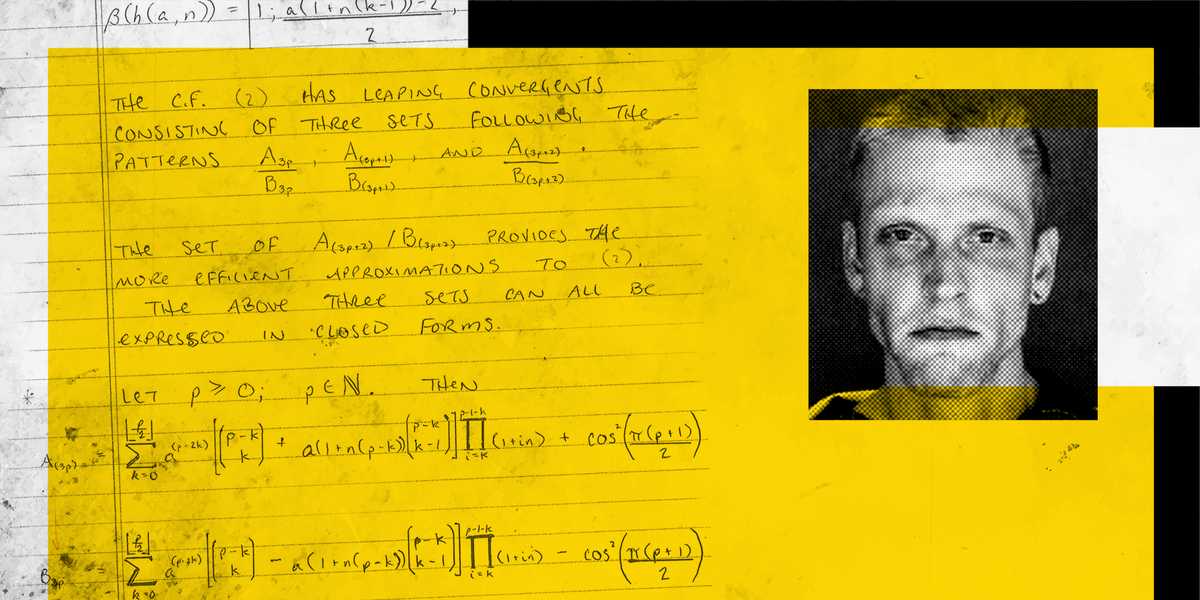
Most people enter solitary confinement with one goal: survive the day without losing their grip on time, sleep, or sanity. Christopher Havens found something stranger in that small, punishing space: mathematics. Not “balancing-a-checkbook” math. Not “tip calculator at a restaurant” math. We are talking about number theory, continued fractions, cryptography, and the kind of equations that make even very confident calculators look emotionally unavailable.
Havens’ story is not a fairy tale, and it should not be polished into one. He was convicted of murder and sentenced to 25 years in prison in Washington state. A man lost his life, a family was devastated, and no amount of academic success can erase that. But the astonishing part of the story is what happened afterward. While isolated in restrictive housing, Havens began solving Sudoku puzzles, then algebra worksheets, then increasingly advanced problems. Over time, he moved from a high school dropout with no formal path in mathematics to a published researcher in number theory.
Today, Christopher Havens is known not only for his peer-reviewed work on continued fractions, but also for co-founding the Prison Mathematics Project, a program that connects incarcerated learners with math mentors. His transformation raises a difficult and fascinating question: what happens when a mind that once chased destruction finds discipline, structure, and purpose in the most unlikely classroom imaginable?
From Rock Bottom to a Packet of Algebra Problems
Before math entered the picture, Havens’ life had followed a brutal downward curve. He dropped out of high school, struggled with drug addiction, experienced homelessness, lost stability with his family, and eventually became involved in a fatal crime. When he arrived in prison, he tried to adapt to a dangerous social environment by fitting into the prison hierarchy. That decision led to an altercation and then to solitary confinement.
Solitary confinement is not a study hall with bad lighting. It is isolation, noise, fluorescent glare, and long hours that stretch like taffy left on a dashboard. Havens later described the environment as chaotic and psychologically harsh. In that setting, Sudoku became a lifeline. The puzzles gave his mind something to hold. Then a prison employee began slipping educational worksheets to inmates. Havens asked for one. The next day, algebra arrived at his cell door.
At first, the problems were basic. But Havens discovered something important: if he sat with a problem long enough, he could usually wrestle it to the ground. The process gave him a sense of order that had been missing from his life. Each equation became a small, quiet victory. In a place designed to reduce a person’s world to walls and routines, mathematics opened a door that no guard had to unlock.
Why Math Worked When Almost Nothing Else Had
Mathematics can be unforgiving, but it is also fair in a way life often is not. A proof does not care where you come from. A theorem does not ask for your résumé. Either the logic holds or it collapses. For Havens, that clarity mattered. He had spent years trapped in chaos, addiction, and bad decisions. Math gave him rules, feedback, and a path forward one problem at a time.
There is also something deeply absorbing about hard mathematics. When a person enters a state of intense focus, the noise of the outside world recedes. In Havens’ case, the outside world was not exactly a peaceful coffee shop with lo-fi music. It was prison. Still, equations offered a mental escape. He began to study for hours, then days. Algebra led to trigonometry. Trigonometry led to calculus. Calculus led to number theory, a branch of mathematics concerned with integers, patterns, primes, divisibility, and relationships hidden inside numbers.
To the casual observer, number theory can look like mathematicians staring at numbers until the numbers confess. In reality, it is one of the oldest and most elegant areas of math. It includes questions simple enough for a child to understand and difficult enough to keep brilliant researchers busy for centuries. That combination made it perfect for a self-taught learner with patience, curiosity, and very limited access to traditional education.
The Letter That Changed Everything
Eventually, Havens reached a point where prison worksheets and available books were not enough. He needed someone who could answer serious questions. In 2013, he wrote to Mathematical Sciences Publishers, asking about math journals and whether anyone might correspond with him. It was an unusual request: an incarcerated, self-taught student asking for a bridge to the professional mathematics world.
That request eventually reached people connected to serious mathematical research, including Umberto Cerruti, a professor from the University of Turin in Italy. Cerruti did what good mathematicians often do when faced with an extraordinary claim: he tested it. He sent Havens a problem. Havens responded with a long, detailed solution written by hand. The answer was correct. That was the moment the story shifted from “interesting prison education anecdote” to “wait, this man might actually be doing real math.”
The correspondence grew into collaboration. Havens, working with limited resources and no normal access to computers, began contributing to research on continued fractions. If that phrase makes your brain reach for a snack, do not worry. Continued fractions are less scary than they sound, although only slightly. They are expressions that represent numbers through nested fractions, like a mathematical set of Russian dolls. They are powerful tools for approximating numbers and studying deep patterns in number theory.
What Did Christopher Havens Actually Discover?
Havens’ major published paper, written with Stefano Barbero, Umberto Cerruti, and Nadir Murru, focused on linear fractional transformations and nonlinear leaping convergents of certain continued fractions. That title sounds like it was assembled by a committee of caffeinated owls, so let’s translate.
A continued fraction can be used to approximate complicated numbers through a sequence of simpler fractions called convergents. These convergents often reveal patterns. Havens and his co-authors studied what happens when certain continued fractions are transformed algebraically. They found regular structures and recurrence relationships that help describe how those transformed fractions behave.
In plain English: they explored how a complicated number pattern changes when you run it through a specific kind of mathematical machine. The result was not “he solved all math.” It was something better and more honest: he made a real contribution to a specialized area of number theory, and that contribution passed the scrutiny required for publication in a peer-reviewed academic journal.
That distinction matters. Viral stories sometimes inflate math accomplishments until every theorem sounds like the Riemann Hypothesis wearing a cape. Havens did not single-handedly defeat every impossible equation known to humankind. He contributed to research in a difficult field where precision, patience, and proof are the price of entry. Frankly, that is impressive enough without putting fireworks on it.
Doing Research Without a Normal Researcher’s Toolkit
Modern mathematicians often use computers to test examples, search for patterns, verify calculations, and write code. Havens did much of his early work with pen, paper, mail, and a level of patience that would make a monastery nervous. When he needed books, prison rules sometimes made access difficult. When he needed feedback, correspondence could take weeks. When he needed computation, he could not simply open a laptop and ask software to crunch through examples.
That obstacle makes his work even more striking. Mathematics is already hard when you have a quiet office, a library card, fast internet, and coffee that does not taste like institutional sadness. In prison, the barriers multiply. Materials can be restricted. Communication is slow. Time is abundant but fragmented by rules and routines. Yet Havens used those constraints to build discipline.
One of the most important lessons from his story is that talent alone was not enough. Havens needed mentors, books, structure, and outside scholars willing to take him seriously. His achievement was personal, but it was not solitary in the romantic sense. It was supported by a network of people who believed that intellectual life should not end at the prison gate.
The Prison Mathematics Project: Turning One Story Into a System
After math changed his life, Havens wanted to share that experience with others. That idea became the Prison Mathematics Project, a program designed to help incarcerated people study math through mentorship and community. The project pairs participants with outside mentors, supports self-study, encourages problem solving, and creates a framework where math becomes more than a subject. It becomes a new identity.
This is where the story grows beyond one man and one astonishing paper. Prison education often focuses on practical skills, and those are important. But mathematics offers something different. It teaches patience, logic, humility, and resilience. A wrong answer is not the end; it is data. A failed proof is not humiliation; it is a map showing where the bridge collapsed. For people trying to rebuild their lives, that mindset can be powerful.
The Prison Mathematics Project also challenges lazy stereotypes about incarcerated people. It does not pretend every prisoner is secretly a genius. It does something more useful: it assumes people are capable of growth when given meaningful tools, accountability, and mentorship. Some participants may work on basic algebra. Others may explore college-level subjects. A few may contribute to original research. The point is not that everyone becomes a mathematician. The point is that everyone deserves access to serious intellectual effort.
Why Continued Fractions Matter More Than They Sound
Continued fractions may not trend on social media unless someone finds a way to make them dance, but they have a long and important history. They are used to approximate irrational numbers, study Diophantine equations, investigate number patterns, and connect with areas of analysis and dynamical systems. They appear in classical mathematics and modern research alike.
For example, the number pi can be approximated by ordinary decimals, but fractions such as 22/7 and 355/113 give surprisingly good approximations. Continued fractions provide a systematic way to find such approximations. They reveal how well numbers can be represented by rational fractions and how those approximations behave. In advanced research, these patterns can lead into deep territory involving transformations, recurrence relations, and special classes of numbers.
That is why Havens’ work belongs in a real mathematical conversation. It is not inspirational wallpaper. It is technical research. The human story draws people in, but the math itself had to stand on its own. Peer review is not moved by a dramatic backstory. It is moved by proof. In that arena, the equations either behave or they do not.
The Redemption Question: What Can Achievement Repair?
Any article about Christopher Havens must be careful with the word “redemption.” It is tempting to turn his transformation into a clean narrative: bad past, hard lesson, beautiful math, inspiring future. Real life is messier. A life was taken. Grief remains. Accountability cannot be replaced by accomplishment.
Still, growth matters. The justice system often talks about rehabilitation, but society is not always sure what it wants rehabilitation to look like when it actually appears. Havens did not merely behave well. He built a scholarly life, contributed to research, helped create a program for others, and pursued mathematics as a way to repay some part of his debt to society. Whether that changes how people view his sentence is a separate debate. But it undeniably changes how we understand human potential.
His story forces a hard question: should prison be only a place where time is served, or should it also be a place where people are expectedand equippedto become different? If we want people to return to society with better habits, better skills, and better judgment, then education is not a luxury. It is public safety wearing glasses and carrying a notebook.
What Students, Teachers, and Struggling Adults Can Learn From Havens
Most readers are not trying to learn number theory from a prison cell, thankfully. But the underlying lessons apply far beyond incarceration. Havens’ path shows that learning does not always begin with confidence. Sometimes it begins with boredom, desperation, or a single worksheet that arrives at the right moment.
Start Where You Are, Not Where You Wish You Were
Havens did not begin with graduate textbooks. He began with Sudoku and algebra worksheets. That matters. Many people quit learning because they are embarrassed to start at the beginning. But every advanced subject has a front door. Walking through it is not shameful. Pretending you already live in the attic is the real problem.
Let Difficulty Become Feedback
Hard problems are not personal insults, although they can feel suspiciously rude. In math, difficulty is information. It shows where your understanding is thin. Havens returned to problems again and again until patterns appeared. That habitstaying with confusion long enough for it to become clarityis useful in school, work, parenting, business, and any situation involving tax forms.
Find Mentors Before You Think You Deserve Them
Havens reached out before he had credentials. That took nerve. He did not wait until he had a perfect academic record, a university email address, or a polished biography. He asked for help. Mentorship changed the trajectory of his learning. For anyone trying to master a difficult field, the lesson is simple: serious questions can open serious doors.
Experience-Based Reflection: Learning Math When Life Feels Too Small
There is a practical emotional lesson hidden inside this story: difficult learning can give shape to a life that feels trapped. You do not have to be in a cell to feel boxed in. People feel trapped in dead-end jobs, debt, addiction, grief, loneliness, bad routines, or the quiet panic of realizing they have been scrolling for three hours and somehow know less than when they started. In those moments, the mind needs a ladder.
Math can be that ladder because it rewards attention. It does not flatter you, but it does respond to effort. When you solve even a small problem, you experience proof that your mind can still move. That feeling is not small. For someone rebuilding self-respect, it can be the first honest evidence that change is possible.
Imagine sitting with a page of algebra after years of believing you are “not a math person.” At first, the symbols look like tiny insects that got organized. Then one rule makes sense. Then another. You solve for x. Nothing explodes. You try a harder problem. You get it wrong. You correct it. Slowly, the page becomes less hostile. That is how identity changes: not with a grand speech, but with repeated evidence.
Havens’ experience also shows the power of obsession when it is pointed in a constructive direction. Many destructive habits are built from focus, repetition, and craving. Learning uses the same machinery but aims it toward growth. The brain that once chased chaos can learn to chase patterns. The person who once needed belonging from the wrong crowd can find belonging in a community of learners. That shift does not happen magically. It requires structure, accountability, and time. But it can happen.
For teachers, mentors, and family members, the story offers another lesson: never underestimate the impact of one well-timed challenge. A worksheet under a door sounds minor. It was not minor. A letter answered by a mathematician sounds like a small act of professional courtesy. It was not small. A mentor who takes a learner seriously can become the difference between wasted potential and disciplined purpose.
For learners, the takeaway is both encouraging and annoying: there is no shortcut. Havens did not become a mathematician by watching one motivational video at 1.5x speed while eating chips. He studied obsessively, made mistakes, wrote letters, waited for replies, and kept going. The glamorous part of transformation is usually visible only after a long, unglamorous stretch of repetition. The chalk dust comes before the breakthrough.
And perhaps that is the most useful message. A person’s past matters, but it is not the only thing that matters. Accountability matters, but so does the question of what someone does while being held accountable. In Havens’ case, mathematics became a way to build a new self out of discipline, curiosity, and service. It did not undo the harm. It did not make the prison walls disappear. But it did prove that even in a place designed around confinement, the human mind can still travel astonishing distances.
Conclusion: The Equation Is Not Finished
Christopher Havens’ story is powerful because it refuses to be simple. It is about crime and consequence, but also about education and transformation. It is about solitary confinement, but also about the strange freedom that can appear when the mind finds a meaningful problem. It is about advanced equations, yes, but also about the everyday arithmetic of change: one worksheet, one solved problem, one letter, one mentor, one proof, one new identity built line by line.
The phrase “solving the world’s hardest equations” may sound like a movie poster, but the deeper truth is better. Havens entered the world of serious mathematics from one of the least likely places imaginable and contributed work that professional mathematicians could evaluate, challenge, and publish. Then he helped build a program so others behind bars could experience the same intellectual awakening.
Not every transformation ends in a journal article. Not every learner becomes a researcher. But every person who discovers disciplined curiosity becomes harder to dismiss. In that sense, the most important equation in this story may not be written in Greek symbols or continued fractions. It may be this: time plus mentorship plus purpose can equal a life that no one saw coming.
Note: This article is a fresh, original synthesis based on publicly available reporting, academic records, and information from mathematics and prison-education organizations. It is written for web publication without source links, while preserving the serious context of the crime and avoiding exaggerated claims about the mathematics.