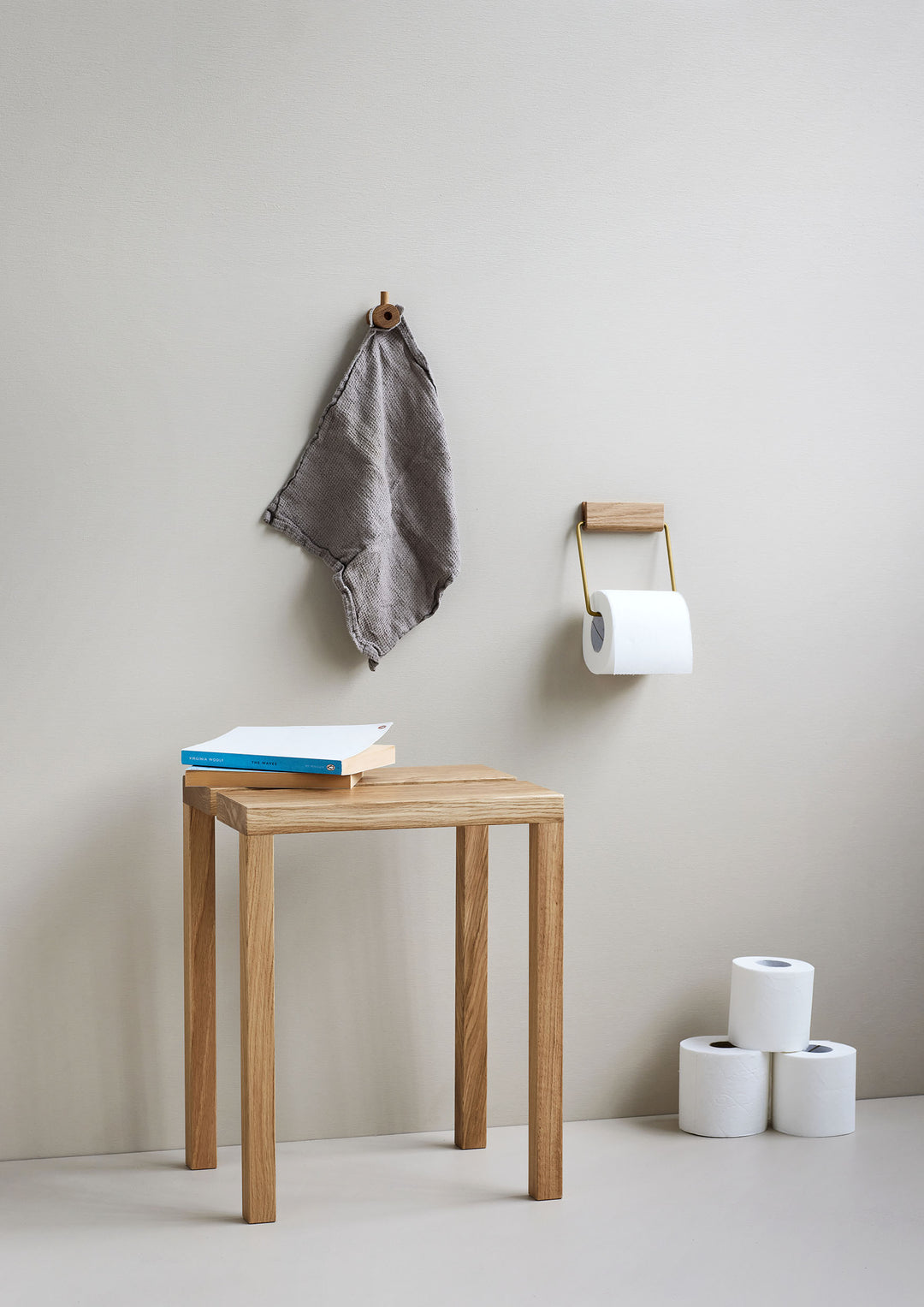
Toilet paper holders rarely receive starring roles in interior design. They are typically selected late in a bathroom renovation, somewhere between choosing grout sealer and wondering why one faucet costs as much as a weekend vacation. Yet this modest piece of bathroom hardware is used every day, remains permanently visible, and has an impressive talent for making an otherwise thoughtful room look strangely unfinished.
Copenhagen-based design studio MOEBE offers a persuasive alternative to the bulky chrome brackets, spring-loaded tubes, and decorative contraptions that have occupied bathroom walls for decades. Its minimalist Toilet Roll Holder combines an oak wall bracket with a loop of metal wire, creating a functional object that feels more like a tiny architectural drawing than conventional bathroom hardware.
The result is simple, warm, and refreshingly honest. It holds the roll. It looks good. It does not include a smartphone shelf, an air freshener compartment, or a mysterious lever requiring an engineering degree. In other words, Danish design has once again taken an ordinary household object and politely asked it to stop being ugly.
Why the Humble TP Holder Deserves Better
Bathrooms are collections of small decisions. A faucet, towel hook, mirror frame, cabinet pull, soap dispenser, and toilet paper holder may occupy only a few inches each, but together they establish whether the room feels deliberate or assembled during a clearance sale.
This is especially true in compact bathrooms and powder rooms, where every fixture is within the same visual field. There may be no freestanding tub or double vanity to distract visitors. Hardware becomes decoration, and the toilet roll holder is suddenly performing in front of a very attentive audience.
American design publications increasingly treat hardware swaps as high-impact, relatively approachable bathroom updates. Brass, matte black, brushed nickel, natural wood, and mixed-metal combinations can change the character of a room without moving plumbing or removing tile. Small bathrooms also benefit from pieces with slim profiles because visually heavy accessories can make limited wall space feel even tighter.
That is where the MOEBE toilet paper holder earns attention. It does not attempt to disguise its function. Instead, it reduces that function to two visible components and makes both of them attractive.
Meet MOEBE, the Studio Behind the Holder
MOEBE was formed in 2014 by architects Martin de Neergard Christensen and Nicholas Oldroyd together with cabinetmaker Anders Thams. The studio develops its furniture and lifestyle objects from a workshop on Amager in Copenhagen. Its stated approach begins by identifying a product’s essential purpose and removing whatever does not contribute to it.
That philosophy sounds lofty until it is applied to toilet paper. Then it becomes wonderfully literal.
Rather than hiding the construction behind molded plastic covers or ornamental mounting plates, MOEBE allows the user to understand the holder almost instantly. A small oak block attaches to the wall. A bent metal wire hangs from the block. The roll sits inside the wire. No visual detective work is necessary.
Doing More With Two Parts
The holder measures approximately 14 centimeters high, 12 centimeters wide, and only 1.5 centimeters deep at the bracket, or about 5.5 by 4.7 by 0.6 inches. It was introduced in 2022, designed in Denmark, and produced in the European Union. The metal element is available in non-polished brass, stainless steel, or black powder-coated stainless steel. Each version is paired with an FSC-certified oak bracket.
The oak is treated with a water-based lacquer intended to help it perform in damp environments. That treatment matters because an untreated wood accessory placed near a shower, sink, or enthusiastic hand washer could quickly acquire more personality than its owner requested.
The official European price is currently listed at €59 for the oak-and-brass, oak-and-steel, and oak-and-black versions. Prices, shipping options, taxes, and availability for American buyers may differ by retailer.
What Makes This Toilet Roll Holder Attractive?
1. Its Construction Is Part of the Design
Most inexpensive bathroom hardware tries to conceal how it works. Fasteners disappear under decorative caps, joints hide behind oversized plates, and moving parts are buried inside tubes. MOEBE takes the opposite approach. The loop is visibly a loop. The bracket is visibly a bracket. Nothing pretends to be more complicated or luxurious than it is.
This clarity gives the holder a quiet confidence. It resembles the type of object an architect might sketch using three lines and a rectangleand then refuse to add anything else because lunch is waiting.
2. Oak Softens the Metal
An all-metal toilet paper holder can look sleek, but it may also feel cold, especially against white porcelain and tile. The oak mounting block introduces warmth, grain, and natural variation. It creates a small bridge between the harder surfaces commonly found in bathrooms and softer materials such as towels, baskets, and wood cabinetry.
Pairing wood with brass is particularly effective because both materials have warm undertones. American design coverage frequently recommends this combination for contemporary, midcentury, and nature-influenced bathrooms. Brass can add richness, while oak keeps the effect from becoming overly glamorous or formal.
3. The Wire Creates Visual Breathing Room
The thin metal loop occupies less visual space than a solid arm, shelf, or box-shaped dispenser. This makes the design especially suitable for a narrow toilet alcove or small powder room. The roll appears almost suspended beneath the wood block, giving a familiar object a surprisingly light silhouette.
It is minimalism without the usual punishment. The holder does not demand that you live in a white room containing one stool and a solemn ceramic vase. It can coexist with patterned wallpaper, vintage mirrors, marble, painted paneling, or a very cheerful shower curtain covered in lemons.
Choosing Between Brass, Steel, and Black
Oak and Brass
The brass model is the warmest and most decorative option. It works naturally with cream tile, terracotta, walnut, warm white paint, veined stone, and aged-metal accents. It also offers a gentle contrast in an otherwise cool gray or white bathroom.
Non-polished or unlacquered-looking brass should not be confused with perfectly uniform gold plating. Brass surfaces may deepen, dull, or develop variation as they interact with moisture, air, and frequent handling. Many designers value that evolving patina because it gives the material character. Anyone who expects permanent jewelry-store shine, however, may prefer a more stable finish or be prepared for occasional polishing.
Oak and Steel
The steel version is crisp, quiet, and easy to coordinate with chrome or stainless-steel plumbing fixtures. It suits Scandinavian bathrooms, modern apartments, and spaces where the wood should provide the warmth while the metal remains visually neutral.
Steel is also the least likely of the three choices to become the room’s focal point. That is useful when a bathroom already contains dramatic tile, bold wallpaper, or a vanity that would prefer not to share applause.
Oak and Black
The black powder-coated model creates the strongest outline. It looks particularly sharp against pale tile or plaster and can connect visually with black faucets, shower frames, sconces, or cabinet pulls.
Matte black hardware is often used to add graphic contrast in compact bathrooms. The oak bracket prevents this version from feeling severe, giving it a softer Scandinavian character than a conventional all-black metal holder.
Does Every Bathroom Finish Need to Match?
No. A bathroom does not have to look as though every accessory arrived in one enormous coordinated box.
Matching all finishes can create a calm, consistent appearance, particularly in a very small room. However, thoughtful mixed-metal schemes can feel more collected and personal. Brass may be paired with polished nickel, chrome, stainless steel, or black when the repetition is intentional. For example, a brass toilet paper holder might relate to a brass mirror frame while the faucet and shower hardware remain chrome.
The key is repetition. One unrelated brass object can look accidental. Two or three warm-metal details create a pattern. Design experts increasingly recommend controlled mixing rather than insisting that every knob, hinge, and drain cover be identical.
Practical Questions to Ask Before Buying
Will It Hold the Rolls You Usually Purchase?
Oversized and “mega” toilet paper rolls vary considerably in diameter and width. The MOEBE design has an open, flexible-looking silhouette, but buyers should still compare its published measurements with their preferred paper. A beautiful holder becomes considerably less charming when the new roll has to be compressed like carry-on luggage.
Where Should It Be Installed?
Before drilling, sit on the closed toilet and test the proposed position with painter’s tape. The holder should be easy to reach without twisting, leaning backward, or performing a seated yoga pose. Confirm that knees, doors, vanity drawers, and cleaning tools will not collide with it.
Wall composition matters as well. Tile, drywall, plaster, masonry, and wood paneling require different anchors and drill bits. Measure twice, check for plumbing or electrical lines, use a level, and remember that “approximately straight” becomes extremely noticeable once a white paper roll provides a horizontal reference line. General bathroom-planning guidance similarly emphasizes comfortable clearances and convenient fixture placement.
How Much Maintenance Is Reasonable?
The lacquered oak should generally be treated gently. Wipe away moisture rather than allowing water to remain on the surface, and avoid abrasive cleaners that could damage the coating. For the metal, begin with a soft dry or slightly damp cloth. Any polishing product should be appropriate for the exact finish and tested discreetly first.
Owners of the brass version must decide whether patina is a feature or an emergency. Allowing the finish to evolve creates a softer, lived-in appearance. Polishing it periodically preserves a brighter tone. Both are legitimate approaches; aggressively scrubbing it every three days is merely a new hobby.
Is a Designer Toilet Paper Holder Worth €59?
Strictly speaking, a much cheaper holder can perform the same basic task. So can a spare dowel, a basket on the floor, or an exceptionally cooperative household member. The question is not whether MOEBE has invented a new way to dispense paper. It has not.
The value lies in proportion, materials, construction, and the pleasure of using a well-considered object every day. Unlike a decorative accessory that may eventually be packed away, bathroom hardware remains in constant service. A modest investment can make sense when the piece complements the room, withstands regular use, and avoids becoming tomorrow’s renovation debris.
MOEBE’s broader component-based philosophy also favors repair and replacement over discarding an entire product. The studio states that spare parts are available for its designs, that its wood is FSC certified, and that most production takes place within Europe. These details do not make any purchase impact-free, but they offer a more considered model than treating small household hardware as disposable.
The Experience: Living With a Design-Forward TP Holder
The first noticeable change after installing an attractive toilet paper holder is not dramatic. The bathroom does not become larger. The grout does not clean itself. No choir appears. Instead, an irritatingly ordinary corner suddenly looks finished.
During the first few days, the holder attracts more attention than anyone expects. This is partly because the oak-and-metal construction differs so clearly from standard bathroom hardware. It may prompt the mildly absurd realization that the previous holder had been visible for years without ever being truly seen. The new one has presence, but it does not dominate. It performs the visual equivalent of speaking clearly without raising its voice.
Changing a roll is straightforward because the design does not rely on a spring-loaded spindle. There is no compressed tube to launch across the floor, roll under the vanity, and gather a mysterious sweater of dust. The open wire construction makes the mechanism understandable at a glance. That simplicity can also encourage the household to replace an empty roll immediately, although no designer can fully guarantee this advanced form of human behavior.
After a week or two, the holder begins to influence how the rest of the room is perceived. The oak bracket may draw attention to the grain of a vanity or wooden mirror. The brass version can make a nearby faucet appear cooler by comparison, while the black model may connect visually with a shower frame or wall light. One small fixture starts acting as punctuation, helping separate and relate the bathroom’s other materials.
The experience is particularly satisfying in a powder room. Guests see nearly every detail in a small space, and there are fewer practical objects competing for attention. A thoughtfully designed toilet roll holder communicates care without feeling staged. It is the kind of detail people may admire without immediately identifying why the room feels better.
Daily use also reveals whether the installation position was chosen wisely. A holder mounted too far forward encourages awkward reaching. One placed too low risks contact with cleaning tools, knees, or an ambitious robot vacuum. If the position was tested before drilling, the MOEBE holder feels pleasantly intuitive: the paper is available exactly where the hand expects it to be.
Maintenance becomes part of the ownership experience, especially with brass. Tiny changes in tone may appear around the areas most frequently touched. For people who enjoy living finishes, this produces individuality. The holder gradually stops looking like a showroom sample and starts looking like part of the home. Those who prefer uniformity may wipe and polish it more regularly, accepting a few minutes of care in exchange for a brighter appearance.
The oak component deserves similar attention. In a properly ventilated bathroom, occasional wiping is generally uneventful. In a steamy room, it is sensible to remove condensation and avoid repeatedly soaking the bracket. The water-based lacquer is designed for damp surroundings, but “damp resistant” should not be interpreted as “please aim the shower at it.”
After a month, the novelty fades, which is arguably the best result. The holder becomes an ordinary part of the routine, yet the room continues to benefit from its proportions and materials. Good everyday design often works this way. It creates a brief moment of delight and then settles into reliable usefulness. You stop admiring it every morning, but you would immediately notice if someone replaced it with a rattling plastic dispenser from a highway rest stop.
This longer-term experience explains why small fixtures deserve careful selection. A toilet paper holder will never be the emotional center of a home, nor should it be. But when an object is touched, seen, and used thousands of times, making it functional and attractive is not frivolous. It is simply design doing its job.
Conclusion: Danish Minimalism, Right Down to the Roll
The MOEBE Toilet Roll Holder succeeds because it does not strain for attention. An oak bracket, a bent wire, and a carefully judged proportion are enough to transform an ignored bathroom necessity into a small design feature.
The brass option adds warmth and the possibility of a changing patina. Steel offers a clean, neutral finish, while black produces graphic contrast. Each version demonstrates the studio’s central idea: remove unnecessary parts, make the remaining parts meaningful, and allow construction to become part of the appearance.
It may still be “just” a toilet paper holder. But it is also proof that everyday usefulness and visual pleasure are not sworn enemies. Sometimes improving a room does not require knocking down a wall. Sometimes it requires two well-made parts, one properly positioned drill hole, and the courage to admit that even toilet paper deserves decent accommodations.
Note: Product prices, finish availability, retailer inventory, and shipping options can change. Confirm current specifications and installation requirements before purchasing.