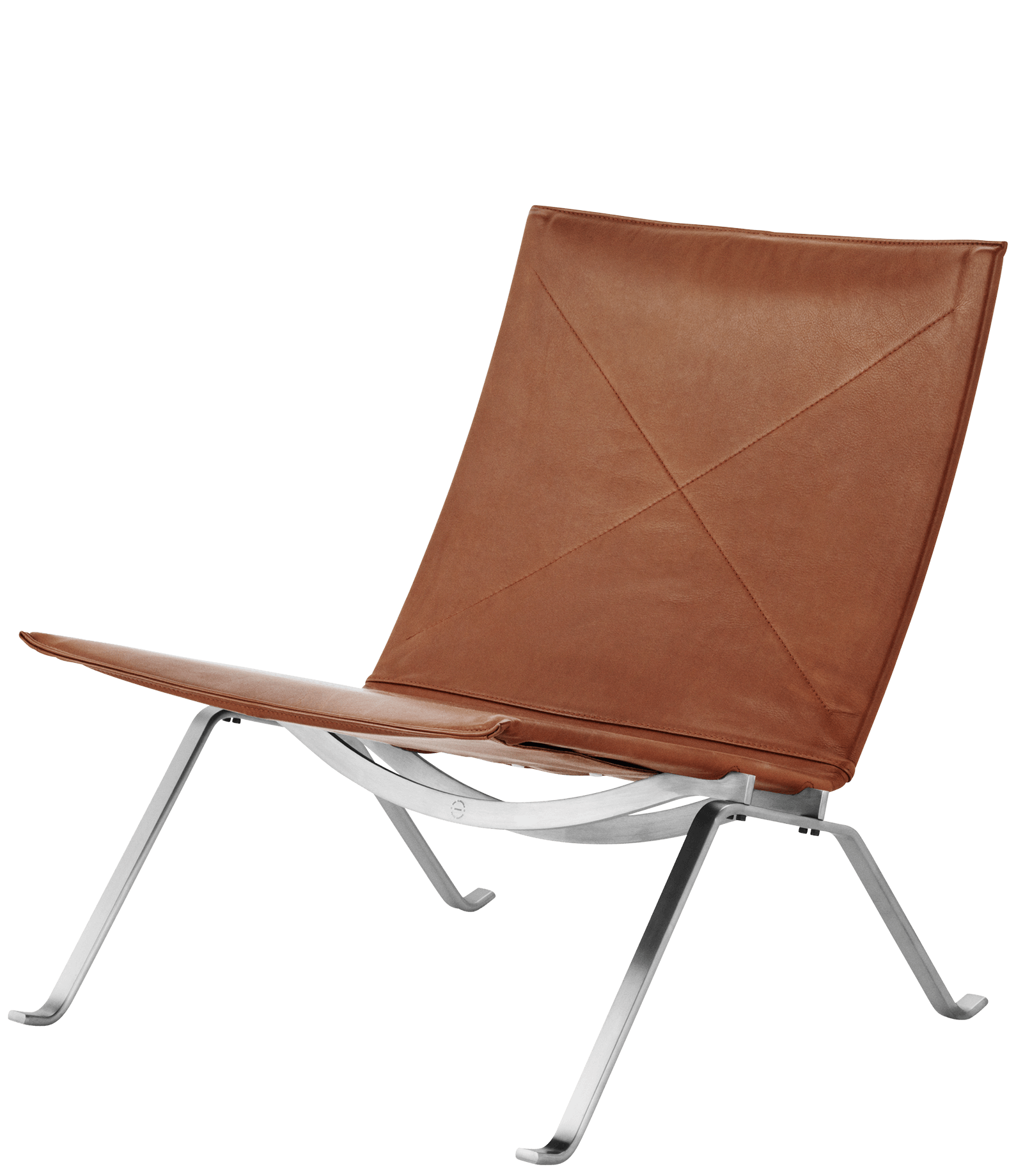
The Poul Kjærholm PK22 Lounge Chair is the kind of furniture that makes a room stand up a little straighter. It is not loud. It does not wave its arms. It does not arrive wearing brass buttons and velvet drama. Instead, the PK22 sits low, clean, and calm, as if it has already read every design book on the shelf and politely decided not to brag about it.
Designed in 1956 by Danish designer Poul Kjærholm, the PK22 is one of the most admired lounge chairs in modern furniture history. It combines a slim steel frame with leather, wicker, or canvas seating, creating a chair that feels both industrial and poetic. That sounds like a contradiction, but Kjærholm was unusually good at contradictions. He made metal feel warm. He made minimalism feel generous. He made a lounge chair look like it had been edited by a very strict but tasteful poet.
For collectors, architects, interior designers, and mid-century modern furniture lovers, the PK22 is more than a place to sit. It is a lesson in proportion, material honesty, and quiet confidence. For everyone else, it is simply a beautiful chair that somehow makes a living room look like it has better manners.
Who Was Poul Kjærholm?
Poul Kjærholm was born in Denmark in 1929 and became one of the most important figures in Danish modern design. Unlike many Danish furniture masters who focused heavily on wood, Kjærholm became fascinated with steel. He did not see steel as cold or mechanical. He saw it as a noble material, capable of elegance when treated with respect.
That idea shaped much of his work. Kjærholm trained as a cabinetmaker, which gave him a deep understanding of craft, structure, and detail. But he also looked beyond traditional woodworking. He admired the precision of industrial production and believed that furniture could be both beautifully made and structurally rational.
His designs are often described as minimalist, but that word can be misleading. The PK22 is not minimal because it lacks personality. It is minimal because every unnecessary gesture has been removed. What remains is personality in its most disciplined form. Think of it as a chair that went to finishing school, then became an architect.
The History of the PK22 Lounge Chair
The PK22 was designed in 1956 and quickly became one of Kjærholm’s signature works. It grew out of his earlier experiments with the PK25, also known as the Element Chair, which explored the idea of reducing a chair to essential materials and construction. With the PK22, Kjærholm refined the concept into something more commercially practical and visually graceful.
The chair was originally produced by E. Kold Christensen, the Danish manufacturer closely associated with Kjærholm’s early career. Their collaboration was one of the great designer-manufacturer partnerships of the modern era. Christensen understood Kjærholm’s exacting standards, and Kjærholm trusted him to produce furniture with the precision his designs demanded.
The PK22 received international recognition when it won the Grand Prix at the Milan Triennale in 1957. That award helped establish Kjærholm as a major name in modern design. In the world of furniture, winning the Milan Triennale was not like getting a participation ribbon at a neighborhood craft fair. It was a serious endorsement from the design world’s sharpest eyes.
Today, the PK22 is produced by Fritz Hansen as part of the Poul Kjærholm Collection. It remains a licensed design classic and continues to appear in design-conscious homes, galleries, offices, showrooms, and museum collections.
Design Analysis: Why the PK22 Still Looks Modern
The most striking thing about the Poul Kjærholm PK22 Lounge Chair is how little it seems to need. The frame is slim. The seat is low. The profile is open. There are no bulky cushions, carved arms, or decorative tricks. Yet the chair has presence. In fact, its restraint is exactly what gives it power.
A Chair Built on Proportion
The PK22 is a masterclass in proportion. Its width, depth, and height are compact, but it never looks small. The low seat gives it a relaxed lounge posture, while the upright angle of the back keeps it from turning into a sleepy puddle. It is comfortable without looking overstuffed, which is more difficult than it sounds. Many chairs solve comfort by adding padding until they resemble upholstered marshmallows. Kjærholm solved it through geometry.
The chair’s scale also makes it useful in real interiors. It can work as a pair in a living room, as a single reading chair, or as a sculptural accent in a bedroom or office. Because the frame is visually light, the PK22 does not block sightlines. This is one reason designers love it in rooms with large windows, art walls, or open layouts.
The Beauty of Steel
Kjærholm’s use of steel is one of the defining features of the PK22. The brushed spring-steel frame gives the chair its structure and visual rhythm. It is strong but not heavy-looking. The metal reflects light subtly, adding a crisp edge to the softer surface of leather, wicker, or canvas.
In less capable hands, steel can look cold. Kjærholm made it look intentional. He treated it almost the way earlier Danish designers treated wood: as a material with character, discipline, and beauty. The result is a chair that feels modern without feeling sterile.
The Single Seat and Back
The PK22’s seat and back are formed as one continuous visual plane. Depending on the version, that surface may be leather, wicker, or canvas. Each option changes the personality of the chair. Leather feels refined and architectural. Wicker feels lighter, more natural, and slightly warmer. Canvas feels casual, rare, and beautifully understated.
This simplicity is part of the chair’s genius. Instead of separating the seat, back, arms, and frame into competing visual elements, Kjærholm lets each component do exactly what it needs to do. Nothing is hiding. Nothing is pretending. The chair is honest, which is probably why it still looks fresh decades later.
Materials and Finish Options
The PK22 Lounge Chair is most commonly associated with a satin-brushed steel base and a seat made from leather or wicker. Some versions are also available in canvas or special upholstery finishes. Each material creates a different mood, so choosing the right one depends on the room, the lifestyle, and the level of drama one wants from a chair. Yes, chairs can have drama. They just usually express it through seams.
Leather PK22
The leather PK22 is perhaps the most iconic version for many interiors. It has a sleek, tailored appearance that works beautifully with modern architecture, stone floors, glass walls, walnut cabinetry, and minimalist spaces. Over time, high-quality leather develops patina, which gives the chair a richer and more personal character.
Black leather feels formal and gallery-like. Cognac or brown leather feels warmer and more mid-century. Lighter leather can look airy and sophisticated, though it may require more careful maintenance. The leather version is ideal for anyone who wants the PK22 to read as a refined design object without turning the room into a museum where guests are afraid to breathe.
Wicker PK22
The wicker PK22 has a different charm. It feels more tactile and organic, softening the industrial clarity of the steel frame. Wicker adds texture without bulk, which is useful in interiors that need warmth but not visual clutter.
This version pairs beautifully with natural woods, linen, wool rugs, stone, plants, and neutral palettes. It can make a modern room feel more human. It is also a good reminder that minimalism does not have to mean “everything is white and nobody owns a blanket.”
Canvas PK22
Canvas versions of the PK22 are especially appealing to collectors who enjoy understated materials. Canvas gives the chair a quiet utility, almost like a refined field chair that went to design school in Copenhagen and came back speaking softly about structure.
Canvas may not have the glossy luxury of leather or the woven texture of wicker, but it offers a restrained, honest look that suits casual modern interiors. It is especially effective in rooms where the goal is ease rather than polish.
Comfort: Is the PK22 Lounge Chair Actually Comfortable?
Because the PK22 looks so elegant, some people assume it must be uncomfortable. This is understandable. Many beautiful chairs have betrayed humanity in the name of aesthetics. The PK22, however, is more comfortable than its slim profile suggests.
Its seat is low, the back angle is relaxed, and the suspended surface offers support without excessive cushioning. It is not a deep, sink-in recliner designed for three-hour naps and popcorn crumbs. It is a lounge chair for reading, conversation, coffee, music, and sophisticated sitting. If a recliner is a sweatshirt, the PK22 is a beautifully tailored linen jacket.
The leather version feels firmer and more structured. The wicker version has a slightly springy, breathable quality. The experience depends on the material, but the overall posture remains consistent: relaxed, elegant, and alert.
How to Style the Poul Kjærholm PK22 Lounge Chair
The PK22 is unusually versatile because it has strong design character without visual heaviness. It can be the star of a room, but it can also sit quietly beside other iconic furniture. The key is to give it breathing space. This is not a chair that wants to be shoved into a corner under a pile of laundry. Frankly, no design classic deserves that kind of emotional damage.
In a Modern Living Room
Place two PK22 chairs across from a sofa to create a clean conversation area. Add a low coffee table, preferably something simple in wood, stone, glass, or metal. The chairs will keep the arrangement open and architectural.
For a warmer look, pair a leather PK22 with a textured rug, a wood sideboard, and soft lighting. For a sharper look, use black leather, pale walls, and a sculptural floor lamp. The chair can handle both moods with ease.
In a Reading Corner
A single PK22 makes an excellent reading chair when paired with a small side table and a focused lamp. Because the chair is compact, it can fit near a bookshelf, window, or fireplace without overwhelming the space.
Choose wicker or brown leather if you want the corner to feel inviting. Choose black leather if you want the corner to feel like the personal library of someone who owns excellent pens.
In an Office or Studio
The PK22 works well in professional interiors because it communicates taste without shouting. In an office, it can serve as a guest chair, lounge chair, or statement piece. It says, “We care about design,” but not, “We spent the entire budget on a chair and now the printer is broken.”
With Other Danish Modern Furniture
The PK22 pairs naturally with Danish modern classics, especially pieces by Arne Jacobsen, Hans Wegner, Finn Juhl, and Børge Mogensen. However, Kjærholm’s steel-based language gives it a slightly different energy. It can bridge wood-heavy mid-century interiors and more contemporary spaces.
This makes the chair especially useful in mixed interiors. It can sit beside a vintage teak cabinet, a marble table, or a contemporary sectional and still look completely at home.
Original, Vintage, and Licensed Production
Collectors often distinguish between early E. Kold Christensen production and later Fritz Hansen production. Early examples can be highly desirable, especially when they retain original materials, stamps, or documented provenance. However, condition matters greatly. A vintage PK22 with damaged leather, weakened wicker, or compromised steel may require professional restoration.
Licensed Fritz Hansen versions offer the benefit of authorized production, consistent quality, and access to current material options. For buyers who want to use the chair daily rather than preserve it like a royal artifact, a current production model can be a practical choice.
When shopping for a vintage PK22, pay attention to the frame, joinery, upholstery, wicker tension, markings, and seller documentation. Be cautious with reproductions. The PK22’s simplicity can make copies look convincing in photographs, but the details usually tell the truth. Proportions, steel quality, edge finishing, upholstery attachment, and overall balance matter.
Why the PK22 Is Considered a Design Icon
The PK22 Lounge Chair has achieved icon status because it captures a rare balance: industrial precision and human grace. It is simple, but not boring. It is refined, but not fragile. It is modern, but not trapped in the 1950s.
Many mid-century designs are beloved because they represent a specific era. The PK22 does something more difficult. It belongs to its era and escapes it at the same time. That is why it can still look contemporary in a glass apartment, a warm family home, a boutique hotel, or a museum gallery.
The chair also reflects Kjærholm’s larger design philosophy. He believed materials should be used honestly. Steel should look like steel. Leather should look like leather. Wicker should be allowed to show its weave. The PK22 does not disguise its construction. It turns construction into beauty.
Care and Maintenance Tips
A PK22 Lounge Chair is built to last, but it still deserves thoughtful care. For leather versions, dust regularly with a soft cloth and follow the manufacturer’s recommendations for conditioning. Avoid harsh cleaners, direct sunlight, and excessive heat. Leather is durable, but it is not invincible. Treat it well and it rewards you with patina. Treat it badly and it writes a complaint letter across its surface.
For wicker versions, keep the chair away from overly dry or humid environments. Wicker can be sensitive to moisture and tension changes. Gentle dusting and careful handling are important. Avoid standing on the chair or using it as a ladder, even if you suddenly decide the top shelf needs emotional attention.
The steel frame can be cleaned with a soft dry or slightly damp cloth. Avoid abrasive pads or aggressive chemicals that may damage the brushed finish. If the chair is vintage, consult a furniture restoration professional before making major repairs.
Buying Guide: Is the PK22 Worth It?
The PK22 is not an impulse purchase for most people. It is a serious design investment. But for those who value authentic modern furniture, it offers long-term visual and cultural value. It is a chair with history, craftsmanship, and enduring relevance.
Before buying, consider how you plan to use it. If it will be a daily lounge chair, choose a durable upholstery and be realistic about maintenance. If it will be a collectible piece, prioritize authenticity, documentation, and condition. If it will be used in a family home, think carefully about pets, children, sunlight, and snack-related incidents. Even Danish modernism has limits.
The PK22 is worth considering if you want a chair that combines beauty, comfort, and design pedigree. It is not the softest chair in the world, nor the cheapest, nor the flashiest. But it is one of the clearest expressions of modern lounge chair design ever made.
Experience Section: Living With the Poul Kjærholm PK22 Lounge Chair
Experiencing the Poul Kjærholm PK22 Lounge Chair in person is different from seeing it in a photograph. In images, it often appears almost too simple, as if someone drew a lounge chair with a ruler and excellent restraint. But in a real room, the chair has a presence that is hard to capture. The steel catches light. The seat surface reveals texture. The low profile changes the rhythm of the space. It does not dominate the room; it improves the room’s posture.
The first thing many people notice is how open the chair feels. Unlike a bulky club chair, the PK22 lets the eye travel through and around it. This is especially valuable in smaller apartments or rooms where visual space matters. You can place the chair near a window without blocking the view. You can use a pair without making the room feel crowded. The chair brings design weight without physical heaviness.
Sitting in the PK22 also teaches you something about Kjærholm’s priorities. The chair is not trying to swallow you. It does not encourage sloppy collapse. Instead, it supports a relaxed but composed posture. You sit low, slightly reclined, and comfortably aware of the room. It is excellent for reading a magazine, having coffee, listening to jazz, or looking thoughtfully at a plant as if the plant has just made an interesting point.
The leather version feels architectural. It has a firm, tailored support that suits more formal living spaces. Over time, the leather softens and develops character, especially in warmer tones such as cognac or chestnut. A black leather PK22 can feel almost gallery-like, while brown leather feels more relaxed and residential. Both are beautiful, but they tell different stories.
The wicker version offers another kind of experience. It feels lighter and more breathable. In a bright room with wood floors, linen curtains, and natural materials, the wicker PK22 can look almost effortless. It introduces craft into the industrial frame, balancing steel with a handwoven surface. If leather is the tailored jacket, wicker is the perfectly rolled-up sleeve.
In daily use, the PK22 works best when it is given space. A small side table makes it more practical. A floor lamp turns it into a reading corner. A soft rug underfoot adds comfort and warmth. The chair does not need many accessories, but the right ones make it feel lived-in rather than displayed.
One practical lesson: the PK22 is honest about lifestyle. If your home involves muddy dogs, flying crayons, or guests who treat furniture like gym equipment, choose materials carefully. This is not because the chair is delicate, but because its beauty comes from visible materials and clean surfaces. Scratches, stains, and wear will show. Some wear becomes patina. Some wear becomes regret.
Still, the PK22 is not merely a museum object. It was designed as furniture, and good furniture should live with people. The best interiors do not treat design classics like sacred relics. They use them thoughtfully. A PK22 beside a stack of books, a wool throw, and a cup of coffee can feel more beautiful than one sitting untouched in a showroom.
What makes the experience memorable is the chair’s calm authority. It does not chase trends. It does not need oversized curves, flashy colors, or decorative noise. It simply remains balanced, intelligent, and useful. After living with or even spending time around a PK22, you begin to notice how much furniture tries too hard. The PK22 does not. It knows exactly what it is.
That may be the real reason the Poul Kjærholm PK22 Lounge Chair remains so admired. It offers a daily encounter with good judgment. Every line has been considered. Every material has a reason. Every detail contributes to the whole. In a world full of furniture that wants attention, the PK22 earns respect.
Conclusion
The Poul Kjærholm PK22 Lounge Chair is a landmark of Danish modern furniture because it proves that simplicity can be deeply expressive. Designed in 1956, recognized internationally soon after, and still produced today, it has earned its reputation through proportion, material honesty, and timeless elegance.
Whether upholstered in leather, woven in wicker, or finished in canvas, the PK22 remains one of the clearest examples of Kjærholm’s design philosophy. It is industrial but warm, minimal but comfortable, collectible but usable. It does not need to shout because it has already said the right thing in the fewest possible words.
For anyone interested in modern lounge chairs, Scandinavian design, or investment-worthy furniture, the PK22 deserves serious attention. It is not merely a beautiful chair. It is a design education with a seat height.
Note: This article was written in original American English based on verified design-history, museum, manufacturer, and reputable U.S. retail information. No source links or citation placeholders have been inserted into the article body.