A framing hammer has undeniable old-school charm, but after driving the fiftieth nail into a wall frame, that charm begins to feel suspiciously like wrist pain. A good framing nailer turns repetitive hammering into fast, consistent fastening, making it invaluable for building walls, installing subfloors, assembling sheds, laying roof decking, and tackling other heavy-duty construction projects.
The best framing nailer is not automatically the most powerful or expensive model. It is the one that matches your work environment, preferred fasteners, existing equipment, and tolerance for hoses, batteries, fuel cells, and shoulder fatigue. Pneumatic nail guns remain popular for their speed and relatively low weight, while cordless framing nailers offer freedom from compressors and air hoses.
This guide examines six standout framing nail guns from 2024, including professional pneumatic workhorses, an affordable DIY option, a battery-powered model, and a gas-powered nailer. Specifications, practical strengths, limitations, and ideal applications are considered so you can choose a tool that drives nails instead of driving you crazy.
The Best Framing Nailers of 2024 at a Glance
| Category | Framing Nailer | Power Source | Magazine Angle | Nail Length |
|---|---|---|---|---|
| Best Overall | Metabo HPT NR83A5 | Pneumatic | 21 degrees | 2 to 3-1/4 inches |
| Best Value | Metabo HPT NR90AES1 | Pneumatic | 21 degrees | 2 to 3-1/2 inches |
| Most Versatile | Bostitch F21PL | Pneumatic | 21 degrees | 1-1/2 to 3-1/2 inches |
| Best Budget | Freeman PFR2190 | Pneumatic | 21 degrees | 2 to 3-1/2 inches |
| Best Battery-Powered | DeWalt 20V Max XR DCN692 | 20V battery | 30 degrees | 2 to 3-1/2 inches |
| Best Gas-Powered | Paslode 906800 XPro | Fuel cell and battery | 30 degrees | 2 to 3-1/4 inches |
The original 2024 lineup and key specifications were checked against manufacturer documentation and established American tool-testing publications.
How We Evaluated the Best Nail Guns for Framing
A framing nail gun must do more than fire a few impressive nails during a demonstration. It needs to drive appropriate fasteners consistently, survive dusty jobsites, remain manageable during long work sessions, and provide controls that do not require a detective and three hex keys to operate.
Driving Power and Consistency
Framing lumber may include soft pine, pressure-treated boards, laminated veneer lumber, and other dense engineered materials. A good nailer should set approved fasteners without leaving proud nail heads that require follow-up hammering. Adjustable depth control is especially useful when moving between materials.
Weight and Balance
A one-pound difference may appear minor on a specification sheet. Hold a nailer above shoulder level while fastening a wall plate, however, and that extra pound begins behaving like a small bowling ball. Balance matters almost as much as total weight because a well-balanced tool places less strain on the wrist.
Fastener Compatibility
Framing nailers use magazines set at specific angles, commonly 21, 28, 30, or 34 degrees. The angle determines which collated nail strips fit the tool. It does not, by itself, guarantee a particular nail-head design. Always confirm the nail length, diameter, head style, shank, coating, and collation material required by the nailer and the project.
Convenience Features
Tool-free depth adjustment, dry-fire lockout, selectable firing modes, rafter hooks, adjustable exhaust ports, and accessible jam-clearing systems can save considerable time. These features sound small until you are standing on a ladder with a jammed nailer and suddenly become very interested in engineering details.
Selection criteria were also informed by professional tool reviews, hands-on comparisons, and major home-improvement buying guides covering power sources, weight, fastener compatibility, ergonomics, and real-world framing performance.
1. Metabo HPT NR83A5: Best Framing Nailer Overall
The Metabo HPT NR83A5 is a serious pneumatic framing nailer built for users who prioritize durability, rapid firing, and a familiar professional design. It accepts 21-degree plastic-collated, full-round-head nails measuring from 2 to 3-1/4 inches. Its operating range is 70 to 120 PSI, and the steel magazine holds roughly two strips of compatible nails.
A selective-actuation trigger allows the operator to switch between sequential and contact firing. Sequential mode is useful when deliberate placement matters, while contact firing can increase speed during repetitive work by firing when the nose contacts the surface while the trigger is held.
The tool-free depth adjustment makes it easy to compensate for differences between ordinary framing lumber and denser materials. The rubberized handle provides a secure grip, and the rear-loading magazine keeps reloading relatively straightforward.
At approximately 8.8 pounds without a hook, this is not the lightest pneumatic nailer available. Its balance helps, but users doing extensive overhead work may prefer a lighter model. For wall framing, floor systems, sheathing, and demanding renovation projects, however, the NR83A5 combines speed and proven construction in a package that feels ready for daily work.
Best for: Professional framers, remodelers, and serious users who already own a suitable compressor.
2. Metabo HPT NR90AES1: Best Value Framing Nailer
The Metabo HPT NR90AES1 delivers much of what users want from a professional pneumatic framing nailer without wandering too far into premium-tool pricing. It weighs about 7.5 pounds, accepts 21-degree plastic-collated nails from 2 to 3-1/2 inches, and operates between 70 and 120 PSI.
Its lower weight is a meaningful advantage during long framing sessions. The nailer is relatively easy to maneuver between studs and around corners, and it is less punishing when used above waist level. Selectable actuation lets users switch firing styles, while tool-free depth adjustment helps produce either flush or countersunk results.
The open-nose design simplifies routine jam clearing, and the redesigned head guard allows easier access during maintenance. It does not include dry-fire lockout, so the operator must pay attention to the remaining nails. Firing an empty tool is not just embarrassing; repeated dry firing can add unnecessary wear.
Despite that omission, the combination of manageable weight, support for nails up to 3-1/2 inches, and straightforward controls makes the NR90AES1 one of the strongest choices for homeowners and contractors seeking performance per dollar.
Best for: Deck building, wall framing, roof decking, subflooring, and frequent DIY construction.
3. Bostitch F21PL: Most Versatile Framing Nail Gun
The Bostitch F21PL earns its versatility badge through more than ordinary marketing enthusiasm. In addition to conventional framing tasks, it includes an interchangeable nosepiece designed for fastening metal connectors such as joist hangers and hurricane ties.
The nailer accepts a broad range of 21-degree fasteners measuring approximately 1-1/2 to 3-1/2 inches. That flexibility allows it to move between structural framing and approved connector applications without forcing the user to purchase two completely separate tools.
Its magnesium housing helps keep the weight around 8.1 pounds, which is respectable for a heavy-duty pneumatic model. A rubber grip improves control, and adjustable depth settings allow the user to match driving depth to the lumber and fastener.
The connector attachment will be unnecessary for someone who only wants to build a fence or frame a backyard shed. For remodelers, deck builders, and contractors who regularly install structural hardware, however, this feature can save time and equipment costs. As always, connector nails must match the hardware manufacturer’s requirements; a random framing nail is not a structural fastener simply because it fits through the hole.
Best for: Users working on framing, decking, joist systems, and approved metal connectors.
4. Freeman PFR2190: Best Budget Framing Nailer
The Freeman PFR2190 is aimed at homeowners and occasional builders who need full-size framing capability without paying professional-jobsite prices. It accepts 21-degree plastic-collated, full-round-head nails measuring from 2 to 3-1/2 inches and operates at approximately 70 to 115 PSI.
Its useful features include tool-free depth adjustment, an anti-dry-fire mechanism, selectable sequential and bump firing, a removable no-mar tip, and a 360-degree adjustable exhaust. The exhaust is more important than it sounds. Nobody enjoys having compressor air repeatedly blasted into their face while trying to align a wall stud.
The magazine holds about 55 nails, and the tool requires roughly 2.4 SCFM at 90 PSI, helping buyers determine whether an existing compressor is suitable. A molded carrying case is included, which protects the nailer during storage and transportation.
The main compromise is weight. At roughly 8.5 pounds, it is heavier than some more expensive competitors. It may not be the first choice for a framing crew firing thousands of nails every week, but it provides an impressive feature set for sheds, fences, decks, subfloors, shipping crates, and occasional renovation projects.
Best for: Budget-conscious DIYers and homeowners completing periodic construction projects.
5. DeWalt 20V Max XR DCN692: Best Battery-Powered Framing Nailer
The DeWalt DCN692 offers the freedom to begin framing without first rolling out a compressor, finding power, connecting a hose, and discovering that the hose is approximately six inches shorter than required. It runs on DeWalt’s 20V Max battery platform and accepts 30-degree paper-collated nails from 2 to 3-1/2 inches.
A dual-speed motor allows the tool to adapt to different nail lengths and materials. Tool-free depth adjustment helps control nail placement, while a stall-release lever assists when the driver becomes stuck. The nailer also offers sequential and rapid-firing modes, dry-fire lockout, and a rafter hook.
Portability is the major advantage. The DCN692 works well for punch-list jobs, remote areas, ladder work, repairs, and locations where setting up a compressor would take longer than the fastening task itself. Contractors already using DeWalt batteries may also avoid the cost of buying an entirely new battery platform.
The trade-off is bulk. Battery-powered framing nailers tend to be heavier and larger than pneumatic tools once a battery is attached. Their balance may also feel different because much of the weight sits near the handle. For mobile work and smaller framing jobs, the convenience can easily outweigh those drawbacks.
Best for: Mobile contractors, remodelers, punch-list work, and DeWalt battery owners.
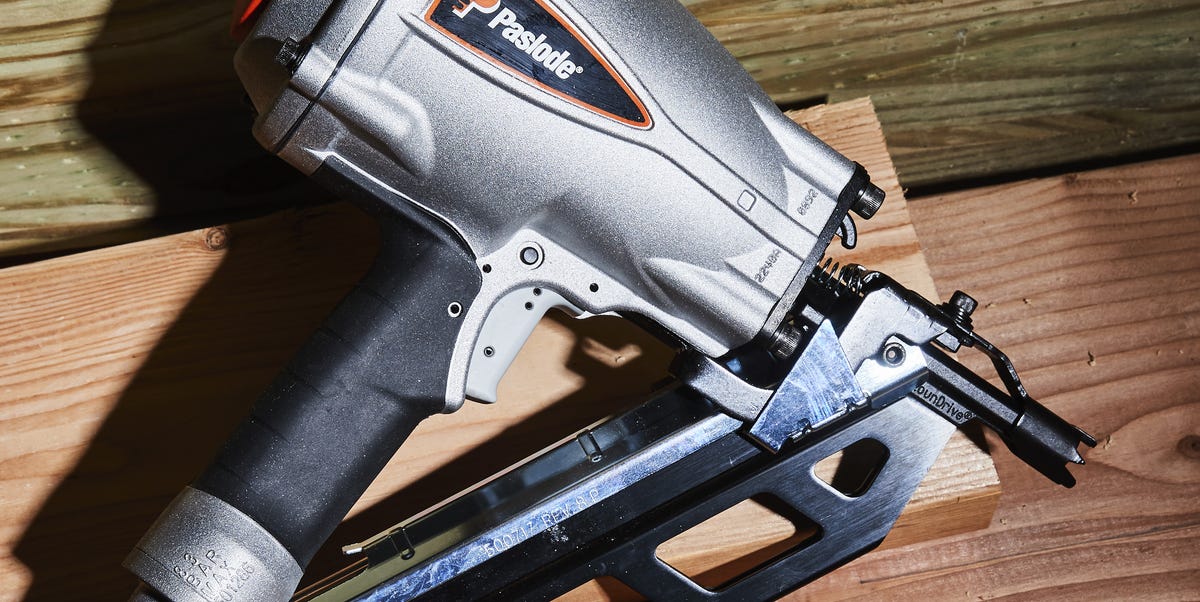
6. Paslode 906800 XPro: Best Gas-Powered Framing Nailer
The Paslode 906800 XPro takes a different cordless approach. A small rechargeable battery manages ignition while a replaceable fuel cell supplies the energy needed to drive each nail. The result is strong fastening performance without an air hose or the large battery pack used by fully electric framing nailers.
At about 7.9 pounds, the XPro is relatively light for a cordless framing gun. Paslode states that a fully charged battery can support up to 6,000 shots, while one full fuel cell can drive approximately 1,200 nails. Actual results depend on temperature, maintenance, fasteners, and working conditions.
The nailer accepts 30-degree paper-collated framing nails and supports both single-fire and rapid-fire operation. It is designed to drive fasteners consistently into common framing materials, including engineered lumber.
The obvious disadvantage is ongoing fuel cost. Fuel cells must be purchased, stored, and replaced, and the tool requires periodic cleaning to remain dependable. There may also be a slight fuel odor during operation. Nevertheless, framers who value low cordless weight and do not want a compressor may find this system more comfortable than carrying a large battery-only nailer all day.
Best for: Professional mobility, remodeling, scattered fastening jobs, and sites without convenient compressor access.
How to Choose the Right Framing Nailer
Pneumatic, Battery, or Fuel Cell?
Choose a pneumatic framing nailer when speed, low tool weight, and long daily runtime matter most. Pneumatic models are often less expensive than cordless tools, but the total system also requires a compressor, hose, fittings, and electricity or fuel for the compressor.
Choose a battery framing nailer for maximum setup convenience. It is especially practical for short jobs, repairs, remote locations, and users who already own compatible batteries. Expect more weight and a higher tool price.
Choose a fuel-cell nailer when you want cordless mobility with a relatively light tool. Remember to include replacement fuel, maintenance supplies, and compatible fasteners in the long-term cost.
Check the Magazine Angle Before Buying Nails
A 21-degree nail strip cannot simply be persuaded to fit a 30-degree magazine through optimism and aggressive pushing. Buy only the collation angle and fastener specifications listed by the manufacturer.
Local building codes and project plans may require particular nail heads, diameters, shanks, coatings, lengths, or corrosion-resistance ratings. Exterior and pressure-treated lumber applications often require appropriately galvanized or stainless-steel fasteners. Structural connectors generally require connector-specific nails approved for the hardware.
Match a Pneumatic Nailer to the Compressor
Check both operating pressure and air-delivery requirements. A compressor may reach the correct PSI but still recover too slowly during rapid firing. Compare the nailer’s SCFM requirement with the compressor’s rated output at the stated pressure, leaving a reasonable performance margin.
Do Not Treat Safety Features as Decorations
Framing nailers fire large fasteners with enough force to penetrate lumber and cause severe injury. Wear approved eye protection and appropriate hearing protection, keep hands away from the fastening path, inspect the material for hidden metal, and disconnect the air supply, battery, or fuel system before clearing jams or servicing the tool.
Sequential firing provides more deliberate control than contact firing. OSHA and NIOSH guidance identifies contact-trigger operation as a significant injury risk and recommends training, safe procedures, personal protective equipment, and full sequential triggers when practical. Even a seemingly minor nail puncture warrants prompt medical attention.
Field Experience: What Using a Framing Nailer Teaches You
The first lesson from using a framing nailer on a real project is that setup matters almost as much as the tool. During a wall-framing job, it is tempting to connect the air hose, load a strip of nails, and immediately begin producing dramatic construction noises. A better approach is to test several fasteners in scrap material first. Lumber density varies, compressor pressure changes, and yesterday’s depth setting may bury today’s nail halfway to the next ZIP code.
Correct depth adjustment saves time. A nail left above the surface interferes with sheathing and requires a hammer. A nail driven too deeply can damage the wood fibers and weaken the connection. The ideal result is normally flush with the material unless the project specification says otherwise. Test again whenever the lumber, nail length, pressure, or application changes.
The second lesson is that lighter tools become more valuable as the day continues. At 8:00 a.m., nearly every framing nailer feels manageable. After several hours of fastening blocking, headers, plates, and sheathing, balance and grip shape become impossible to ignore. A heavier cordless nailer may still be the right choice when it eliminates a hose, but the convenience should be weighed against fatigue rather than admired only in the store aisle.
Air hoses create their own personality. They catch on corners, loop around lumber, and occasionally attempt to pull a pneumatic nailer off a workbench. Planning the hose route before beginning reduces frustration and tripping hazards. A lightweight, flexible hose can make a pneumatic tool feel considerably more pleasant, while a stiff or undersized hose can make an excellent nailer feel clumsy.
Fastener quality is another practical difference that becomes obvious during a long project. Cheap or poorly matched collated nails may break apart during loading, jam more frequently, or feed inconsistently. Confirming the exact angle, diameter, head style, and recommended collation prevents many problems. Keeping nail strips dry and protected also matters because damaged paper collation can become unreliable.
Users quickly learn to appreciate a good rafter hook. Setting a loaded nailer on top of a wall, ladder, or sloped roof is a bad habit with expensive and potentially dangerous consequences. A sturdy hook provides a secure temporary resting place while the operator moves material or checks alignment.
Jam clearing is another moment when tool design stops being theoretical. A convenient open nose or accessible magazine can turn a jam into a brief interruption. A complicated disassembly process can turn the same jam into an unscheduled lunch break featuring several words not found in the owner’s manual. Always disconnect the power source before opening the tool, even when the jam appears harmless.
Finally, speed should never replace placement. Contact firing can move rapidly across sheathing or repetitive framing, but only when the operator has the training, control, and safe working position to use it properly. Sequential mode is generally better for toenailing, connector work, confined spaces, or situations where another person is nearby.
The practical winner is therefore not always the nailer with the longest feature list. A professional crew working beside a compressor may prefer the dependable rhythm of a pneumatic Metabo HPT or Bostitch. A remodeler moving through occupied rooms may appreciate the cordless DeWalt. Someone framing in scattered locations may choose the lighter Paslode system, while an occasional DIY builder may get everything needed from the Freeman. The best framing nail gun is the one that remains safe, comfortable, and predictable after the novelty of firing the first nail has worn off.
Final Verdict
The Metabo HPT NR83A5 is the strongest all-around choice from this 2024 group because of its durability, selectable firing, useful depth control, and balanced professional design. The lighter NR90AES1 offers outstanding value, while the Bostitch F21PL is particularly attractive for users who also work with approved metal connectors.
The Freeman PFR2190 is a sensible option for occasional projects. For cordless work, the DeWalt DCN692 eliminates compressors and fuel cells, whereas the Paslode 906800 XPro combines cordless mobility with a relatively light body and consistent fuel-powered performance.
Note: This comparison preserves a 2024 product lineup. Retail prices, packages, warranties, model availability, and building-code requirements may change. Confirm current specifications and approved fasteners before purchasing or beginning structural work.