Learning Urdu is one of those delightful language adventures where you start by trying to memorize a few simple words and suddenly find yourself fascinated by script, politeness, and why one little phrase can sound warm, formal, friendly, or accidentally too casual. In other words, Urdu is not just about vocabulary. It is about tone, respect, and rhythm.
If you are brand new to the language, the smartest place to begin is not with a giant dictionary that looks like it could stop a door from swinging shut. Start with the words and phrases you will actually use. The title of this article says words, but to be fair, a few of the most common things people say in Urdu are short phrases. Real life is messy like that. Conveniently, real life is also a better teacher than a dry word list.
Below are eight of the most useful and common Urdu words and phrases for beginners, along with pronunciation help, usage tips, and a little cultural context so you do not end up using a super-intimate form of “you” on a stranger and accidentally speed-running awkwardness.
Why These Urdu Words Matter More Than Fancy Vocabulary
When people first learn Urdu, they often want impressive words right away. Something poetic. Something dramatic. Something that makes them sound like they stepped out of a film with excellent lighting. But in everyday conversation, the real heroes are the basics: hello, yes, no, thank you, goodbye, and polite social phrases that keep conversation moving smoothly.
These expressions are the front door to the language. Once you know them, you can greet someone, respond politely, ask how they are doing, and sound much more natural than someone who knows the word for “astronomy” but cannot say “thank you.” That is not a judgment. It is just a very specific kind of chaos.
A Quick Note on Roman Urdu and Pronunciation
Urdu is written in a Perso-Arabic script known as Nastaliq, and many beginners first meet the language through Roman Urdu, which writes Urdu sounds with the English alphabet. That is helpful, but it is not perfectly standardized. So you may see spellings like kaise, kaisay, or kaisey. They are usually pointing you toward the same spoken phrase.
That means your goal is not to obsess over one “holy” spelling. Your goal is to recognize the phrase, say it politely, and keep learning. A little flexibility goes a long way in Urdu.
Note: Roman Urdu spellings vary by teacher, textbook, and region. That is normal. Your keyboard is innocent.
1. Hello السلام علیکم / آداب
Roman Urdu: Assalaam-o-alaikum / Aadab
Meaning: Hello
If you learn only one greeting at the start, make it Assalaam-o-alaikum. It is one of the most widely recognized and respectful greetings in Urdu. In many contexts, it works beautifully as a general hello. Another greeting you may hear is Aadab, which is also polite and elegant.
The lovely thing about this phrase is that it does more than open a conversation. It signals courtesy. It says you came to communicate like a civilized human being and not like someone who just burst into the room yelling, “Words! I know some!”
Common reply: وعلیکم السلام (Wa alaikum assalaam)
Example:
Person A: Assalaam-o-alaikum.
Person B: Wa alaikum assalaam.
2. How Are You? آپ کیسے ہیں؟
Roman Urdu: Aap kaise hain?
Meaning: How are you?
This is one of the most useful Urdu phrases for beginners because it immediately turns a greeting into an actual conversation. The key word here is aap, the polite form of “you.” If you are unsure which form to use, aap is usually the safest and smartest choice.
You can answer with:
میں ٹھیک ہوں Main theek hoon.
Meaning: I am fine.
There is something wonderfully efficient about this pair of phrases. You can greet someone, ask how they are doing, and sound thoughtful in under ten seconds. That is language learning value for money.
Example:
Aap kaise hain?
Main theek hoon. Aur aap?
Translation: How are you? I am fine. And you?
3. Yes ہاں / جی ہاں
Roman Urdu: Haan / Ji haan
Meaning: Yes
Yes, there is more than one way to say yes in Urdu, because of course politeness had to show up and make things more interesting. Haan is the everyday yes. Ji haan is a more respectful or polite version, often used with elders, teachers, strangers, or in formal situations.
The tiny word ji carries a lot of cultural weight. It softens, respects, and adds warmth. If English had a similarly portable politeness button, email would be a much friendlier place.
Example:
Kya aap tayyar hain?
Ji haan.
Translation: Are you ready? Yes.
4. No نہیں
Roman Urdu: Nahin
Meaning: No
Nahin is essential. Simple, direct, and useful in everything from answering questions to declining food you cannot possibly eat because you are already holding one plate in each hand and a cup in the other.
The trick is to say it with the right tone. Urdu often sounds softer and more courteous when spoken with gentle intonation, especially in polite settings. So even a basic nahin can sound perfectly fine if your tone stays calm and respectful.
Example:
Kya yeh aap ki kitaab hai?
Nahin.
Translation: Is this your book? No.
5. Thank You شکریہ
Roman Urdu: Shukriya
Meaning: Thank you
If you want one word that instantly makes your Urdu sound kinder, learn shukriya. It is a basic, useful expression of gratitude and belongs in your first batch of vocabulary. It is easy to remember, pleasant to say, and useful in nearly every social setting.
You can use it after receiving help, a favor, directions, food, information, or the kind of patient pronunciation correction that saves you from accidentally asking for something wildly different from what you intended.
Example:
Shukriya!
Translation: Thank you!
Want to sound a little warmer? Pair it with a smile. Human language technology remains surprisingly analog.
6. Please براہِ مہربانی
Roman Urdu: Barae meherbani
Meaning: Please / Kindly
This is where Urdu gets interesting in the best way. Yes, barae meherbani can mean “please” or “kindly,” but politeness in Urdu is not always packed into one magic word. Often, it is built into the structure of the sentence, especially through respectful verb forms and the polite pronoun aap.
That means beginners should not treat “please” as a one-word shortcut for sounding polite. In Urdu, your whole sentence matters. A respectful request often sounds more natural than simply dropping in one polite word and hoping it does all the work alone.
Example:
Barae meherbani, dobara kahiye.
Translation: Please say it again.
Even more natural in many situations is a polite request using aap and a respectful verb form. That is one reason Urdu can sound especially graceful when spoken well.
7. Sorry / Excuse Me معاف کیجیے
Roman Urdu: Maaf kijiye
Meaning: Sorry / Excuse me / Pardon me
This phrase is a workhorse. You can use it to apologize lightly, to get someone’s attention, to ask for repetition, or to politely interrupt. In beginner conversation, that makes it absurdly valuable. It is basically the Swiss Army knife of social recovery.
Did you bump into someone? Maaf kijiye.
Did you miss what they said? Maaf kijiye, dobara kahiye.
Need to squeeze past someone? Also maaf kijiye.
Notice the verb form kijiye. It carries respect. That matters in Urdu more than many English speakers expect at first.
8. Goodbye / See You Again خدا حافظ / پھر ملیں گے
Roman Urdu: Khuda hafiz / Phir milenge
Meaning: Goodbye / See you again
A conversation needs an ending, ideally one that does not involve you slowly backing away while making nervous eye contact. In Urdu, Khuda hafiz is a common way to say goodbye, while Phir milenge means “we will meet again” or “see you again.”
Both are useful, but they have slightly different flavors. Khuda hafiz works as a warm farewell. Phir milenge feels a little more relational, almost like saying, “This is not the end; we will talk again.” Together, they make a very natural closing.
Example:
Shukriya. Phir milenge. Khuda hafiz.
Translation: Thank you. See you again. Goodbye.
One More Thing: The Power of آپ, تم, and تو
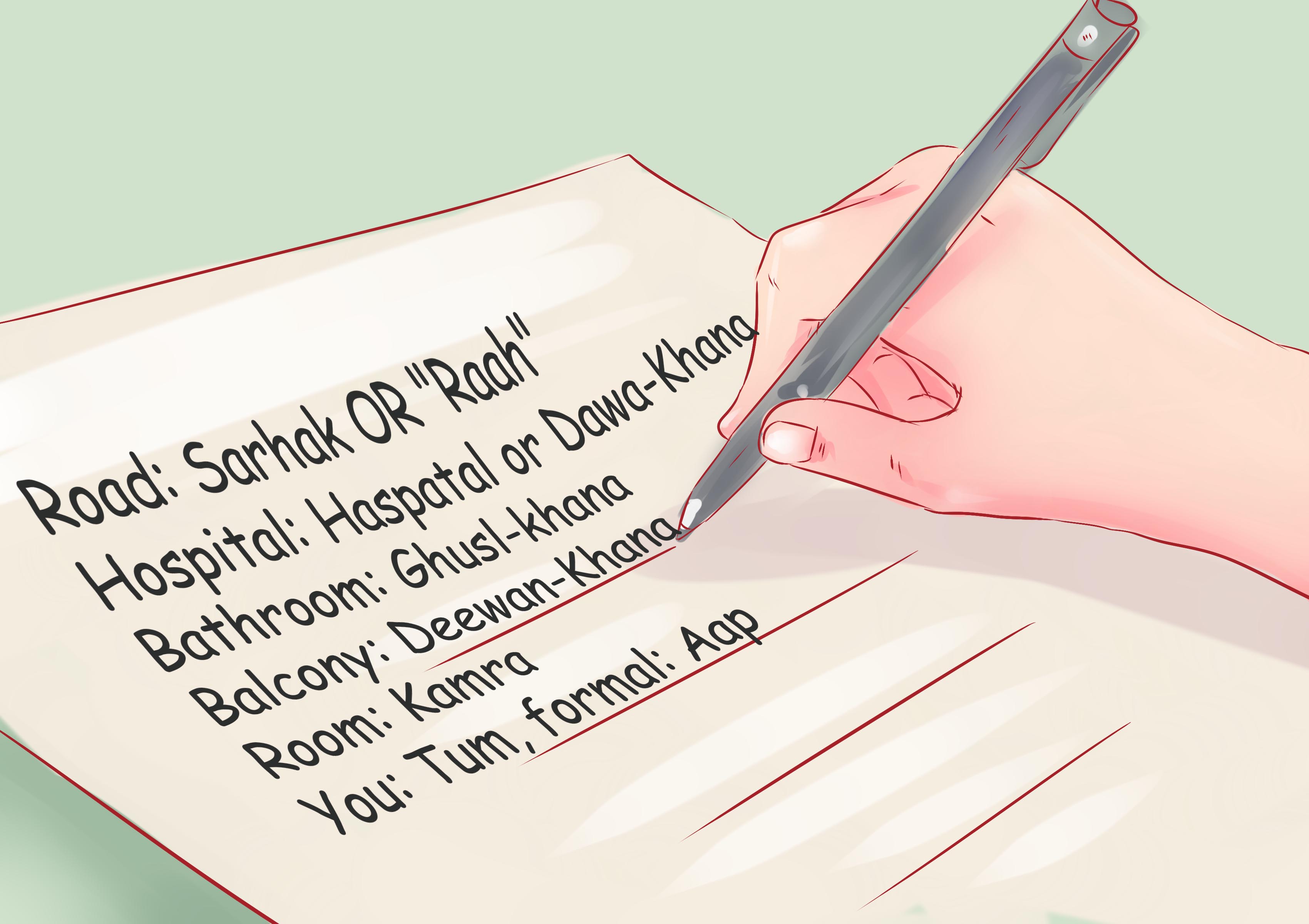
If you remember only one cultural tip from this article, let it be this: not every “you” in Urdu is created equal. Urdu has different levels of familiarity and respect, and this affects how polite you sound immediately.
Aap is polite and safest for most beginner situations. Tum is more informal and used with friends or equals. Tu is very intimate and can sound rude if used carelessly with the wrong person. So if you are meeting someone new, talking to an elder, asking a question politely, or just trying to avoid accidentally causing emotional property damage, choose aap.
Quick Beginner Cheat Sheet
| English | Urdu | Roman Urdu | Best Use |
|---|---|---|---|
| Hello | السلام علیکم / آداب | Assalaam-o-alaikum / Aadab | General polite greeting |
| How are you? | آپ کیسے ہیں؟ | Aap kaise hain? | Starting conversation politely |
| Yes | ہاں / جی ہاں | Haan / Ji haan | Everyday and respectful agreement |
| No | نہیں | Nahin | Basic negative response |
| Thank you | شکریہ | Shukriya | Expressing gratitude |
| Please | براہِ مہربانی | Barae meherbani | Polite request |
| Sorry / Excuse me | معاف کیجیے | Maaf kijiye | Apology, interruption, attention-getter |
| Goodbye / See you again | خدا حافظ / پھر ملیں گے | Khuda hafiz / Phir milenge | Natural conversation ending |
Common Mistakes Beginners Make With Basic Urdu Words
1. Treating every phrase as a direct one-word translation.
Urdu does not always map neatly onto English. “Please,” for example, is often expressed through respectful phrasing, not just one standalone word.
2. Ignoring politeness levels.
Beginners sometimes memorize vocabulary without learning who it is appropriate for. In Urdu, that matters a lot.
3. Panicking over spelling variations.
Roman Urdu is helpful, but it is not perfectly standardized. Focus on sound, context, and repeated exposure.
4. Memorizing without speaking aloud.
Urdu is a language you feel in the mouth. If you do not say the phrases out loud, they stay flat on the page.
What Learning These Urdu Words Felt Like in Real Life
The first time I tried using basic Urdu phrases in conversation, I learned something important: people do not usually care whether your accent is flawless. They care whether you are trying with sincerity. That was both comforting and mildly humbling, because I had spent an unreasonable amount of time worrying about whether my shukriya sounded elegant or like I had stepped on a Lego mid-syllable.
What surprised me most was how quickly the simplest phrases changed the mood of an interaction. Saying Assalaam-o-alaikum did not feel like repeating a textbook line. It felt like opening the door correctly. Suddenly, conversation had a warmer entry point. I was not just tossing random vocabulary into the air and hoping something landed. I was participating in a social rhythm.
The phrase Aap kaise hain? taught me something even more useful: beginner language learning is not about impressive speeches. It is about asking small questions well. The first few times I said it, I felt slow and slightly mechanical, like a person assembling flat-pack furniture with too much determination and not enough grace. But every repetition made it smoother. Then came the even better moment: understanding the reply Main theek hoon without needing a mental pause long enough to file taxes.
Ji haan and nahin also became unexpectedly powerful. Tiny words, yes, but they made real conversation possible. There is something deeply satisfying about being able to answer clearly, even when your vocabulary is still small. A language stops feeling decorative and starts feeling usable the moment you can agree, disagree, thank someone, and exit a conversation politely.
The politeness system was probably the biggest lesson. English speakers often underestimate how much social meaning can live inside pronouns and verb forms. In Urdu, choosing aap instead of a more casual form is not a tiny grammar detail. It is respect made audible. Once I understood that, the language felt richer. Also, I became far less eager to casually experiment with forms of “you” like a reckless tourist in a grammar museum.
Maaf kijiye may have been the most practical phrase of all. It helped when I missed a word, when I needed repetition, and when I wanted to politely interrupt. That one phrase carried me through several moments where my brain knew exactly zero useful follow-up words. There is real comfort in having a phrase that buys time while still sounding considerate.
And then there was Khuda hafiz. Endings matter. Early on, I realized that learning how to leave a conversation gracefully is almost as important as learning how to begin one. A good goodbye gives you confidence. It lets the interaction end neatly rather than dissolving into a confused smile and a panicked wave.
Looking back, these eight common Urdu words and phrases did more than expand vocabulary. They changed how approachable the language felt. Urdu stopped being “that beautiful language I admire from a distance” and became “that language where I can greet, respond, ask, thank, apologize, and leave with dignity mostly intact.” That is real progress. Not glamorous, maybe. But very real. And honestly, in language learning, real beats glamorous every time.
Final Thoughts
If you want to learn the most common Urdu words, start with the ones that help you connect: greet, ask, respond, thank, apologize, and say goodbye. These are the phrases that show up in everyday life, not just on vocabulary quizzes designed to ruin your afternoon.
The best way to remember them is simple: use them out loud, use them often, and use them politely. Urdu rewards attention to tone and respect. Once you begin hearing the social meaning behind these basic words, the language becomes easier, richer, and much more enjoyable to learn.
If you master these eight expressions, you will already have a solid beginner toolkit for real conversation. That is not everything, of course. But it is an excellent start, and every language journey needs one.