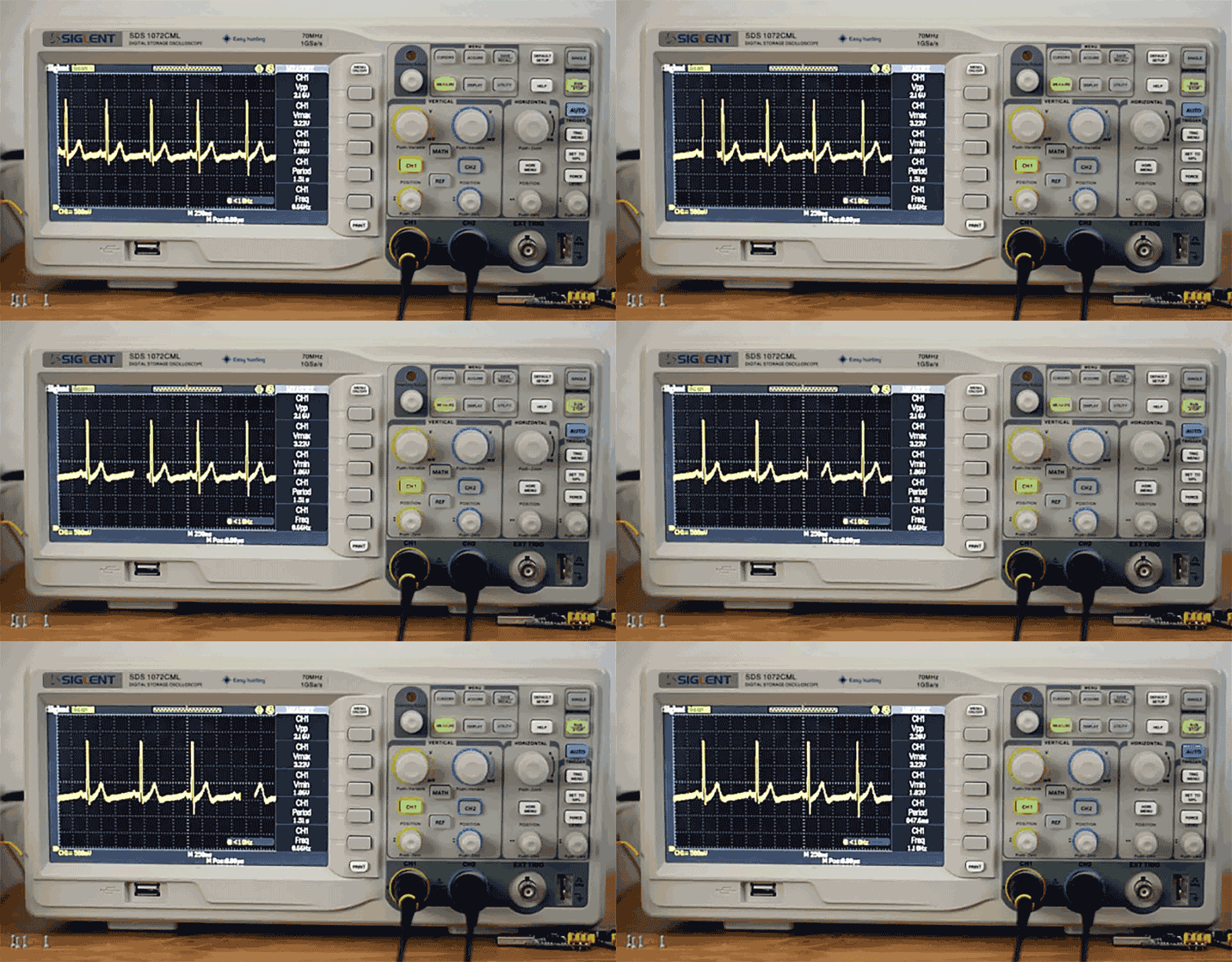
There is something delightfully mischievous about using a computer sound card as an analog-to-digital converter for electrocardiograms. A sound card was designed to capture guitars, podcasts, questionable karaoke, and the occasional “is my microphone working?” test. Yet under the right educational setup, it can also capture the tiny electrical rhythm of a heartbeat. That is the charm of sound card ADCs for electrocardiograms: they turn ordinary audio hardware into a surprisingly capable signal-acquisition tool.
Before anyone tapes wires to themselves and declares the laptop a cardiologist, let us be very clear: a DIY sound card ECG is an educational electronics project, not a medical device. It should not be used for diagnosis, treatment decisions, emergency monitoring, or anything involving real clinical risk. The heart may be poetic, but electrical safety is brutally literal. This article explores how the idea works, why it is technically clever, where it falls short, and how hobbyists, students, and engineers can think about it responsibly.
What an ECG Actually Measures
An electrocardiogram, or ECG, records electrical activity produced by the heart. Electrodes placed on the skin detect voltage differences caused by cardiac depolarization and repolarization. The familiar ECG waveform includes the P wave, QRS complex, and T wave, each representing a different part of the cardiac electrical cycle. In a clinical setting, ECGs help trained professionals evaluate rhythm, conduction, ischemic changes, and other heart-related clues.
For electronics people, the ECG is both fascinating and annoying. Fascinating because the signal is real, biological, and beautifully structured. Annoying because it is small, slow, and surrounded by noise. A useful ECG front end must amplify microvolt-to-millivolt-level signals while rejecting power-line hum, motion artifacts, electrode offsets, muscle noise, and the grand electromagnetic soup of modern life. In other words, the heart whispers while the world shouts.
Why a Sound Card Can Work as an ECG ADC
A sound card contains an ADC, or analog-to-digital converter, that samples analog audio and turns it into digital data. Many consumer audio inputs support sample rates such as 44.1 kHz or 48 kHz, far above what a simple ECG display needs. ECG monitoring often focuses on relatively low-frequency content, especially compared with music. That makes the sound card look tempting: it is cheap, widely available, already supported by operating systems, and easy to access with software.
The clever trick is not that the sound card is medically ideal. It is not. The clever trick is that the ECG signal can be conditioned into a form the audio input understands. A front-end circuit amplifies and filters the biopotential signal, then feeds a safe, scaled version into the microphone or line input. The computer records it as if it were audio. Software then plots the waveform over time, applies filtering, detects peaks, and estimates heart rate. Somewhere, a retired oscilloscope sheds a nostalgic tear.
The Basic Signal Chain
A sound card ECG setup usually has four major blocks: electrodes, an analog front end, the sound card ADC, and software. Each block matters. Weakness in one stage shows up as noise, distortion, drift, clipping, or a waveform that looks less like an ECG and more like a worm trying to escape a spreadsheet.
1. Electrodes
Skin electrodes convert ionic activity at the body surface into an electrical signal a circuit can measure. Disposable gel electrodes are common because they reduce contact impedance and improve stability. Dry electrodes can work in some systems, but they tend to be more sensitive to motion and skin contact quality. Poor electrode contact is one of the fastest ways to turn a promising ECG experiment into a modern art installation.
2. Analog Front End
The analog front end is the serious part of the project. It typically includes an instrumentation amplifier or ECG-specific chip, high input impedance, filtering, protection components, and sometimes lead-off detection. Popular hobbyist projects often use the AD8232, a single-lead ECG front-end chip designed to amplify and filter small biopotential signals. Other designs may use dedicated ECG ADC chips, such as TI’s ADS129x family, which integrate high-resolution ADCs, programmable gain, reference circuitry, and features intended for biopotential measurements.
3. Sound Card ADC
The sound card digitizes the conditioned analog signal. Its strengths are availability, high sample rate, and easy software access. Its weaknesses include uncertain input filtering, AC coupling, microphone bias voltage, automatic gain settings, noisy laptop power environments, and limited knowledge of the actual analog input design. A studio audio interface with a line input may behave better than a mystery microphone jack on a bargain laptop, but neither becomes a certified ECG recorder simply because the waveform looks pretty.
4. Software
Software transforms sampled data into a usable display. A simple program can read the audio stream, plot voltage versus time, smooth the signal, add a notch filter for 50 or 60 Hz interference, and detect R peaks to estimate heart rate. More advanced software may include rolling buffers, adjustable gain, peak detection thresholds, beat-to-beat interval calculations, and export tools for analysis. This is where many sound card ECG projects shine: once data enters the computer, visualization becomes flexible and fun.
Why the AD8232 Became a Favorite
The AD8232 is popular because it packages much of the difficult analog work into a small, accessible ECG front end. Breakout boards are widely available, often bundled with electrode cables and pads. The chip is intended for single-lead heart-rate monitoring and can provide an output that a microcontroller ADC, oscilloscope, or audio input can capture. For a student or hobbyist, that is a major shortcut. Instead of designing a full medical-grade analog front end from scratch, you can focus on signal capture, filtering, and software display.
However, the AD8232 is not magic heart dust. It still needs proper power, layout, electrodes, lead placement, filtering choices, and safety precautions. It also produces a single-lead signal, which is useful for learning rhythm basics but not equivalent to a clinical 12-lead ECG. Think of it as a friendly doorway into biopotential measurement, not a hospital in a breakout board.
Sampling Rate: More Than Enough, Sometimes Too Much
From a sampling-rate perspective, audio hardware is overqualified for basic ECG display. A sound card sampling at 44.1 kHz captures far more samples per second than needed for a low-frequency cardiac waveform. That extra speed can make plotting smooth and filtering flexible, but it also means the software may need to downsample or process more data than necessary. For ECG experiments, the goal is not “maximum sample rate because bigger numbers feel athletic.” The goal is stable, accurate, low-noise acquisition in the frequency band of interest.
Dedicated ECG ADCs often operate at lower sample rates with higher resolution, excellent common-mode rejection support, low input noise, and features built specifically for biopotential signals. A sound card is optimized for audio, not electrodes on human skin. That difference matters. Audio ADCs expect signals from microphones, instruments, and line-level sources. ECG front ends must tolerate electrode offsets, body-coupled interference, and safety constraints. The sound card can be a convenient digital doorway, but it is not the whole house.
The Great Safety Elephant in the Room
Electrical safety is the most important topic in any ECG project. Electrodes create a conductive path to the body. That means a design must consider leakage current, isolation, fault conditions, and power sources. Professional medical equipment follows strict safety standards for good reason. A battery-powered front end is safer than a mains-connected circuit, but “battery-powered” alone does not automatically make a system safe when it is connected to a desktop PC, grounded audio interface, charger, oscilloscope, or USB device.
For educational experiments, safest practice means avoiding direct body connection to mains-powered equipment, using proper medical-grade isolation where appropriate, and understanding that consumer audio hardware was not designed as a patient-connected device. If the project involves real electrodes on a person, the conservative answer is simple: use certified equipment or an isolated, purpose-built biosignal platform. The heartbeat is not the place to beta-test optimism.
Noise: The Uninvited Guest at Every ECG Party
ECG noise comes in several flavors. Baseline wander is slow drift caused by breathing, motion, and electrode movement. Power-line interference appears near 50 or 60 Hz depending on the local electrical system. Muscle activity adds higher-frequency noise. Loose electrodes add chaos. A laptop charger can contribute interference. Nearby fluorescent lights, monitors, and cables may join the band like they were invited.
Filtering helps, but filtering is not a broom that sweeps away all sins. A high-pass filter can reduce baseline wander, but too aggressive a cutoff can distort clinically important features. A notch filter can reduce mains hum, but it can also introduce artifacts if poorly designed. Low-pass filtering can calm high-frequency noise, but excessive smoothing may blur the QRS complex. Good ECG acquisition starts with good electrodes, short leads, clean layout, battery operation, shielding, and proper common-mode rejection before software tries to rescue the signal.
Microphone Input vs. Line Input
One practical issue is the choice between microphone input and line input. A microphone input is sensitive and convenient, but it may provide bias voltage for electret microphones, apply automatic gain control, or include unknown filtering. A line input is generally more predictable and better suited for external signal sources, but many modern laptops no longer include one. USB audio adapters can help, although their quality varies wildly. Some are surprisingly decent; others sound like they were assembled during a coffee break by a raccoon with a soldering iron.
When using audio hardware for signal acquisition, consistency matters. Disable automatic gain control when possible. Avoid clipping. Keep signal levels within the input range. Confirm whether the input is mono or stereo. Understand whether the device applies high-pass filtering that may remove low-frequency ECG content. Test with a known signal before trusting a biological signal. A function generator or ECG simulator is a much better first dance partner than a human chest.
What Sound Card ECGs Are Good For
Sound card ADCs for electrocardiograms are excellent for education. They demonstrate analog signal conditioning, ADC sampling, digital filtering, peak detection, biomedical instrumentation, and the limits of consumer hardware. They are also useful for software prototyping. If you want to write a real-time ECG viewer, experiment with QRS detection, or teach students how tiny analog signals become digital waveforms, the sound card approach is approachable and memorable.
They are less appropriate for medical use, long-term monitoring, arrhythmia diagnosis, or any situation where accuracy and safety carry consequences. A waveform that looks like an ECG is not automatically reliable. Lead placement may be nonstandard. Calibration may be uncertain. Filtering may distort features. The analog path may clip or drift. The software may mis-detect peaks. In short, it is a terrific classroom project and a terrible substitute for clinical equipment.
Dedicated ECG ADCs vs. Sound Card ADCs
Dedicated ECG ADCs exist because ECG acquisition has special needs. Chips designed for biopotential measurement often include high-resolution delta-sigma ADCs, programmable gain amplifiers, right-leg drive support, lead-off detection, test signals, low input noise, and simultaneous sampling across channels. These features are not decorative. They solve real problems that appear when measuring tiny signals from living bodies.
Sound card ADCs win on convenience and cost. Dedicated ECG ADCs win on suitability. A sound card can be a clever hack; a purpose-built ECG front end is engineering with fewer compromises. The best educational projects often combine both ideas: use an ECG front-end module to condition the signal, then use the sound card only as a convenient digitizer. That division of labor keeps the analog front end focused on biology and lets the computer focus on display.
Software Ideas for a Better ECG Display
A good sound card ECG program should do more than draw a moving line. Useful features include adjustable time scale, gain control, signal-quality indicators, selectable filters, R-peak detection, heart-rate averaging, data export, and calibration tools. It should also make noise visible rather than hiding every problem under aggressive smoothing. If the software makes a bad signal look too good, it is not helping. It is putting a tuxedo on a raccoon.
For analysis, the software can downsample the incoming audio stream after proper anti-alias filtering, apply a band-pass filter suitable for the experiment, and detect R peaks using adaptive thresholds. Heart rate should be averaged over several beats rather than jumping wildly after every detected spike. The display should show enough raw signal behavior to reveal electrode problems, motion artifacts, and clipping. Pretty graphs are nice; honest graphs are better.
Common Mistakes in DIY Sound Card ECG Projects
Skipping Isolation
The most serious mistake is ignoring electrical isolation. Any project connected to the body deserves a conservative safety mindset. Do not assume a USB adapter, laptop, or charger is safe just because it worked yesterday.
Feeding Raw Electrodes Into Audio Inputs
A sound card is not an instrumentation amplifier. Raw electrode signals need high input impedance, differential amplification, filtering, and protection. Feeding electrodes directly into consumer audio hardware is poor engineering and poor judgment wearing the same hat.
Trusting the Waveform Too Much
DIY ECG traces can look convincing. That does not make them diagnostic. Lead placement, filtering, scaling, and noise rejection determine whether a waveform is meaningful.
Overfiltering
Heavy filtering can make a trace look clean while removing important details. A clean lie is still a lie, even if it has smooth edges.
Experience Section: Lessons From Working With Sound Card ECG Concepts
The most valuable experience with sound card ADCs for electrocardiograms is learning that the hard part is rarely the ADC itself. Beginners often assume the converter is the star of the show. After all, “ADC” sounds official, digital, and important. But in practice, the front-end analog design, electrode contact, grounding strategy, and safety plan determine whether the project succeeds. The sound card simply digitizes whatever mess or masterpiece arrives at its input.
One practical lesson is that electrode placement changes everything. A small shift in lead position can alter waveform shape and amplitude. Loose gel pads introduce wandering baselines. Dry skin increases impedance. Movement adds artifacts that may resemble signal features. A beginner may blame software when the real culprit is a tired electrode hanging on like a sticker from a child’s lunchbox. Preparing the skin, using fresh electrodes, and keeping wires still can improve the trace more than rewriting the entire program.
Another lesson is that laptop power matters. Running on battery can reduce interference compared with using a charger, especially in noisy rooms. Long unshielded leads behave like antennas. Nearby power bricks, monitors, and lights may inject hum. Sometimes the best debugging step is not a new algorithm but moving the setup away from electrical clutter. Biomedical signals are humbling because they remind engineers that the real world has no respect for tidy schematics.
Software experiments also teach restraint. It is tempting to add filters until the ECG looks perfect. But a perfect-looking waveform can be artificially shaped. A better habit is to display both raw and filtered signals, label the filters clearly, and make processing choices transparent. When testing peak detection, it helps to start with recorded sample data or an ECG simulator before using live input. That way, the algorithm can be evaluated without confusing biological variability with code problems.
The biggest experience-based takeaway is that sound card ECG projects are best treated as learning instruments. They are wonderful for exploring sampling, filtering, visualization, and the realities of low-level analog measurement. They are not shortcuts around medical-device engineering. The fun comes from understanding the limitations, not pretending they do not exist. Build cautiously, test with known signals, isolate properly, document assumptions, and keep the project in the education lane. That lane is already interesting enough.
Conclusion
Sound card ADCs for electrocardiograms are a brilliant example of creative engineering: inexpensive audio hardware, a proper ECG front end, and smart software can turn a computer into a real-time biosignal viewer. The approach is especially useful for education, prototyping, and understanding the path from skin electrodes to digital waveforms. It also teaches the unglamorous truths of biomedical electronics: safety comes first, analog design matters, noise is relentless, and a convincing trace is not the same thing as a clinical result.
For students, makers, and engineers, the sound card ECG is a rewarding project when handled responsibly. It shows how much capability hides inside everyday hardware and how much care is required when measuring the human body. The heart may generate the signal, but good engineering determines whether you capture music, noise, or a very expensive lesson.
Note: This article is for educational and informational purposes only. DIY ECG projects should not be used for diagnosis, medical monitoring, treatment decisions, or emergency care.