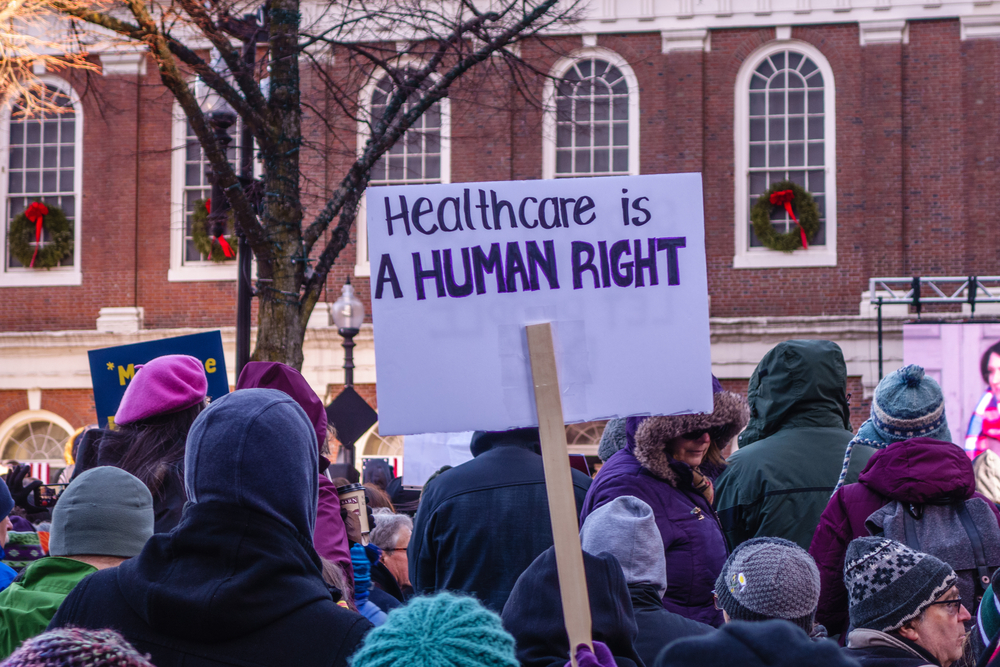
American health law has a talent for making simple questions wear very complicated suits. Ask whether federal law violates our right to health care, and the honest answer is not a clean yes or no. It is more like opening a filing cabinet labeled “rights,” only to discover three drawers marked “depends,” one marked “federalism,” and another one somehow on fire.
Still, there is a real issue underneath the legal clutter. Millions of Americans experience health care as something they need, cannot avoid, and often cannot afford. So when federal rules expand access in one area and slam the brakes in another, people understandably ask whether the law is protecting health or playing keep-away with it.
The short version is this: the United States does not have a broad, explicit federal constitutional right to health care. That matters. It means federal law usually is not judged against a general constitutional promise that everyone is entitled to medical care. But that does not mean federal law is off the hook. Congress and federal agencies have created specific health care protections, and in some places they work quite well. In other places, federal law leaves giant holes, creates exceptions, or helps produce a patchwork system where your access to care depends on your income, your state, your immigration status, the kind of care you need, and whether the nearest hospital lawyer is having a dramatic afternoon.
So does federal law violate our right to health care? If by “right” you mean a universal, enforceable federal guarantee to medical care, the harder truth is that federal law mostly fails to create that right in the first place. If by “right” you mean the narrower protections Americans do have, such as emergency treatment, non-discriminatory access, preventive coverage, and protection from certain abusive billing practices, then federal law can both defend and undermine those rights at the same time. That contradiction is the real story.
The first big problem: America does not recognize a broad constitutional right to health care
Let’s start with the legal foundation, because this is where many debates go sideways. The U.S. Constitution is mostly a charter of limits on government power, not a shopping list of guaranteed public services. Courts have long treated most constitutional rights as protections against government interference, not as commands that government provide resources. In plain English, the Constitution is better at saying, “The government cannot do that to you,” than, “The government must buy that for you.”
That distinction has shaped health care law for decades. The Supreme Court has repeatedly resisted reading the Constitution as creating a general duty for government to provide medical care or financial support for treatment. That is one reason this debate never lands neatly. Many people talk about health care as a moral right, a human right, or a democratic necessity. Those arguments have force. They just do not automatically become federal constitutional law because they are morally persuasive.
In that sense, federal law does not usually “violate” a broad constitutional right to health care because that right is not clearly recognized at the federal level. The more accurate criticism is that federal law has never fully established it. That may sound like a technicality, but in law, technicalities are often where the entire battle lives.
Where federal law does create real health care rights
Emergency rooms cannot simply shrug and point at your wallet
One of the clearest federal protections is EMTALA, the Emergency Medical Treatment and Labor Act. If you show up at a hospital emergency department with a possible emergency medical condition, the hospital must provide an appropriate medical screening exam. If an emergency condition exists, it must offer stabilizing treatment or an appropriate transfer. It cannot delay care just because you are uninsured or unable to pay. That is not a tiny technical promise. It is one of the most important practical access rights in American health law.
EMTALA does not create universal health care, and it definitely does not turn the emergency room into a one-stop wellness spa. It is limited to emergency settings and stabilization. But it reflects something close to a moral baseline embedded in federal law: in a true emergency, hospitals do not get to audition for the role of nightclub bouncer.
The Affordable Care Act expanded access in meaningful ways
The ACA also pushed federal law toward something more rights-like, even if it stopped short of a full guarantee. The law expanded premium subsidies, strengthened insurance rules, and aimed to expand Medicaid to adults with incomes below 138% of the federal poverty level. It also helped make preventive care more accessible by requiring many plans to cover certain screenings, vaccines, and preventive services without cost-sharing.
That matters more than it sometimes gets credit for. Preventive care is where health policy often either gets smart or gets expensive later. When people can get screenings, blood pressure checks, diabetes testing, cancer prevention services, and immunizations without extra out-of-pocket costs, access improves before a crisis hits. In 2025, the Supreme Court preserved a key ACA preventive-services structure in Kennedy v. Braidwood Management, keeping an important part of the no-cost preventive coverage framework intact.
Federal law also bans at least some forms of health care discrimination
Section 1557 of the ACA is the federal government’s main civil-rights provision for health care. It prohibits discrimination in certain covered health programs and activities on the basis of race, color, national origin, sex, age, and disability. That is a major protection, especially in a system where access is often shaped by language barriers, disability accommodations, biased benefit design, and unequal treatment.
Even here, though, the story is messy. Section 1557 has been revised, litigated, expanded, narrowed, and litigated again, because apparently health law enjoys cardio. Some parts of the 2024 rule have been stayed or enjoined by courts, especially around gender-identity-related provisions. So the right exists, but its scope remains contested. That uncertainty matters because a right that can be announced in a rule and then frozen in court starts to feel less like a shield and more like a weather forecast.
The No Surprises Act protects patients from some billing nonsense
Federal law has also stepped in against one of the least lovable features of the U.S. system: surprise medical bills. The No Surprises Act protects many people with private coverage from certain out-of-network charges for emergency services, some non-emergency services at in-network facilities, and air ambulance services. In those situations, patients are not supposed to be dragged into the middle of billing fights between insurers and providers.
That may not sound philosophical enough for a rights debate, but it is. Financial access is access. A person can be “covered” on paper and still feel effectively excluded from care if one emergency ride or one out-of-network specialist can torch the household budget.
Where federal law limits, narrows, or complicates health care access
The Constitution protects prisoners’ care more clearly than ordinary patients’ care
Here is one of the grimmer ironies in American law: if the government incarcerates you, it has a constitutional duty to provide adequate medical care. Under Estelle v. Gamble, deliberate indifference to a prisoner’s serious medical needs can violate the Eighth Amendment. That makes sense. If the state takes control of your body and liberty, it cannot then act shocked that you still require insulin, antibiotics, or actual human treatment.
But notice the contrast. Outside custody, ordinary Americans do not enjoy an equally clear federal constitutional right to care. In other words, the law is often more explicit when the government is locking the door than when a working family is trying to get asthma medication. That should make anyone pause.
Medicaid expansion became optional for states, and the gap is still real
The ACA was supposed to move the country closer to broad low-income coverage through Medicaid expansion. Then came NFIB v. Sebelius. The Supreme Court allowed the ACA to survive, but ruled that the federal government could not effectively force states to expand Medicaid by threatening their existing Medicaid funding. The result was a patchwork map that still shapes health access today.
That patchwork is not abstract. In non-expansion states, uninsured rates remain far higher, and many low-income adults fall into the coverage gap. They earn too much under their state’s narrow Medicaid rules but too little to qualify for subsidized marketplace coverage. That is the sort of policy design that makes a person wonder whether the law is playing a practical joke with very unfunny consequences.
Federal funding restrictions can narrow access even when care is legal
Federal law does not merely fail to guarantee health care. In some areas, it affirmatively restricts support for it. A classic example is the Hyde Amendment, which limits federal funding for abortion in most circumstances. In Harris v. McRae, the Supreme Court upheld those funding restrictions, making clear that even where a medical service may be constitutionally protected or legally available, that does not mean the federal government must pay for it.
That principle has huge consequences. Rights on paper are weaker when they are detached from the money required to use them. A formal choice without practical access is still a barrier, just wearing nicer clothes.
Post-Dobbs America made the conflict even sharper
After Dobbs v. Jackson Women’s Health Organization, there is no longer a federal constitutional right to abortion. That dramatically changed the health care landscape. Federal law still requires emergency care under EMTALA, and litigation such as Moyle v. United States has highlighted conflict between federal emergency-care obligations and strict state abortion bans. But the larger constitutional umbrella is gone.
For patients, that means access to time-sensitive care can turn into a collision between federal statutes, state criminal bans, hospital risk management, and physician fear. When doctors begin consulting legal memos before stabilizing a medical crisis, the patient is already losing.
Immigration rules create federal access barriers too
Federal law also limits eligibility for some publicly funded care based on immigration status. Certain lawfully present immigrants must wait five years before becoming eligible for federally funded Medicaid or CHIP, although states have options to cover some children and pregnant people sooner. That means federal law is not neutral on access. It draws lines. Sometimes those lines are defended as budget policy or immigration policy. To the person needing treatment, they still feel like health care barriers.
Conscience protections can collide with patient access
Federal conscience protections are another example of law serving two values that do not always coexist peacefully. These rules protect certain providers, entities, and participants who object on religious or moral grounds to involvement in specific health care services. Supporters view these protections as essential civil liberties. Critics argue they can delay or block care for patients, especially in areas like reproductive health and gender-related care.
That does not make conscience protections illegitimate. It does mean the law often prioritizes institutional or provider refusal rights without guaranteeing that the patient standing in front of the reception desk can quickly get the needed care elsewhere. In practice, that imbalance can feel less like pluralism and more like a scavenger hunt.
So, does federal law violate our right to health care?
The most precise answer is this: federal law does not violate a broad, universally recognized federal constitutional right to health care because American law has never clearly established one. But that is not exactly a defense of the system. It is closer to an admission of how limited the legal baseline is.
At the same time, federal law does create narrower health care rights, and those rights matter enormously. Emergency screening and stabilizing treatment. Anti-discrimination protections. Preventive services without cost-sharing under many plans. Protection from certain surprise bills. Constitutional medical care for incarcerated people. These are real legal safeguards, not decorative language.
Yet federal law also narrows access through funding restrictions, optional Medicaid expansion, eligibility barriers, and refusal protections that can leave patients stranded. So the better question may not be whether federal law violates a single right to health care. It may be whether federal law has constructed a fragmented, conditional, frequently litigated substitute for a real right, and then acted surprised when people call it unfair.
That criticism lands. America’s federal health care framework protects care in slices instead of guaranteeing it as a whole. The result is a system where your “rights” often depend on where you live, what care you need, how much money you make, and whether your crisis is sufficiently dramatic to count as an emergency. That is not nothing. But it is not justice finished, either.
Experiences from the American health care maze
Consider a composite patient in a non-expansion Southern state: a restaurant worker in her early thirties, making too little to comfortably buy private coverage but too much, under her state’s rules, to qualify for Medicaid. She has recurring stomach pain and keeps postponing care because rent, groceries, and gas arrive with more confidence than her paycheck. By the time she finally goes to the emergency room, the hospital must screen and stabilize her under federal law. That is a right. But the right arrives late, after pain, fear, lost work, and a bill she will be paying long after the discharge paperwork has become refrigerator clutter. Legally, she received care. Realistically, the system waited until she was in trouble.
Now think about a pregnant patient in a state with strict abortion limits who develops a dangerous complication. Her doctors know she is getting worse, but they also know the legal line is blurry, politically charged, and potentially career-altering. Federal emergency law says the hospital must provide stabilizing care. State law threatens punishment for prohibited procedures. So the patient ends up in the most American scene imaginable: highly trained physicians practicing medicine with one eye on the chart and the other on a legal memo. She is not wondering about constitutional theory. She is wondering why emergency care in a wealthy country feels like a negotiation.
Or take a lawfully present immigrant family, recently settled, working, paying taxes, trying to do everything “the right way.” One child may be eligible for help in a state that adopted an option for quicker coverage. Another family member may still be stuck in a waiting period for federally funded Medicaid. On paper, the system looks orderly. In practice, it feels arbitrary. The family learns fast that “legal access” and “actual access” are distant cousins who do not return each other’s calls. They delay checkups, compare pharmacy prices like detectives, and hope nobody’s symptoms become urgent before the coverage rules do.
Then there is the incarcerated patient, a person with diabetes, severe depression, or opioid use disorder inside a jail or prison. Here the constitutional rule is clearer: once the government has custody, it must not show deliberate indifference to serious medical needs. Yet enforcement is uneven, and the experience can still be harsh. The bitter irony is impossible to ignore. Outside custody, people may struggle for years to obtain regular primary care. Inside custody, the law finally speaks in firmer constitutional terms, as though losing freedom is what it takes to gain a more definite claim to treatment. That inversion says something uncomfortable about the architecture of American rights.
These experiences help explain why the public keeps returning to the same question. Most people are not asking whether a law review article can derive a perfect doctrinal theory of health rights from the Fourteenth Amendment. They are asking something plainer: when the country has the money, the medicine, the hospitals, and the knowledge, why is access still so conditional? Why does help arrive fastest in emergencies, slower in chronic illness, and sometimes not at all unless you fit the right category, live in the right state, or need the right kind of legally favored care?
That is why this debate will not disappear. Federal law has built protections that save lives every day. It has also built gaps large enough for families to fall through. Americans feel both truths at once. They see the emergency room that cannot turn them away, and the specialist they still cannot afford. They see anti-discrimination promises, and also the litigation that keeps redrawing them. They see coverage expansions, and also the people left outside the map. The legal system may call that complexity. Patients usually call it exhausting.