Human beings love to think of themselves as tiny, well-dressed logic machines. We compare prices, read reviews, make budgets, weigh pros and cons, and then confidently choose the thing that somehow costs more, takes longer, and comes with a subscription we forgot to cancel. Welcome to the wonderfully messy world of Predictably Irrational, a phrase made famous by behavioral economist Dan Ariely and now used widely to describe a strange truth about decision-making: people are irrational, but not randomly so.
That last part matters. If our mistakes were totally random, studying them would be like trying to organize a sock drawer during an earthquake. But behavioral economics shows that our errors often follow patterns. We overvalue what we own. We hate losses more than we enjoy equal gains. We compare choices badly when a sneaky “decoy” option appears. We procrastinate even when our calendar is practically screaming at us. We chase “free” things as if zero dollars were a magical unicorn. And yes, we still buy the larger popcorn because it is “only a dollar more,” even though we were not hungry enough for a feed bucket.
This article explores the core ideas behind Predictably Irrational, why they matter in everyday life, and how understanding them can help us make better choices without pretending we have suddenly become robots with excellent credit scores.
What Does “Predictably Irrational” Mean?
Predictably irrational means that people often make decisions that do not match pure logic, but those mistakes are systematic enough to be studied, anticipated, and sometimes corrected. Traditional economics often assumes that people behave rationally: they know what they want, consider all available information, and choose the option that gives them the most benefit. Behavioral economics politely walks into the room, points at the clearance rack, online shopping cart, and gym membership contract, and says, “Are we sure about that?”
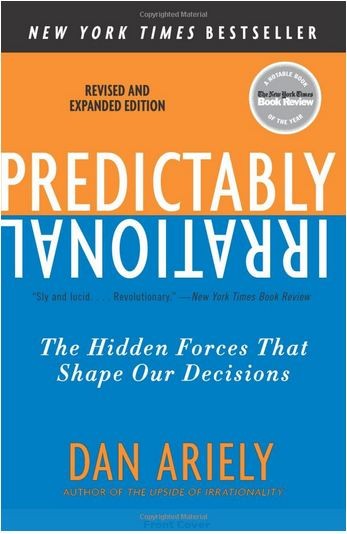
Dan Ariely’s book Predictably Irrational: The Hidden Forces That Shape Our Decisions helped popularize the idea that our choices are shaped by context, emotion, comparison, social expectations, defaults, and mental shortcuts. The book uses experiments and real-world examples to show that people are not simply bad at math or weak-willed. Instead, our brains use rules of thumb that are useful in many situations but can misfire spectacularly in modern markets.
The result is not a gloomy portrait of human stupidity. It is more like a user manual for the brain, written after someone finally admitted that the machine has buttons nobody labeled.
Behavioral Economics: The Science Behind Everyday Weirdness
Behavioral economics blends psychology and economics to study how people actually make decisions, not how perfectly rational creatures would behave in a textbook. This field became especially influential through the work of Daniel Kahneman, Amos Tversky, Richard Thaler, Dan Ariely, and many others who examined cognitive biases, risk perception, mental accounting, and choice architecture.
Instead of assuming that people always maximize utility, behavioral economists ask better questions: Why do we keep a bad investment because selling feels like admitting defeat? Why does a “limited time offer” make a product seem more urgent than it was five seconds ago? Why does a free shipping threshold convince us to spend $22 more to “save” $6? Why do we treat cash differently from a gift card, even when both can buy the same sandwich?
The answers usually point to cognitive biases. A cognitive bias is a predictable mental shortcut or distortion that influences judgment. Biases are not always bad. They help us make quick decisions in a complicated world. The problem is that marketers, apps, financial products, and even our own emotions can push those shortcuts in the wrong direction.
Key Lessons From Predictably Irrational Thinking
1. We Compare More Than We Calculate
People rarely know the absolute value of things. We understand value through comparison. A $90 shirt looks expensive next to a $40 shirt, but surprisingly reasonable next to a $180 jacket. A restaurant wine list often includes a very expensive bottle that few people buy, but its presence can make the second-most expensive bottle look like a sensible compromise. Congratulations, your wallet has been gently mugged by relativity.
This is where the decoy effect comes in. A decoy is an option that exists mainly to make another option look better. Imagine three subscription choices: digital-only for a low price, print-only for a high price, and digital plus print for the same high price. The print-only option may be unattractive by itself, but it makes the bundle look like a steal. People shift toward the bundle not because their needs changed, but because the comparison changed.
The lesson is simple: when evaluating a purchase, remove the obvious decoy and ask, “Would I still choose this if the comparison option disappeared?” If the answer is no, the product may not be a brilliant deal. It may just be standing next to something worse and wearing a tiny crown.
2. “Free” Is Not Always Free
Few words hypnotize the human brain like free. Free samples, free trials, free shipping, buy-one-get-one-free offersthese can be useful, but they also distort judgment. Zero cost feels emotionally different from a small cost, even when the “free” option leads to extra spending, wasted time, or a subscription trap.
Consider the classic free shipping threshold. You need one item for $28. Shipping costs $6 unless you spend $50. Suddenly, a $24 candle you did not need becomes a financial strategy. You spend $52 to avoid paying $6 and call it savings. Somewhere, a spreadsheet quietly faints.
The smarter question is not, “Is something free?” It is, “What behavior is this free offer trying to create?” If the free item encourages a choice you already wanted, great. If it pushes you into extra spending or unnecessary commitments, the true price may be hiding in plain sight.
3. We Hate Losing More Than We Like Winning
Loss aversion is one of the most powerful ideas in behavioral economics. People tend to feel the pain of losing more strongly than the pleasure of gaining the same amount. Losing $100 may sting more than finding $100 delights. That emotional imbalance affects investing, shopping, relationships, career decisions, and even whether we return a sweater that makes us look like a nervous lampshade.
Loss aversion helps explain why people hold on to losing investments, unused memberships, clutter, bad plans, and outdated beliefs. The loss feels real, while the future benefit of changing course feels abstract. We say, “I already paid for it,” as if the past can be negotiated with. Sadly, sunk costs do not offer refunds.
A practical fix is to reframe the decision. Instead of asking, “How much have I already invested?” ask, “Knowing what I know now, would I choose this again today?” That question pulls attention away from regret and back toward future value.
4. Ownership Changes Value
The endowment effect describes our tendency to value things more simply because we own them. A mug in a store is just a mug. A mug on your desk is suddenly a treasured ceramic companion with emotional depth and a backstory. This bias affects garage sales, home pricing, collectibles, stocks, business ideas, and personal projects.
Ownership creates attachment. Attachment creates inflated value. Inflated value creates awkward negotiations where one person sees “used chair” and the other sees “vintage seating experience with character.”
To reduce the endowment effect, try imagining that you do not own the item. How much would you pay to buy it today? If the number is much lower than the price you would demand to sell it, ownership may be doing the math for you.
5. Anchors Pull Our Decisions
The anchoring effect happens when an initial number, price, or impression influences later judgments. A product marked down from $199 to $79 feels like a deal, even if it was never really worth $199. A salary negotiation can be shaped by the first number mentioned. A restaurant’s most expensive entrée can make everything else look moderate.
Anchors work because the brain loves reference points. Once a number appears, we adjust around it, often insufficiently. That is why “suggested retail price,” “was/now” pricing, and “only three left” messages can be so persuasive.
The antidote is independent research. Before accepting the anchor, look for outside benchmarks. Compare similar products, historical prices, market averages, or your own budget. A number is not truth just because it arrived first and brought confidence.
Predictably Irrational in Marketing and Online Design
Modern digital life is basically a giant behavioral economics laboratory with better fonts. Every online store, streaming platform, finance app, and social media feed is built around choices. Some design choices help users. Others quietly exploit predictable irrationality.
Helpful choice architecture can make good decisions easier. Automatic enrollment in retirement savings, clear nutrition labels, simplified forms, and timely reminders can reduce friction and support better outcomes. Good design respects human limits. It says, “People are busy, distracted, and imperfect, so let’s make the smart path easier.”
Manipulative design does the opposite. Dark patterns may hide cancellation buttons, disguise ads, add surprise fees late in checkout, use fake urgency, or make privacy choices confusing. These tactics work because they exploit predictable human tendencies: inertia, fear of missing out, limited attention, and the desire to finish a task quickly.
For businesses, the ethical line matters. Using behavioral insights to clarify options can build trust. Using them to trap customers may produce short-term revenue but long-term resentment. A customer who feels tricked does not become loyal. They become a one-person documentary titled, “Why I Will Never Buy From This Company Again.”
Predictably Irrational at Work
In the workplace, predictable irrationality shows up in hiring, meetings, project planning, performance reviews, and leadership decisions. Managers may anchor on a first impression during an interview. Teams may continue a failing project because they have already invested months into it. Employees may choose urgent tasks over important ones because urgency provides a satisfying little adrenaline snack.
Group decisions are especially vulnerable. Once a senior person expresses an opinion, others may unconsciously adjust toward it. If a team celebrates busyness, people may fill calendars with meetings to signal value. If deadlines are vague, procrastination flourishes like a houseplant that only grows near panic.
Better systems can help. Teams can use pre-mortems to imagine why a project might fail before it starts. Hiring committees can score candidates against clear criteria before open discussion. Leaders can separate brainstorming from evaluation. Project owners can define kill criteria early, before sunk costs make everyone emotionally attached to the office equivalent of a leaky boat.
Predictably Irrational in Personal Finance
Money decisions are packed with emotion, which is inconvenient because money also enjoys math. People mentally separate funds into categories: rent money, vacation money, bonus money, “found” money, emergency money, and the mysterious category known as “I deserve this.” This is called mental accounting, and it can be both helpful and harmful.
Budget categories can support discipline, but mental accounting can also lead to strange choices. Someone may carry high-interest credit card debt while refusing to touch a low-interest savings account because the savings feels sacred. Another person may spend a tax refund freely because it feels like a bonus, even though it was their money all along.
Predictably irrational money habits often improve when decisions are automated. Automatic savings, automatic bill payment, cooling-off periods before large purchases, and written investment rules can protect us from our future selvesthe version of us who shops online at midnight and believes a waffle maker will transform our personality.
How to Make Better Decisions Without Becoming Boring
The goal is not to eliminate emotion. Emotion is part of being human, and frankly, a purely rational life would probably involve eating plain oatmeal in a windowless room while optimizing sock rotation. The goal is to design better environments for decision-making.
Use Friction Wisely
Add friction to choices you want to avoid and remove friction from choices you want to encourage. Delete shopping apps from your phone if impulse buying is a problem. Put healthy food where you can see it. Keep your savings automatic. Place your phone outside the bedroom if bedtime scrolling keeps defeating you in single combat.
Delay Emotional Decisions
Strong emotions narrow attention. Before making a major purchase, sending a heated email, quitting a project, or accepting a risky offer, create a pause. Even a 24-hour delay can reveal whether the choice still makes sense after the emotional fireworks fade.
Make Defaults Your Friend
Defaults are powerful because people tend to stick with the preselected option. Choose defaults that serve your goals: automatic retirement contributions, recurring calendar blocks for focused work, healthy grocery lists, and subscription reviews every month.
Ask the “Future Me” Question
Before acting, ask: “Will my future self thank me for this?” Future you is often wiser, calmer, and less impressed by flash sales. Future you also has to clean the closet, pay the bill, and explain why there are three novelty air fryers in the kitchen.
Real-Life Experiences Related to Predictably Irrational
The easiest way to understand Predictably Irrational is to notice it in ordinary life. One common experience happens at the grocery store. A shopper walks in for milk, eggs, and bananas. Fifteen minutes later, the cart contains seasonal cookies, a family-size cereal box, sparkling water in a flavor called “confused raspberry,” and a discount candle that smells like ambition. None of these choices felt irrational in the moment. Each had a tiny justification: it was on sale, it looked interesting, it might be useful, it was near the checkout, or the packaging looked cheerful. The irrationality was not dramatic. It was polite, incremental, and wearing a coupon.
Another familiar experience is the free trial. A person signs up for a service because it costs nothing today. The plan is to cancel before billing starts. This plan depends on memory, discipline, calendar awareness, and a future version of the person who apparently has the administrative powers of a Supreme Court clerk. Then the charge appears. The customer feels tricked, but the deeper lesson is that “free” lowered the emotional barrier while inertia did the rest. A simple reminder or virtual card could have prevented the problem.
Work provides even better examples. Many people have stayed in a project too long because they already invested effort. A website redesign, a marketing campaign, a business idea, or even a long report can become emotionally expensive. The team says, “We have come too far to stop now,” which sounds noble until everyone realizes they are marching deeper into a swamp because the first three miles were difficult. The sunk-cost fallacy turns effort into a reason to continue, even when new evidence says the plan is not working.
Personal relationships also reveal predictable irrationality. Someone may avoid a difficult conversation because the short-term discomfort feels larger than the long-term benefit. Another person may overreact to a small criticism because losses of status, approval, or affection feel intense. We are not just calculating facts in relationships; we are protecting identity, belonging, and self-image. This is why a comment about dishes can somehow become a referendum on respect, adulthood, and the entire history of the kitchen.
Even productivity is full of irrational patterns. Many people delay a meaningful task, then spend enormous energy on low-value chores. The inbox gets cleaned. The desk gets organized. The pencil drawer achieves museum-level curation. Meanwhile, the important proposal waits untouched. This is not laziness alone. Small tasks offer quick rewards and clear completion. Big tasks create uncertainty, and uncertainty feels expensive. Breaking the big task into a first tiny actionopen the document, write the title, create three bulletscan reduce that mental cost.
The hopeful part is that awareness changes behavior. Once people recognize these patterns, they can design around them. They can create shopping lists, set cancellation reminders, define project exit rules, ask for outside opinions, compare prices independently, and make important decisions when rested. Predictably irrational does not mean permanently doomed. It means human. And humans, with the right systems, can be surprisingly clever.
Conclusion: Why Predictably Irrational Still Matters
Predictably Irrational remains a useful idea because it explains a daily contradiction: people are intelligent, experienced, and capable, yet still make choices that puzzle them later. Behavioral economics does not insult human nature. It explains it. Our decisions are shaped by comparison, emotion, defaults, ownership, social pressure, fear of loss, and the seductive sparkle of “free.”
The practical takeaway is not to trust yourself less. It is to understand yourself better. When you know the patterns, you can build better habits, better products, better policies, and better guardrails. You can pause before accepting an anchor, question a decoy, resist sunk costs, and design defaults that make your future self proud. Irrationality may be predictable, but so is improvement when we pay attention.