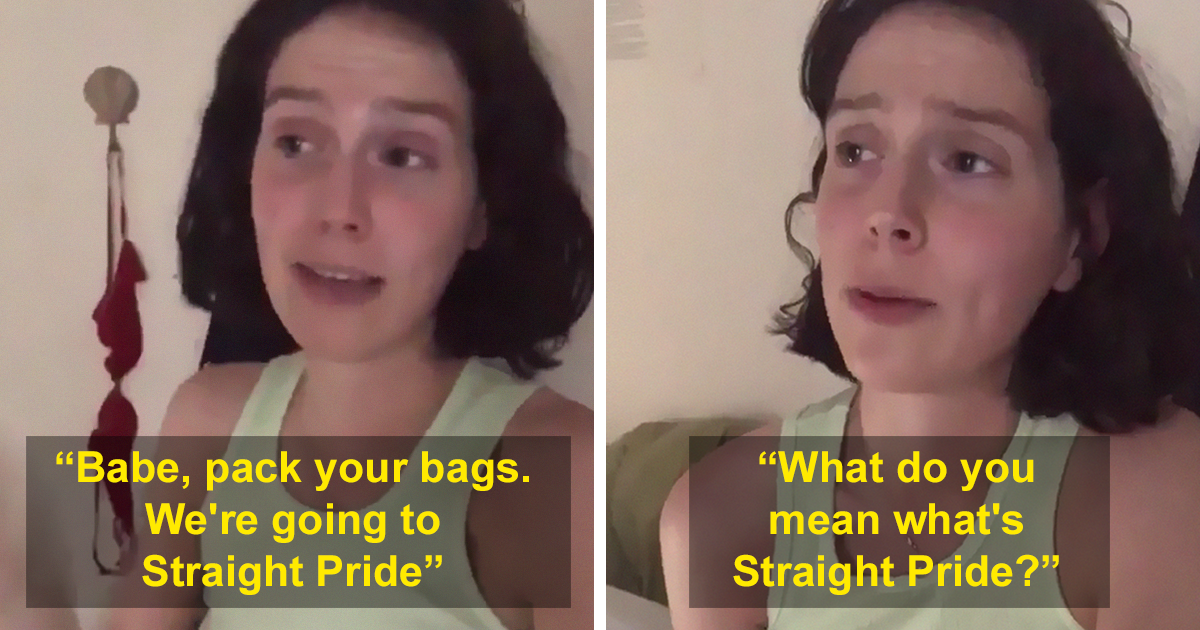
Every so often, the internet produces a joke so sharp that it does not need a marching band, a press conference, or a 14-part explanation thread. It simply walks into the room wearing jeans, flats, and a look of breathless fake urgency. That is essentially what happened when actor, writer, and comedian Eva Victor posted a satirical video imagining what it would look like to prepare for “Straight Pride.” The clip landed because it did what great comedy often does: it made a complicated cultural argument feel instantly obvious.
The video appeared in 2019, when a proposed “Straight Pride Parade” in Boston became a national conversation starter, a controversy generator, and, for many people online, a giant blinking sign that read: “Please explain privilege, but make it funny.” Victor accepted the assignment. In her parody, she plays a woman urgently explaining to her boyfriend that they simply must attend Straight Pride, as though heterosexual people had survived centuries of hiding, legal discrimination, police raids, job loss, family rejection, and cultural erasure. The joke, of course, is that they have not.
That is why people loved it. The video did not just mock an event. It exposed the faulty comparison behind it. LGBTQ Pride exists because LGBTQ people have historically been pushed into shame, silence, danger, and invisibility. Straight pride, by contrast, is like holding a parade for people who have never had to check whether a bakery, landlord, workplace, school, doctor, church, or family dinner would treat their relationship as a problem. Congratulations on your courage, Brad and Susan. Your matching beige outfits have moved us all.
Why the “Straight Pride” Video Went Viral
Eva Victor’s sketch worked because it understood the internet’s favorite language: exaggeration with a point. She did not deliver a dry lecture about social hierarchy. She performed the emotional logic of the “straight pride” argument until it became ridiculous on its own. In the video, preparing for Straight Pride does not involve rainbow sequins, protest signs, or glitter-covered resilience. It involves ordinary clothes and the dramatic claim that straight people finally get one day to celebrate, after enjoying unspoken privilege for the other 364 days of the year.
That framing is funny because it flips the script. Pride Month is not simply a party with better playlists than most office mixers. It is tied to the history of LGBTQ resistance, most famously the Stonewall uprising of June 1969, when patrons of the Stonewall Inn in New York City fought back after yet another police raid. Pride became a public answer to private shame. It said: we are here, we are not disappearing, and we will not live as if our existence is a scandal.
Victor’s parody takes the emotional vocabulary of Prideurgency, belonging, visibility, communityand applies it to people who already move through most public spaces with their relationships treated as default. That is where the comedy lives. “Straight Pride” sounds meaningful only if someone ignores why Pride exists in the first place. The video made that point without turning into homework, which is probably why people shared it so enthusiastically. Nobody wants a 900-page textbook in their feed. A good joke with eyebrows? Much more clickable.
The Real Backdrop: Boston’s “Straight Pride” Controversy
The parody was not created in a vacuum. It came after a group called Super Happy Fun America pushed for a “Straight Pride Parade” in Boston. The organizers claimed the event would celebrate heterosexual identity and promote inclusivity for straight people. Critics saw it differently, arguing that the event was less about inclusion and more about trolling LGBTQ Pride during Pride Month.
Boston eventually granted a permit for the parade, emphasizing that the city could not deny a public event permit simply because officials disagreed with the group’s message. That free-speech dimension made the event more complicated than a simple online dunk. People can have the legal right to hold a demonstration while others have every right to criticize the message behind it. Freedom of speech does not come with freedom from side-eye, satire, counterprotests, or a comedian turning your slogan into a viral punchline.
When the Boston event took place later that year, counterprotesters outnumbered participants, and local reporting described arrests, injuries, heavy police presence, and political signage that made the event look less like a neutral celebration of heterosexuality and more like a culture-war parade in khakis. For many observers, that confirmed the suspicion that “Straight Pride” was not really about straight people needing visibility. It was about reacting against LGBTQ visibility.
Why LGBTQ Pride Is Not the Same Thing as “Straight Pride”
The easiest way to understand the difference is to ask one question: what shame is being answered?
LGBTQ Pride responds to a long history of shame imposed from the outside. For generations, queer and transgender people were told to hide their relationships, soften their voices, change their clothes, deny their names, lose their jobs quietly, accept family rejection politely, and be grateful for crumbs of tolerance. Even today, many LGBTQ Americans report discrimination, harassment, fear for personal safety, poor treatment in health care, and workplace unfairness. Pride is not a random desire for attention. It is a public refusal to be treated as lesser.
Straight people, as a group, have not needed a movement to make heterosexual love publicly acceptable. Movies, insurance forms, school dances, Valentine’s Day ads, wedding magazines, family sitcoms, church bulletins, holiday commercials, and awkward uncle jokes have been celebrating straight relationships for a very long time. In fact, straight romance has been so culturally dominant that people call it “traditional” even when the tradition includes disastrous first dates, divorce lawyers, and couples arguing in Target over throw pillows.
That does not mean every straight person has an easy life. Many do not. Straight people can experience poverty, racism, sexism, disability discrimination, religious bias, family trauma, loneliness, and personal hardship. But those struggles are not caused by being straight. LGBTQ Pride is about a specific history of stigma tied to sexual orientation and gender identity. “Straight Pride” borrows the language of that struggle without carrying the burden behind it.
The Genius of Satire: Making Privilege Visible
Privilege can be hard to see when it simply feels like normal life. That is why satire is useful. It puts “normal” behavior in a strange frame and lets people notice what they usually overlook. Victor’s video makes heterosexual privilege visible by pretending it is oppression. The more seriously her character takes the need for Straight Pride, the more absurd the premise becomes.
In comedy terms, the sketch works because of commitment. Victor does not wink at the camera and say, “Hello viewers, this is satire.” She plays the part with emotional sincerity. She is excited. She is urgent. She is ready to go. That commitment makes the joke stronger because it mirrors how some real arguments about “straight pride” are delivered: with the wounded tone of people who mistake equality for exclusion.
The phrase “why do they get a Pride Month and we do not?” sounds fair only until context enters the chat wearing combat boots. Pride Month is not a participation trophy. It is rooted in resistance to criminalization, police harassment, medical stigma, family rejection, violence, and legal inequality. Asking why straight people do not have the same thing is like asking why there is no “International Men Finally Allowed to Vote Day.” The answer is not that men are unloved. The answer is that history happened.
Why People Online Connected With the Video
People shared Victor’s video because it gave them a funny, efficient response to a frustrating argument. Anyone who has spent time online knows the exhaustion of explaining the same basic point repeatedly. Why is Pride necessary? Why is representation important? Why is a movement built around marginalized people not the same as excluding everyone else? Why does Uncle Gary keep typing in all caps?
The video turned those explanations into a character sketch. Instead of saying, “Straight people are not marginalized for being straight,” it showed a straight woman acting as though she were. Instead of saying, “Pride exists because LGBTQ people have faced discrimination,” it created a fake crisis around the absence of straight struggle. Viewers could laugh first and think second, which is often how viral commentary slips past defensiveness.
That is also why the clip appealed even to many straight viewers. The joke was not “straight people are bad.” The joke was “straight people do not need this specific kind of parade.” There is an important difference. Satire does not require hating the group being referenced; it requires identifying a false claim and pushing it until it wobbles.
The Bigger Lesson: Equality Is Not a Zero-Sum Parade Float
One reason “Straight Pride” arguments keep resurfacing is that some people interpret visibility for marginalized groups as a personal loss. When LGBTQ people celebrate Pride, some straight people hear, “This is not about you,” and mistake that for hostility. But not every event has to center everyone. A birthday party does not insult people born in other months. A breast cancer awareness walk does not attack healthy breasts. Black History Month does not mean every other history vanished into a decorative fog machine.
Public recognition often exists because recognition was previously denied. Pride says LGBTQ lives deserve dignity because they were too often treated as shameful. It does not say straight lives are meaningless. It says straight lives have not been the ones pushed into legal and cultural hiding for being straight.
That is the emotional intelligence behind Victor’s video. It understands that the problem with “Straight Pride” is not heterosexuality. Heterosexuality is fine. Many beloved people are straight. Some of them even know how to season chicken. The problem is the attempt to mimic the language of liberation while ignoring the conditions that made liberation necessary.
What Brands, Media, and Creators Can Learn From the Moment
For writers, creators, and social media teams, this viral moment is a neat case study in how cultural commentary spreads. The video was timely, short, character-driven, emotionally clear, and easy to quote. It connected to a real news event while making a broader point about privilege and visibility. That combination is powerful because it gives audiences both a reason to laugh and a reason to share.
The clip also shows why authenticity matters. Victor’s humor felt specific, not corporate. It did not sound like a brand account trying to “join the conversation” after three approval meetings and a legal review. It sounded like a comedian reacting quickly to a public absurdity. The internet can smell forced relevance the way a dog smells cheese through a closed refrigerator door.
Media outlets picked up the story because it sat at the intersection of politics, LGBTQ culture, comedy, and viral video. That made it attractive for readers searching for “Straight Pride video,” “Eva Victor parody,” “Boston Straight Pride parade,” and “why Straight Pride is controversial.” In SEO terms, the story had search demand because people were not only looking for the clip; they were looking for context.
Experience-Based Reflections: What This Topic Feels Like in Real Life
Conversations about Pride often begin casually, but they can become revealing very quickly. Picture a group of coworkers in the break room during June. Someone mentions rainbow logos, Pride events, or a viral clip like Victor’s. One person laughs and says the video is brilliant. Another person shrugs and asks, “But why can’t there be Straight Pride too?” Suddenly the room gets quiet enough to hear the office refrigerator make that mysterious buzzing noise it has been making since 2017.
In moments like that, the best response is often not a lecture. It is a question. “What would Straight Pride be pushing back against?” That question changes the shape of the conversation. It invites people to think about the difference between celebration and correction. LGBTQ Pride corrects a history of enforced silence. Straight Pride, in most contexts, reacts to the discomfort of not being centered.
Many LGBTQ people have lived through tiny calculations that straight people may never notice. Can I mention my partner at work? Will my landlord treat us differently? Is this doctor safe? Can I hold hands here? Will my parents still invite me home? Do I need to edit myself at Thanksgiving so the mashed potatoes remain peaceful? These are not abstract culture-war questions. They are daily emotional math problems.
For allies, watching the “Straight Pride” parody can become a useful mirror. It shows how easy it is to treat comfort as neutrality. A straight couple may never think twice about kissing at an airport goodbye gate, putting wedding photos on a desk, or correcting someone who assumes they are single. LGBTQ people often know that visibility can carry risk. Pride exists because being visible wasand sometimes still isan act of courage.
The video also reminds us that humor can lower the temperature without weakening the message. A person who might resist a formal explanation of privilege may still laugh at a sketch that makes the same point sideways. That laughter can open a door. It does not solve discrimination, but it can interrupt a lazy argument before it hardens into a slogan.
Of course, not every conversation will end with a heartfelt group hug and someone thoughtfully deleting a Facebook post. Some people cling to false equivalence because it protects them from discomfort. But others genuinely have never connected Pride to history. For those people, satire can be the first step. It nudges them to ask why the joke lands, and that question can lead to a deeper understanding of LGBTQ visibility, safety, and dignity.
That is why Eva Victor’s video still works beyond its original news cycle. It is not just about one proposed parade in Boston. It is about the recurring misunderstanding that equality for others means less belonging for oneself. In reality, Pride does not take anything away from straight people. It asks everyone to imagine a public world where nobody has to shrink their love, edit their identity, or treat basic dignity like a limited-edition coupon.
Conclusion
Eva Victor’s “Straight Pride” parody became beloved because it packed a full cultural critique into a funny, frantic performance. It showed that the issue was never whether straight people are allowed to enjoy being straight. They are. The issue is whether a dominant group needs to borrow the symbols of a marginalized group’s survival movement and pretend the situations are the same. They are not.
Pride is rooted in history, resistance, grief, joy, protest, and the ongoing demand to live openly. “Straight Pride,” as mocked in the video, is rooted mostly in misunderstanding, backlash, and the strange belief that not being centered for one month is a form of oppression. Victor’s sketch made that contradiction impossible to missand easy to laugh at.
Note: This article is an original, fully rewritten synthesis based on public reporting, LGBTQ history resources, comedy coverage, and contemporary research on LGBTQ experiences. Source links are intentionally omitted for publication formatting.