Family drama has many flavors. There is the classic “who brought the dry turkey?” holiday drama, the “why did you name the baby that?” drama, and then there is the rare, extra-sparkly variety: a relative secretly baptizes a child, gets confronted, and is then hit with revenge so absurd that the internet briefly puts down its popcorn just to applaud.
The viral story behind “Someone Has To Save The Boy” has all the ingredients of an online family saga: a deeply religious aunt, parents who believe their children should choose their own beliefs, a younger brother caught in the middle, and an older sister with the comedic timing of a sitcom writer who has had one espresso too many. At the center of the controversy is a serious question: who gets to decide a child’s religious path?
While the revenge is funny in a theatrical, “please do not try this at Thanksgiving dinner” way, the deeper issue is not a joke. The story touches on religious boundaries in families, consent, parental authority, and the tension between sincere faith and respect for others. In other words, it is not just a splashy tale. It is a case study in what happens when love, belief, and control get thrown into the same blender.
The Viral Story: When Faith Crossed A Family Boundary
According to the viral Reddit-based story later covered by major internet publications, the teen who shared the incident explained that her parents believed children should be free to choose their own religion when they were old enough to understand it. Her aunt, however, did not agree. The aunt reportedly tried for years to push Christianity on the teen and her younger brother, even though the parents had made their position clear.
The tension finally boiled over when the aunt secretly arranged for the younger brother to be baptized. The phrase “someone has to save the boy” became the emotional headline of the situation because, from the aunt’s perspective, she was rescuing him spiritually. From the family’s perspective, she had ignored the parents, the child’s autonomy, and the basic social rule that says you do not make life-shaping decisions for someone else’s kid unless you enjoy being banned from dessert.
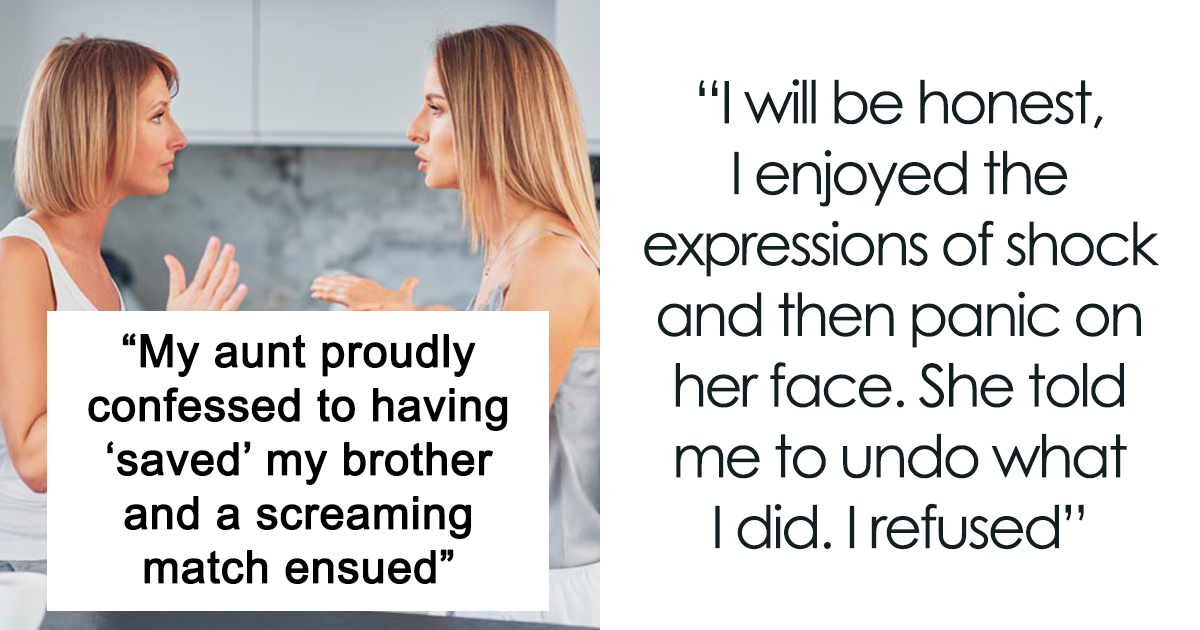
When the brother told their mother what happened, the family confronted the aunt. Instead of treating the event as a misunderstanding, the aunt reportedly defended her decision. That is where the teen sister stepped in with a revenge move that launched the story from “family conflict” to “internet folklore.” She poured water over the aunt and jokingly declared her baptized into something the aunt very much did not approve of.
The aunt demanded that the teen “undo” it. The teen refused. The internet, naturally, reacted as if someone had just delivered the final line of a Broadway comedy.
Why The Internet Found The Revenge So Funny
The revenge worked as comedy because it mirrored the aunt’s own logic back at her. If the aunt believed a ritual could be imposed on a child without consent, the teen responded by staging an equally unwanted symbolic ritual on the aunt. It was not subtle. It was not diplomatic. It was basically a boundary lesson wearing clown shoes.
Online readers tend to love stories where someone uses irony to expose hypocrisy. In this case, the teen’s point was easy to understand: if you do not want someone assigning spiritual meaning to you against your will, maybe do not do that to a child. The act was ridiculous enough to be funny, but the message underneath was sharp.
That is why so many people sided with the teen. They were not necessarily mocking religion itself. Many religious readers also understand that faith loses its beauty when it is forced. The humor came from the aunt discovering, very suddenly and very damply, that consent matters even when water is involved.
Baptism Is MeaningfulWhich Is Exactly Why Consent Matters
Baptism is not a casual gesture in Christianity. In many traditions, it marks entry into the Christian faith, symbolizes spiritual cleansing, and connects a person to a church community. For believing families, infant baptism can be a joyful, sacred milestone. For older children or adults, baptism may represent a personal decision and public commitment.
That meaning is the whole reason the aunt’s actions felt so invasive to the parents. If baptism were just a quick rinse, nobody would care. But baptism carries spiritual, family, and community significance. In Catholic teaching, for example, infant baptism is deeply connected to parental responsibility and a child’s upbringing in the faith. Other Christian traditions also involve parents, sponsors, godparents, or the wider congregation making promises on behalf of the child.
In short, baptism is supposed to be embedded in trust. When a relative bypasses the parents and secretly arranges it, the act stops feeling like a blessing and starts feeling like a spiritual ambush. Nobody likes an ambush, unless it involves surprise cupcakes.
The Real Issue: Belief Versus Control
The aunt’s motive may have been sincere. That matters. People who truly believe baptism affects a child’s soul may feel terrified when parents delay or reject it. To them, the concern is not symbolic; it is eternal. That emotional urgency can make their actions feel justified in their own minds.
But sincerity does not automatically make a decision respectful. Many family conflicts begin when one person says, “I only did it because I care,” while everyone else hears, “I ignored your boundaries because I think I know better.” Care without respect can become control wearing a cardigan.
In healthy families, religious disagreement requires a difficult balance. Believers should be able to express their hopes. Nonreligious or differently religious parents should be able to raise their children according to their values. Children should be protected from pressure that turns identity into a tug-of-war. The aunt broke that balance by moving from persuasion to action behind everyone’s back.
Why Parents React Strongly To Secret Religious Decisions
Parents often see religious upbringing as part of their core responsibility. Whether they are Christian, Jewish, Muslim, Hindu, Buddhist, atheist, agnostic, spiritual-but-not-religious, or still recovering from a youth group lock-in, many parents want the final say in how their children are introduced to belief systems.
That does not mean parents own their children’s minds. Good parenting leaves room for questions, growth, and disagreement. But it does mean that relatives should not make major religious decisions behind a parent’s back. A grandparent may buy the loudest toy in the store and survive the consequences. Secret baptism is a different category.
When a relative ignores parental boundaries, parents may worry about what else that relative will ignore. Will they tell the child the parents are wrong? Will they create fear around hell, sin, or punishment? Will they make the child feel responsible for adult religious anxiety? Those questions can damage trust quickly.
Religious Freedom Also Means Freedom From Pressure
One of the most important lessons from this story is that religious freedom is not only the freedom to practice a faith. It also includes room for people to decline, question, wait, or choose differently. A child raised with openness may eventually embrace the aunt’s religion, choose another path, or reject organized religion altogether. The key is that the choice should be informed rather than forced.
Modern American religious life is increasingly diverse. Pew Research Center has found that a significant share of U.S. adults no longer identify with the religion in which they were raised, while many younger adults describe themselves as religiously unaffiliated. That does not mean religion is disappearing. It means identity is more fluid, and families often include people with very different beliefs sitting at the same table, passing the same mashed potatoes, and silently judging the same cousin’s dating choices.
In that environment, mutual respect matters more than ever. Families do not need to agree on theology to agree on consent. They do not need to share the same church, temple, mosque, meditation app, or Sunday morning routine to say, “We will not force rituals on each other.”
What The Aunt Could Have Done Instead
The aunt had options that did not involve secrecy. She could have told the parents, “I worry about the children spiritually, and I would like to talk about it.” She could have asked whether she was allowed to take them to church. She could have offered books, invited conversations, or simply modeled her faith through kindness. Revolutionary concept: sometimes the best advertisement for a belief system is not panic, but being pleasant at brunch.
She also could have respected the parents’ answer, even if she disagreed. Respect does not require approval. It requires restraint. Many relatives struggle with that distinction, especially when religion, politics, parenting, or baby names are involved. But restraint is often what keeps a family from becoming a group chat with casualties.
What The Teen’s Revenge Revealed
The teen’s revenge was funny because it was symbolic. She did not write a legal memo. She did not host a family summit with name tags and stale cookies. She used the aunt’s own framework to show how absurd it feels when someone imposes a label on you without permission.
Of course, in real life, pouring water on relatives is not a recommended conflict-resolution strategy. It may create more drama, wet carpets, and a suspicious silence at future birthdays. But as a viral story, the moment became a perfect internet metaphor: forced rituals feel different when you are the one being forced.
The aunt wanted the teen to undo the mock ritual because it offended her beliefs. That reaction proved the teen’s point. The aunt understood immediately that unwanted spiritual labeling felt wrong when directed at her. The challenge was helping her see that the same principle applied to her nephew.
How Families Can Handle Religious Conflict Without Going Full Soap Opera
Religious conflict in families is common because belief is personal. It is tied to identity, tradition, morality, fear, hope, and belonging. When someone changes faith or raises children differently, relatives can interpret it as rejection. They may think, “If you do not follow our religion, you are rejecting us.” That emotional leap is powerful, but it is not always fair.
Healthy conversations start with clarity. Parents can say, “You may share what your faith means to you, but you may not pressure our child, frighten them, or involve them in religious rituals without permission.” That boundary is direct without being cruel. It tells the relative what is allowed, what is not allowed, and what must happen next.
Relatives, meanwhile, can express concern without taking control. A sentence like, “My faith teaches baptism is important, and I hope one day you will consider it,” is very different from secretly booking the sacrament like it is a dentist appointment. One invites discussion. The other detonates trust.
Specific Examples Of Better Boundaries
1. The “No Secret Religious Activities” Rule
Parents can make it clear that no one may take the child to religious services, classes, ceremonies, or private meetings without permission. This rule does not attack anyone’s faith. It simply protects parental consent and the child’s emotional safety.
2. The “No Fear-Based Teaching” Rule
Relatives should avoid telling children they are doomed, sinful, evil, or unsafe because they are not part of a particular religion. Children can explore big questions without being handed nightmares as party favors.
3. The “Answer Questions Honestly, But Don’t Recruit” Rule
If a child asks, “What do you believe?” a relative can answer. But answering is different from recruiting. Families can encourage curiosity without turning every visit into Vacation Bible School: Surprise Edition.
4. The “Parents Decide The Ceremony” Rule
Major rituals such as baptism, confirmation, bar or bat mitzvah preparation, religious naming ceremonies, or other formal commitments should never be arranged by extended family members without parental involvement.
Why This Story Hit Such A Nerve Online
The story went viral because many people recognized the pattern, even if the details were extreme. A relative oversteps. The parents object. The overstepper insists they meant well. The family gets split between “respect the boundary” and “but family means forgiveness.” Then someone makes a dramatic gesture and suddenly everyone has opinions strong enough to power a small city.
The baptism conflict is also relatable because it sits at the intersection of two values Americans often care about: religious liberty and parental choice. People may disagree on theology, but most understand that parents should not be blindsided by major decisions involving their children. Even religious communities often have rules requiring parental consent or participation for infant and child baptism.
That is why the aunt’s defense did not land well online. Her belief may have been sincere, but her method was the problem. When people feel morally certain, they can forget that other people still have rights. Certainty is not a permission slip.
Experience-Based Reflections: What Families Can Learn From The Baptism Backlash
Anyone who has spent time around large families knows that boundaries are often tested in small ways before they are broken in big ones. It starts with a relative giving a child candy after the parents said no. Then comes the haircut nobody approved. Then someone teaches the toddler to call soda “breakfast juice.” By the time a major issue arrives, the family already has a history of ignored limits.
In situations like the viral baptism story, the secret ceremony is rarely the first conflict. It is usually the grand finale of many smaller moments: comments about parenting, guilt-heavy conversations, unwanted religious materials, side remarks about salvation, and pressure disguised as concern. The lesson for parents is to address the small moments early. A calm boundary today may prevent a dramatic family explosion later.
One practical experience many families share is the importance of putting boundaries in plain language. Vague requests like “please respect our choices” can mean different things to different people. A determined relative may think, “I respect your choices, but I also respect heaven, so here we go.” Clearer language works better: “Do not discuss baptism with him. Do not take him to church without asking us. Do not tell him he is in spiritual danger.” It may feel awkward, but awkward is cheaper than chaos.
Another useful lesson is to avoid turning the child into the messenger. In the viral story, the younger brother reportedly told the mother what happened. That is a heavy position for a child. Adults should not create secrets with children that undermine parents. A healthy rule is simple: if an adult says, “Don’t tell your mom and dad,” the child should know that is exactly when they need to tell mom and dad.
Families can also learn from the teen sister’s reaction, even if they should choose a less splash-based method. Her revenge was funny because it made the boundary violation visible. In real life, the safer version is naming the issue directly: “You are upset because I assigned a belief to you without consent. That is what you did to him.” Sometimes people understand boundaries only when the mirror is held very close to their face.
For religious relatives, the experience-based takeaway is equally important: influence grows through trust, not force. A child is more likely to respect a faith tradition when the people practicing it are patient, kind, and honest. Secret rituals may create a technical religious milestone, depending on the tradition, but they can also create resentment that lasts for years. If the goal is to guide a child toward faith, betrayal is a strange vehicle. It has terrible mileage.
For nonreligious or mixed-belief families, this story is a reminder that neutrality must still be protected. Saying “we want our child to choose later” does not mean “any relative may fill the gap now.” Children need space to ask questions without being pulled into adult fears. Parents can expose children to religion through books, holidays, services, or conversations while still making it clear that belonging is not something to be forced.
The best family experiences happen when adults can say, “I disagree, but I will not override you.” That sentence is not glamorous. It will never go viral. No one will make a meme out of it. But it prevents the kind of drama where someone ends up wet, offended, and spiritually married to a punchline.
Final Thoughts: The Splash Heard Around The Internet
The story of the religious woman who baptized her nephew behind everyone’s back is funny because the revenge was theatrical, unexpected, and perfectly ironic. But it is also memorable because it exposes a serious truth: belief cannot be made meaningful through force.
Faith, at its best, is rooted in conviction, love, community, and choice. Family, at its best, is rooted in trust. When someone violates trust in the name of faith, both can suffer. The aunt may have believed she was saving the boy, but the teen sister’s hilarious response reminded everyone that consent is not a decorative accessory. It is the whole door.
So yes, the revenge was funny. It was petty in the way only a teenager with a pot of water and a point to prove can be petty. But beneath the comedy is a lesson every family can use: respect the parents, respect the child, respect belief, and for the love of dry furniture, do not turn religion into a sneak attack.