In startup mythology, billion-dollar companies are supposed to sprint out of garages, dorm rooms, and suspiciously well-lit coworking spaces as if someone strapped rocket boosters to their cap table. The founder launches a product on Monday, gets a term sheet by Friday, appears on a podcast by the following Tuesday, and rings the NYSE bell before anyone has even fixed the onboarding flow. Lovely story. Also, often nonsense.
The more interesting version of the software success story is slower, stranger, and far more useful for founders, investors, operators, and anyone trying to understand how great companies actually get built. Squarespace, Procore, and UiPath all became mega IPO stories, but none of them followed the “overnight success” script. Their paths took yearsmany yearsof product iteration, market education, customer obsession, timing, category development, and plain old stubbornness.
Squarespace began as a college-dorm website project in 2003 and became a public company through a direct listing in 2021. Procore was founded in 2002, spent years serving a construction industry that was not exactly famous for buying SaaS tools at the speed of TikTok trends, and finally went public in 2021. UiPath started in Bucharest in 2005, spent roughly a decade searching for product-market fit, and then exploded into one of the most watched enterprise software IPOs of the 2021 boom.
The lesson is not that slow is always good. Slow without learning is just expensive wandering. But slow with compounding insight, loyal customers, improving technology, and a huge market that eventually wakes up? That can become very big indeed.
Why These Three IPOs Still Matter
Squarespace, Procore, and UiPath are different businesses. One helps people and small businesses build websites and online brands. One provides construction management software for a complex, field-heavy industry. One became a leader in robotic process automation and enterprise automation. Yet their journeys share a pattern that deserves attention: they built durable companies before the IPO spotlight arrived.
These companies show that mega IPOs are rarely created in the final funding round. The public offering is the graduation ceremony, not the education. By the time Wall Street notices the cap and gown, the company has already survived awkward product years, customer doubts, category confusion, recessions, platform shifts, competition, hiring mistakes, and probably at least one terrifying finance spreadsheet named something like “Final_Final_REAL_BoardModel_v12.”
For SEO readers searching for “mega IPOs,” “Squarespace IPO,” “Procore IPO,” or “UiPath IPO,” the bigger question is not just when these companies went public. It is why it took so long for them to get bigand what that says about building valuable software companies.
Squarespace: The Long Road From Dorm Room Tool To Public Brand Platform
A Website Builder Before Website Builders Were Cool
Squarespace was founded by Anthony Casalena in 2003 while he was a student at the University of Maryland. In the early days, he handled product design, engineering, and customer support himself. In other words, Squarespace began with the classic founder job description: “everything, all the time, preferably before breakfast.”
The company’s original idea was simple but powerful: make it easier for people to create polished websites without needing to become web developers. Today, that sounds obvious. In the early 2000s, the web was still full of clunky design tools, hand-coded pages, blogging platforms, and templates that often looked like they had been assembled during a power outage.
Squarespace’s bet was that design mattered. Not just functionality. Not just hosting. Not just “your page technically loads.” The company focused on giving creators, small businesses, entrepreneurs, and professionals a way to look credible online. That design-first identity became one of its clearest differentiators.
Why Growth Took Time
Squarespace did not become a household name overnight because the market itself had to mature. In the early years, many small businesses did not yet view a website as a central business system. A website was often treated like a digital business card: useful, yes, but not necessarily mission-critical. Over time, that changed.
As e-commerce, online scheduling, digital marketing, domains, subscriptions, and creator businesses expanded, Squarespace’s value proposition became more obvious. The company was no longer merely helping users publish a homepage. It was helping them run a brand, sell products, book appointments, market services, and present themselves professionally in a digital-first economy.
The 2020 pandemic accelerated the need for small businesses to operate online. Restaurants, consultants, creators, coaches, local service providers, and retailers needed digital tools quickly. Squarespace benefited from that shift because it had spent nearly two decades building a platform ready for the moment.
The Squarespace IPO Moment
Squarespace went public through a direct listing on the New York Stock Exchange in May 2021 under the ticker SQSP. Unlike a traditional IPO, a direct listing allows existing shareholders to sell shares without the company issuing new shares in the same way a conventional IPO does. It was a fitting route for a brand that had already achieved scale and recognition before entering the public market.
But the story did not end with the listing. In 2024, private equity firm Permira completed a deal to take Squarespace private in a transaction valued at approximately $7.2 billion. That move reinforced an important truth: public markets are only one chapter in a company’s life. For some businesses, going private can offer more flexibility to invest, restructure, expand, or make strategic moves away from quarterly market pressure.
Squarespace’s long journey proves that brand, design, and trust can compound. It took years to build the platform, years to educate the market, and years to become a default option for people who wanted a beautiful web presence without needing to argue with CSS at 1:00 a.m.
Procore: Building Software For An Industry That Builds Everything Else
The Construction Market Was HugeAnd Hard
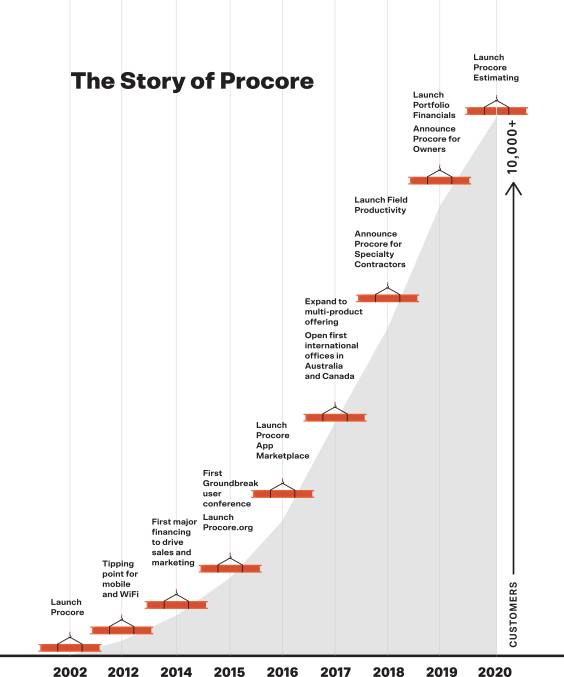
Procore was founded in 2002 by Craig “Tooey” Courtemanche. The company focused on construction management software, a category with enormous potential because construction is one of the largest industries in the world. But large markets are not automatically easy markets. Sometimes they are large because they are messy, fragmented, relationship-driven, slow to digitize, and full of processes that have survived since approximately the invention of the clipboard.
Construction projects involve owners, general contractors, subcontractors, architects, engineers, field teams, finance teams, safety teams, and compliance requirements. Documents change. Schedules slip. Budgets move. Communication breaks. People are on job sites, in trailers, in offices, and on phones. A single source of truth is not a luxury; it is the difference between “project delivered” and “everyone is pointing at everyone else in a meeting that should have been an email.”
Procore’s insight was that construction needed a connected platform built for the field as much as the office. The company developed tools for project management, financial management, quality and safety, resource management, and collaboration across construction stakeholders.
Why Procore Needed Patience
Procore’s path took nearly two decades because the construction industry did not digitize all at once. The market had to become ready. Mobile devices had to become common on job sites. Cloud software had to become trusted. Contractors had to see that modern software could reduce chaos instead of adding another annoying login screen to their day.
This is one of the most important lessons from Procore’s growth: timing is not just about being early. It is about staying alive and improving until the market catches up. Procore was early to a massive opportunity, but early markets require endurance. You must educate customers, shape workflows, win trust, and prove that your software works in the real worldnot just in a demo with perfect Wi-Fi and suspiciously clean data.
The Delayed IPO
Procore initially filed to go public before the full force of the COVID-19 pandemic disrupted markets and business planning. The company delayed its public debut, then completed its IPO in May 2021. It priced shares at $67 and began trading on the New York Stock Exchange under the ticker PCOR.
By the time Procore reached public markets, the narrative was clear: construction technology had become a major software category. The company had built credibility, scale, and a strong industry position over many years. Its IPO was not just a financing event. It was a signal that even traditional, field-based industries were moving into the cloud software era.
Procore’s long build teaches founders that “boring” industries are often anything but boring. They are full of expensive problems, deep workflows, and customers who will pay for software that genuinely helps them work better. The trick is surviving long enough to become indispensable.
UiPath: From Bucharest Bootstrapping To Automation Giant
The Automation Company That Took The Scenic Route
UiPath was founded in 2005 in Bucharest, Romania, by Daniel Dines and his team. The company was originally known as DeskOver before evolving into UiPath. Its eventual categoryrobotic process automation, or RPAfocused on software robots that could handle repetitive digital tasks across business systems.
That sounds glamorous now, especially in an era obsessed with artificial intelligence and automation. But in the beginning, the road was far from glamorous. UiPath spent years trying to find the right product, customer, and market. For a long period, it was a small, bootstrapped company, far from Silicon Valley’s fundraising spotlight.
Then the market changed. Enterprises were drowning in repetitive administrative work spread across old software systems, spreadsheets, forms, finance tools, HR workflows, and back-office processes. Companies wanted automation, but many could not simply replace all legacy software overnight. UiPath offered a practical bridge: automate repetitive tasks across existing systems.
Why UiPath Suddenly Looked Like The Future
UiPath’s growth accelerated as enterprises embraced digital transformation and automation. The idea of using software robots to perform repetitive tasks became attractive to companies trying to improve productivity, reduce errors, and free employees for higher-value work. UiPath positioned itself not merely as a tool vendor, but as an automation platform.
The company expanded globally, built a developer and partner ecosystem, and became one of the most recognized names in RPA. By the time it filed to go public, UiPath had become a symbol of enterprise automation’s potential. Investors saw a massive addressable market, strong revenue growth, and a story that fit the post-pandemic appetite for digital efficiency.
The UiPath IPO
UiPath priced its IPO in April 2021 at $56 per share and began trading on the New York Stock Exchange under the ticker PATH. The offering raised more than $1 billion and became one of the most prominent software IPOs of the year.
Yet UiPath’s story is especially useful because it reminds founders that product-market fit can arrive late. The company’s early years were not a clean hockey stick. They were more like a long hike through fog, followed by someone suddenly discovering the mountain had an elevator. Once automation became a boardroom priority, UiPath’s years of technical work and market learning became a powerful advantage.
What These Three Mega IPOs Have In Common
1. They Served Real, Persistent Problems
Squarespace helped people and businesses build credible online identities. Procore helped construction teams manage complex projects. UiPath helped enterprises automate repetitive work. None of these were toy problems. They were persistent, expensive, and widespread.
Great software companies often begin with a problem that refuses to go away. If the pain is real, the market may eventually reward the company that solves it besteven if the first decade feels like pushing a piano uphill.
2. Their Markets Needed Time To Mature
Squarespace needed the creator economy, small business digitization, and e-commerce adoption to expand. Procore needed construction teams to accept mobile and cloud tools. UiPath needed enterprises to prioritize automation and digital transformation. In each case, the company’s growth depended not only on internal execution, but also on external market readiness.
This is why timing is so complicated. A company can be right about the future and still be early. The winners are often the companies that keep building while the rest of the market catches up.
3. They Built Category Trust
Trust is underrated in software. Customers do not adopt business-critical platforms because a landing page says “revolutionary” seven times. They adopt them because the product works, the company understands their needs, and the risk feels manageable.
Squarespace built trust through design and simplicity. Procore built trust through deep construction workflows. UiPath built trust by showing enterprises that automation could deliver measurable value. That trust accumulated slowly, then showed up suddenly in market momentum.
4. They Prove That IPOs Are Lagging Indicators
An IPO feels like a beginning because public investors are meeting the company at scale. But for founders, employees, and early customers, it is often the result of years of invisible work. Squarespace, Procore, and UiPath were not born in 2021. They were revealed to public markets in 2021.
That distinction matters. The IPO is not the miracle. The miracle is all the unglamorous work that made the IPO possible.
Lessons For Founders, Investors, And Operators
Patience Is Not A Strategy Unless It Compounds
There is a dangerous way to interpret these stories: “Just wait long enough and success will happen.” That is not the lesson. Waiting alone does not create a mega IPO. These companies used time productively. They improved products, refined positioning, expanded capabilities, and learned from customers.
Patience works when it compounds. A company that is learning faster, serving customers better, and building a stronger product each year can benefit from a long timeline. A company that is simply delaying hard decisions is not patient; it is parked.
Big Markets Often Look Unfashionable At First
Before a market becomes hot, it often looks slow, fragmented, or too specialized. Construction software did not always sound like a glamorous venture category. Website building was crowded and design-sensitive. Robotic process automation took time to become a mainstream enterprise priority. Yet each market contained enormous demand.
Founders should pay attention to boring pain. Boring pain pays invoices. Boring pain renews contracts. Boring pain makes customers say, “Please fix this before my team stages a rebellion near the printer.”
Distribution And Timing Can Transform A Product
Squarespace benefited from the rise of online entrepreneurship. Procore benefited from mobile devices and cloud adoption in the field. UiPath benefited from enterprise automation demand. The product mattered, but distribution and timing magnified the product’s impact.
One reason long-running companies can suddenly accelerate is that the world around them changes. A product that once felt early can become perfectly timed when customer behavior, infrastructure, and budget priorities shift.
Additional Experiences And Practical Reflections On Slow-Build Mega IPOs
One of the most useful experiences related to the stories of Squarespace, Procore, and UiPath is the realization that long-building companies often look unimpressive from the outside until they do not. In the early years, a company may appear too niche, too slow, or too dependent on a market that has not yet caught fire. Outsiders may compare it with flashier startups raising giant rounds or dominating headlines. But headlines are not revenue, and hype is not customer retention.
For operators, the experience of building slowly can be emotionally difficult. Teams must keep morale high while the market takes its sweet time. Sales cycles may be long. Product feedback may be contradictory. Investors may ask why growth is not faster. Competitors may appear with louder marketing and shinier dashboards. In those moments, the discipline is to stay close to the customer. The customer usually knows where the real value is hiding.
Squarespace’s experience shows the power of taste and consistency. The company did not win merely by offering website tools. It won by making design feel accessible to people who cared about how their brand looked but did not want to build everything from scratch. That kind of positioning takes years to refine. Every template, campaign, feature, and customer interaction reinforced the same promise: you can look professional online without becoming a full-time web designer.
Procore’s experience shows the importance of respecting industry complexity. Construction is not a spreadsheet with hard hats sprinkled on top. It is a deeply operational world where software must fit real workflows. A founder serving a specialized industry must be willing to learn the language, visit the job site, understand the budget process, and build for users who may not sit at a desk all day. That is not glamorous work, but it creates defensibility.
UiPath’s experience shows that product-market fit can be a late-blooming event. The company’s long search did not prevent it from becoming a major public software company. In fact, the long search may have created the technical depth and organizational grit needed when the automation market finally surged. Many founders quit because the first version of the market is not ready. UiPath is a reminder that sometimes the question is not “Is this useful?” but “When will the world urgently need it?”
For investors, these three companies challenge the obsession with instant growth curves. Fast growth is wonderful when it is real and durable. But some of the biggest outcomes come from markets that require education, behavior change, and infrastructure shifts. A patient investor must distinguish between a company that is slow because it is weak and a company that is slow because it is early to a large, inevitable transformation.
For founders, the practical takeaway is to build systems that survive the waiting period. Keep burn under control. Hire people who can handle ambiguity. Create feedback loops with customers. Avoid chasing every trend. Measure whether the product is getting more valuable over time. If the answer is yes, time can become an asset. If the answer is no, time becomes a very expensive consultant.
The funniest part of startup culture is that everyone praises persistence after it works. Before it works, persistence is often mistaken for delusion. Squarespace, Procore, and UiPath each had to pass through years when the final outcome was not obvious. Their eventual IPOs made the stories look clean in hindsight, but the lived experience was almost certainly messier, riskier, and more uncertain.
That is why these mega IPOs remain valuable case studies. They teach that durable companies can take a long, long time to get big. The slow road is not a consolation prize. Sometimes it is the only road that leads to a business strong enough to matter.
Conclusion: The Long Game Can Still Win Big
Squarespace, Procore, and UiPath did not become mega IPO stories because they discovered shortcuts. They became important companies because they solved real problems, stayed close to customers, adapted to changing markets, and kept building long after the easy narrative would have ended.
Their IPOs arrived in 2021, but their foundations were laid years earlier. Squarespace spent nearly two decades turning web design into an accessible business platform. Procore spent nearly two decades digitizing one of the world’s most complex industries. UiPath spent years searching for the right automation opportunity before becoming a global enterprise software name.
For entrepreneurs, the message is encouraging but not comfortable: your company does not have to explode instantly to become meaningful. But it does have to learn, improve, and compound. The market may take time. Customers may take time. Categories may take time. The work, however, starts now.
Note: This article is written for web publication and synthesizes publicly available information from company filings, official company announcements, investor materials, and reputable business reporting. No source links are inserted in the article body per the publishing requirements.