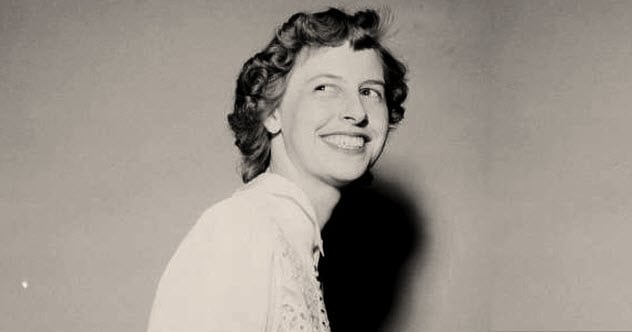
Sara Northrup is often introduced with a label that sounds simple: “L. Ron Hubbard’s second wife.” But that label is like putting a sticky note on a storm cloud. Behind it is a life tangled with postwar California, occult circles, the birth of Dianetics, a messy marriage, custody panic, public scandal, and the long shadow of a man who became one of America’s most controversial religious founders.
Her story is not just “weird history,” though there is plenty of weirdness. It is also a reminder that famous men often arrive in history books with spotlights, while the women beside them are left holding the flashlight batteries. Sara Elizabeth Bruce Northrup Hollister lived through a chapter that was sensationalized in newspapers, argued over by biographers, and later blurred by competing narratives. So let’s separate the carnival smoke from the human being.
Below are 10 tragic facts about Sara Northrup, L. Ron Hubbard’s wife, written with the drama intact but the exploitation turned down. History can be strange enough without adding a fake mustache and a thunderclap.
Who Was Sara Northrup?
Sara Elizabeth Bruce Northrup, also known as Betty Northrup, was born in Pasadena, California, in 1924. She became connected to the Pasadena circle around rocket scientist Jack Parsons, an early figure in American rocketry and a member of the Ordo Templi Orientis, an occult organization influenced by Aleister Crowley. Through that world, she met L. Ron Hubbard, then a pulp science-fiction writer and former Navy officer.
Hubbard and Northrup married in 1946, though the marriage later became controversial because Hubbard had not fully resolved his first marriage at the time. Their relationship collapsed in 1951 in a storm of divorce allegations, custody conflict, and press attention. Sara later married Miles Hollister, moved away from the public drama, and lived a far quieter life until her death in 1997.
10 Tragic Facts About Sara Northrup, L. Ron Hubbard’s Wife
1. She Entered a Chaotic Adult World While Still Very Young
Sara’s early life placed her near people who were brilliant, eccentric, and unstable in equal measure. Pasadena in the 1940s was not just orange trees and polite porch furniture. It was also a hotbed of aerospace experiments, bohemian house parties, fringe spirituality, science fiction writers, occultists, and people who treated “normal life” like a boring radio station they refused to tune in to.
As a teenager, Sara became part of the circle around Jack Parsons, a gifted rocket scientist whose life mixed serious scientific achievement with occult practice. Parsons helped shape early rocket research, yet his private world was dramatic enough to make a soap opera feel undercaffeinated. For Sara, that environment offered excitement and belonging, but it also placed her in adult situations with powerful personalities long before she had much protection from them.
2. Her Relationship With Jack Parsons Put Her in the Middle of a Famous Love Triangle
Before Sara became linked to Hubbard, she was involved with Jack Parsons. The situation was complicated because Parsons had been married to Sara’s older sister, Helen. That alone could make any family dinner feel like a legal deposition with mashed potatoes.
When Hubbard entered the Pasadena scene in 1945, he quickly became close to Parsons and then to Sara. Contemporary accounts describe Parsons feeling betrayed when Sara’s affection shifted toward Hubbard. The emotional wreckage was not just private heartbreak; it became part of the larger legend surrounding Parsons, Hubbard, and the Pasadena occult circle.
For Sara, this meant her identity was almost immediately framed through the desires and disappointments of famous men. She was remembered as someone’s lover, someone’s wife, someone’s betrayal. That is one of the quieter tragedies of her story: she became a plot device in other people’s biographies.
3. She Was Pulled Into the Strange Parsons-Hubbard Business Disaster
In 1946, Hubbard, Parsons, and Sara became involved in a business arrangement called Allied Enterprises. The idea was to buy yachts on the East Coast and resell them. On paper, it sounded adventurous. In practice, it became a financial and legal mess.
Parsons put up substantial money, while Hubbard and Sara left for Florida. Parsons later pursued legal action after the partnership collapsed. Depending on which account you read, the episode looks like either a reckless business failure or a deliberate betrayal. Either way, Sara was caught in the middle of a dispute that followed her into history.
It was another moment when a young woman’s life became attached to men with grand plans, shaky judgment, and a habit of turning chaos into mythology.
4. Her Marriage to Hubbard Was Shadowed by Bigamy Allegations
Sara married L. Ron Hubbard in August 1946. The problem was that Hubbard was still legally tied to his first wife, Margaret “Polly” Grubb, at the time. This created the basis for later accusations that his marriage to Sara was bigamous.
Imagine thinking you have married a charismatic writer with a bold future, then discovering the paperwork has more loose wires than a discount lamp. Sara reportedly did not understand the full situation at first. When she later learned more about Hubbard’s first marriage, it placed her in a deeply painful and embarrassing position.
This fact matters because it shows how early deception, or at least serious omission, shaped the relationship. Sara was not simply entering a troubled marriage; she was entering a legal and emotional maze.
5. She Helped During the Dianetics Years but Was Later Overshadowed
During the late 1940s and early 1950s, Hubbard developed Dianetics, the self-help system that later became the foundation for Scientology. Sara was not merely sitting in the background polishing teacups and wondering why everyone was shouting about “engrams.” She was close to Hubbard during the early development period and has been described in biographical accounts as involved in the Dianetics circle.
Yet as Hubbard’s public image grew, Sara’s place in the origin story became uncomfortable. The official version of great men often prefers a clean stage: one genius, one destiny, no messy former spouse with court papers. Sara’s contribution, proximity, and perspective were pushed to the edges.
That erasure is tragic because people who help shape early movements often disappear once the movement becomes a brand. History loves founders. It is less generous to witnesses.
6. Their Daughter Became Part of a Painful Custody Conflict
Sara and Hubbard had a daughter, Alexis Valerie Hubbard, born in 1950. The birth of a child might have stabilized the relationship, but instead the marriage deteriorated further. In 1951, Sara alleged that Hubbard had taken their daughter away from her without consent. Contemporary accounts and later biographies describe a frightening custody struggle that stretched across locations and involved desperate attempts to regain contact.
Few parts of Sara’s story are more painful than this. Public scandal is one thing. A legal dispute is another. But the fear of losing access to your child is a private terror that does not need embellishment. It is already heavy enough.
For readers searching “Sara Northrup daughter” or “Alexis Valerie Hubbard,” this episode is central because it shows the human stakes beneath the headlines. This was not merely a celebrity-adjacent divorce. It involved a mother trying to protect her bond with her child.
7. Her Divorce Filing Included Serious Allegations of Cruelty
In April 1951, Sara filed for divorce from Hubbard. Her complaint accused him of extreme cruelty and described a marriage marked by fear, control, and mistreatment. Because these were legal allegations in a divorce case, responsible writing should present them carefully: they were Sara’s claims, widely reported and later discussed by biographers, not a modern court verdict delivered with a neat ribbon.
Still, the allegations were serious and damaging. They challenged the image of Hubbard as a visionary healer by placing his private conduct under harsh public light. The contrast was impossible to ignore: the man promoting a system of mental improvement was being accused by his wife of behavior that caused deep mental and physical distress.
That contradiction is why Sara’s story continues to matter. It asks whether public philosophies should be tested against private behavior. The answer is usually yes, even when the result makes everyone at the dinner table suddenly interested in the salad.
8. She Was Accused of Being a Communist in a Paranoid Era
After the marriage collapsed, Hubbard reportedly made accusations about Sara and Miles Hollister, including claims tied to Communist influence. In the early 1950s, such accusations were not casual insults. During the Red Scare, being labeled Communist could damage reputations, careers, and safety.
This was a particularly tragic layer because it transformed a domestic conflict into a political accusation. When personal disputes become ideological warfare, truth often gets dragged behind the parade float. Sara had to navigate not only a divorce but also a climate where suspicion itself could become a weapon.
For modern readers, this part of the story feels familiar in a new way. Today, reputations can be attacked online in minutes. In Sara’s era, the tools were different, but the strategy was recognizable: define the other person as dangerous before they can define themselves.
9. Her Public Image Was Shaped by Scandal More Than by Her Own Voice
The 1951 divorce made headlines because it had everything newspapers loved: a controversial writer, a young wife, a missing child, shocking allegations, and the faint smell of occult Pasadena weirdness. If newspapers had clickbait back then, the headline writers would have needed a nap.
But sensational coverage rarely gives a person dignity. Sara’s pain became content. Her marriage became spectacle. Her accusations became public entertainment. The tragedy is not only what happened to her, but how quickly her experience was converted into a dramatic episode in Hubbard’s biography.
Women connected to famous men often face this double bind. If they stay silent, they are erased. If they speak, they are sensationalized. Sara experienced both.
10. She Spent Much of Her Later Life Away From the Spotlight
After the divorce, Sara married Miles Hollister and moved into a quieter life. She eventually lived in Hawaii and later Massachusetts. She did not spend decades trying to become a professional anti-Hubbard celebrity. She largely stepped away from the storm.
That silence can be read in many ways. It may have been self-protection. It may have been exhaustion. It may have been the practical decision of someone who wanted a life not permanently organized around a famous ex-husband. Whatever the reason, it left later writers to reconstruct her story from court filings, biographies, interviews, and fragments.
Sara died in 1997. By then, Hubbard had become a global religious figure, Scientology had become a powerful institution, and the disputes around his life had hardened into opposing camps. Sara’s own humanity still risks getting lost between those camps. That may be the final tragedy: she is remembered because of Hubbard, but her story asks us to look beyond him.
Why Sara Northrup’s Story Still Matters
Sara Northrup’s life sits at the intersection of several American obsessions: reinvention, charisma, spiritual experimentation, celebrity, and the uneasy relationship between public genius and private harm. She was present near the birth of Dianetics, connected to the Pasadena occult world, and central to one of the most explosive chapters in L. Ron Hubbard’s personal history.
Her story also challenges a common habit in biography. We often treat women around controversial men as supporting characters. The wife. The lover. The muse. The problem. The witness. The one who “complicated things.” But Sara was not a footnote with lipstick. She was a person who made choices, suffered consequences, protected her child, and eventually built a life outside the noise.
For SEO readers looking for “L. Ron Hubbard wife,” “Sara Northrup facts,” “Sara Northrup Hubbard,” or “Dianetics history,” the search often begins with curiosity about scandal. But the better takeaway is more serious: history is full of people whose names survive only because they passed through the orbit of someone louder. Sara Northrup deserves to be read not only as a scandalous chapter, but as a case study in power, memory, and survival.
Related Experiences and Reflections: Reading Sara Northrup’s Story Today
Spending time with Sara Northrup’s story can feel like walking through a museum where half the labels have been scratched off. You see the big names clearly: L. Ron Hubbard, Jack Parsons, Aleister Crowley, Dianetics, Scientology. Then you notice Sara standing in the middle of the room, not exactly hidden, but not properly introduced either. That experience is frustrating, and it should be.
One relatable experience is recognizing how easily charisma can distort judgment. Many people have met someone who seems larger than life: the brilliant talker, the visionary friend, the person who makes ordinary plans feel like a trailer for an epic movie. Hubbard appears in accounts of Sara’s life as exactly that kind of figure: persuasive, dramatic, impossible to ignore. The lesson is not that charisma is always dangerous. The lesson is that charisma is not character. A sparkling personality can still leave emotional broken glass on the floor.
Another experience is watching how quickly a woman’s credibility becomes the battlefield. In Sara’s case, her divorce allegations were not simply received as claims to be evaluated. They became part of a war over Hubbard’s reputation. That pattern remains familiar. When women speak about powerful men, the public often studies their tone, motives, relationships, and past choices before it studies the behavior being described. It is an old habit wearing new shoes.
Sara’s story also creates a strange feeling for anyone who has ever tried to leave a chaotic relationship. Outsiders often ask, “Why didn’t she leave sooner?” That question sounds practical, but it usually ignores the fog people live in when love, fear, money, children, reputation, and confusion all pile up at once. Leaving is not always a single brave door slam. Sometimes it is a long process of realizing the house is on fire while everyone else insists it is just dramatic lighting.
There is also an experience here for researchers, writers, and readers: the discomfort of incomplete truth. Sara’s life is documented, but not perfectly. Some accounts conflict. Some sources are hostile to Hubbard; some are defensive of him. Some details come from court filings, some from interviews, some from later biographies. Writing about her responsibly means resisting the urge to pretend every puzzle piece is equally clear. The honest phrase “accounts differ” may not win a beauty contest, but it does keep the article from becoming historical fan fiction.
Finally, Sara Northrup’s story teaches the value of restoring proportion. L. Ron Hubbard built a movement. Jack Parsons helped build the future of rocketry. Those are large historical facts. But Sara’s personal struggleher marriage, her child, her reputation, her silence, her later privacyalso matters. Not because she founded an institution, but because she reveals the human cost that can sit behind institutions.
Reading her story today feels less like gossip and more like a warning label: beware of grand narratives that require inconvenient people to disappear. If a history becomes too clean, someone probably did the sweeping.
Conclusion
Sara Northrup’s life was shaped by extraordinary proximity to famous and controversial men, but her story should not be reduced to their biographies. She was a young woman drawn into a volatile world of occult experimentation, ambition, legal conflict, motherhood, and public scandal. Her marriage to L. Ron Hubbard placed her near the early development of Dianetics, but it also exposed her to a painful relationship that ended in serious allegations and lasting controversy.
The tragedy of Sara Northrup is not simply that bad things happened around her. It is that her voice was often overshadowed by louder men, bigger institutions, and cleaner official stories. To remember her well is to read carefully, avoid sensationalism, and recognize the person behind the headline.
Note: This article is based on publicly available biographical reporting, historical accounts, court-related summaries, and major media coverage of Sara Northrup, L. Ron Hubbard, Jack Parsons, Dianetics, and early Scientology history. Disputed claims are presented with cautious wording where appropriate.