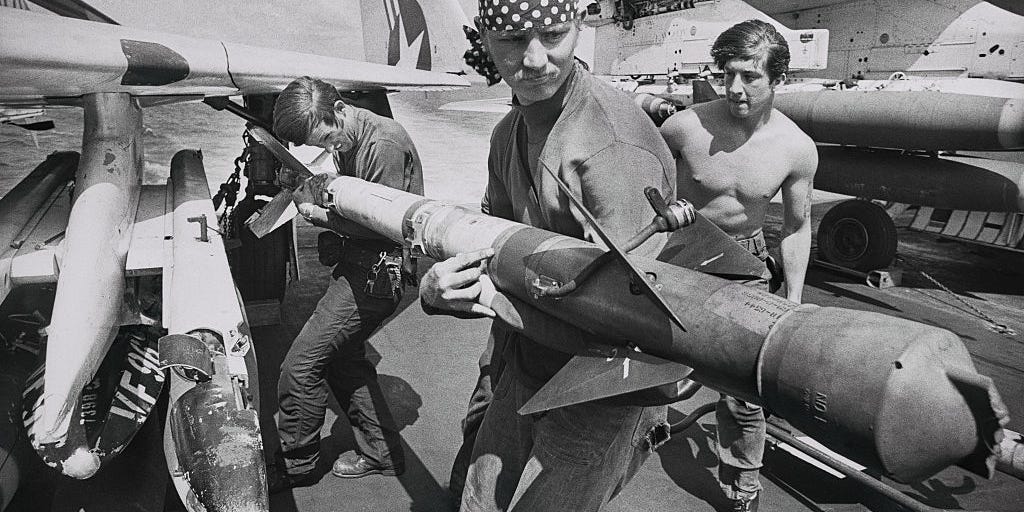
The Sidewinder missile is one of those rare military technologies that sounds like it was named by a Hollywood screenwriter, but the name actually makes perfect sense. The AIM-9 Sidewinder is a short-range, heat-seeking air-to-air missile originally developed by the U.S. Navy and later adopted widely by the U.S. Air Force and allied militaries. Like the desert rattlesnake it is named after, the Sidewinder tracks heat. Unlike the snake, it does not need a dramatic hiss, a dusty close-up, or a cowboy soundtrack to get attention.
For more than seven decades, the AIM-9 Sidewinder has remained a defining weapon in modern air combat. It began as a compact, relatively simple missile designed to follow the infrared signature of enemy aircraft. Over time, it evolved into the AIM-9X, a highly advanced missile with improved maneuverability, modern infrared sensing, datalink capability, and compatibility with advanced fighter aircraft. Its story is part engineering breakthrough, part Cold War history, part aviation legend, and part reminder that sometimes the best inventions come from small teams who refuse to accept that “good enough” is actually good enough.
What Is the Sidewinder Missile?
The Sidewinder missile, officially known as the AIM-9 Sidewinder, is a supersonic, infrared-guided missile built primarily for short-range air combat. In plain English, it is designed to be launched from aircraft against other aircraft, using heat signatures to guide itself toward a target. Modern versions can also be adapted into ground-based air defense systems, including layered defense setups where short-range interceptors help protect against airborne threats.
The original AIM-9 was developed for fleet air defense, meaning it was meant to help Navy aircraft protect ships and aircraft carriers from enemy planes. Later, the U.S. Air Force adopted the missile for its own fighters. The basic idea was elegant: instead of requiring the launch aircraft to continuously guide the missile by radar, the missile carried its own seeker. Once fired under appropriate conditions, it could guide itself. That “fire-and-forget” concept was revolutionary for its time.
Early Sidewinders were limited compared with modern versions. The AIM-9B, for example, was most effective when fired from behind a target, where the hot engine exhaust was easiest to detect. Later versions improved range, reliability, maneuverability, and target-detection ability. The AIM-9L introduced all-aspect capability, allowing the missile to engage targets from more angles, including head-on. The AIM-9M improved resistance to countermeasures and reliability. The AIM-9X brought the family into the digital age.
Why the Name “Sidewinder” Fits So Well
The name comes from the sidewinder rattlesnake, a desert species known for detecting warm-blooded prey with heat-sensitive organs. That is exactly the metaphor the missile needed. The Sidewinder does not “see” like a human pilot. It detects infrared energy, which is associated with heat. In early models, the easiest heat source was an aircraft’s exhaust. In newer versions, more advanced sensors help the missile identify and track targets with far greater sophistication.
There is also something delightfully poetic about a weapon born in the California desert being named after a desert snake. The missile’s roots trace back to China Lake, California, where a small team led by physicist Dr. William B. McLean explored the idea of using infrared radiation for guidance. The project began with a practical question: could a small missile home in on heat instead of relying on heavier, more complicated systems? The answer changed air combat.
The Origins: China Lake and a Small Team With a Big Idea
The Sidewinder’s origin story is unusually charming for something bolted under a fighter jet. In the late 1940s and early 1950s, a group at the Naval Ordnance Test Station at China Lake worked on what was first considered a side project. Guided missiles were not always at the center of the station’s formal mission, but the team believed a practical infrared-guided weapon was possible.
Dr. William McLean and his colleagues focused on simplicity, reliability, and producibility. That may sound like a boring engineering slogan, but in weapons design it is the difference between a brilliant prototype that lives forever in a display case and a real system that pilots can actually trust. The Sidewinder’s compact form, relatively low cost, and modular design helped it become one of the most widely used air-to-air missile families in the world.
The missile was successfully test-fired in the early 1950s and entered service in the 1950s. It quickly proved that air combat was entering a new era. Guns still mattered, pilot skill still mattered, and aircraft performance still mattered, but the missile gave fighters a new way to engage enemies at short range. Dogfighting did not disappear; it got a very sharp new tooth.
How the Sidewinder Changed Air Combat
Before missiles like the Sidewinder became practical, air combat depended heavily on guns, rockets, and pilot positioning. A fighter pilot had to maneuver into a favorable position, line up a shot, and fire. With the Sidewinder, the aircraft still needed the right conditions, but the missile’s infrared seeker gave pilots a much more capable short-range weapon.
The Sidewinder influenced fighter tactics, aircraft design, pilot training, and international defense planning. It also proved that compact guided weapons could be affordable enough to produce in large numbers. That mattered. A missile that is too expensive or too complex to field widely may impress engineers, but it will not transform air forces. The Sidewinder did both: it impressed engineers and showed up in inventory.
Its influence extended beyond the United States. Allies adopted it, adversaries studied it, and other nations developed comparable systems. The missile’s reputation grew because it was not a one-generation wonder. Instead, it became a platform for continuous improvement. The Sidewinder of the 1950s and the AIM-9X of today share a family name, but the modern missile is far more capable.
Major AIM-9 Sidewinder Variants
AIM-9B: The Early Workhorse
The AIM-9B was the first major production model and helped establish the Sidewinder as a serious air-to-air weapon. It was relatively simple and effective for its era, but it had limitations. It generally needed to be fired from behind a target where engine heat was most visible. It also lacked the flexibility and countermeasure resistance of later versions.
AIM-9D, AIM-9E, and AIM-9J: Improving the Basics
As combat experience revealed shortcomings, engineers improved the seeker, electronics, maneuverability, and reliability. Versions such as the AIM-9D, AIM-9E, and AIM-9J reflected the constant push to make the missile more useful in real air combat. These upgrades were not cosmetic. They addressed practical problems pilots encountered in fast, chaotic engagements.
AIM-9L: A Major Leap Forward
The AIM-9L was a milestone because it introduced all-aspect capability. Earlier Sidewinders were mostly tail-chase weapons. The AIM-9L could engage from more angles, including head-on under suitable conditions. That made it much more flexible and dangerous in close-range aerial combat.
AIM-9M: More Reliable and More Resistant
The AIM-9M built on the AIM-9L’s strengths and added improved performance against infrared countermeasures, better background discrimination, and a reduced-smoke motor. In practical terms, it was designed to be harder to fool and easier to use effectively. It became a major version in U.S. and allied inventories.
AIM-9X: The Modern Sidewinder
The AIM-9X is the most advanced member of the family. It uses modern infrared sensing, improved maneuverability, and compatibility with helmet-mounted cueing systems on advanced fighters. It can be carried by aircraft such as the F-15, F-16, F/A-18, F-22, and F-35. It is also integrated into broader defense concepts, including surface-launched applications. In other words, the Sidewinder grew up, went digital, and still kept the family nickname.
How the Sidewinder Works at a High Level
At a high level, the Sidewinder uses an infrared seeker to detect heat energy from a target. After launch, the missile’s onboard guidance system directs it toward the target. The missile uses a rocket motor for propulsion and control surfaces to maneuver. Modern versions add more advanced seekers, improved electronics, and greater agility.
The key concept is passive infrared guidance. Unlike radar-guided missiles that may rely on radar emissions or illumination, infrared missiles can track heat without broadcasting the same kind of signal. That can be useful in close-range engagements where speed, surprise, and pilot workload matter. The Sidewinder’s value has always been tied to that combination: compact size, passive guidance, and practical reliability.
For safety and security reasons, this article avoids operational details, tactics, or instructions. The important public takeaway is simple: the Sidewinder is designed to detect, track, and intercept airborne targets using heat-sensitive guidance technology. That was impressive in the 1950s. It remains impressive today, especially considering how much the system has evolved.
The Sidewinder in Real-World Events
The Sidewinder made its combat debut in the late 1950s and became closely associated with Cold War air combat. Early combat use showed both the promise and limitations of guided missiles. As aircraft became faster and engagements more complex, missile engineers had to improve seekers, fuzes, motors, and electronics. Every new generation of Sidewinder reflected lessons from test ranges, pilot feedback, and combat experience.
One of the most public modern examples occurred in February 2023, when a U.S. Air Force F-22 Raptor fired an AIM-9X Sidewinder to shoot down a high-altitude Chinese surveillance balloon off the coast of South Carolina. That event brought the Sidewinder back into mainstream public conversation. Many people who had never thought about air-to-air missiles suddenly learned that a weapon designed for fast aircraft could also be used against a slow, high-altitude balloon under carefully controlled circumstances.
The Sidewinder has also remained relevant in the context of Ukraine’s air defense needs. Older AIM-9 variants, including AIM-9M missiles, have been discussed publicly in relation to efforts to counter drones and cruise missiles. That modern use case shows something important: a weapon does not have to be brand-new to be strategically valuable. Sometimes an older system, used creatively and supported properly, can still contribute to defense in a very modern conflict.
Why the AIM-9X Still Matters
The AIM-9X matters because close-range air combat has not vanished. Beyond-visual-range missiles, stealth aircraft, sensors, and networked warfare have changed the sky, but fighters still need short-range weapons. The AIM-9X gives pilots a modern tool for visual-range engagements, while also fitting into layered defense systems.
Another reason the AIM-9X matters is interoperability. U.S. allies and partners operate many of the same aircraft types or compatible systems. A missile that can work across multiple platforms is easier to integrate into coalition defense planning. That is one reason the AIM-9X has attracted continued international demand.
Production and procurement also tell part of the story. Recent public contracts and foreign military sales show that allied militaries still see value in the Sidewinder family. Defense planners are not collecting missiles like rare baseball cards; they are buying them because short-range air defense remains a real requirement.
Sidewinder Missile vs. Other Air-to-Air Missiles
The Sidewinder is often compared with longer-range missiles such as the AIM-120 AMRAAM. The difference is not simply “one is better.” They are built for different roles. The AMRAAM is a medium-range radar-guided missile designed for beyond-visual-range engagements. The Sidewinder is primarily a short-range infrared-guided missile designed for close combat and quick-reaction scenarios.
Think of it like tools in a workshop. A hammer is not inferior to a wrench because it does not tighten bolts. It has a different job. The Sidewinder’s job is short-range, high-agility engagement. The AIM-9X continues that role with modern sensors and control systems.
Its longevity comes from matching a persistent need. Aircraft still produce heat. Pilots still need short-range weapons. Air forces still need systems that can be upgraded, integrated, and produced at scale. The Sidewinder checks those boxes with the confidence of a veteran mechanic who has seen every engine problem twice.
What Makes the Sidewinder So Successful?
Several factors explain the Sidewinder’s success. First, it was relatively simple compared with many competing concepts of its era. Simplicity made it easier to produce, maintain, and improve. Second, it was compact enough to fit on a wide range of aircraft. Third, it proved adaptable. Engineers could upgrade seekers, motors, electronics, and control systems while preserving the basic family concept.
Fourth, the Sidewinder benefited from continuous feedback. Combat experience, test data, and allied use all contributed to improvements. A missile family does not stay relevant for seventy years by accident. It stays relevant because engineers keep listening to physics, pilots, and procurement officersthree groups that rarely agree on lunch, let alone weapons design.
Finally, the Sidewinder earned trust. In aviation, trust is everything. Pilots do not want “interesting.” They want dependable. Maintainers do not want “futuristic.” They want serviceable. Commanders do not want “promising.” They want available. The Sidewinder became famous because it delivered practical value again and again.
Experiences and Reflections Related to the Sidewinder Missile
For many people, the Sidewinder missile is first encountered not in combat, but in museums, air shows, documentaries, aviation books, or video footage of fighter aircraft lined up on a runway. Seeing one mounted under the wing of a fighter can be surprisingly understated. It does not look like science fiction. It looks slim, purposeful, and almost modestuntil you remember that this compact object helped reshape the way nations think about air combat.
At aviation museums, visitors often walk past missiles quickly on their way to the glamorous aircraft. The fighter gets the photos. The missile gets the small label. But if you slow down and read the placard, the Sidewinder becomes a doorway into a much bigger story. It connects desert test ranges, Cold War competition, naval innovation, fighter tactics, electronics, thermodynamics, and international security. Not bad for something that looks, to the untrained eye, like a very expensive metal pencil.
Air shows offer another kind of experience. When a fighter performs a high-speed pass, spectators feel the sound in their chest before they fully process what they are seeing. Under the wings, missiles such as the AIM-9 represent the invisible layer of modern air power: sensors, training, rules of engagement, logistics, maintenance crews, and decades of engineering. The aircraft may be the star, but the weapons and systems around it are part of the performance.
There is also an educational experience in studying the Sidewinder’s development. The story challenges the idea that innovation always begins with massive budgets and huge committees. The missile’s early development involved a small group pursuing a clear technical insight: heat could guide a weapon. Their achievement shows how focused engineering, practical design, and persistence can produce a breakthrough. It is a useful lesson far beyond military history.
For students of technology, the Sidewinder is a case study in iterative improvement. The first model was not perfect. Later versions did not appear magically. Each generation addressed real limitations. Better seekers, more reliable electronics, improved maneuverability, and greater resistance to countermeasures turned a promising missile into a long-lived family of systems. That is how many durable technologies evolve: not through one miracle, but through many disciplined upgrades.
For the general public, the Sidewinder also raises thoughtful questions about defense and responsibility. Modern weapons are often discussed in terms of performance, but they also exist within policy, law, alliances, deterrence, and ethics. A missile is not just hardware. It is part of a national decision-making chain. The 2023 balloon incident showed this clearly: the public conversation was not only about what missile was used, but why officials waited, where debris might fall, how risk was managed, and what the event meant diplomatically.
That is why the Sidewinder remains fascinating. It is not merely a missile. It is a symbol of how military technology can begin as a clever idea, become a standard tool, adapt across generations, and remain relevant in unexpected situations. From fighter combat to air defense discussions, the Sidewinder has stayed in the conversation because it solves a problem that has never gone away: how to defend the sky when seconds matter.
Conclusion
The Sidewinder missile is one of the most important air-to-air weapons ever developed. Born from a small team’s infrared-guidance experiment at China Lake, the AIM-9 grew into a family of missiles used by the United States and many allies around the world. Its evolution from early rear-aspect models to the modern AIM-9X shows how smart design can survive decades of technological change.
The Sidewinder’s lasting success comes from its balance of simplicity, adaptability, reliability, and effectiveness. It changed air combat in the 1950s, adapted through the Cold War, and remains relevant in modern defense planning. Whether viewed as an engineering achievement, a military history milestone, or a symbol of aviation innovation, the Sidewinder deserves its reputation. Small snake, big legacy.