Note: This article is based on current pickleball scoring rules and reputable pickleball education resources, rewritten in original language for web publication.
Pickleball is famously easy to start. You grab a paddle, step onto a court, and within five minutes you are smacking a plastic ball around like you have discovered the athletic version of popcorn. Then someone says, “Zero-zero-two,” and suddenly everyone looks like they are doing tax math in gym shorts.
Good news: pickleball scoring is not as scary as it sounds. It only feels strange because it works differently from tennis, table tennis, and most casual backyard games. Once you understand who can score, how to call the score, and why doubles uses three numbers, the system becomes surprisingly logical. This beginner’s guide explains how to keep score in pickleball, including doubles scoring, singles scoring, side outs, server numbers, common mistakes, and real examples you can use the next time you play.
Pickleball Scoring Basics: The Big Picture
The most important rule in traditional pickleball scoring is simple: only the serving team can score a point. If the receiving team wins a rally, it does not immediately receive a point. Instead, it earns the serve back or moves the serve to the next server, depending on the situation.
Most recreational pickleball games are played to 11 points, win by 2. That means a team cannot win 11-10. The game continues until one side leads by at least two points, such as 12-10, 13-11, or, if everyone is stubborn and well-hydrated, 18-16. Tournament games may sometimes be played to 15 or 21, but the “win by 2” principle usually remains the same.
Before every serve, the server calls the score out loud. This is not just a polite ritual. It keeps all players aligned, prevents arguments, and gives everyone a moment to confirm the correct server and position. Think of it as the game’s tiny verbal seatbelt.
How to Call the Score in Pickleball
The way you call the score depends on whether you are playing singles or doubles. Singles uses two numbers. Doubles uses three numbers.
Singles Score Format
In singles pickleball, the score is called like this:
Server’s score – receiver’s score
For example, if you are serving and you have 5 points while your opponent has 3, you call:
“Five-three.”
That is it. No third number. No secret pickleball password. Singles scoring is the clean version.
Doubles Score Format
In doubles pickleball, the score is called like this:
Serving team’s score – receiving team’s score – server number
For example:
“Four-two-one” means the serving team has 4 points, the receiving team has 2 points, and the current server is the first server for that team during this service turn.
“Four-two-two” means the same score, but the second server is now serving.
That third number is the part that makes beginners stare into the distance. It does not mean court number, game number, player ranking, or how many snacks are left in the cooler. It simply tells everyone whether the serving team is on its first server or second server.
Why Does Doubles Pickleball Start at 0-0-2?
Every doubles game starts with the score:
“Zero-zero-two.”
This looks odd at first because nobody has served yet, so why is the first server called the second server? The reason is fairness. In doubles, each team normally gets two service opportunities during a turn: one for each partner. However, at the very start of the game, the first serving team gets only one server. This reduces the advantage of serving first.
So, when the first server of the game loses the rally, it is immediately a side out, and the serve goes to the other team. After that first sequence, both players on each doubles team get a chance to serve before the serve passes to the opponents.
What Is a Side Out in Pickleball?
A side out happens when the serving team loses its right to serve and the serve goes to the opposing team. In doubles, this usually occurs after both players on the serving team have lost their service turns. The exception is the very first service sequence of the game, when only one player serves before a side out.
Here is a simple example:
| Score Call | What It Means |
|---|---|
| 0-0-2 | The game begins. The first serving team has only one server. |
| Side out | The first server loses the rally, so the serve goes to the other team. |
| 0-0-1 | The other team begins serving with its first server. |
| 0-0-2 | If the first server loses the rally, that team’s second server serves. |
| Side out | If the second server loses the rally, the serve returns to the opponents. |
Once you understand side outs, doubles scoring becomes much easier. The serve moves like a relay baton: first server, second server, then over to the other team.
How Points Are Scored
In traditional pickleball scoring, a point is scored when the serving team wins the rally. A rally ends when a player or team commits a fault. Common faults include hitting the ball into the net, hitting out of bounds, letting the ball bounce twice, volleying from the non-volley zone, or violating a serving rule.
For example, suppose your team is serving at 3-2-1. You serve, your opponents return the ball, your team hits a good third shot, and the opponents eventually hit the ball out. Your team wins the rally and scores a point. The new score is 4-2-1, and the same server continues serving from the opposite side of the court.
Now suppose your team is serving at 4-2-1 and your team hits the ball into the net. Because your team was serving and lost the rally, you do not lose a point. Instead, the serve moves to your partner. The new call is 4-2-2.
If your team loses another rally at 4-2-2, that creates a side out. The opponents now serve, and because the serving team’s score is always called first, the next score would be 2-4-1.
Serving Position: Right Side, Left Side, and Score Logic
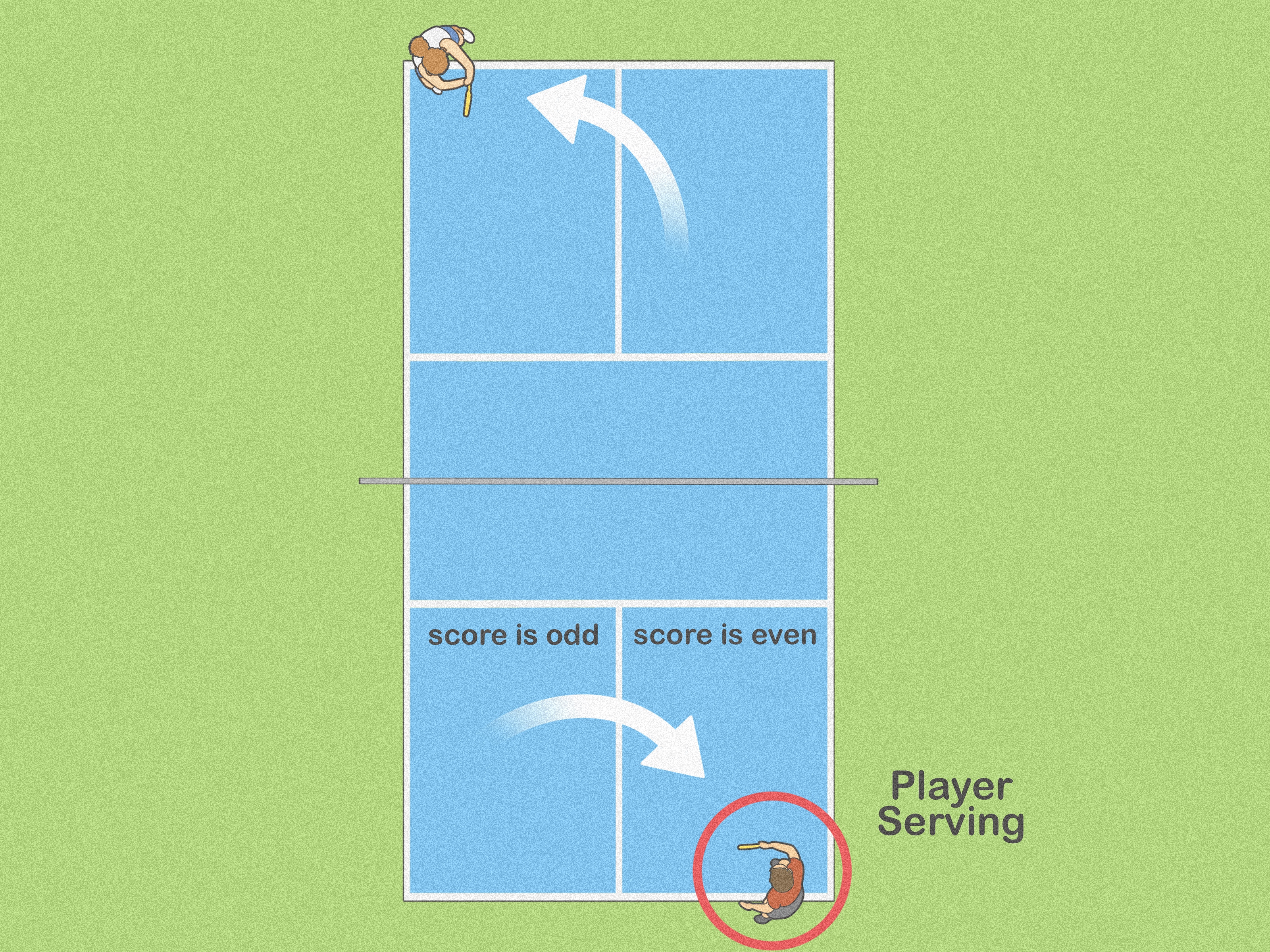
Pickleball serving always begins from the right side of the court after a side out. The serve must be hit diagonally into the opposite service court. If the serving team scores a point, the server switches sides and serves from the left. If another point is scored, the server switches back to the right. This back-and-forth continues until the serving team commits a fault.
Here is the easy memory trick:
- Even score: serve from the right side.
- Odd score: serve from the left side.
This even-right, odd-left rule is especially useful in singles, where there is no partner and no third number in the score. If your score is 0, 2, 4, 6, 8, or 10, you serve from the right. If your score is 1, 3, 5, 7, or 9, you serve from the left.
In doubles, positioning takes a little more awareness because partners switch sides only when their team scores while serving. If your team wins a rally as the serving team, the server switches sides. The receiving team does not switch sides. If no point is scored, players usually stay where they are unless the serve changes according to the sequence.
Step-by-Step Doubles Scoring Example
Let’s walk through a beginner-friendly doubles game. We will call the teams Team A and Team B.
Start of the Game
Team A serves first. The score is called:
0-0-2
Team A loses the rally. Because this is the first service sequence of the game, Team A does not get a second server. It is a side out.
Team B Takes the Serve
Team B now serves:
0-0-1
Team B wins the rally. Team B scores a point, and the same server switches sides.
1-0-1
Team B wins again.
2-0-1
Then Team B loses the rally. The serve moves to Team B’s second server.
2-0-2
Team B loses again. Now it is a side out. Team A gets the serve, and the score is called with the new serving team’s score first:
0-2-1
This is where many beginners get confused. The numbers do not “stay in the same order” for the whole game. The serving team’s score is always called first. When the serve changes sides, the score order flips.
Common Beginner Mistakes in Pickleball Scoring
Mistake 1: Giving Points to the Receiving Team
The receiving team can win a rally, but under traditional scoring it does not score a point. It earns a change in serve. This is the biggest mental adjustment for beginners coming from rally-scoring sports.
Mistake 2: Forgetting the Third Number
In doubles, the third number matters because it tells players whether the team is on its first or second server. If you forget it, pause and ask: “Did this team just get the serve back, or has one partner already served?” If the team just got the serve back, it is usually server one. If one partner already lost the serve, it is server two.
Mistake 3: Starting Every Game at 0-0-1
Doubles starts at 0-0-2, not 0-0-1. This one little rule prevents the first serving team from getting two full service chances before the other team touches the serve.
Mistake 4: Standing on the Wrong Side
When your team is serving and scores a point, the server switches sides. If you did not score, do not switch just because you feel like adding choreography. The court already has enough movement without surprise square dancing.
Mistake 5: Whispering the Score
Call the score clearly before serving. A confident score call prevents confusion and gives everyone a fair chance to be ready. It also makes you look like you know what you are doing, which is half the battle in recreational sports.
Singles Pickleball Scoring Made Easy
Singles scoring is simpler than doubles scoring because there is no server number. You call your score first, then your opponent’s score. If you are serving at 6-4, say “six-four.” If you lose the rally, it is a side out, and your opponent serves at 4-6.
The key singles rule is serving position. When your score is even, serve from the right. When your score is odd, serve from the left. This means your score tells you where to stand. If your brain freezes, look at your score, not the clouds.
For example, if you are serving at 8-7, you stand on the right because your score is even. If you are serving at 9-7, you stand on the left because your score is odd. The receiver stands diagonally across from you.
Traditional Scoring vs. Rally Scoring
Most beginner and recreational pickleball games use traditional side-out scoring. However, you may hear about rally scoring, especially in some leagues or professional team formats. In rally scoring, a point is awarded after every rally, regardless of which team served.
For beginners, the best advice is simple: before you start, ask which scoring format the group is using. If nobody says otherwise, assume traditional scoring. It is the standard format most new players learn first, and it is the system used in many casual games.
Quick Cheat Sheet: How to Keep Score in Pickleball
- Most games are played to 11 points, win by 2.
- Only the serving team scores in traditional pickleball scoring.
- The score must be called before every serve.
- Singles uses two numbers: server score, receiver score.
- Doubles uses three numbers: serving team score, receiving team score, server number.
- Doubles games start at 0-0-2.
- After a side out, the new serving team calls its score first.
- In singles, serve from the right when your score is even and from the left when your score is odd.
- In doubles, both partners usually get a chance to serve before a side out, except at the very start of the game.
Beginner Court Experiences: What Scoring Feels Like in Real Games
The first time many beginners try to keep score in pickleball, the game feels like two sports at once. Your body is trying to remember how to serve, your feet are trying not to wander into the kitchen at the wrong time, and your brain is quietly yelling, “Was I server one or server two?” That is normal. Pickleball scoring is learned through repetition, not by staring at a rulebook until your paddle files a complaint.
A common beginner experience happens right after a side out. The receiving team wins the rally, celebrates a little, and someone says, “Nice, we get a point!” Then the most experienced player gently explains that no, the team gets the serve, not a point. This can feel disappointing for about three seconds, until you realize winning the serve is how you earn the opportunity to score. In traditional pickleball, possession matters. You first win the serve, then you win points.
Another real-life moment happens with the 0-0-2 opening call. New players often ask, “Why are we starting with two?” The answer usually turns into a mini lesson at the baseline. After hearing it once or twice, beginners start to appreciate the rule. It keeps the first serving team from getting a full double-serving advantage before the other side even has a chance. The game begins more balanced, even if the score call sounds like a garage door code.
Many beginners also discover that calling the score out loud improves confidence. At first, players mumble. Then they miss a serve because they are still thinking about whether they said the right number. After a few games, the rhythm becomes natural: call the score, take a breath, serve. That small routine settles the nerves. It also helps your partner know whether to expect a switch, a second-server situation, or a possible side out.
In doubles, partner communication makes scoring much easier. A helpful partner might say, “We’re first server,” or “Stay there, no point,” after a rally. These quick reminders are not annoying; they are part of learning. Pickleball has a friendly culture, and most recreational players would rather explain the score than spend ten minutes debating whether the last rally created a side out. Clear communication keeps the game moving and saves everyone from scoreboard archaeology.
The best beginner habit is to pause before serving and ask three questions: What is our score? What is their score? Am I server one or server two? If you can answer those, you can call the score correctly. If you cannot, ask before serving. Nobody loses honor points for checking. In fact, experienced players check the score all the time because rallies, rotations, and social chatter can scramble anyone’s memory.
Over time, scoring becomes part of the game’s strategy. You start noticing that being on second server feels different from being on first server because one lost rally can create a side out. You become more careful at 10-9-2 because the next rally could decide whether your team closes the game or hands the serve back. You begin to understand why patient shots, smart serves, and steady returns matter. Scoring is not just bookkeeping; it shapes pressure, decisions, and momentum.
Most importantly, learning how to keep score makes pickleball more fun. You stop feeling like a guest at a party where everyone knows the inside joke. You know when to switch sides, when to celebrate a point, when to call side out, and when to say “0-0-2” with the calm confidence of a person who has officially joined the pickleball club.
Conclusion
Learning how to keep score in pickleball is one of the fastest ways to feel comfortable on the court. The system may seem quirky at first, especially in doubles, but the logic is steady: only the serving team scores, the serving team’s score is called first, doubles uses a server number, and games are usually played to 11, win by 2.
Start with the basics. Remember that doubles begins at 0-0-2. Call the score clearly before every serve. Use the even-right, odd-left rule in singles. In doubles, track whether your team is on the first or second server. When in doubt, pause and ask. Pickleball players are usually happy to help, partly because everyone remembers being confused by 0-0-2 the first time.
Once scoring clicks, you can focus less on numbers and more on the good stuff: smart serves, soft dinks, satisfying rallies, and the occasional heroic shot that you will absolutely describe to your friends as intentional.