Note: This article discusses a viral claim about AI-generated books as an alleged success story, not as verified financial proof. The broader analysis is based on real public reporting, Amazon publishing policies, author advocacy concerns, and current debates about transparency in AI-assisted publishing.
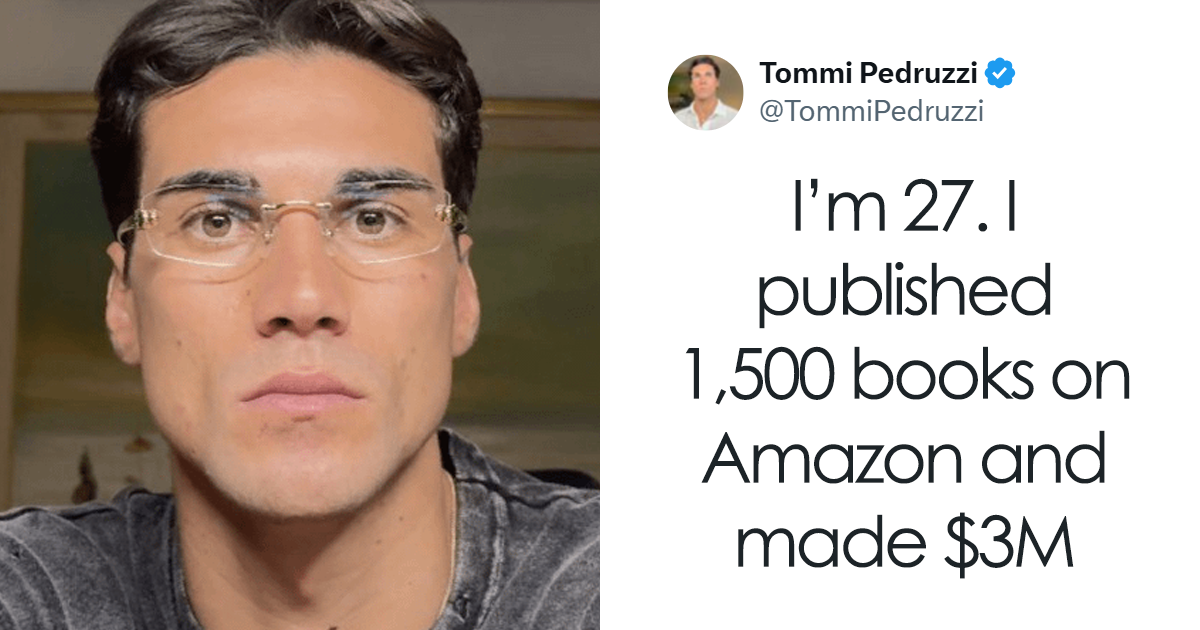
A 27-year-old entrepreneur says he went from being broke to making $3 million by publishing AI-generated books. Naturally, the internet reacted with the calm, gentle nuance of a raccoon discovering a locked trash can. Some people called him a genius. Others called him a symbol of everything wrong with the creator economy. Many asked the obvious question: if the books were really printing money, why share the recipe with thousands of potential competitors?
The story spread because it hits every button online audiences cannot resist: artificial intelligence, passive income, Amazon publishing, “I was broke and now I am rich” energy, and a comment section ready to bring folding chairs. The man at the center of the controversy, widely identified in coverage as Tommi Pedruzzi, claimed he used AI to help create and publish around 1,500 books, building a business that allegedly generated millions. He framed the strategy as less about romantic authorship and more about market demand: find topics people already want, use AI to produce nonfiction content that solves practical problems, package it well, publish it, and scale.
That is where the applause stopped and the dragging began. Critics questioned whether the $3 million figure came from book sales, courses, coaching, or a mix of all three. Others pointed out that mass-produced AI books can crowd online marketplaces, mislead readers, and hurt real authors whose names, topics, and research are copied or surrounded by low-quality knockoffs. In other words, the internet did not just see a young entrepreneur celebrating a win. It saw a giant flashing sign reading, “Welcome to the Slop Economy.”
The Viral Claim: Broke To $3M With AI Books
The basic pitch sounds simple enough to fit on a motivational mug: use AI, publish books, scale hard, get rich. According to the viral thread discussed online, the entrepreneur claimed he had published about 1,500 books and earned roughly $3 million through Amazon-related publishing. The books were reportedly nonfiction titles built around practical topics rather than literary masterpieces. Nobody was claiming the next Moby-Dick had been generated between lunch and a gym selfie.
The appeal is obvious. Traditional publishing is slow, selective, and brutally competitive. Self-publishing, especially through Kindle Direct Publishing, removes many gates. AI then appears to remove another gate: the blank page. A creator who once needed writers, editors, designers, and researchers can now use AI tools to draft outlines, generate text, brainstorm titles, translate content, create covers, and test niches. It is the publishing equivalent of replacing a horse-drawn wagon with a rocket scooter. Exciting? Yes. Stable? Please wear a helmet.
Pedruzzi’s defenders saw the story as proof that the market rewards execution, not nostalgia. They argued that readers buy solutions. If a short guide helps someone meal prep, organize finances, plan a garden, or understand a hobby, does it matter whether AI helped make it? In this view, AI publishing is simply a new tool in the long history of business automation.
Critics saw something very different. They argued that publishing 1,500 books is not authorship in any meaningful sense. It is content farming. They worried that the business model encourages speed over quality, quantity over expertise, and search optimization over trust. To them, the “AI books made me rich” claim sounded less like a publishing breakthrough and more like a course funnel wearing a fake mustache.
Why People Dragged Him Online
The backlash was not just about jealousy, although the internet does occasionally confuse moral outrage with “I wish I had bought Bitcoin in 2011.” The criticism had several layers, and they reveal why AI-generated books are such a messy issue.
1. People questioned the proof
The first concern was verification. A person claiming to make millions online will always trigger suspicion, especially when the claim is attached to a business model that can be sold as a course, coaching program, or paid community. Some commenters asked for receipts: royalty dashboards, tax documents, author pages, recognizable titles, or other evidence that the money came primarily from book sales.
That skepticism matters. The online business world has a long history of people selling “how I got rich” systems where the real money comes from selling the system, not from doing the thing. Gold rushes are famous for miners, but the shovel sellers often did just fine. In modern internet terms, the shovel is a webinar with a countdown timer.
2. People worried about low-quality books
The second issue was quality. AI can produce readable text quickly, but readable is not the same as reliable, original, useful, or carefully edited. A book about productivity with generic advice may merely waste money. A book about health, finance, law, parenting, or safety can do real damage if it is wrong. Readers do not always know whether a title was written by an expert, assembled by a ghostwriter, or generated by a machine that confidently says things like a substitute teacher bluffing through chemistry class.
Many critics used the word “slop” to describe mass-produced AI content. It is not a scientific term, but everyone understands it. Slop is content that looks like content, moves like content, and technically contains sentences, yet feels strangely empty. It is the literary version of eating a rice cake while staring at a photo of pizza.
3. Authors fear marketplace pollution
Authors and publishing analysts have warned that AI-generated books can flood platforms with copycats, summaries, fake biographies, and low-effort guides. This is especially frustrating when a legitimate author spends years researching a book, only to see knockoff summaries appear almost immediately after release. Those titles can siphon attention, confuse customers, and damage reputations.
The problem is not that every AI-assisted book is automatically bad. The problem is scale. One mediocre book is annoying. Thousands of them become a search problem. When online bookstores are flooded with similar covers, keyword-heavy subtitles, anonymous author names, and questionable reviews, readers have to become detectives. Nobody wants to open Amazon looking for a cookbook and leave with a minor in forensic publishing.
Amazon KDP And The AI Disclosure Problem
Amazon’s Kindle Direct Publishing platform allows authors and publishers to upload digital and print books directly. That accessibility has helped many independent authors reach readers without needing traditional publishing approval. It has also made the platform vulnerable to abuse.
Amazon now requires KDP users to disclose AI-generated content when publishing or republishing a book. The company distinguishes between AI-generated content and AI-assisted content. If AI creates the actual text, images, or translations, Amazon treats it as AI-generated, even if the publisher edits it later. If a human creates the content and uses AI for brainstorming, editing, refinement, or error-checking, Amazon considers that AI-assisted and does not require disclosure.
That distinction sounds neat on paper, but real workflows can be messy. Suppose a creator asks AI for an outline, writes a chapter, asks AI to expand sections, edits the result, uses AI to rewrite paragraphs, then hires a freelancer to polish it. Is that AI-generated, AI-assisted, human-authored, or a publishing smoothie? Amazon’s policy gives a framework, but enforcement depends on honest disclosure, detection tools, customer complaints, and platform review.
Amazon has also said that publishers are responsible for ensuring AI-generated or AI-assisted content follows content guidelines and respects intellectual property rights. That matters because AI systems can reproduce patterns, summaries, structures, and phrasing derived from existing works. Even when there is no clear legal violation, readers and authors may still feel deceived if a book is marketed as original expertise but contains recycled generic output.
The Bigger AI Books Debate: Tool Or Shortcut?
The debate over AI books is not really about whether technology belongs in writing. Writers already use spellcheck, grammar tools, search engines, transcription software, stock-photo databases, formatting apps, and caffeine so strong it should require a permit. The question is not “Can tools help?” Of course they can. The better question is: where does helpful assistance end and misleading automation begin?
Used responsibly, AI can help authors research faster, organize ideas, test outlines, spot confusing sentences, generate marketing copy, and translate drafts for review. A human expert can still guide the argument, verify facts, add lived experience, and make creative decisions. That is a tool-based workflow.
Used irresponsibly, AI can generate entire books in niches the publisher barely understands. The human role becomes choosing keywords, pushing buttons, and uploading files. That is a shortcut-based workflow. It may make money for a while, but it shifts the risk to readers, legitimate authors, and the platform’s trust.
This is why transparency has become the central issue. Readers may accept AI-assisted books if they know what they are buying. Many people do not object to a clearly labeled AI-generated workbook, puzzle book, or experimental story. What frustrates readers is deception: fake experts, fake reviews, fake author bios, fake urgency, fake originality, and fake “I personally tested every tip in this book” claims.
Why The $3M Claim Feels Like A Modern Internet Parable
The viral AI-book millionaire story works because it is both inspiring and unsettling. On one hand, it suggests that a young person used new technology, spotted an opportunity, and built a business from nothing. That is the classic internet dream. No gatekeepers. No fancy degree. No old-school publishing lunch where someone says “circle back” while rejecting your manuscript.
On the other hand, the story raises a darker question: what happens when success comes from overwhelming the market rather than serving it? If an entrepreneur publishes 1,500 books, readers naturally wonder how many were carefully researched, edited, fact-checked, and improved by human judgment. The number itself becomes suspicious. It suggests industrial output, not craftsmanship.
That does not automatically mean every book was worthless. It does mean the burden of trust becomes heavier. If someone says, “I wrote two excellent books this year,” readers can imagine the work. If someone says, “I published 1,500 books,” readers imagine a laptop sweating in a warehouse.
The backlash also reflects a cultural divide. Some people see AI as a force multiplier that helps small entrepreneurs compete. Others see it as a machine that turns art, knowledge, and human effort into low-cost inventory. Both views contain truth. AI can help a talented creator move faster. It can also help an opportunist produce oceans of bland content at a speed no human editor can reasonably check.
What Readers Should Watch For Before Buying AI-Generated Books
Readers do not need to become anti-AI detectives, but a little caution helps. When buying nonfiction, especially in sensitive categories, look for signs of credibility. Does the author have a real background? Are there references, examples, original insights, or practical details? Does the book preview show clear structure and human judgment? Are the reviews specific, or do they sound like five stars written by a toaster trying to pass as a yoga instructor?
Be especially careful with books that promise fast money, instant expertise, miracle health solutions, or secret formulas. A vague author bio, generic cover, keyword-stuffed title, and repetitive description can be red flags. So can a catalog where one “author” has published dozens of books across unrelated fields in a suspiciously short time. Today they are an expert on keto desserts, tomorrow they are explaining quantum computing, and by Friday they have solved parenting. Impressive range, or one very busy algorithm.
For low-stakes categories, readers may decide the risk is acceptable. A coloring book, journal, basic checklist, or simple prompt book may not need Pulitzer-level authorship. For high-stakes categories, expertise matters. Medical, legal, financial, educational, and technical books should be held to a much higher standard because mistakes can cause harm.
What Ethical AI Publishing Could Look Like
The future of publishing does not have to be humans versus robots in a dramatic rainstorm. A healthier model is possible. Ethical AI publishing would start with clear disclosure. If AI generated substantial portions of a book, say so. If a human expert wrote the core material and used AI for editing or organization, explain that too. Readers are not helpless. They can decide what they value when the label is honest.
Second, publishers should use human review as a non-negotiable step. AI can draft quickly, but humans need to verify facts, remove nonsense, improve examples, check tone, and ensure the work serves the reader. A book is not finished because the file reached 30,000 words. That is like saying dinner is ready because the smoke alarm went off.
Third, AI-assisted creators should avoid pretending to be experts in fields they do not understand. Publishing a practical guide requires responsibility. If the topic involves health, finance, law, mental well-being, child development, or safety, the creator should involve qualified professionals or stay out of the category. “ChatGPT said it confidently” is not a credential.
Finally, platforms should continue improving labeling, review integrity, duplicate detection, and abuse prevention. The FTC has already made clear that fake reviews and deceptive AI claims can trigger enforcement. That matters because many AI-book schemes rely not only on automated writing but also on misleading marketing, review manipulation, and exaggerated income claims.
Experiences And Lessons From The AI Book Gold Rush
The biggest lesson from this controversy is that AI can reduce production friction, but it cannot eliminate trust. In fact, the easier content becomes to produce, the more trust becomes the product. Readers are no longer only buying information. Information is everywhere. They are buying judgment, taste, clarity, accuracy, structure, and confidence that the person behind the book did not simply ask a chatbot to “make me a bestselling guide, bro.”
Creators experimenting with AI publishing often learn this quickly. The first AI draft may look magical. It has headings, paragraphs, bullet points, and a tone that politely refuses to shut up. But when you read closely, the weaknesses appear. Examples are vague. Advice repeats. Facts need checking. The voice sounds like a motivational speaker trapped in a software update. Turning that raw output into a genuinely useful book still requires editorial work.
Readers, meanwhile, are becoming more alert. Many have been burned by books that look polished on the sales page but feel hollow inside. A beautiful cover and a strong title can win the click, but a weak book loses the reader forever. This creates a long-term problem for low-effort publishers: you can trick an algorithm for a moment, but disappointing humans is a terrible retention strategy.
Independent authors have their own experience with the downside. Many already struggle for visibility in crowded categories. When AI-generated titles multiply, discoverability becomes even harder. A thoughtful debut author may spend years on a book, only to compete with dozens of quick-turnaround titles optimized around the same keywords. That does not just affect sales. It affects morale. It makes the marketplace feel less like a bookstore and more like a vending machine that occasionally dispenses soup instead of coffee.
Entrepreneurs also face a lesson: money screenshots are not a reputation strategy. Even if a creator genuinely earns millions, the way they present the story matters. If the message sounds like “I hacked literature and got rich,” writers and readers will push back. If the message is “I used new tools transparently to build useful products, and here is what I learned about quality and responsibility,” the conversation becomes more interesting. Online audiences can smell a funnel from three tabs away.
There is also a practical business lesson. Publishing at scale may create short-term revenue, but brands are built through consistency and trust. A catalog of forgettable books can become a liability if platforms tighten rules, readers demand labels, or reviewers expose low-quality content. A smaller catalog of genuinely helpful, well-edited books can last longer, earn better reviews, and support related products without making the creator look like the mayor of Slop City.
For writers, the experience is not all doom. AI can help with outlines, research organization, editing passes, title brainstorming, and accessibility. Used thoughtfully, it can lower barriers for people who have ideas but struggle with structure or language. The danger is not the tool itself. The danger is replacing curiosity, expertise, and care with pure output. A hammer can build a house or smash a window. The hardware store is not the entire moral universe.
The strongest path forward is boring but powerful: disclose AI use honestly, choose topics responsibly, verify everything, add original value, respect readers, and do not confuse publishing volume with publishing quality. If AI helps a creator make a better book, great. If AI helps someone make 1,500 empty products and flood the shelves, readers are right to roll their eyes so hard they can see last Tuesday.
Conclusion: AI Books Can Make Money, But Trust Is The Real Bestseller
The viral story of a 27-year-old claiming he went from broke to making $3 million with AI books is bigger than one entrepreneur. It is a snapshot of the internet’s current identity crisis. We love innovation, but we hate feeling tricked. We admire hustle, but we distrust gurus. We want tools that make creativity easier, but we do not want bookstores stuffed with machine-made fog.
AI-generated books are not going away. Amazon, booksellers, authors, regulators, and readers are all adjusting to a world where publishing can happen faster than ever. The winners will not simply be the people who generate the most pages. The winners will be the people who combine speed with standards, automation with accountability, and technology with human judgment.
So, did AI books make one 27-year-old rich? Maybe. Maybe the real money came from publishing. Maybe it came from teaching publishing. Maybe the truth is somewhere in the messy middle, wearing a hoodie and selling a course. But the public reaction makes one thing clear: in the age of AI content, readers are not just asking, “Can this be made?” They are asking, “Should I trust it?”
And that question may be worth more than $3 million.