Few phrases make taxpayers sit up straighter than “IRS audit.” It has the emotional warmth of a dentist drill and the suspense of a thriller where the villain is a shoebox full of receipts. But the average audit rate by income level is usually much lower than people imagine. For most individual taxpayers, the chance of being audited is well below 1% in a typical year. That does not mean audits are mythical creatures, like unicorns wearing green eyeshades. It means the IRS uses limited staff, data matching, correspondence notices, and risk scoring to decide which returns deserve a closer look.
The short answer: audit rates generally rise as income rises, especially above $500,000 and dramatically above $1 million. However, some lower-income taxpayers, especially those claiming refundable credits such as the Earned Income Tax Credit, can also face above-average scrutiny because those audits are often automated and handled by mail.
What Does “Audit Rate” Mean?
The audit rate is the percentage of filed tax returns that the IRS examines. If 1,000 taxpayers file returns and 3 are audited, the audit rate is 0.3%. Simple enough, right? Almost. Tax administration is never satisfied until it adds a few footnotes wearing tiny business suits.
First, the IRS often reports audit coverage by tax year, not simply by the year an audit closes. That matters because an audit can start months or years after a return is filed. Second, many income-level tables use total positive income, often shortened to TPI. TPI generally counts positive income items before losses are used to reduce the total. This can make a taxpayer look “higher income” for audit-classification purposes than adjusted gross income would suggest.
For example, imagine a real estate investor with $1.2 million in gross income and $800,000 in losses. Their adjusted gross income may look modest compared with their gross activity, but their total positive income may still place them in a higher audit category. In IRS-land, the spreadsheet always wants the full family history.
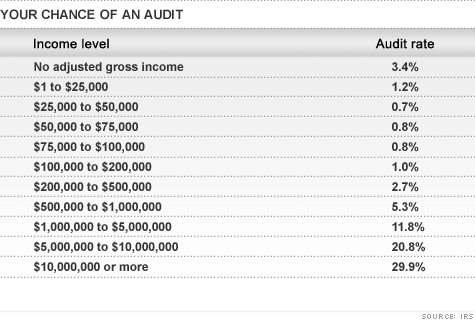
Average Audit Rate By Income Level
The most useful public benchmark is tax year 2019, because it is one of the latest years for which audit coverage is mature enough to compare income groups meaningfully. Later years may still change as audits are opened, closed, or updated. The figures below combine broad GAO income categories with later IRS Data Book high-income breakdowns.
| Income Level | Approximate Audit Rate | What It Means |
|---|---|---|
| $1 to under $25,000 | About 0.40% | Higher than some middle-income groups, partly because of refundable credit reviews. |
| $25,000 to under $200,000 | About 0.17% | One of the lowest-risk broad categories for ordinary wage earners. |
| $200,000 to under $500,000 | About 0.17% | Still low on average, though complex deductions can raise risk. |
| $500,000 to under $1 million | About 0.53% | Audit risk begins to climb as returns often become more complex. |
| $1 million to under $5 million | About 1.6% | Meaningfully higher than average, especially with business, investment, or partnership income. |
| $5 million to under $10 million | About 3.1% | High-income taxpayers face more specialized IRS attention. |
| $10 million or more | About 11.0% | The highest published individual income group faces the strongest audit coverage. |
So, what is the average IRS audit rate? For individual returns overall, recent mature-year estimates generally land around a fraction of 1%. But the average is not very useful by itself. It is like saying the average person has less than two legs: technically interesting, practically weird. Income level, income type, deductions, credits, business activity, and documentation all matter.
Why Higher Income Usually Means Higher Audit Risk
Higher-income returns often contain more moving parts: businesses, partnerships, trusts, rental properties, capital gains, stock options, foreign accounts, charitable gifts, private foundations, and tax strategies with names that sound like rejected spy movies. More moving parts mean more places for mistakes, mismatches, aggressive positions, or legitimate questions.
The IRS also expects higher revenue potential from complex high-income audits. A small wage-earner audit may produce a few hundred or a few thousand dollars in adjustments. A high-income audit can involve six, seven, or even eight figures of disputed income, deductions, basis calculations, or entity-level issues. The tradeoff is that wealthy taxpayer audits take more time, more expertise, and more specialized examiners.
Why Some Low-Income Taxpayers Still Get Audited
One surprising feature of IRS audit statistics is that lower-income taxpayers can be audited at higher rates than middle-income taxpayers. This is largely connected to refundable credits, especially the Earned Income Tax Credit. These audits are often correspondence audits, meaning the taxpayer receives a letter asking for proof of eligibility rather than an invitation to an in-person meeting with a serious-looking auditor and a calculator that could bench-press a Buick.
Correspondence audits are cheaper and easier for the IRS to conduct, but they can be stressful for taxpayers. A letter asking for school records, residency proof, dependent documentation, or income verification may sound simple on paper. In real life, people move, lose documents, change phones, miss mail, or do not understand what the IRS is requesting. The audit may be low-dollar from the government’s perspective, but it can feel enormous to the person waiting for a refund.
Audit Risk Is Not Only About Income
Income level is a major factor, but it is not the whole story. A $90,000 W-2 employee with standard deductions, clean information reporting, and no unusual credits is usually less likely to be audited than a $90,000 self-employed taxpayer claiming large vehicle expenses, home office deductions, cash income, and a side business that has lost money for five straight years.
Common Audit Risk Factors
Several issues can increase IRS attention regardless of income level:
- Unreported income: A mismatch between your return and Forms W-2, 1099, K-1, or brokerage reports is one of the fastest ways to get a notice.
- Large deductions compared with income: Charitable gifts, business meals, travel, vehicle use, and home office claims should be supported by real records.
- Schedule C businesses: Sole proprietors often have more deduction flexibility, which also means more room for IRS questions.
- Rental losses: Passive activity rules are complicated, and the IRS knows it.
- Foreign accounts and crypto: Reporting failures can carry serious penalties.
- Refundable credits: Credits that produce refunds can receive extra verification.
Examples: How Audit Risk Looks In Real Life
Example 1: The W-2 Employee
Maria earns $82,000 as a project manager. She receives a W-2, takes the standard deduction, reports a small amount of bank interest, and files electronically. Her audit risk is generally low because most of her income is already reported directly to the IRS. Unless there is a mismatch, identity-theft issue, or unusual credit claim, her return is not exactly screaming, “Please examine me.”
Example 2: The Self-Employed Designer
Jason earns $145,000 as a freelance designer. He deducts software, advertising, travel, subcontractors, a home office, and mileage. His income level is not extreme, but his return has more audit-sensitive areas. If his mileage log is “I drove a lot, trust me,” he has a problem. If he keeps invoices, bank records, receipts, and a contemporaneous mileage log, he is in far better shape.
Example 3: The High-Income Investor
Linda reports $7 million in total positive income from businesses, partnerships, capital gains, and rental properties. Her audit rate is much higher than that of an ordinary wage earner. The IRS may ask about basis, passive losses, entity distributions, charitable contributions, and whether reported income matches third-party filings. Linda does not need to panic, but she does need professional records that can survive daylight.
How Audit Rates Have Changed Over Time
Audit rates fell sharply during the 2010s as IRS staffing and enforcement resources declined. The decline affected every income group, but the drop was especially steep for higher-income taxpayers because their audits usually require experienced examiners. A simple correspondence audit can be handled with standardized documents. A high-income audit may involve partnerships, valuation issues, trusts, business entities, and enough paper to make a printer consider retirement.
In recent enforcement plans, the IRS has stated that it intends to focus expanded enforcement on high-income individuals, large corporations, and complex partnerships while avoiding increases above historical levels for taxpayers and small businesses below the $400,000 threshold. That does not mean everyone under $400,000 gets a magic invisibility cloak. It means the policy emphasis is on complex, higher-dollar noncompliance.
How To Reduce Your Audit Risk Without Playing Games
The best audit strategy is boring, legal, and deeply unglamorous: report all income, keep clean records, avoid fantasy deductions, and file on time. Tax compliance is one of the rare places where being boring is a superpower.
Match Your Information Forms
Before filing, compare your return with every W-2, 1099, K-1, brokerage statement, and tax document you receive. If a payer reports income to the IRS and you forget it, the IRS computer may notice. The computer is not emotional. It does not care that the form was hiding under a pizza coupon.
Keep Receipts And Logs
For business expenses, the question is not only “Did you spend the money?” It is also “Can you prove it was ordinary, necessary, and connected to your business?” Bank statements help, but they may not show the business purpose. A receipt, invoice, calendar entry, contract, or mileage log can turn a scary audit question into a manageable paperwork chore.
Be Realistic With Deductions
If your income is $70,000 and you claim $45,000 in charitable donations, the IRS may blink twice. Large deductions are not illegal, but unusual deductions require strong documentation. The bigger the claim, the better the paper trail should be.
Do Not Ignore IRS Letters
Many audits begin as letters. Open them. Read them. Respond by the deadline. If you do not understand the notice, ask a qualified tax professional. Ignoring the IRS is not a strategy; it is a slow-motion way to make a small problem put on a cape and become a larger problem.
Personal Experience-Style Lessons About Audit Rates
When people talk about IRS audits, they often talk as if the process is random, like tax-season lightning. In practice, audit risk usually feels less random and more pattern-based. The taxpayers who sleep best are not always the ones with the lowest income. They are the ones who can explain their return without sweating through their chair.
One common experience is that ordinary wage earners tend to overestimate their audit risk. A person with one W-2, modest bank interest, and the standard deduction may imagine an auditor lurking behind every mailbox. But their return is mostly verified by third-party documents. The IRS already receives wage and withholding data from the employer, so there is less mystery. For these taxpayers, the bigger practical risk is usually a mismatch, a typo, a missing form, or a delayed refundnot a full-blown audit drama.
Self-employed taxpayers often have a different experience. Their audit rate may not be sky-high by income alone, but their return invites more questions because deductions are self-reported. A consultant who claims internet, phone, travel, meals, software, education, subcontractors, and home office expenses should expect one basic rule: every deduction needs a story and a receipt. The story explains why the expense belongs on the return. The receipt proves the story is not tax-season fan fiction.
High-income taxpayers experience audit risk in a more complex way. The issue is rarely just salary. It is usually entity income, partnership allocations, stock transactions, real estate, trusts, foreign accounts, or large charitable gifts. A wealthy taxpayer may have a lower emotional fear of audits because they can hire help, but the audit itself can be longer, deeper, and more technical. In these cases, the best defense is not charm. It is coordinated records among tax preparers, bookkeepers, attorneys, investment advisors, and business managers.
Another real-world lesson is that IRS letters are not always audits, and audits are not always disasters. A CP2000 notice, for example, is often a proposed adjustment based on information matching. It may feel like an audit because it arrives in an envelope with government seriousness, but it is usually narrower. Sometimes the IRS is right. Sometimes the taxpayer has an explanation. The key is to respond clearly and on time.
The most practical experience-based advice is simple: build your tax file before anyone asks for it. Keep digital folders by year. Save income forms, receipts, mileage logs, charitable acknowledgments, brokerage statements, closing documents, business invoices, and copies of filed returns. If an audit letter arrives, you want to be the person calmly opening a folder, not the person digging through a glove compartment from three cars ago.
Conclusion
The average audit rate by income level shows a clear pattern: most taxpayers face a very low chance of audit, but risk rises with income, complexity, refundable credits, business activity, and documentation problems. Middle-income wage earners often face the lowest average audit rates, while million-dollar earners and especially taxpayers above $10 million face much higher audit coverage. At the same time, lower-income taxpayers claiming refundable credits can face more correspondence audits than many people expect.
The smartest takeaway is not “make less money” or “fear the IRS.” The smarter takeaway is this: report every dollar, document every meaningful deduction, respond to notices, and treat your tax return like a financial statement rather than a creative writing contest. Good records may not make tax season fun, but they can make it far less terrifying. And in the world of audits, boring paperwork is basically a superhero cape.
Note: This article is for general educational purposes only and should not be treated as personal tax, legal, or accounting advice. Taxpayers with complex returns, large deductions, business income, foreign reporting, cryptocurrency activity, or IRS notices should consult a qualified tax professional.